Television spreads
about 1950 United States, Europe and, from 1954, Italy
In short
The first regular television broadcasts began in the 1930s in Germany and Great Britain, but real success came after the war. By around 1950 millions of families in the United States already had a television set in the living room. In Italy the Rai began regular broadcasts on 3 January 1954, and at first people watched TV in cafés or at the neighbours'. The programme Non è mai troppo tardi (‘It's never too late’) later taught a great many adults to read and write.
Why it matters Television brought news and entertainment into homes and helped Italians to speak the same language.
Source: Treccani, entry “Televisione”
Study card about 5 minutes of reading
The story
Pictures that travel
The idea of sending pictures over a distance is almost as old as radio. In 1884 a young German, Paul Nipkow, invented a disc with holes in it that, as it spun, broke a picture up into lots of dots. It was the beginning. In the 1920s the Scotsman John Logie Baird showed in London a first transmission of blurry pictures using a mechanical system, and in the same years two inventors, the American Philo Farnsworth, aged twenty-one, and the Russian-American Vladimir Zworykin, built the first completely electronic systems, with a tube that formed the picture using a beam of electrons. These systems proved to be the best.
The first regular “high-definition” television service began in England, with the BBC, on 2 November 1936, from a building in London, Alexandra Palace. Very few families had a set, but already in 1937 the BBC broadcast the coronation of King George VI live. In 1939 television was presented to the public, in the United States, at the World's Fair in New York. Then came the war, and television was almost entirely stopped.
In the 1950s
After the war, television spread at an incredible speed. In the United States, in 1950, fewer than one family in ten had a television; by 1955 it was already two families in three. In Britain, the great boost was the coronation of Queen Elizabeth II, on 2 June 1953: about twenty million people, almost half the country, watched it live, often at the homes of neighbours or friends who had a set, or in public places.
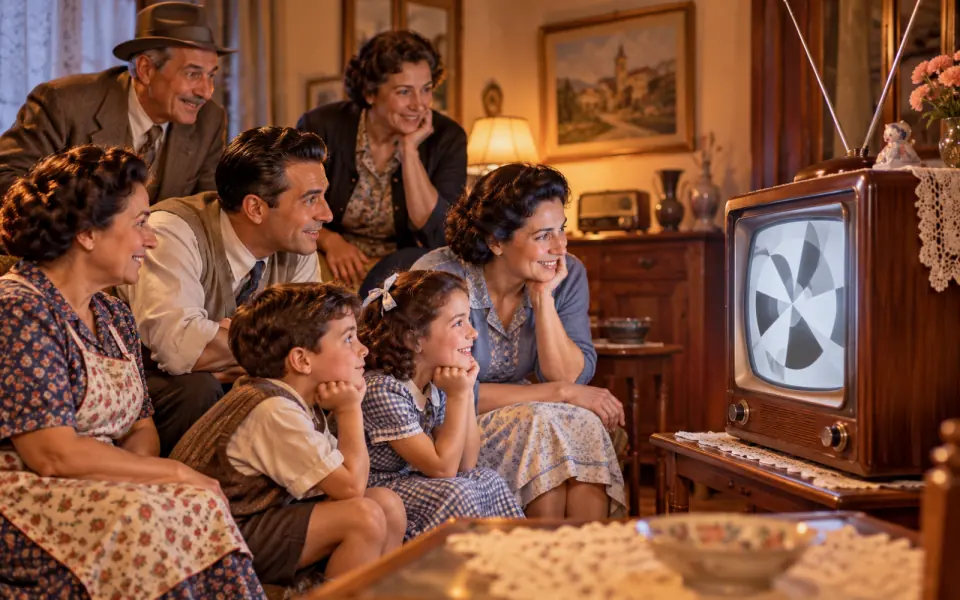
Televisions were big wooden cabinets with a small black-and-white screen, and they cost a lot: in Italy, in the mid-1950s, a set cost as much as several months of a factory worker's wages. So people often gathered in bars or in the homes of those who had one, or in party offices and parishes: the whole neighbourhood sat in front of the screen.
Television in Italy
In Italy the regular RAI broadcasts began on 3 January 1954, after some years of trials: the first pictures had come from Turin, Milan and Rome. The first to appear, to welcome the viewers, was the announcer Fulvia Colombo. At the end of 1954 there were some tens of thousands of subscribers, and ten years later more than five million.
There were few programmes, shown for only a few hours a day: the news, variety shows, TV dramas, football matches, and quiz shows such as “Lascia o raddoppia?” (“Double or Nothing?”, 1955), hosted by Mike Bongiorno, which emptied the streets because everyone ran home or to the bar to watch it. From 1957 “Carosello” was on the air, short advertising films with little stories that fascinated young and old, and after which children went to bed.
A special programme was “Non è mai troppo tardi” (“It's Never Too Late”), which began in 1960: a teacher, Alberto Manzi, taught adults on television to read and write if they had not been able to go to school. It is estimated that thanks to these lessons more than a million Italians learned to read and write. Television also helped to unify the way people spoke: before, many Italians used only their dialect, whereas now everyone was listening to the same Italian language.
An invention that changes habits
Television changed everyday life: in the evening many families gathered in front of the screen, children waited for their programmes, people followed the same shows and talked about the same characters. It changed politics: in 1960, in the first televised debate between two candidates, John Kennedy and Richard Nixon, many thought that Kennedy had won, as he was more confident and at ease in front of the cameras. Colour arrived in the United States in the 1950s and in Italy in 1977.
Why it happened
Television was born from the joining of earlier inventions: radio, cinema, the telephone and the cathode-ray tube. It took decades of research and many different people, in various countries, to make it a practical and affordable device.
After the war, its spread was helped by the economic recovery, the desire for entertainment and news, and the mass production of television sets. In many countries, as in Italy, a public body, RAI, had the job of running the broadcasts, with the mission to inform, educate and entertain.
What changed
Television became the main means of information and entertainment of the 20th century. Great news events, such as the Moon landing in 1969, were followed together by hundreds of millions of people. It has influenced tastes, fashions, politics, advertising and consumption.
It has also had controversial sides: critics and scholars have asked whether watching a lot of television is useful or harmful, especially for children, and how to ensure fair news. Today experts advise choosing programmes with care and not spending too many hours in front of the screen.
Since the 2000s television has changed again, with digital, high definition and streaming services: many people watch films and series whenever they like, on a phone or a computer, and less at the times set by the schedule. But the idea of sending pictures and sounds over a distance, born more than a hundred years ago, carries on.
Key people and places
People
- Philo Farnsworth
- American inventor (1906–1971): at 21 he made the first completely electronic television system.
- John Logie Baird
- Scottish inventor (1888–1946): he gave the first television demonstrations in London.
- Vladimir Zworykin
- Russian-American engineer (1888–1982): he invented the iconoscope, a tube for cameras.
- Mike Bongiorno
- Italian-American presenter (1924–2009): he hosted “Lascia o raddoppia?” and was one of the faces of Italian TV.
- Alberto Manzi
- Italian teacher and writer (1924–1997): presenter of the programme “Non è mai troppo tardi”.
Places
- Alexandra Palace, London
- From here the BBC began the first regular television service, in 1936.
- Corso Sempione, Milan
- The home of one of RAI's first production centres.
Good to know
- Regular Italian television broadcasts began on 3 January 1954.
- The quiz show “Lascia o raddoppia?”, in 1955, emptied the streets: everyone was watching it.
- The teacher Alberto Manzi taught more than a million adults to read and write on TV.
- “Carosello”, from 1957, was an advertising slot made of little stories.
- Colour television arrived in Italy in 1977.
Find out more
- Wikipedia, “Television” en.wikipedia.org
- Wikipedia, “History of television” en.wikipedia.org
- Wikipedia, “Alberto Manzi” en.wikipedia.org
Related events
- Radio for everyoneabout 1920 · Early 20th centuryRadio had opened the way for mass communication.
- Talking pictures1927 · Early 20th centurySound cinema was the other great mass entertainment.
- The Moon landing1969 · TodayIn 1969 hundreds of millions of people watched the Moon landing on TV.
- The World Wide Web1991 · TodayToday a lot of television comes through the Web and streaming.
Before and after, in the era “Early 20th century”
Event 25 of 25
 BeforeThe first powered flight1903
 BeforeSpecial relativity1905
 BeforeMaria Montessori's Children's House1907
 BeforeAbstract artabout 1910
 BeforeMarie Curie and her two Nobel Prizes1911
 BeforeThe First World War1914–1918
 BeforeThe Russian Revolution1917
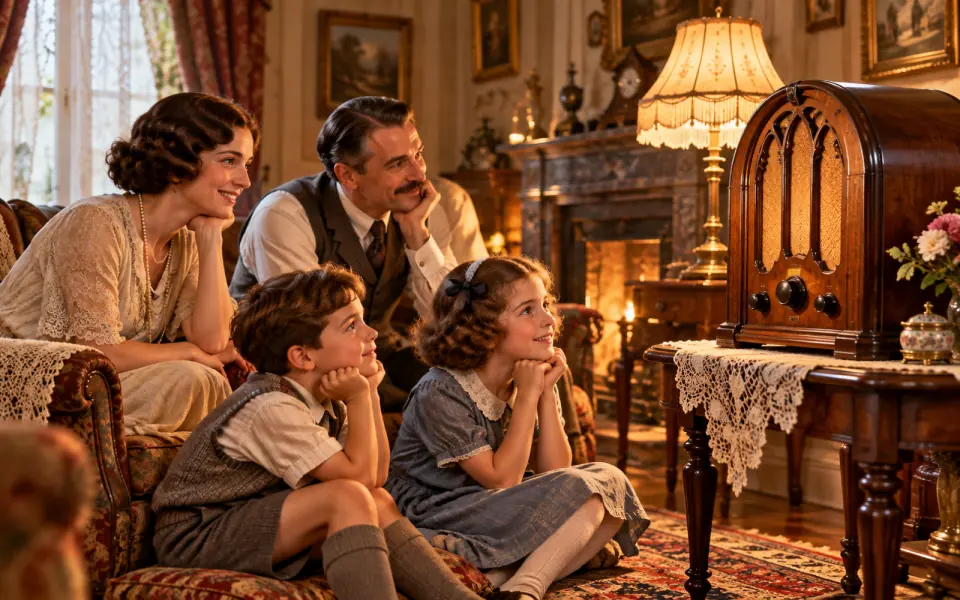 BeforeRadio for everyoneabout 1920
 BeforeJazz spreadsabout 1920
 BeforeInsulin against diabetes1922
 BeforeTotalitarian regimes in Europe1922
 BeforeTalking pictures1927
 BeforeThe discovery of penicillin1928
 BeforeThe Great Depression1929
 BeforePicasso's Guernica1937
 BeforeThe Second World War1939–1945
 BeforeThe Shoahabout 1941–1945
 BeforeAnne Frank writes her diary1942
 BeforeFermi and the first atomic pile1942
 BeforeThe Italian Resistance1943–1945
 BeforeThe Italian Republic and votes for women1946
 BeforeThe first general-purpose electronic computer1946
 BeforeThe Italian Constitution1948
 BeforePost-war rebuildingabout 1948
- You are hereTelevision spreadsabout 1950
Listen / Read next
- Music to read by: Cinematic JourneyEpic film-style music, no lyrics, by Ciro Simone IrmiciSpotifyYouTube Music
Meanwhile, elsewhere in the world
Other events of the era “Early 20th century”
- The first powered flight
- Special relativity
- Maria Montessori's Children's House
- Abstract art
- Marie Curie and her two Nobel Prizes
- The First World War
- The Russian Revolution
- Radio for everyone
- Jazz spreads
- Insulin against diabetes
- Totalitarian regimes in Europe
- Talking pictures
- The discovery of penicillin
- The Great Depression
- Picasso's Guernica
- The Second World War
- The Shoah
- Anne Frank writes her diary
- Fermi and the first atomic pile
- The Italian Resistance
- The Italian Republic and votes for women
- The first general-purpose electronic computer
- The Italian Constitution
- Post-war rebuilding
