Insulin against diabetes
1922 Toronto, Canada
In short
In those days type 1 diabetes was almost always fatal: it is caused by a lack of insulin, a hormone made by the pancreas. In 1921, at the University of Toronto, in Canada, the doctor Frederick Banting and the student Charles Best managed to extract insulin. In January 1922 they tried it on a 14-year-old boy, Leonard Thompson, who quickly got better. Within a few months insulin had saved the lives of a great many patients.
Why it matters Even today millions of people with diabetes live normal lives thanks to insulin.
Source: The Nobel Prize, “The Discovery of Insulin”
Study card about 5 minutes of reading
The story
A disease with no cure
Diabetes is a disease in which the body cannot control the amount of sugar, glucose, in the blood. Normally, after a meal, the pancreas, an organ behind the stomach, makes a hormone called insulin, which lets sugar into the cells, where it is used as fuel. In type 1 diabetes, which mostly affects children and young people, the pancreas stops making insulin: the sugar stays in the blood and the cells are left without energy.
Before 1922 this disease was a death sentence. A child diagnosed with diabetes generally lived only a few weeks or months. People became thinner and weaker and more and more thirsty, and in the end they fell into a coma. The only known treatment was a very strict diet, almost starvation, which lengthened life a little but left patients skeletal. In hospitals there were wards full of desperately hungry children, struggling against hunger.
An idea in the night
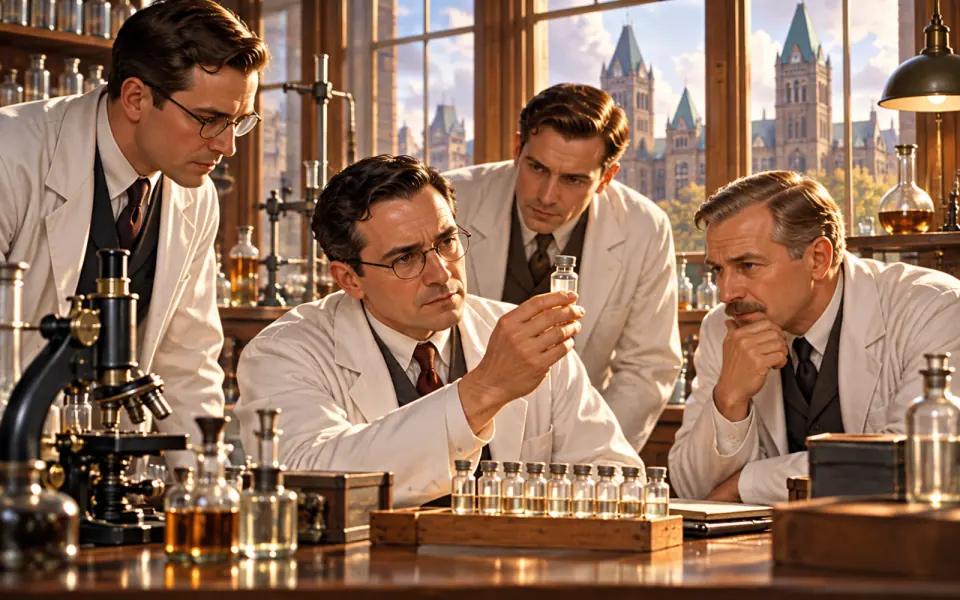
In October 1920 a young Canadian surgeon in Toronto, Frederick Banting, had an idea while reading an article in a journal. Scientists knew that in the pancreas there are groups of special cells, the “islets”, which make a substance that regulates sugar, but when people tried to extract it, it was destroyed by the digestive juices of the same organ. Banting thought of tying off the ducts of the pancreas, so that the cells that make the juices would shut down and only the islets would stay active. He wrote the idea in a notebook, in the middle of the night.
In the spring and summer of 1921 he persuaded Professor John Macleod, at the University of Toronto, to lend him a laboratory for eight weeks, during his holidays, and an assistant, a twenty-two-year-old student, Charles Best. They worked with dogs. They extracted a substance from the pancreas and injected it into dogs that had been made diabetic: the amount of sugar in their blood went down, and the animals felt better. A little dog called Marjorie lived this way for weeks.
A fourteen-year-old boy
To make the treatment suitable for humans a purer substance was needed. An expert biochemist, James Collip, joined the group. On 11 January 1922, in the Toronto General Hospital, came the first test on a human being: Leonard Thompson, a fourteen-year-old boy, by now in his last days of life. The first injection was still too impure and had little effect, with a painful reaction. After Collip had improved the method, a second injection was given on 23 January: the amount of sugar in the blood dropped clearly and the boy began to feel better.
Soon other young patients were treated. In the wards where children lay almost in a coma, who no longer woke up, the injections brought them back to life within a few hours. Parents, nurses and doctors remembered those days as a miracle, as if it were a resurrection. Leonard lived another thirteen years. A young girl, Elizabeth Hughes, daughter of the American Secretary of State, who was treated in 1922, lived to the age of 73.
A gift to the world
In 1923 the Nobel Prize in Medicine was awarded to Banting and Macleod. Banting, angry that the committee had left out Best, shared his prize with him; Macleod did the same with Collip. The three scientists sold the patent to the University of Toronto for one dollar, so that the treatment would be available to everyone. A big American company, Eli Lilly, began to produce insulin in large quantities, extracting it from the pancreas of cattle and pigs.
Why it happened
Doctors were already close to the solution: in 1889 two German researchers had discovered that if the pancreas was removed from a dog, the animal developed diabetes, and it was known that regulating substances existed in the “islets of Langerhans”. What was missing was a way to isolate the hormone without destroying it.
Banting had the right idea, but he could not have carried it out alone: he needed a laboratory, a tenacious student like Best, and an expert chemist like Collip. It was teamwork, in a few months and with limited means, that turned an idea into a treatment.
What changed
Insulin has saved millions of lives. People with type 1 diabetes can now live long lives, go to school, work, play sport and have children. Over the years the way of treating it has changed: the structure of insulin was worked out by the English chemist Frederick Sanger (Nobel Prize in 1958), and in 1978 it became possible to produce human insulin with bacteria, thanks to genetics, without using animals any more. Today there are pens, pumps and sensors that measure sugar all day long.
Worldwide, over five hundred million adults live with diabetes, mostly type 2, which is linked to age, weight and lifestyle, and in many cases can be prevented with an active life and a balanced diet. In some countries, though, insulin is still too expensive or hard to get, and this is a reminder of how important Banting's idea was that the treatment should be for everyone.
14 November, Banting's birthday, is World Diabetes Day.
Key people and places
People
- Frederick Banting
- Canadian doctor (1891–1941): he thought up the experiment that led to insulin; Nobel Prize in 1923.
- Charles Best
- Canadian student and later doctor (1899–1978): he worked with Banting on the 1921 experiments.
- John Macleod
- Scottish physiologist (1876–1935): he directed the Toronto laboratory; Nobel Prize in 1923.
- James Collip
- Canadian biochemist (1892–1965): he purified insulin for use on humans.
- Leonard Thompson
- Canadian boy (1908–1935): the first patient treated with insulin, in 1922.
Places
- University of Toronto, Canada
- The place where Banting and his colleagues discovered insulin.
- Toronto General Hospital, Canada
- The hospital where the first patient was treated in January 1922.
Good to know
- The name “insulin” comes from the Latin “insula”, island: the cells that make it form the “islets” of the pancreas.
- Banting and his colleagues sold the patent for insulin for one dollar.
- The first patient treated, Leonard Thompson, was 14 years old.
- 14 November, Banting's birthday, is World Diabetes Day.
- Since 1978 insulin has been produced with bacteria thanks to genetic engineering.
Find out more
- The Nobel Prize, “The Nobel Prize in Physiology or Medicine 1923” nobelprize.org
- Wikipedia, “Insulin” en.wikipedia.org
- Wikipedia, “Frederick Banting” en.wikipedia.org
- Wikipedia, “Diabetes” en.wikipedia.org
Related events
- The discovery of penicillin1928 · Early 20th centuryA few years later, penicillin treated another great class of diseases.
- Jenner's vaccine1796 · Age of revolutionsJenner's vaccine had been the first great victory over disease.
- The double helix of DNA1953 · TodayDNA made it possible to produce human insulin with bacteria.
- The polio vaccine1955 · TodaySalk's vaccine defeated polio.
Before and after, in the era “Early 20th century”
Event 10 of 25
 BeforeThe first powered flight1903
 BeforeSpecial relativity1905
 BeforeMaria Montessori's Children's House1907
 BeforeAbstract artabout 1910
 BeforeMarie Curie and her two Nobel Prizes1911
 BeforeThe First World War1914–1918
 BeforeThe Russian Revolution1917
 BeforeRadio for everyoneabout 1920
 BeforeJazz spreadsabout 1920
- You are hereInsulin against diabetes1922
 AfterTotalitarian regimes in Europe1922
 AfterTalking pictures1927
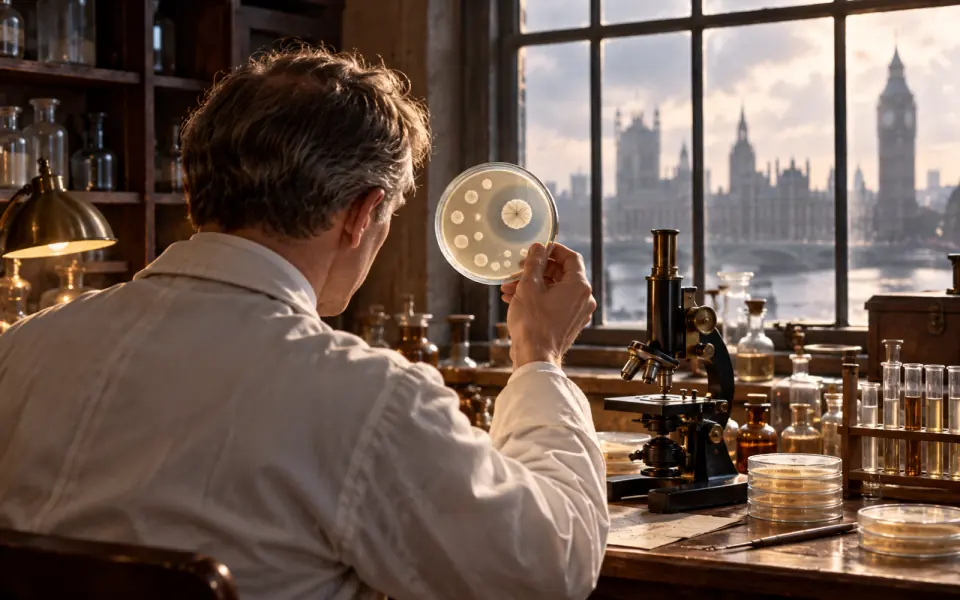 AfterThe discovery of penicillin1928
 AfterThe Great Depression1929
 AfterPicasso's Guernica1937
 AfterThe Second World War1939–1945
 AfterThe Shoahabout 1941–1945
 AfterAnne Frank writes her diary1942
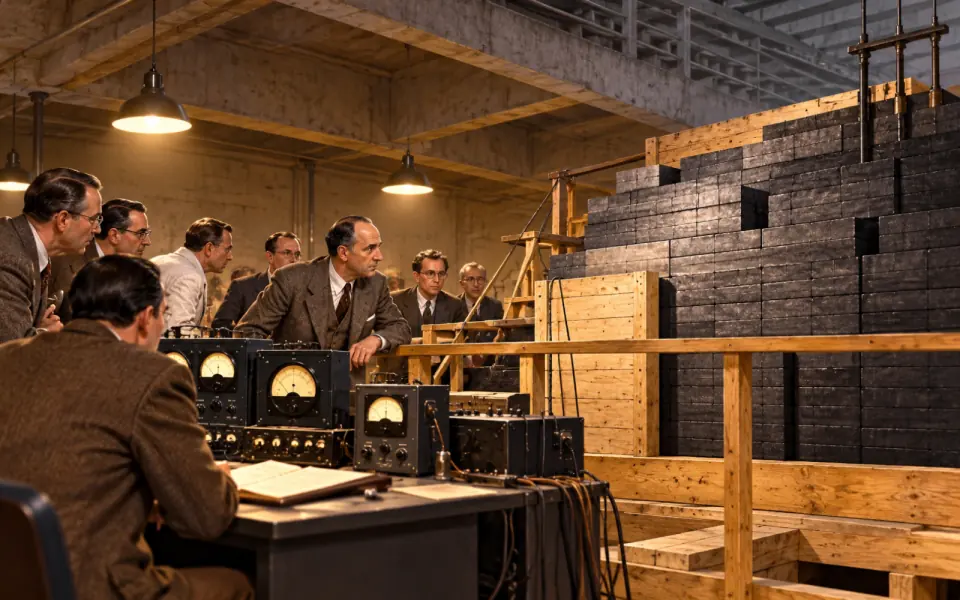 AfterFermi and the first atomic pile1942
 AfterThe Italian Resistance1943–1945
 AfterThe Italian Republic and votes for women1946
 AfterThe first general-purpose electronic computer1946
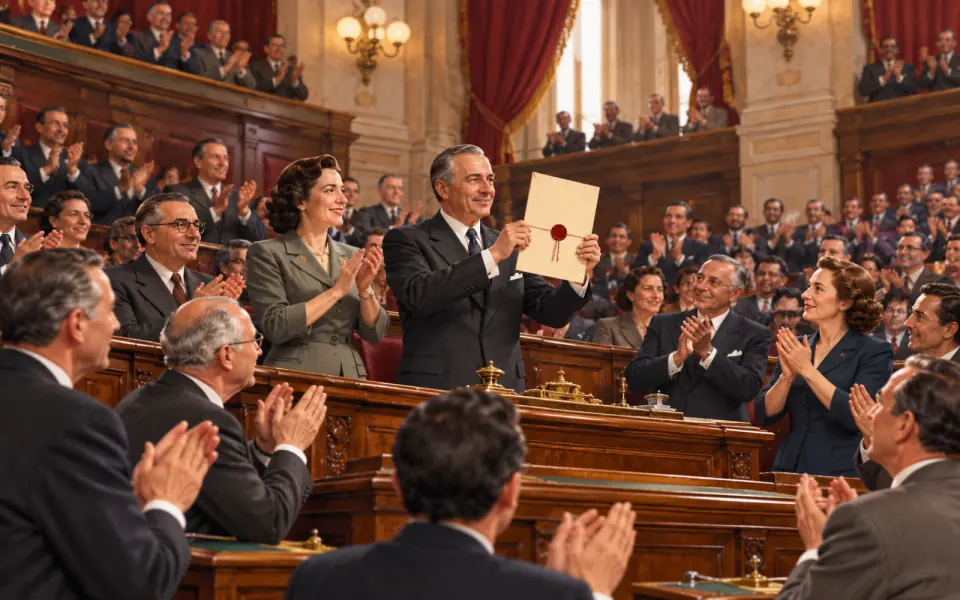 AfterThe Italian Constitution1948
 AfterPost-war rebuildingabout 1948
 AfterTelevision spreadsabout 1950
Listen / Read next
- Music to read by: Cinematic JourneyEpic film-style music, no lyrics, by Ciro Simone IrmiciSpotifyYouTube Music
Meanwhile, elsewhere in the world
Other events of the era “Early 20th century”
- The first powered flight
- Special relativity
- Maria Montessori's Children's House
- Abstract art
- Marie Curie and her two Nobel Prizes
- The First World War
- The Russian Revolution
- Radio for everyone
- Jazz spreads
- Totalitarian regimes in Europe
- Talking pictures
- The discovery of penicillin
- The Great Depression
- Picasso's Guernica
- The Second World War
- The Shoah
- Anne Frank writes her diary
- Fermi and the first atomic pile
- The Italian Resistance
- The Italian Republic and votes for women
- The first general-purpose electronic computer
- The Italian Constitution
- Post-war rebuilding
- Television spreads
