Post-war rebuilding
about 1948 Italy and western Europe
In short
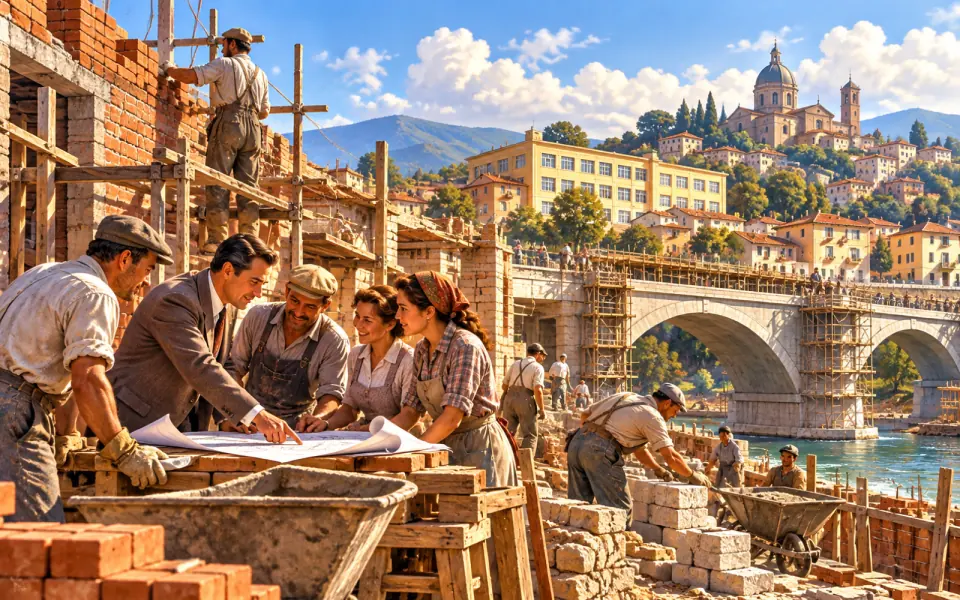
At the end of the war many Italian and European cities lay in ruins, with bridges, roads and houses destroyed. From 1948 the United States paid for the Marshall Plan, which sent aid, machinery and raw materials to Europe to get factories and farms going again. In Italy houses and railways were rebuilt, and products that became famous were born, such as the Vespa scooter. In the following years this effort led to the so-called economic miracle.
Why it matters It shows how a destroyed country can be reborn through work and cooperation between nations.
Source: Encyclopaedia Britannica, “Marshall Plan”
Study card about 5 minutes of reading
The story
A country in ruins
When the war ended, in 1945, Italy had destroyed cities, collapsed bridges, broken railways, damaged factories and abandoned fields. Millions of people had lost their homes. In many areas there was no food: bread, pasta, sugar and milk were rationed and bought with a ration card, and those who could bought on the “black market”, where prices were sky-high. Children wore broken shoes and second-hand clothes. Many men had died, others were coming back from captivity, and there was a great need for work.
And yet, after the war, there was also a great desire to start again. Families were reunited, children went back to school, shops reopened. On 11 May 1946, in La Scala theatre in Milan, bombed during the war and rebuilt in a few months, the conductor Arturo Toscanini conducted the reopening concert, with tears in the audience's eyes.
The Marshall Plan
All of Europe was on its knees, and the United States, which had come out of the war stronger, feared that poverty would push European countries towards Communism. On 5 June 1947 the American Secretary of State, General George Marshall, speaking at a university, proposed a great aid plan for the reconstruction of Europe, the “European Recovery Program”, known as the Marshall Plan. In April 1948 the American Congress approved the funds.
Between 1948 and 1952 the United States sent about thirteen billion dollars to the European countries that accepted the aid, in food, machinery, raw materials and money. Italy received more than a billion. The countries of Eastern Europe, under the influence of the Soviet Union, refused. The aid came with a condition: the countries had to cooperate with one another, and this encouraged European cooperation.
Rolling up their sleeves
Aid alone was not enough: the work of the Italians was needed. Bridges, roads and railways were rebuilt, and factories repaired. The government, led by Alcide De Gasperi, and a strict economist, Luigi Einaudi, managed to curb inflation, that is, the rise in prices, which was eating up wages. In 1949 a plan to build houses, the INA-Casa Plan, backed by Amintore Fanfani, gave work to thousands of workers and homes to many families. In 1950 the Fund for the South (Cassa per il Mezzogiorno) was created, to bring roads, aqueducts and industries to the south, which was much poorer. In the countryside, a land reform gave land to poor farmers.
Meanwhile the way people travelled and lived was changing too. In 1946 the Piaggio company introduced the Vespa, and soon afterwards the Lambretta: two cheap scooters that took people to work and on outings. Italian cinema showed reality with new eyes: films such as “Rome, Open City” (1945) and “Bicycle Thieves” (1948), shot in real streets with non-professional actors, became famous all over the world and gave rise to “neorealism”.
Towards the boom
Within a few years industrial production was back to pre-war levels, and the recovery continued. From the mid-1950s the Italian economy grew at a tremendous pace, so much that people spoke of an “economic miracle”: from 1958 to 1963 the gross domestic product (GDP) rose by more than six per cent every year. Big companies such as Fiat, Olivetti and ENI were born, and many Italians moved from the fields to the factories. Many from the south moved to the north, or emigrated abroad, in search of work.
In 1957 Fiat introduced the 500, a small, cheap car that turned Italy into a motorised country. Fridges, washing machines and televisions arrived. Life changed: Italy, which in 1945 had been a poor farming country, within a generation became one of the world's major industrial powers.
Why it happened
The reconstruction was possible thanks to a combination of factors: American aid, the will of the democratic parties to work together, the work and ingenuity of the Italians, and confidence in the future. Political stability, guaranteed by the new Constitution and free elections, also played its part.
There was also Italy's choice to open up to international trade: joining NATO (1949), the Coal and Steel Community (1951) and then the Common Market (1957), which allowed Italian companies to sell all over Europe.
What changed
The Marshall Plan and the reconstruction transformed Western Europe: stable and prosperous democracies were born, which tied themselves to one another with economic and political agreements. It was the first step towards the European Union. The plan was also a move in the Cold War: Europe split into two blocs, the western one with the United States and the eastern one with the Soviet Union.
For Italy, the period of reconstruction and the economic miracle deeply changed society: more prosperity, more schooling, more consumption, but also imbalances between north and south, large internal migrations, and problems of development and environment that are still felt today.
For many families, the memory of those years is made of sacrifice and hope, and it has left a message: after destruction, cooperation and work can bring a country back to life.
Key people and places
People
- George Marshall
- American general and politician (1880–1959): he proposed the aid plan for Europe; Nobel Peace Prize in 1953.
- Alcide De Gasperi
- Italian politician (1881–1954): prime minister from 1945 to 1953.
- Luigi Einaudi
- Italian economist and politician (1874–1961): he stopped inflation and was President of the Republic from 1948 to 1955.
- Amintore Fanfani
- Italian politician (1908–1999): he promoted the INA-Casa housing plan.
- Arturo Toscanini
- Italian conductor (1867–1957): he conducted the reopening concert of La Scala in 1946.
Places
- Milan, Teatro alla Scala
- The theatre rebuilt after the bombing, reopened on 11 May 1946.
- Cassino
- The town almost completely destroyed in 1944 and rebuilt in the following years.
Good to know
- With the Marshall Plan Europe received about thirteen billion dollars between 1948 and 1952.
- After the war many foods were bought with a ration card.
- The Vespa was introduced by Piaggio in 1946.
- The Fiat 500 came out in 1957.
- Between 1958 and 1963, during the “economic miracle”, the Italian economy (GDP) grew by more than six per cent every year.
Find out more
- U.S. Department of State, “Marshall Plan, 1948” history.state.gov
- Wikipedia, “Marshall Plan” en.wikipedia.org
- Wikipedia, “Italian economic miracle” en.wikipedia.org
- Wikipedia, “Italian neorealism” en.wikipedia.org
Related events
- The Second World War1939–1945 · Early 20th centuryReconstruction began after the destruction of the war.
- The Italian Constitution1948 · Early 20th centuryThe Constitution gave stability to political life.
- Birth of the European Community1957 · TodayThe Marshall Plan paved the way for the European Community.
- Television spreadsabout 1950 · Early 20th centuryTelevision, which spread in the 1950s, accompanied the boom.
Before and after, in the era “Early 20th century”
Event 24 of 25
 BeforeThe first powered flight1903
 BeforeSpecial relativity1905
 BeforeMaria Montessori's Children's House1907
 BeforeAbstract artabout 1910
 BeforeMarie Curie and her two Nobel Prizes1911
 BeforeThe First World War1914–1918
 BeforeThe Russian Revolution1917
 BeforeRadio for everyoneabout 1920
 BeforeJazz spreadsabout 1920
 BeforeInsulin against diabetes1922
 BeforeTotalitarian regimes in Europe1922
 BeforeTalking pictures1927
 BeforeThe discovery of penicillin1928
 BeforeThe Great Depression1929
 BeforePicasso's Guernica1937
 BeforeThe Second World War1939–1945
 BeforeThe Shoahabout 1941–1945
 BeforeAnne Frank writes her diary1942
 BeforeFermi and the first atomic pile1942
 BeforeThe Italian Resistance1943–1945
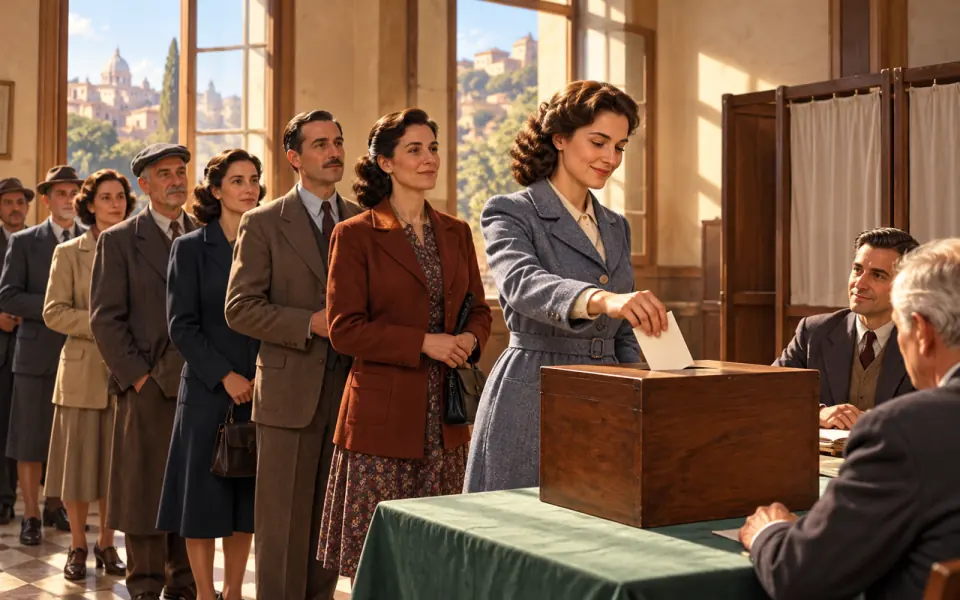 BeforeThe Italian Republic and votes for women1946
 BeforeThe first general-purpose electronic computer1946
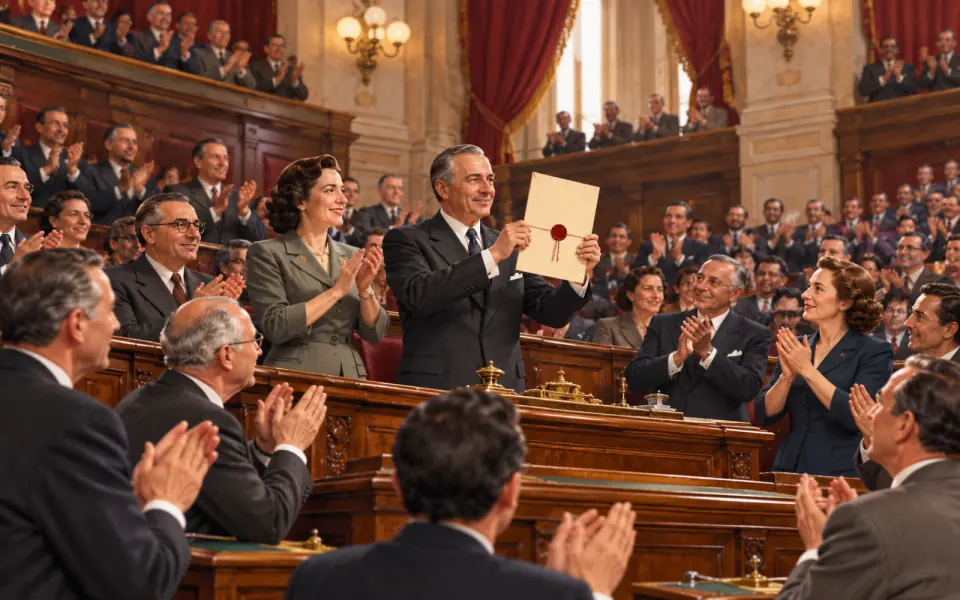 BeforeThe Italian Constitution1948
- You are herePost-war rebuildingabout 1948
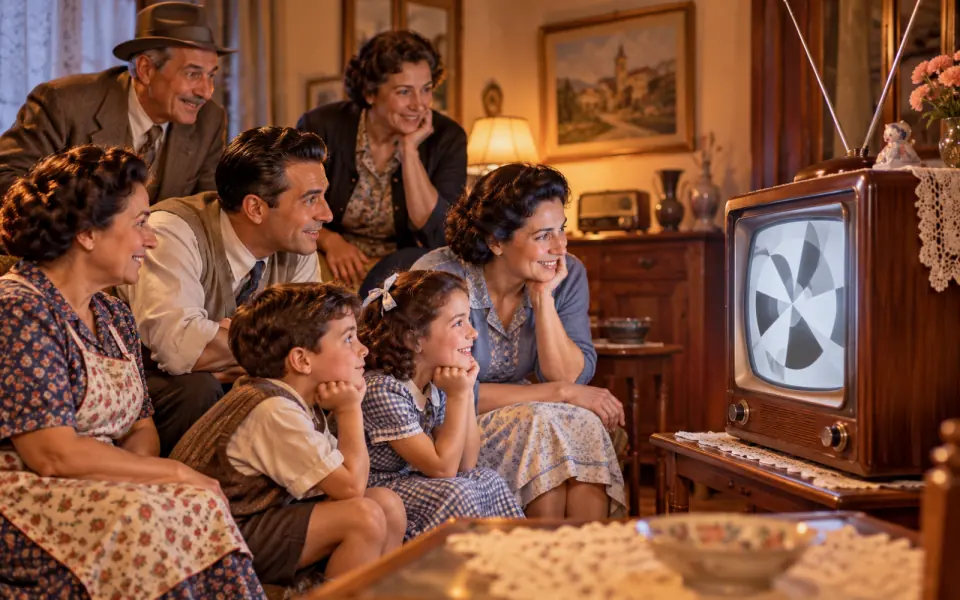 AfterTelevision spreadsabout 1950
Listen / Read next
- Music to read by: Cinematic JourneyEpic film-style music, no lyrics, by Ciro Simone IrmiciSpotifyYouTube Music
Meanwhile, elsewhere in the world
Other events of the era “Early 20th century”
- The first powered flight
- Special relativity
- Maria Montessori's Children's House
- Abstract art
- Marie Curie and her two Nobel Prizes
- The First World War
- The Russian Revolution
- Radio for everyone
- Jazz spreads
- Insulin against diabetes
- Totalitarian regimes in Europe
- Talking pictures
- The discovery of penicillin
- The Great Depression
- Picasso's Guernica
- The Second World War
- The Shoah
- Anne Frank writes her diary
- Fermi and the first atomic pile
- The Italian Resistance
- The Italian Republic and votes for women
- The first general-purpose electronic computer
- The Italian Constitution
- Television spreads
