The discovery of penicillin
1928 St Mary's Hospital, London, England
In short
In September 1928 the Scottish bacteriologist Alexander Fleming, at St Mary's Hospital in London, noticed that a mould had spoilt one of his dishes of bacteria. Around the mould, though, the bacteria had stopped growing. Fleming called the substance made by the mould penicillin. Only in the early 1940s did Howard Florey and Ernst Chain manage to produce it in large amounts and use it as a medicine.
Why it matters It was the first antibiotic: since then many once-deadly infections can be cured with a few pills.
Source: The Nobel Prize, “Sir Alexander Fleming – Biographical”
Study card about 5 minutes of reading
The story
A messy laboratory
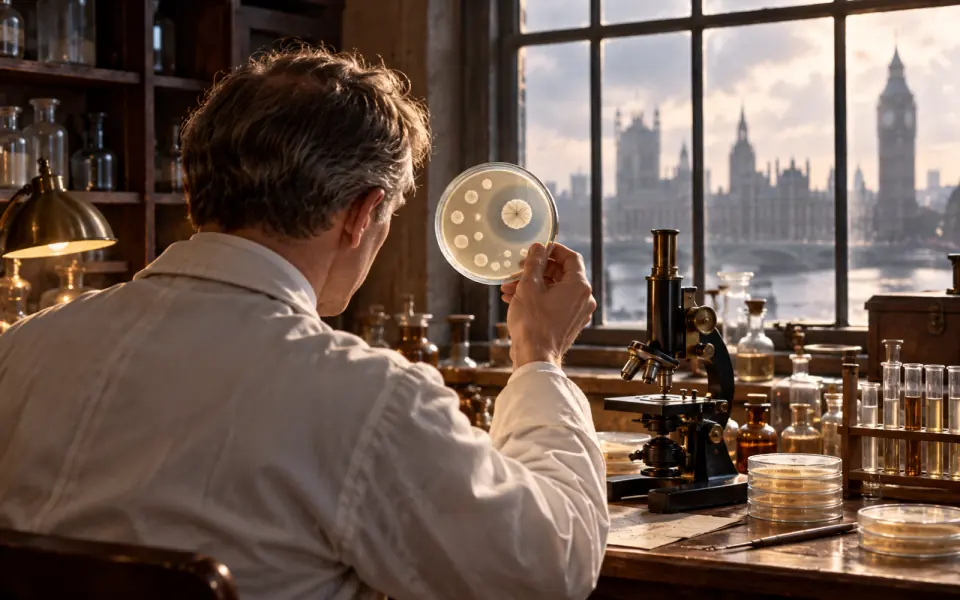
At the beginning of September 1928 Alexander Fleming came back from his holidays to his laboratory at St Mary's Hospital in London. He was a 47-year-old Scottish bacteriologist, clever and curious, and famous among his colleagues for the mess on his workbench. Before leaving he had left some glass plates with colonies of staphylococci, the bacteria that cause boils, abscesses and serious infections.
While tidying the plates, Fleming noticed a strange one. On one side a blue-green mould had grown, perhaps blown in from the air or from a nearby laboratory. Around the mould there was an empty circle: the bacteria there had died or had stopped growing. Many people would have thrown the spoiled plate away. Fleming, instead, stopped and looked: “That's funny,” he told a colleague.
The “mould juice”
The mould was a Penicillium, a relative of the ones that grow on stale bread and on citrus fruit. Fleming grew it in a broth and found that the liquid killed many dangerous bacteria, such as staphylococci, streptococci and the bacterium that causes diphtheria, without harming the white blood cells. He named the substance “penicillin” and in 1929 published his results in a scientific journal.
Fleming had a special reason for looking for a weapon like this. During the First World War he had worked in military hospitals in France and had seen thousands of soldiers die not from their wounds, but from the infections that followed. The disinfectants of the time killed bacteria on the surface, but they also damaged the tissues and did not reach deep down.
There was a problem, though. Penicillin was very hard to separate from the broth, it spoiled quickly and only tiny amounts could be made. Fleming and his assistants tried, but they were not chemists and did not succeed. For ten years the discovery was almost forgotten, a curiosity of the laboratory.
Oxford: it becomes real medicine
In 1939, as the Second World War was breaking out, a team at the University of Oxford took up Fleming's paper again. They were led by Howard Florey, an Australian doctor, and Ernst Chain, a German biochemist of Jewish origin who had fled Nazi Germany. The biochemist Norman Heatley invented a way of extracting and purifying penicillin, using makeshift equipment: milk bottles, bathtubs, hospital bedpans. A group of young women, the “penicillin girls”, looked after growing the mould in hundreds of containers.
On 25 May 1940 Florey carried out the decisive experiment: he infected eight mice with a deadly bacterium and treated four of them with penicillin. The next morning the four untreated mice were dead; the treated ones were alive. In February 1941 penicillin was tried on a person for the first time: Albert Alexander, a police officer in Oxford with a very serious infection. In a few days he improved remarkably; but the medicine ran out, even though it was recovered from his urine, and the infection came back. Alexander died. It was proof that penicillin worked, and that much more of it was needed.
The American factory
Britain, at war, did not have the factories to make it. In the summer of 1941 Florey and Heatley flew to the United States. In a government laboratory in Peoria, Illinois, it was found that the mould grew much better in a liquid left over from processing maize. Then people searched the whole world for more productive moulds: the best one came from a mouldy melon bought at the market in Peoria. Pharmaceutical companies built huge fermentation tanks, and production exploded.
For the Normandy landings on 6 June 1944, millions of doses were ready for the Allied soldiers. After the war penicillin reached hospitals all over the world. In 1945 Fleming, Florey and Chain shared the Nobel Prize in Medicine.
Fleming's warning
In his Nobel speech, Fleming said something that at the time seemed a detail: if penicillin is used badly, in doses that are too low or for too short a time, bacteria can learn to resist it. He was right. Today resistance to antibiotics is one of the most serious problems in world medicine.
Why it happened
The discovery was partly luck: a mould spore landing on the right plate, at the right moment, at the right temperature. But luck favoured a prepared person. Fleming had been searching for years for substances that would kill bacteria without harming people: in 1921 he had already discovered lysozyme, an antibacterial substance found in tears and mucus.
The need was enormous. Before antibiotics, an infected wound, pneumonia or an infection after childbirth could kill in a few days, and doctors had very few weapons. In the 1930s the sulphonamides had arrived, the first drugs against bacteria, but they worked only on some infections. It was the Second World War, with millions of wounded, that pushed governments and industries to put everything into penicillin.
What changed
Penicillin was the first antibiotic used in large quantities and it changed medicine. Diseases such as bacterial pneumonia, syphilis, scarlet fever and wound infections stopped being so often deadly. Together with vaccines, clean water and better nutrition, antibiotics have helped to add many years to average life expectancy.
After penicillin, scientists looked for other substances made by moulds and bacteria, and found many: streptomycin against tuberculosis (1943), the tetracyclines and many other antibiotics. Without antibiotics many things we take for granted today would not be possible, such as surgery, transplants and treatments for cancer, which weaken the body's defences.
Today, however, some bacteria have become resistant, just as Fleming had predicted. According to a study published in The Lancet in 2022, in 2019 infections resistant to antibiotics directly caused about 1.27 million deaths worldwide. That is why doctors recommend taking antibiotics only when a doctor prescribes them, for all the days indicated, and never using them against viruses, such as those of colds and flu, on which they do not work.
Key people and places
People
- Alexander Fleming
- Scottish doctor and bacteriologist (1881–1955). He discovered lysozyme in 1921 and penicillin in 1928; Nobel Prize in 1945.
- Howard Florey
- Australian doctor (1898–1968), head of the Oxford team that turned penicillin into a medicine; Nobel Prize in 1945.
- Ernst Chain
- Biochemist born in Berlin (1906–1979), who fled Nazism; he studied the chemistry of penicillin; Nobel Prize in 1945.
- Norman Heatley
- Oxford biochemist: he invented the way to extract and purify penicillin.
- Dorothy Crowfoot Hodgkin
- English chemist: in 1945 she worked out the structure of the molecule using X-rays; Nobel Prize in Chemistry in 1964.
Places
- St Mary's Hospital, London
- The hospital where Fleming made his discovery: his laboratory is now a small museum.
- University of Oxford
- At the Sir William Dunn School of Pathology penicillin became a medicine (1939–1941).
- Peoria, Illinois (United States)
- The laboratory where the way, and the right mould, were found to make it in large quantities.
Good to know
- The most productive mould for penicillin was found on a mouldy melon bought at the market in Peoria, in the United States.
- Fleming, Florey and Chain shared the Nobel Prize in Medicine in 1945.
- Antibiotics work against bacteria but not against viruses: they are no use for a cold or the flu.
- Before penicillin, Fleming had discovered lysozyme, an antibacterial substance found in tears.
- Penicillin stops bacteria from building their outer wall: so, when they grow, they burst.
Find out more
- Wikipedia, “Penicillin” en.wikipedia.org
- Nobel Prize in Physiology or Medicine 1945, official site nobelprize.org
- Wikipedia, “Alexander Fleming” en.wikipedia.org
- Wikipedia, “Antimicrobial resistance” en.wikipedia.org
- World Health Organization, “Antimicrobial resistance” who.int
Related events
- Jenner's vaccine1796 · Age of revolutionsMany years earlier, Jenner's vaccine was the other great weapon against infectious diseases.
- Insulin against diabetes1922 · Early 20th centuryIn the same years insulin changed the lives of people with diabetes.
- The Second World War1939–1945 · Early 20th centuryThe war pushed the production of penicillin in large quantities.
- The double helix of DNA1953 · TodayDNA was also studied with X-rays, like the penicillin molecule.
- The Black Death1347–1352 · Late Middle AgesThe plague, which killed one European in three, can now be treated with antibiotics.
Before and after, in the era “Early 20th century”
Event 13 of 25
 BeforeThe first powered flight1903
 BeforeSpecial relativity1905
 BeforeMaria Montessori's Children's House1907
 BeforeAbstract artabout 1910
 BeforeMarie Curie and her two Nobel Prizes1911
 BeforeThe First World War1914–1918
 BeforeThe Russian Revolution1917
 BeforeRadio for everyoneabout 1920
 BeforeJazz spreadsabout 1920
 BeforeInsulin against diabetes1922
 BeforeTotalitarian regimes in Europe1922
 BeforeTalking pictures1927
- You are hereThe discovery of penicillin1928
 AfterThe Great Depression1929
 AfterPicasso's Guernica1937
 AfterThe Second World War1939–1945
 AfterThe Shoahabout 1941–1945
 AfterAnne Frank writes her diary1942
 AfterFermi and the first atomic pile1942
 AfterThe Italian Resistance1943–1945
 AfterThe Italian Republic and votes for women1946
 AfterThe first general-purpose electronic computer1946
 AfterThe Italian Constitution1948
 AfterPost-war rebuildingabout 1948
 AfterTelevision spreadsabout 1950
Listen / Read next
- Music to read by: Cinematic JourneyEpic film-style music, no lyrics, by Ciro Simone IrmiciSpotifyYouTube Music
Meanwhile, elsewhere in the world
Other events of the era “Early 20th century”
- The first powered flight
- Special relativity
- Maria Montessori's Children's House
- Abstract art
- Marie Curie and her two Nobel Prizes
- The First World War
- The Russian Revolution
- Radio for everyone
- Jazz spreads
- Insulin against diabetes
- Totalitarian regimes in Europe
- Talking pictures
- The Great Depression
- Picasso's Guernica
- The Second World War
- The Shoah
- Anne Frank writes her diary
- Fermi and the first atomic pile
- The Italian Resistance
- The Italian Republic and votes for women
- The first general-purpose electronic computer
- The Italian Constitution
- Post-war rebuilding
- Television spreads
