The Carolingian Renaissance
about AD 790 Charlemagne's court, Aachen
In short
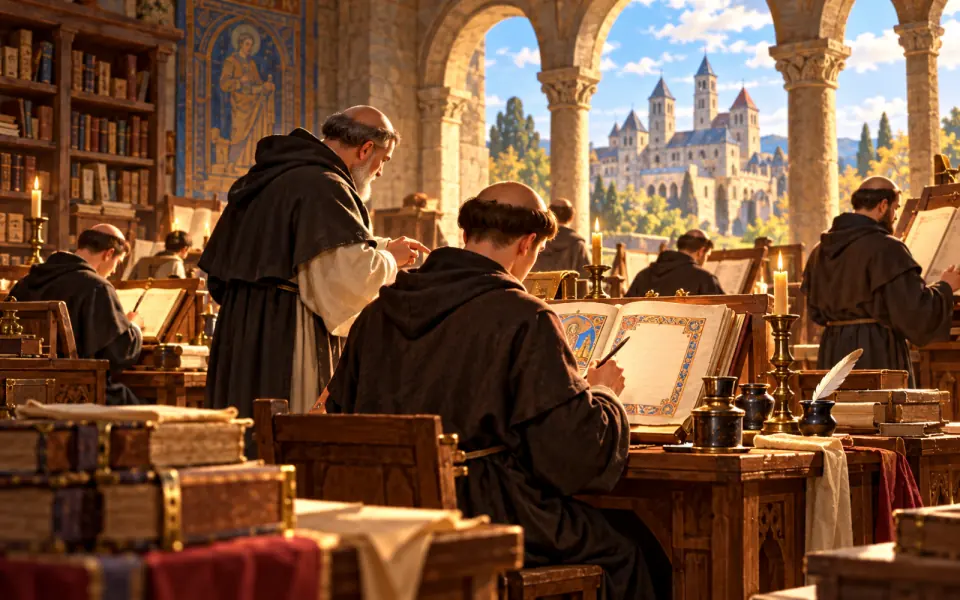
Scholars came to Charlemagne's court from all over Europe, such as the English monk Alcuin of York. Schools were opened at monasteries and cathedrals, and scribes copied out many ancient Latin texts. To make handwriting clearer, Carolingian minuscule was created, with round, separate letters that were easy to read. The small letters on this page come from that very script.
Why it matters Without the books copied in those years, many Roman works would have been lost.
Source: Encyclopaedia Britannica, “Carolingian minuscule”
Study card about 5 minutes of reading
The story
Reading and writing had become difficult
In the 8th century, in the Frankish kingdom, almost nobody could write well. After the fall of the Roman Empire the schools had disappeared, except for a few in the monasteries. Even among priests, many no longer knew Latin and made grammar mistakes in the prayers. The scripts in use were messy: every region had its own, with distorted letters, shortened and joined to one another, hard to read even for monks.
Charlemagne, who had learned to read but never to write well, understood that a great kingdom needs educated people: it needed officials who could draw up documents, priests able to read the Gospel without mistakes, and judges who understood the laws. He decided to do something about it.
The palace school
Charles called the best scholars in Europe to his court: the Italian Paul the Deacon, the Goth Theodulf, his biographer Einhard, and above all an English monk from York, Alcuin, who arrived in 782 and ran the palace school at Aachen. The king's children, young nobles and even Charles himself studied there, for he was curious about everything: astronomy, grammar, rhetoric.
In 789 Charles issued a decree, the “Admonitio generalis”, in which he ordered that every monastery and every cathedral should open a school to teach reading, writing, singing and arithmetic. He wanted children to be able to learn to read and write in those schools. In practice it did not always work out that way, but it was an important first step. In 796 Alcuin was made abbot of the monastery of Saint Martin at Tours, in France, where he founded a scriptorium, that is, a room where monks copied books.
A new script
At Corbie and Tours, and in other monasteries, the copyists perfected a clear, tidy script: Carolingian minuscule. The letters are round and separate, with tall and short strokes clearly distinct; the words are divided by spaces, as Irish scribes had already done; there are full stops and commas to mark pauses; capital letters are used to begin sentences and proper names. In short, it looks very much like the writing we use today.
It was a great novelty: late-antique writing often had no spaces between words and no punctuation, in capital letters, and reading aloud in order to understand was not easy; Irish scribes, however, had already introduced spaces at the end of the 7th century, and the Carolingian script adopted them and made them the rule. Carolingian minuscule spread throughout the empire: the documents and books of Aachen, Tours and Corbie could be understood at a glance in Rome as in Cologne.
Everyday work in the scriptorium was regulated too. The monks wrote seated at a lectern, with a goose quill or a reed pen and a small knife to correct mistakes on the parchment. They worked only by daylight, to avoid burning the books with candles, and silence was compulsory. One copyist wrote at the end of a job that only three fingers hold the pen, but the whole body works.
Ancient books saved
The Carolingian monks did not copy only Christian texts. They also copied works by ancient authors: Cicero, Virgil, Ovid, Julius Caesar, Pliny. By a lucky chance, most of the ancient Latin texts we know today survived because they were copied in the monasteries of this age; the Roman originals, on papyrus or parchment, had almost all been lost.
In the 15th century the Italian humanists, who were searching for the books of the Romans, found old manuscripts in Carolingian minuscule and thought it was the writing of the ancient Romans. They adopted it, turned it into an elegant hand and then into printing types: this is where our lower-case printed letters come from, the “roman” type. It is a curious story: a script invented in the 9th century was mistaken for Roman, and today we have it in front of us every day.
Why it happened
Charlemagne ruled a huge kingdom, with different peoples and languages, and he wanted an efficient administration and a united Church. To manage that, he needed people who could read and write Latin correctly.
The revival was helped by foreign scholars called to court, by the monasteries, which had libraries and were used to the work of copying, and by a king determined to support culture with his own money.
What changed
A network of schools and libraries was formed, which made teaching possible in the following centuries and became the foundation on which, from the 11th century, the universities were born.
Carolingian minuscule was the most widespread script in Europe for three centuries, then it was replaced by the Gothic script; but it returned with humanism and with printing. Our lower-case letters descend from it.
Many ancient books have reached us thanks to the Carolingian monks: without them, we would not know most of Latin literature.
Key people and places
People
- Charlemagne
- King of the Franks and emperor (747–814): he promoted the reform of schooling.
- Alcuin of York
- English scholar (about 735–804): he ran the palace school and the abbey of Tours.
- Paul the Deacon
- Lombard historian (about 720–799): he worked at Charles's court and wrote the history of the Lombards.
- Einhard
- Frankish scholar (about 770–840): he wrote Charles's biography.
- Theodulf of Orléans
- Poet and bishop of Gothic origin (about 750–821): adviser to Charles.
Places
- Aachen
- Capital of the Carolingian empire, home of the palace school.
- Tours
- French city with the abbey of Saint Martin, where Alcuin founded a scriptorium.
- Corbie
- French abbey famous for its copyists.
Good to know
- Carolingian minuscule made the spaces between words, and clearer punctuation, already used by Irish monks, into a rule.
- Charlemagne never managed to learn to write well.
- Most of the ancient Latin texts we know have reached us through Carolingian copies.
- Our lower-case printed letters come from Carolingian minuscule.
- The “Admonitio generalis” of 789 ordered schools in every monastery.
Find out more
- Wikipedia, “Carolingian minuscule” en.wikipedia.org
- Wikipedia, “Alcuin” en.wikipedia.org
- Wikipedia, “Carolingian Renaissance” en.wikipedia.org
- Wikipedia, “Scriptorium” en.wikipedia.org
Related events
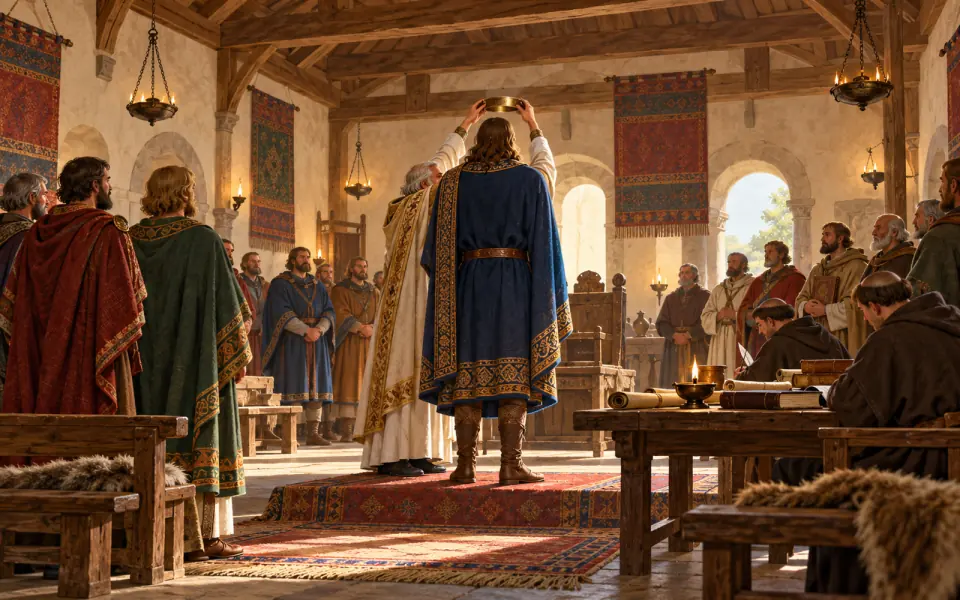
- Charlemagne, King of the FranksAD 768 · Early Middle AgesCharles became king of the Franks in 768.
- Charlemagne crowned emperorAD 800 · Early Middle AgesCharles was crowned emperor in Rome in 800.
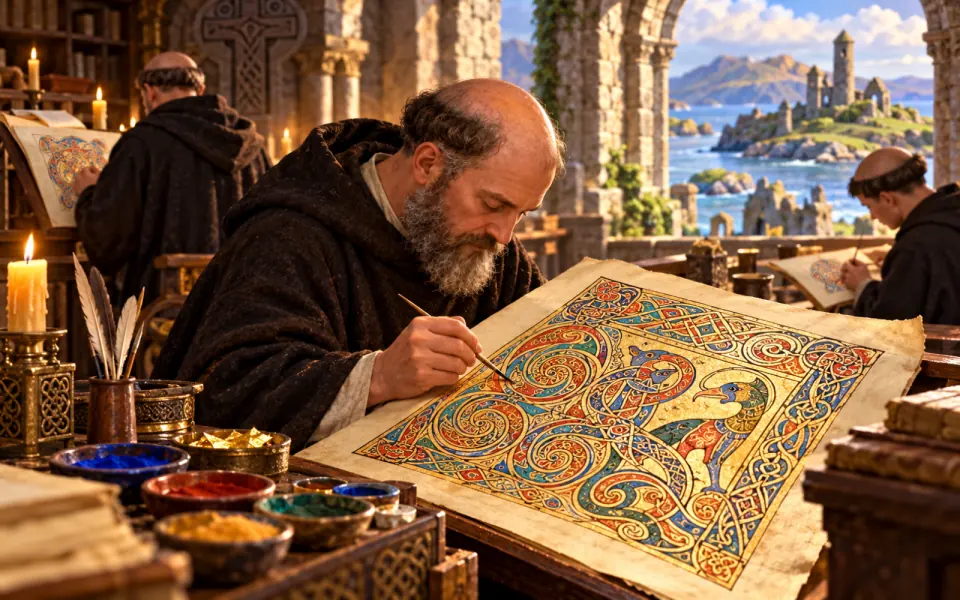
- The Book of Kellsabout AD 800 · Early Middle AgesIn Ireland monks illuminated the Book of Kells.
- Writing music down with neumesabout AD 850 · Early Middle AgesIn the monasteries people also began to write down music.
Before and after, in the era “Early Middle Ages”
Event 13 of 25
 BeforeThe Romano-Germanic kingdomsabout AD 480
 BeforeEmperor JustinianAD 527
 BeforeJustinian's CodeAD 529
 BeforeBenedictine monksabout AD 529
 BeforeHagia Sophia in ConstantinopleAD 537
 BeforeThe mosaics of San Vitale in RavennaAD 547
 BeforeThe Lombards in ItalyAD 568
 BeforeMuhammad's HijraAD 622
 BeforeIsidore writes the Etymologiesabout AD 625
 BeforeThe spread of IslamAD 632–750
 BeforePaper reaches Samarkandabout AD 751
 BeforeCharlemagne, King of the FranksAD 768
- You are hereThe Carolingian Renaissanceabout AD 790
 AfterThe Book of Kellsabout AD 800
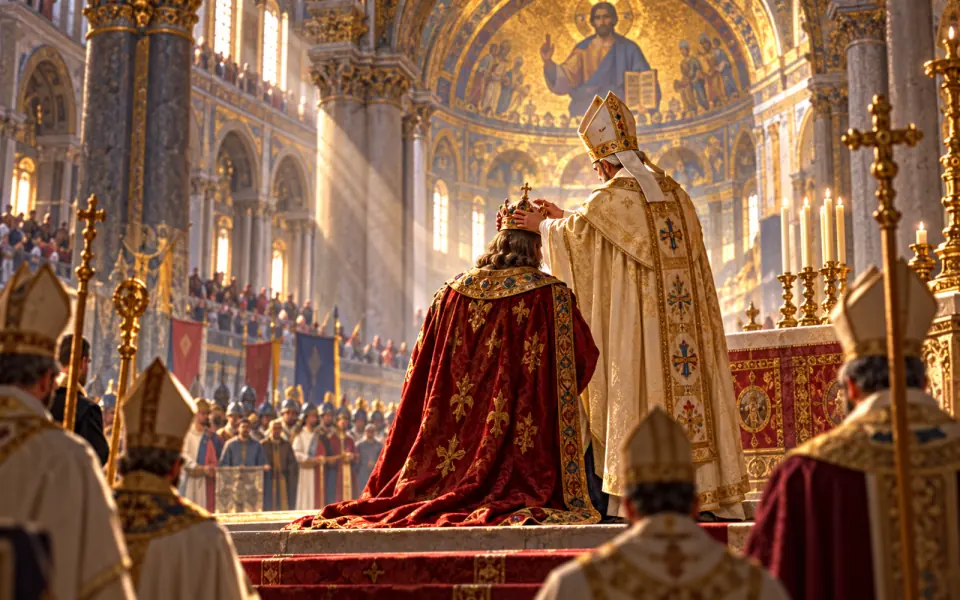 AfterCharlemagne crowned emperorAD 800
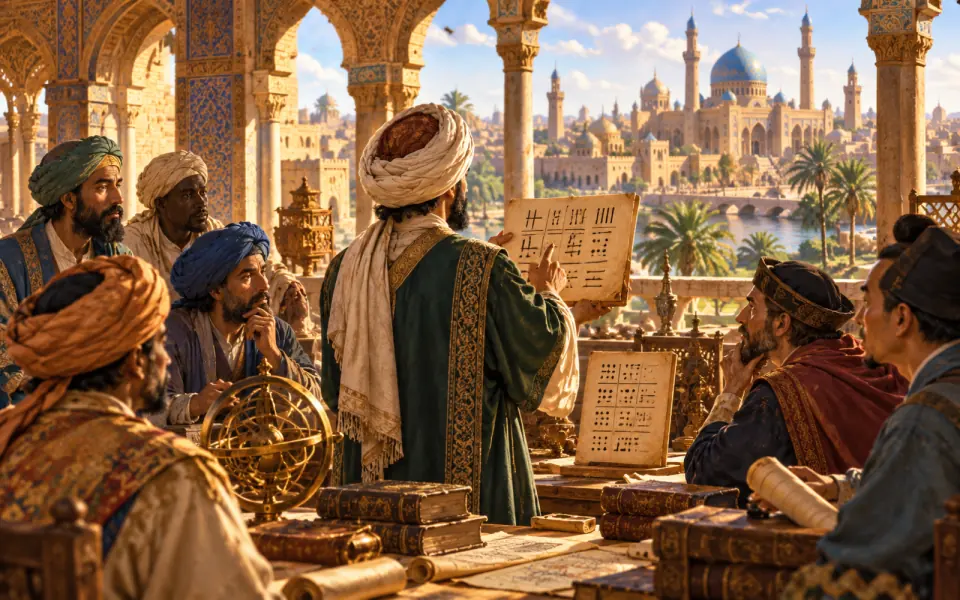 AfterHindu-Arabic numerals head westabout AD 825
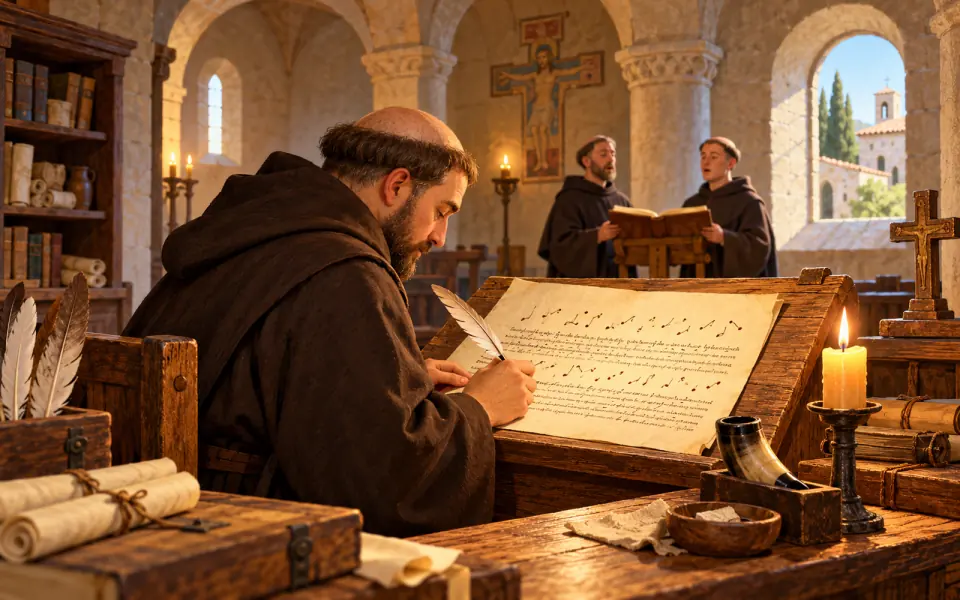 AfterWriting music down with neumesabout AD 850
 AfterThe Diamond Sutra, oldest dated printed bookAD 868
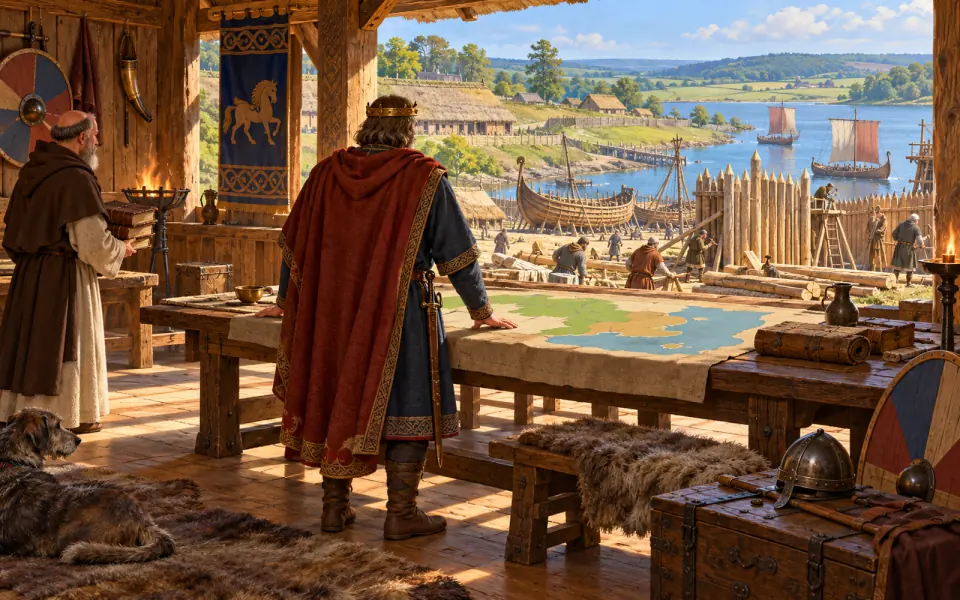 AfterAlfred the GreatAD 871
 AfterThe Vikings reach Icelandabout AD 874
 AfterThe feudal system spreadsabout AD 900
 AfterThe Medical School of Salernoabout AD 950
 AfterThe Vikings in Greenlandabout AD 985
 AfterLeif Erikson in North Americaabout 1000
 AfterThe heavy plough spreadsabout 1000
Listen / Read next
- Music to read by: Cinematic JourneyEpic film-style music, no lyrics, by Ciro Simone IrmiciSpotifyYouTube Music
Meanwhile, elsewhere in the world
Other events of the era “Early Middle Ages”
- The Romano-Germanic kingdoms
- Emperor Justinian
- Justinian's Code
- Benedictine monks
- Hagia Sophia in Constantinople
- The mosaics of San Vitale in Ravenna
- The Lombards in Italy
- Muhammad's Hijra
- Isidore writes the Etymologies
- The spread of Islam
- Paper reaches Samarkand
- Charlemagne, King of the Franks
- The Book of Kells
- Charlemagne crowned emperor
- Hindu-Arabic numerals head west
- Writing music down with neumes
- The Diamond Sutra, oldest dated printed book
- Alfred the Great
- The Vikings reach Iceland
- The feudal system spreads
- The Medical School of Salerno
- The Vikings in Greenland
- Leif Erikson in North America
- The heavy plough spreads
