The Medical School of Salerno
about AD 950 Salerno, Campania
In short
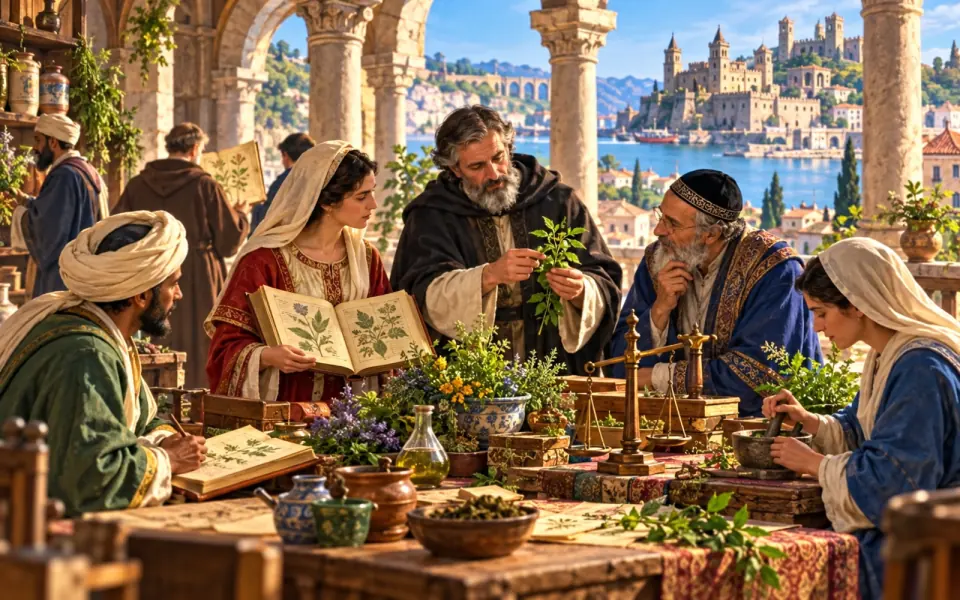
In Salerno one of the first schools of medicine in Europe was born, already famous in the 10th century. According to legend it was founded by four teachers: a Latin, a Greek, a Jew and an Arab. Students there learnt from the ancient texts of Hippocrates and Galen and, later, from the books of Arab doctors translated into Latin. Among the teachers were some women too, such as Trotula, an expert in women's health.
Why it matters The school was the model for the faculties of medicine later founded in universities.
Source: Treccani, entry “Salernitana, Scuola”
Study card about 4 minutes of reading
The story
Doctors without universities
In the early Middle Ages in Western Europe, getting treated was difficult. The knowledge of the ancient Greek and Roman doctors, such as Hippocrates and Galen, had been largely lost or reduced to a few summaries. People turned to the monasteries, where monks grew medicinal herbs and cared for the sick, to village healers and to the shrines of saints, where they prayed to get better. Very few doctors had real training.
Salerno, in southern Italy, on the gulf of the same name, was a different kind of city. It lay in a meeting-place of Latin, Greek, Arab and Jewish culture. Merchants and pilgrims arrived in its port from all over the Mediterranean, and with them, probably, came books and news. In Salerno there were hospitals linked to the monasteries and many doctors.
The School
We do not know exactly when the medical school of Salerno began. A legend says it was founded by four masters: a Latin, a Greek, an Arab and a Jew. It is a nice story, but it is not documented. One of the first certain pieces of evidence dates from about 988: Bishop Adalbero of Verdun, in France, fell ill and went to Salerno to be treated. By then the city was famous as the “city of Hippocrates”, in memory of the great Greek doctor.
It was not a university like those of today, with buildings, degrees and fixed rules, but a community of doctors who taught the young through lectures, cases of sick people and writings. Nor was it a religious school: the masters were often laymen, that is, not priests, and were married. In a city with such varied traditions, women too could practise medicine. The most famous was Trota, who lived in the 12th century and to whom a treatise on women's illnesses, “De passionibus mulierum”, is attributed, although scholars argue about its real author.
Arabic books translated
In the 11th century a merchant from Carthage, in Tunisia, Constantine the African, arrived in Salerno. He knew Arabic and Arab medicine, which at that time was much more advanced than Latin medicine. He became a monk at Monte Cassino and translated many Arabic medical treatises into Latin, giving Europeans access to a body of knowledge that would otherwise have stayed locked in the Arabic language. Some of the translations, however, were free, or were presented as his own works.
Constantine's work, which also contained descriptions of the eye, the brain and drugs, was much discussed in the following centuries. In this way the doctors of Salerno were able to compare themselves with the books of Hippocrates, Galen and Arab doctors such as Rhazes and Haly Abbas (Avicenna came only later, in the 12th century). They also experimented with dissection: in the 12th century they studied the bodies of pigs, which are similar to human ones, in a text called the “Anatomy of the Pig”.
The poem of health
The School's most famous work is the “Regimen sanitatis Salernitanum”, a collection of health advice in Latin verse, easy to remember, which spread all over Europe and was copied, translated and printed in hundreds of editions. It gave practical suggestions: eat in moderation, sleep the right amount, wash your hands before meals, take a walk after dinner, stay cheerful. The first line, in essence, says: if you want to stay healthy, put heavy worries aside and do not get angry, because anger is bad for you.
In 1231 the emperor Frederick II, with the “Constitutions of Melfi”, laid down that to practise medicine in his kingdom you had to be examined by the masters of Salerno, and separated the trade of the doctor from that of the apothecary, that is, the person who prepares medicines. With time the school lost importance in the face of the new universities and was closed in 1811.
Why it happened
Several cultures met in Salerno, and a short distance away stood the monastery of Monte Cassino, rich in books. The doctors could count on an open environment, where important people also came to be treated.
It was a city of trade and pilgrimage, with many sick people, many local herbs and many hospitals: an ideal place to learn by observing and trying, day after day.
What changed
The Salerno medical school was the first great school of medicine in Europe and a model for later universities, such as those of Bologna, Montpellier and Padua. In the following centuries scientific medicine was born in the universities.
Its poem on health remained popular for centuries and brought to Europe the idea that to be well you need a good lifestyle, just as we say today.
Salerno itself today has the Minerva Garden, among the oldest medicinal gardens, where medicinal plants were grown. The city has had a new university since 1968.
Key people and places
People
- Constantine the African
- Monk and translator (born perhaps around 1015, died about 1087): he translated Arabic medical texts into Latin.
- Trota (Trotula) de Ruggiero
- Woman doctor of Salerno in the 12th century: a treatise on women's medicine is attributed to her.
- Adalbero of Verdun
- Bishop (died 988): around 988 he went to Salerno to be treated.
- Frederick II
- Emperor (1194–1250): he regulated the medical profession in 1231.
- Hippocrates
- Greek doctor (5th century BC), considered the father of medicine.
Places
- Salerno
- City in Campania on the Tyrrhenian Sea, home of the medical school.
- Monte Cassino
- Abbey where Constantine translated the Arabic texts.
Good to know
- One of the first certain pieces of evidence about the School dates from about 988.
- In Salerno in the 12th century they also studied the dissection of pigs.
- A woman doctor of Salerno, Trota, wrote a treatise on women's illnesses.
- The “Regimen sanitatis” is a poem of health advice in Latin verse.
- The School was closed only in 1811.
Find out more
- Wikipedia, “Schola Medica Salernitana” en.wikipedia.org
- Wikipedia, “Constantine the African” en.wikipedia.org
- Wikipedia, “Trota of Salerno” en.wikipedia.org
- Wikipedia, “Monte Cassino” en.wikipedia.org
Related events
- Benedictine monksabout AD 529 · Early Middle AgesBenedictine monks grew herbs and cared for the sick.
- Hindu-Arabic numerals head westabout AD 825 · Early Middle AgesMathematics and the sciences came from the Arab world.
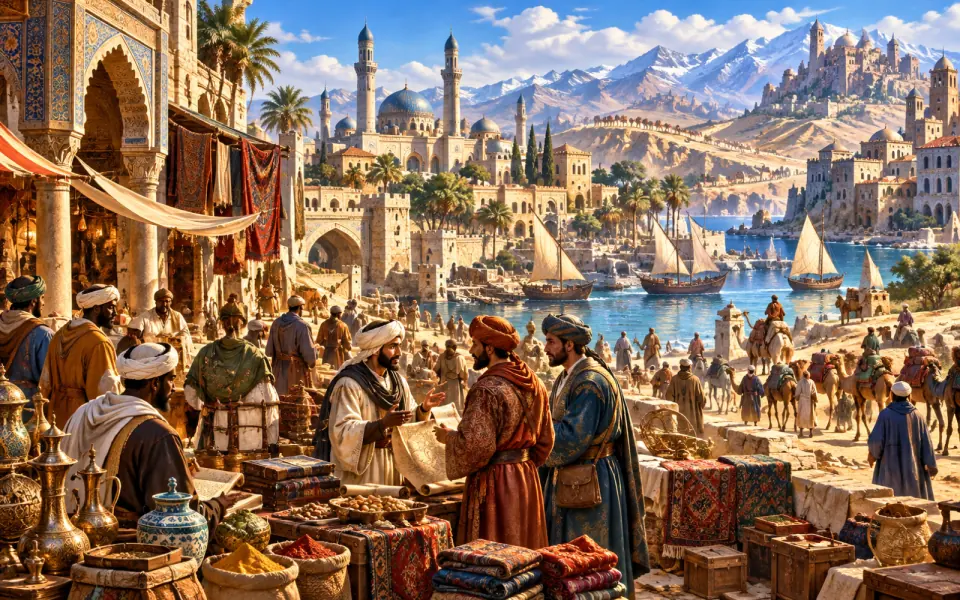
- The spread of IslamAD 632–750 · Early Middle AgesArab culture spread across the Mediterranean.
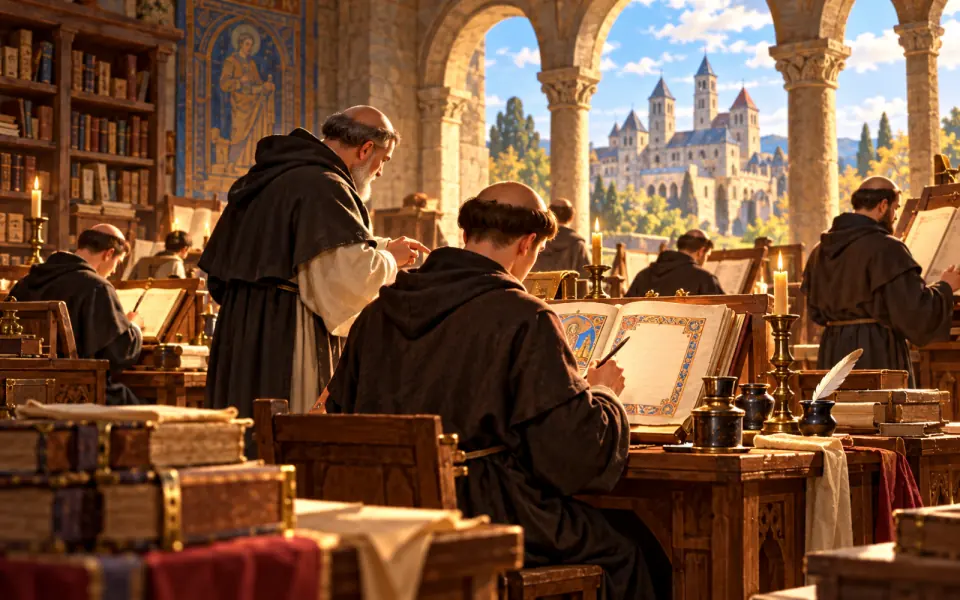
- The Carolingian Renaissanceabout AD 790 · Early Middle AgesIn the Carolingian monasteries ancient texts were copied.
Before and after, in the era “Early Middle Ages”
Event 22 of 25
 BeforeThe Romano-Germanic kingdomsabout AD 480
 BeforeEmperor JustinianAD 527
 BeforeJustinian's CodeAD 529
 BeforeBenedictine monksabout AD 529
 BeforeHagia Sophia in ConstantinopleAD 537
 BeforeThe mosaics of San Vitale in RavennaAD 547
 BeforeThe Lombards in ItalyAD 568
 BeforeMuhammad's HijraAD 622
 BeforeIsidore writes the Etymologiesabout AD 625
 BeforeThe spread of IslamAD 632–750
 BeforePaper reaches Samarkandabout AD 751
 BeforeCharlemagne, King of the FranksAD 768
 BeforeThe Carolingian Renaissanceabout AD 790
 BeforeThe Book of Kellsabout AD 800
 BeforeCharlemagne crowned emperorAD 800
 BeforeHindu-Arabic numerals head westabout AD 825
 BeforeWriting music down with neumesabout AD 850
 BeforeThe Diamond Sutra, oldest dated printed bookAD 868
 BeforeAlfred the GreatAD 871
 BeforeThe Vikings reach Icelandabout AD 874
 BeforeThe feudal system spreadsabout AD 900
- You are hereThe Medical School of Salernoabout AD 950
 AfterThe Vikings in Greenlandabout AD 985
 AfterLeif Erikson in North Americaabout 1000
 AfterThe heavy plough spreadsabout 1000
Listen / Read next
- Music to read by: Cinematic JourneyEpic film-style music, no lyrics, by Ciro Simone IrmiciSpotifyYouTube Music
Meanwhile, elsewhere in the world
Other events of the era “Early Middle Ages”
- The Romano-Germanic kingdoms
- Emperor Justinian
- Justinian's Code
- Benedictine monks
- Hagia Sophia in Constantinople
- The mosaics of San Vitale in Ravenna
- The Lombards in Italy
- Muhammad's Hijra
- Isidore writes the Etymologies
- The spread of Islam
- Paper reaches Samarkand
- Charlemagne, King of the Franks
- The Carolingian Renaissance
- The Book of Kells
- Charlemagne crowned emperor
- Hindu-Arabic numerals head west
- Writing music down with neumes
- The Diamond Sutra, oldest dated printed book
- Alfred the Great
- The Vikings reach Iceland
- The feudal system spreads
- The Vikings in Greenland
- Leif Erikson in North America
- The heavy plough spreads
