Writing music down with neumes
about AD 850 Monasteries of western Europe (for example St Gallen, Switzerland)
In short
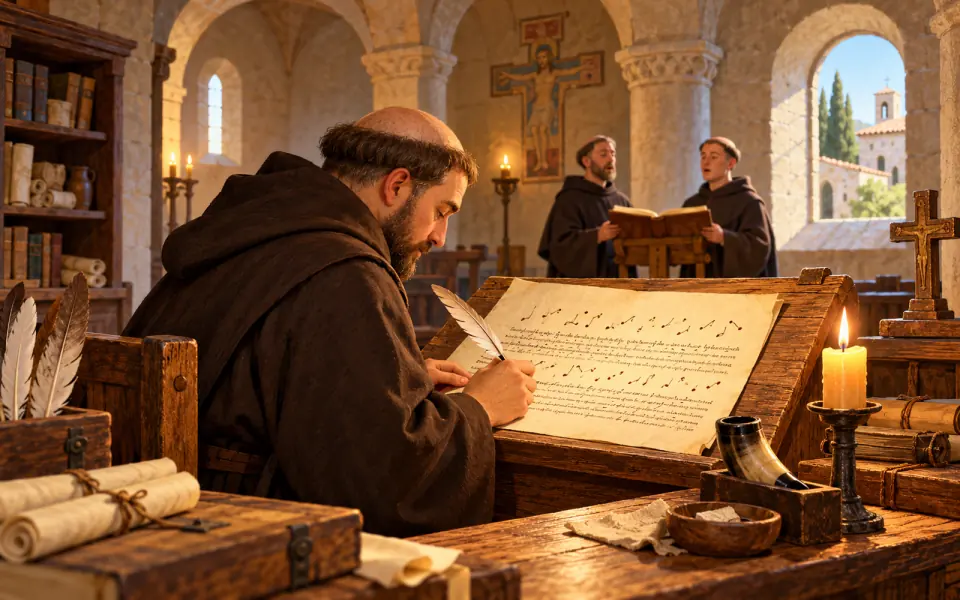
In the monasteries Gregorian chant was sung, but the tunes were learnt by heart by listening to the teachers. Around the middle of the 9th century monks began writing small signs above the words, called neumes, which showed whether the voice should go up or down. At first there were no lines, so the neumes only helped people remember a tune they already knew. Later, around 1025, Guido of Arezzo added the lines and gave the notes names.
Why it matters The stave used today to write music grew out of those first signs.
Source: Treccani, entry “Neuma”
Study card about 4 minutes of reading
The story
Songs learned by heart
In the monasteries and churches of the early Middle Ages people sang every day: psalms, prayers and hymns, in Latin, in a single voice, without instruments. That singing is now called Gregorian chant, after Pope Gregory the Great, because a tradition, probably a legend, said that a dove, the symbol of the Holy Spirit, had dictated it to him. In reality it took shape slowly over many centuries, mixing Roman and Frankish traditions.
For centuries nobody wrote the music down, not even the great choirmasters. Singers learned the melodies by listening and repeating them, and remembered hundreds by heart. A great scholar of the 7th century, Isidore of Seville, wrote that if sounds are not remembered by people, they are lost, because they cannot be written down. And in fact there was no way of doing it.
Signs above the words
Around the middle of the 9th century, in some monasteries in France and Switzerland, such as the one at St Gall, someone had the idea of marking the shape of the melody with little symbols above the words of the text. These signs are called “neumes”, from a Greek word meaning “a nod”. They are lines, dots and squiggles that recall the gestures with which the choirmaster directed the singers, raising and lowering his hand.
Neumes did not say how high a note was, only whether the melody went up, went down, paused or wavered. They were useful for someone who already knew the chant, to help remember it, and not for someone who had to learn it from scratch. Singers still had to learn the melodies from their masters, which took years, and if the tradition was broken, the music was lost.
Lines and notes
The decisive step came in the 11th century, in Italy, thanks to a monk named Guido of Arezzo, born around 991. He taught singing to boys in the cathedral schools and noticed how tiring it was to make them learn everything by heart: it took ten years, he said, to train a good singer. So he devised a method.
On the parchment he drew horizontal lines, four of them (today there are five), and coloured some in red and yellow to show particular notes. Each neume, placed on a line or in a space, thus showed a note of exact pitch. This was the musical staff, the basis of every score today.
Guido also invented a trick for remembering sounds. He took a hymn to Saint John the Baptist, “Ut queant laxis”, in which each line begins on a higher note than the one before. The first syllables of the first six lines of the verse, “ut, re, mi, fa, sol, la”, were used to name the six notes. Later “ut” became “do” and “si” was added. To this day the names of the notes come from there. After him there also spread the so-called “Guidonian hand”, a teaching aid attributed to him: each fingertip and each joint of the fingers stood for a note, and the teacher pointed to it with a finger.
Before Arezzo, Guido had lived in the abbey of Pomposa, near Ferrara. There his ideas were not well received by his fellow monks, perhaps out of jealousy, and so he moved to a city where the bishop listened to him and supported him. Guido described his methods in a book, the “Micrologus”, written around 1026. Pope John XIX wanted to meet him and invited him to Rome, where he tested him with an unknown antiphon: the monk learned it in a short time, and the pope was amazed. That is how he tells it himself, in a letter.
Why it happened
The Carolingian monasteries were trying to unify the liturgy and the singing throughout Charlemagne's empire. To keep the chants the same in faraway places, a way of fixing them in writing was needed.
The repertoire had become too large to be remembered by heart, and teaching the chants to boys took years. A written system would save time and effort for all the choirmasters.
What changed
Musical notation made it possible to preserve music over time and spread it from place to place. Without it, music would have remained tied to what the singers could remember.
Lines and notes encouraged the writing of music for several voices, that is, polyphony, which in the following centuries gave rise to Western art music. Composers such as Bach, Mozart and Verdi wrote their works with a system that descends from Guido's.
The names of the notes, do re mi fa sol la si, are used in Italy, France, Spain and many other countries. In English- and German-speaking countries, letters of the alphabet are used instead, but the origin is the same.
Key people and places
People
- Guido of Arezzo
- Monk and music theorist (about 991 – after 1033): he invented the musical staff and the names of the notes.
- Gregory the Great
- Pope from 590 to 604: by tradition, Gregorian chant is attributed to him.
- Isidore of Seville
- Bishop and scholar (about 560–636): he wrote that sounds cannot be written down.
- Paul the Deacon
- Monk and historian (about 720–799): author of the hymn “Ut queant laxis”.
Places
- St Gall (Switzerland)
- Abbey with a famous singing school and an important library.
- Arezzo
- Tuscan city where Guido taught, and where a square now bears his name.
- Pomposa (Ferrara)
- Abbey where Guido is said to have worked before moving to Arezzo.
Good to know
- The names do, re, mi, fa, sol, la come from the first syllables of a hymn to Saint John the Baptist.
- The first name of the note “do” was “ut”.
- The first musical staves had only four lines.
- Guido of Arezzo said it took ten years to train a good singer.
- Neumes recalled the gestures of the choir director.
Find out more
- Wikipedia, “Neume” en.wikipedia.org
- Wikipedia, “Guido of Arezzo” en.wikipedia.org
- Wikipedia, “Gregorian chant” en.wikipedia.org
- Wikipedia, “Musical notation” en.wikipedia.org
Related events
- The Carolingian Renaissanceabout AD 790 · Early Middle AgesCharlemagne promoted unity of chant in the Carolingian empire.
- Benedictine monksabout AD 529 · Early Middle AgesThe Benedictine monks sang the canonical hours.
- The Diamond Sutra, oldest dated printed bookAD 868 · Early Middle AgesIn China, in the same century, the first book was printed.
- Isidore writes the Etymologiesabout AD 625 · Early Middle AgesIsidore, a couple of centuries earlier, had written that sounds cannot be written down.
Before and after, in the era “Early Middle Ages”
Event 17 of 25
 BeforeThe Romano-Germanic kingdomsabout AD 480
 BeforeEmperor JustinianAD 527
 BeforeJustinian's CodeAD 529
 BeforeBenedictine monksabout AD 529
 BeforeHagia Sophia in ConstantinopleAD 537
 BeforeThe mosaics of San Vitale in RavennaAD 547
 BeforeThe Lombards in ItalyAD 568
 BeforeMuhammad's HijraAD 622
 BeforeIsidore writes the Etymologiesabout AD 625
 BeforeThe spread of IslamAD 632–750
 BeforePaper reaches Samarkandabout AD 751
 BeforeCharlemagne, King of the FranksAD 768
 BeforeThe Carolingian Renaissanceabout AD 790
 BeforeThe Book of Kellsabout AD 800
 BeforeCharlemagne crowned emperorAD 800
 BeforeHindu-Arabic numerals head westabout AD 825
- You are hereWriting music down with neumesabout AD 850
 AfterThe Diamond Sutra, oldest dated printed bookAD 868
 AfterAlfred the GreatAD 871
 AfterThe Vikings reach Icelandabout AD 874
 AfterThe feudal system spreadsabout AD 900
 AfterThe Medical School of Salernoabout AD 950
 AfterThe Vikings in Greenlandabout AD 985
 AfterLeif Erikson in North Americaabout 1000
 AfterThe heavy plough spreadsabout 1000
Listen / Read next
- Music to read by: Cinematic JourneyEpic film-style music, no lyrics, by Ciro Simone IrmiciSpotifyYouTube Music
Meanwhile, elsewhere in the world
Other events of the era “Early Middle Ages”
- The Romano-Germanic kingdoms
- Emperor Justinian
- Justinian's Code
- Benedictine monks
- Hagia Sophia in Constantinople
- The mosaics of San Vitale in Ravenna
- The Lombards in Italy
- Muhammad's Hijra
- Isidore writes the Etymologies
- The spread of Islam
- Paper reaches Samarkand
- Charlemagne, King of the Franks
- The Carolingian Renaissance
- The Book of Kells
- Charlemagne crowned emperor
- Hindu-Arabic numerals head west
- The Diamond Sutra, oldest dated printed book
- Alfred the Great
- The Vikings reach Iceland
- The feudal system spreads
- The Medical School of Salerno
- The Vikings in Greenland
- Leif Erikson in North America
- The heavy plough spreads
