Kepler describes the orbits
1609 Prague (now Czech Republic)
In short
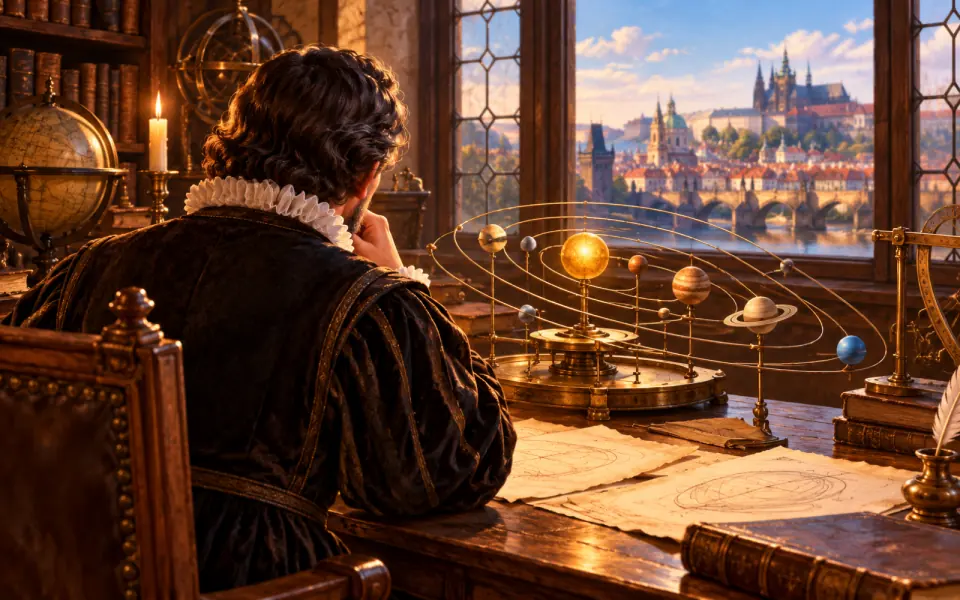
Johannes Kepler, a German astronomer, worked in Prague with the very precise measurements collected by his teacher Tycho Brahe. After studying the motion of Mars for years, he realised that the planets do not go round the Sun in perfect circles, but in ellipse-shaped orbits, a kind of squashed circle. He also discovered that a planet moves faster when it is close to the Sun. He published these laws in 1609 in the book Astronomia nova.
Why it matters Kepler's laws made it possible to predict the positions of the planets precisely, and Newton used them for his theory of gravity.
Source: Treccani, entry “Keplero, Giovanni”
Study card about 4 minutes of reading
The story
The perfect circle
Since ancient times astronomers had a fixed idea: the sky is perfect, and perfect things move along the most perfect shape, the circle. This is why Ptolemy, and Copernicus too, had imagined that the planets moved in circles, or in circles on top of other circles. The system worked only in part, and to make it match the observations it always needed new corrections.
Johannes Kepler was born in 1571 in Weil der Stadt, in Germany, into a modest family. He was a frail, sickly child, but very good at school, and he reached university thanks to a scholarship. He had a passion for mathematics and astronomy, and when he came across Copernicus's idea, that it is the Earth that goes around the Sun, he was struck by it.
Tycho and Mars
In 1600 Kepler moved to Prague, the capital of Emperor Rudolf II, to work with the Danish astronomer Tycho Brahe. Tycho was an exceptional observer: for decades he had measured the positions of the planets with a precision never reached before, with the naked eye, using large instruments he had designed himself. He did not trust Copernicus's system, but his data was a treasure. Tycho died in 1601, and Kepler inherited his tables and his post as imperial mathematician.
Kepler was given the hardest problem: the orbit of Mars, the planet that would not fit into circles. For years he tried different combinations of circles, with enormous calculations by hand. In the end he found one that agreed with the observations almost perfectly, but it was wrong by eight arcminutes, a tiny fraction, about a quarter of the width of the full Moon. Another astronomer would have let it go. Kepler reasoned that Tycho could not have been wrong by so much, and that it was the model that was wrong.
The ellipse
For a time Kepler was almost in despair: he wrote that he felt he had been “waging a war against Mars”. After very many attempts, he discovered that the orbit of Mars is not a circle but an ellipse, that is, a sort of squashed circle, and that the Sun is not at the centre, but at one of the two special points called foci. This is Kepler's first law. The second law says that a planet moves faster when it is closer to the Sun and slower when it is farther away, so that the line joining it to the Sun sweeps out equal areas in equal times.
Kepler published these two laws in 1609 in the “Astronomia nova”, that is, “New Astronomy”, a long book full of calculations, in which he also tells of his mistakes and false trails. Ten years later, in the “Harmony of the World”, he added the third law: the farther planets take longer to make one circuit, and there is a precise mathematical rule linking time and distance.
A hard life
Kepler's life was not easy. He always worked for emperors who paid him little or late; he lost his first wife and some of his children; and he was caught up in the wars of religion, because he was a Lutheran in a mostly Catholic country. His mother, Katharina, was accused of witchcraft in a trial that lasted years, and Kepler had to put aside his studies to defend her: in the end she was acquitted, in 1621. He also wrote a work of fantasy, the “Somnium”, in which a man travels to the Moon.
In 1627 he published the “Rudolphine Tables”, the most accurate planetary tables ever made, which used his laws. He died in Regensburg in 1630, during a journey to recover unpaid wages.
Why it happened
Kepler was convinced, like Copernicus, that the Sun was at the centre, and he wanted to use mathematics to explain how the planets really moved. He believed that the world followed a harmony and an order that humans could discover.
He had Tycho Brahe's extraordinary data and great stubbornness in calculation. When the data did not fit the theory, he had the courage to change the theory.
What changed
The break with the perfect circle was a decisive step: the sky did not follow ideal shapes, but mathematical laws discovered from data. Kepler's three laws are still today the basis for calculating the orbits of planets, comets and satellites.
Newton used Kepler's laws to discover his law of gravitation, and showed that the three laws are necessary consequences of gravity. Without them, his theory would not have been possible.
His method, made of precise observations, rigorous calculation and respect for the data even when they contradict the most cherished ideas, is an example of the modern scientific method.
Key people and places
People
- Johannes Kepler
- German astronomer and mathematician (1571–1630): he discovered the three laws of planetary motion.
- Tycho Brahe
- Danish astronomer (1546–1601): he gathered the observations Kepler worked on.
- Rudolf II
- Emperor from 1576 to 1612 (1552–1612): he protected astronomers and alchemists in Prague.
- Katharina Kepler
- Kepler's mother (1547–1622): accused of witchcraft and acquitted in 1621.
Places
- Prague
- Capital of Emperor Rudolf II, where Kepler worked with Tycho Brahe.
- Weil der Stadt (Germany)
- Kepler's birthplace.
Good to know
- To find the orbit of Mars, Kepler filled hundreds of pages with calculations by hand.
- The difference that made him change his mind was only eight arcminutes.
- Kepler wrote a fantasy story about a journey to the Moon, the “Somnium”.
- His mother was tried as a witch and acquitted.
- A crater on the Moon and a NASA space telescope bear his name.
Find out more
- Wikipedia, “Johannes Kepler” en.wikipedia.org
- Wikipedia, “Kepler's laws of planetary motion” en.wikipedia.org
- Wikipedia, “Tycho Brahe” en.wikipedia.org
- Wikipedia, “Astronomia nova” en.wikipedia.org
Related events
- Copernicus puts the Sun at the centre1543 · Early modern ageKepler started from Copernicus's system.
- Galileo turns his telescope to the sky1609 · Early modern ageIn the same year Galileo was observing the sky with the telescope.
- Newton publishes the Principia1687 · Early modern ageNewton explained Kepler's laws with gravity.
- The Gregorian calendar1582 · Early modern ageThe calendar reform had also used the tables of astronomers.
Before and after, in the era “Early modern age”
Event 21 of 25
 BeforeRenaissance perspectiveabout 1420
 BeforeBrunelleschi completes the dome1436
 BeforeThe fall of Constantinople1453
 BeforeGutenberg prints the Bibleabout 1455
 BeforeLorenzo de' Medici in Florence1469
 BeforeLeonardo designs machinesabout 1485
 BeforeColumbus's voyage1492
 BeforeVasco da Gama reaches India1498
 BeforeMichelangelo carves David1504
 BeforeRaphael paints the Vatican Rooms1508
 BeforeLuther and the Reformation1517
 BeforeThe conquest of Tenochtitlán1521
 BeforeThe first voyage round the world1522
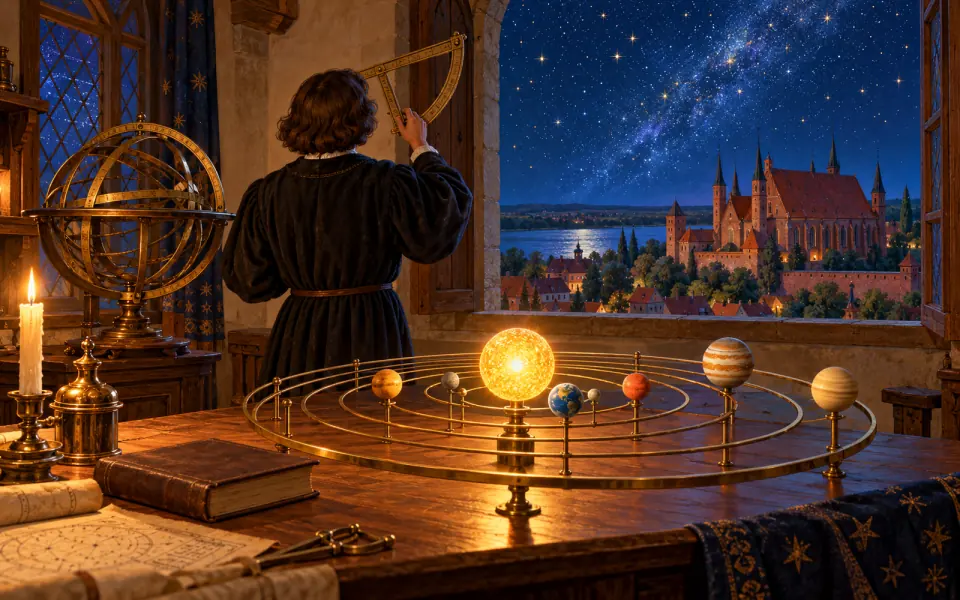 BeforeCopernicus puts the Sun at the centre1543
 BeforeThe Council of Trent1545–1563
 BeforeTomatoes, maize and potatoes reach Europeabout 1550
 BeforeThe Gregorian calendar1582
 BeforeShakespeare's theatreabout 1590
 BeforeRegular newspapers1605
 BeforeGalileo turns his telescope to the sky1609
- You are hereKepler describes the orbits1609
 AfterArtemisia Gentileschiabout 1612
 AfterHarvey studies the circulation of the blood1628
 AfterScientific academies1660
 AfterNewton publishes the Principia1687
Listen / Read next
- Music to read by: Cinematic JourneyEpic film-style music, no lyrics, by Ciro Simone IrmiciSpotifyYouTube Music
Meanwhile, elsewhere in the world
Other events of the era “Early modern age”
- Renaissance perspective
- Brunelleschi completes the dome
- The fall of Constantinople
- Gutenberg prints the Bible
- Lorenzo de' Medici in Florence
- Leonardo designs machines
- Columbus's voyage
- Vasco da Gama reaches India
- Michelangelo carves David
- Raphael paints the Vatican Rooms
- Luther and the Reformation
- The conquest of Tenochtitlán
- The first voyage round the world
- Copernicus puts the Sun at the centre
- The Council of Trent
- Tomatoes, maize and potatoes reach Europe
- The Gregorian calendar
- Shakespeare's theatre
- Regular newspapers
- Galileo turns his telescope to the sky
- Artemisia Gentileschi
- Harvey studies the circulation of the blood
- Scientific academies
- Newton publishes the Principia
