Harvey studies the circulation of the blood
1628 London, England
In short
The English doctor William Harvey, who had studied at the University of Padua, wanted to understand how blood moves around the body. With experiments and measurements he showed that the heart works like a pump and pushes the blood round a closed circuit: it leaves through the arteries and comes back through the veins. Before then people believed that blood was constantly made by the liver and used up by the organs. He explained his discovery in 1628 in a short book in Latin.
Why it matters It was the foundation of modern physiology, the science of how the body works.
Source: Treccani, entry “Harvey, William”
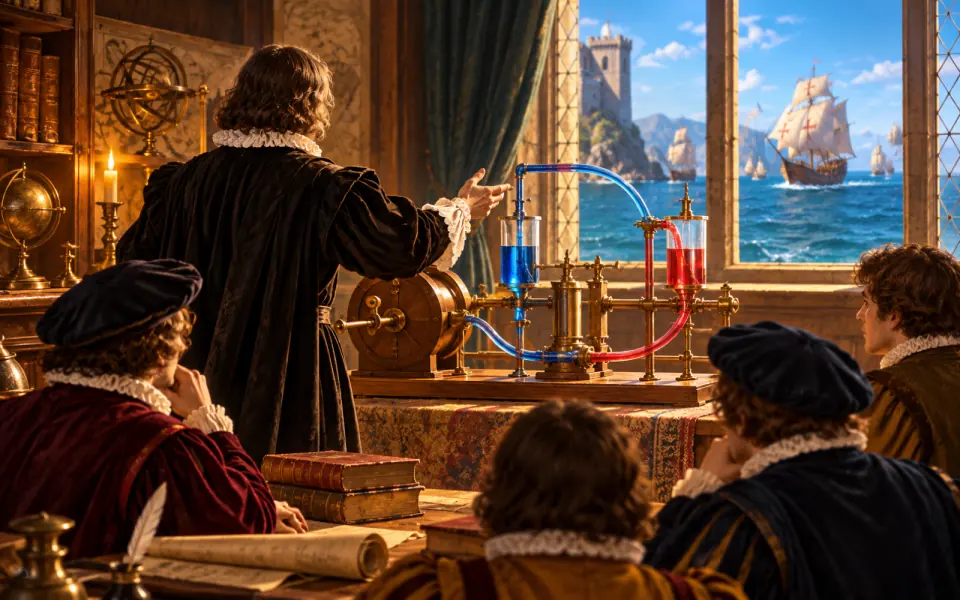
Study card about 5 minutes of reading
The story
Fourteen hundred years of mistakes about the human body
For more than fourteen hundred years doctors had followed the teachings of Galen, a Greek doctor who worked in Rome in the 2nd century AD. Galen thought that blood was produced all the time by the liver, from the food we eat, and that it then went around the body, where it was “used up” by the tissues, like wood in a fire. According to him the blood moved slowly back and forth, like water in the tide, but did not travel in a circle. He also thought that in the heart there were tiny invisible holes between the two halves, which let the blood through.
Galen had made many observations, but he had mostly dissected animals, because in Rome it was not allowed to open human bodies. For this reason some of his errors stood uncorrected for a long time. In the 16th century Andreas Vesalius, in Padua, began to correct them with human dissections, but on the movement of the blood the picture had not yet changed.
An English doctor in Padua
William Harvey was born in 1578 in Folkestone, in England. He studied at Cambridge and then at Padua, the most famous university in Europe for medicine, where his teacher was the anatomist Girolamo Fabrici d'Acquapendente. Fabrici showed him the valves of the veins, small flaps shaped like swallows' nests that let the blood pass in one direction only. Those valves, which made little sense in Galen's model, stayed in Harvey's mind.
Back in London, Harvey became an established doctor. He treated Kings James I and Charles I and taught anatomy at the Royal College of Physicians. With the king's permission he could also study the deer of the royal hunts. For many years he repeated experiments on animals of all kinds, from fish to snakes, from frogs to dogs, to see how the heart beat.
The sum that did not add up
Harvey made a simple and brilliant calculation. He worked out how much blood passes from the heart at each beat, and how many beats there are in an hour. Even with cautious estimates, the result was huge: much more than the weight of a person. It was not possible for the liver to make so much blood in an hour, nor for the body to use up so much. So it had to be the same blood all the time, going round in a circle: it leaves the heart through the arteries, reaches the tissues, comes back through the veins and enters the heart again.
To prove it he did experiments on himself and on others too. When an arm was tied tightly with a band, you could see the veins swell below the band and the arteries pulse above it. When you pushed the blood along a vein with your finger, you could see that it went only towards the heart and that the valves stopped it from going back.
A small and brave book
In 1628 Harvey published in Frankfurt, in Latin, a little book of only seventy-two pages, “De motu cordis”, “On the Motion of the Heart and Blood”. The book was printed on poor paper and with mistakes. Many doctors criticised it: they found it contrary to authors who had guided medicine for centuries. According to a biographer of the time, John Aubrey, after its publication Harvey lost many patients.
There was a gap: Harvey had not been able to see how the blood passed from the arteries to the veins, because the smallest vessels, the capillaries, are too thin for the naked eye. He imagined them, but could not show them. In 1661, four years after his death, the Italian Marcello Malpighi saw them with the microscope in the lungs of a frog. It was the missing confirmation.
Why it happened
Harvey had behind him the study of the great Italian anatomists, who had by then gone back to looking at the body directly. He also had the habit of measuring and counting, and of not trusting only what ancient books said.
The valves of the veins and the dissections of living animals gave him clues that Galen's theory could not explain, and a simple calculation showed that the old idea could not be true.
What changed
The discovery of the circulation of the blood is considered the beginning of modern physiology, that is, the study of how the living body works. The heart was understood for what it is: a pump. This idea fitted into an age in which people tried to explain the phenomena of nature with mechanics.
It opened the way to a new medicine based on experiment. Later came blood transfusions, injections into veins and the study of heart diseases.
It also showed that a single person, with few instruments, a calculation and a well-made experiment, could change an idea shared by everyone. Harvey died in 1657, respected by his colleagues in his lifetime, but still criticised by some.
Key people and places
People
- William Harvey
- English doctor (1578–1657): he proved that blood circulates around the body.
- Galen
- Greek doctor (about 129–216): his ideas dominated medicine for 1,400 years.
- Girolamo Fabrici d'Acquapendente
- Italian anatomist (1533–1619): Harvey's teacher in Padua.
- Andreas Vesalius
- Flemish anatomist (1514–1564): he corrected many of Galen's mistakes by studying human bodies.
- Marcello Malpighi
- Italian doctor (1628–1694): he saw the capillaries with the microscope.
Places
- Padua
- The university where Harvey studied and where Fabrici was his teacher.
- London
- The city where Harvey worked as a court doctor.
Good to know
- Harvey's book has only 72 pages.
- Harvey could not see the capillaries: he imagined them, and they were seen after his death.
- Galen thought that blood was formed in the liver and used up in the body.
- The valves of the veins have a shape that recalls a swallow's nest.
- Harvey studied the hearts of frogs, fish and snakes, because they beat more slowly and are easier to see.
Find out more
- Wikipedia, “William Harvey” en.wikipedia.org
- Wikipedia, “Exercitatio Anatomica de Motu Cordis et Sanguinis in Animalibus” en.wikipedia.org
- Wikipedia, “Marcello Malpighi” en.wikipedia.org
- Wikipedia, “Galen” en.wikipedia.org
Related events
- Galileo turns his telescope to the sky1609 · Early modern ageGalileo and Harvey also lived in the same period and had to convince scholars with proof.
- Scientific academies1660 · Early modern ageScientific academies took an interest in his research and that of his successors.
- Newton publishes the Principia1687 · Early modern ageNewton brought the same idea of mechanical law to the heavens.
- Copernicus puts the Sun at the centre1543 · Early modern ageLike Copernicus, Harvey changed an idea believed for centuries.
Before and after, in the era “Early modern age”
Event 23 of 25
 BeforeRenaissance perspectiveabout 1420
 BeforeBrunelleschi completes the dome1436
 BeforeThe fall of Constantinople1453
 BeforeGutenberg prints the Bibleabout 1455
 BeforeLorenzo de' Medici in Florence1469
 BeforeLeonardo designs machinesabout 1485
 BeforeColumbus's voyage1492
 BeforeVasco da Gama reaches India1498
 BeforeMichelangelo carves David1504
 BeforeRaphael paints the Vatican Rooms1508
 BeforeLuther and the Reformation1517
 BeforeThe conquest of Tenochtitlán1521
 BeforeThe first voyage round the world1522
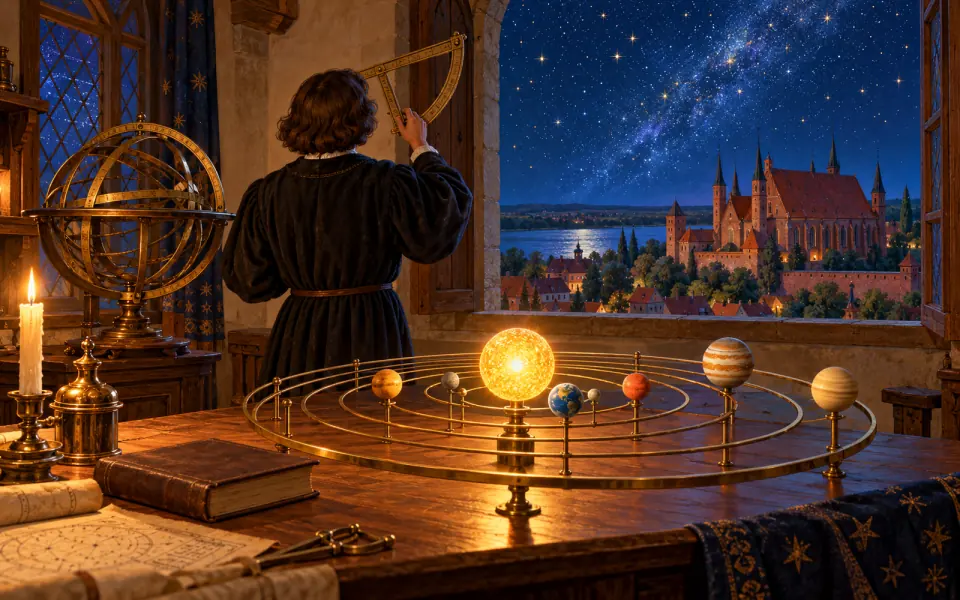 BeforeCopernicus puts the Sun at the centre1543
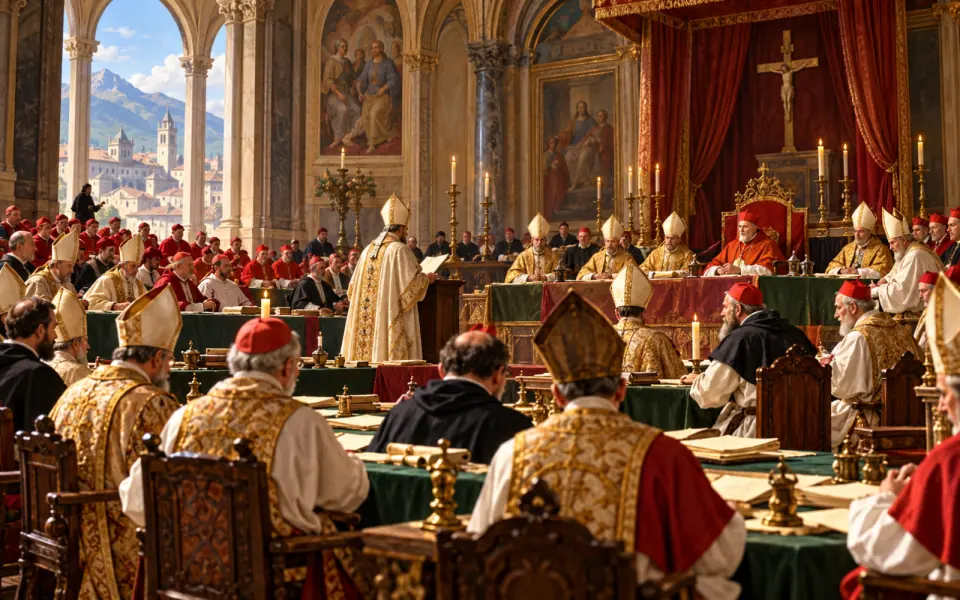 BeforeThe Council of Trent1545–1563
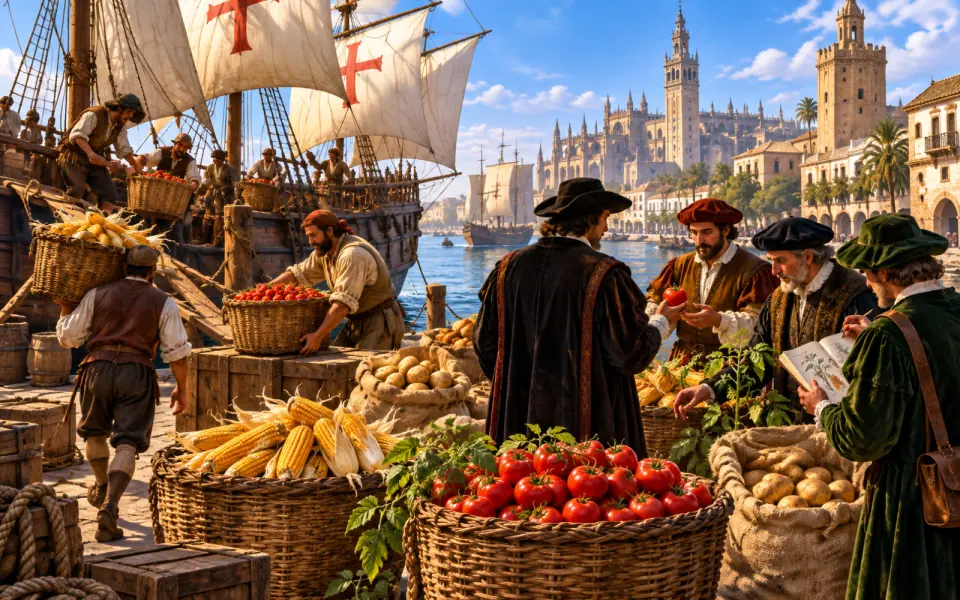 BeforeTomatoes, maize and potatoes reach Europeabout 1550
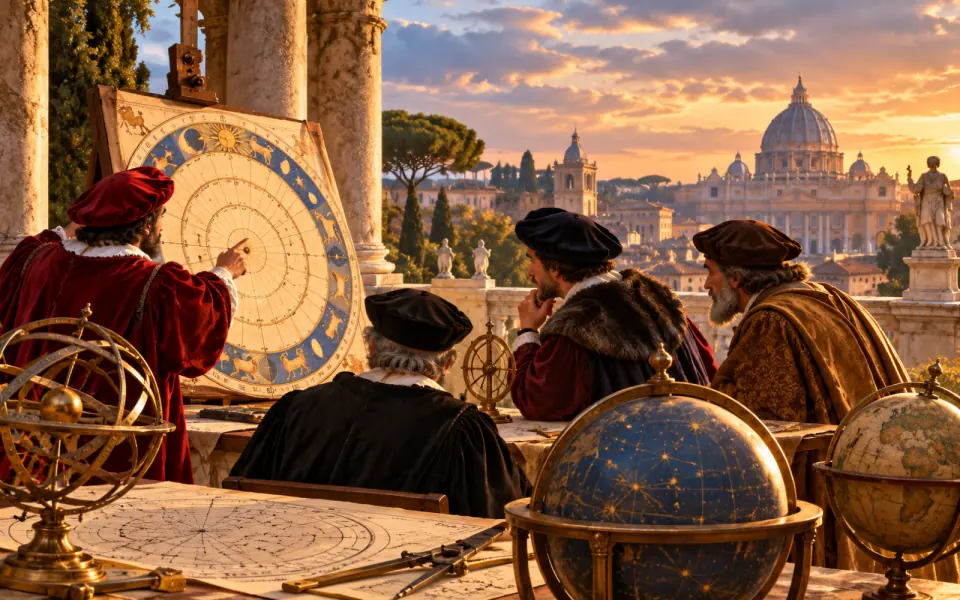 BeforeThe Gregorian calendar1582
 BeforeShakespeare's theatreabout 1590
 BeforeRegular newspapers1605
 BeforeGalileo turns his telescope to the sky1609
 BeforeKepler describes the orbits1609
 BeforeArtemisia Gentileschiabout 1612
- You are hereHarvey studies the circulation of the blood1628
 AfterScientific academies1660
 AfterNewton publishes the Principia1687
Listen / Read next
- Music to read by: Cinematic JourneyEpic film-style music, no lyrics, by Ciro Simone IrmiciSpotifyYouTube Music
Meanwhile, elsewhere in the world
Other events of the era “Early modern age”
- Renaissance perspective
- Brunelleschi completes the dome
- The fall of Constantinople
- Gutenberg prints the Bible
- Lorenzo de' Medici in Florence
- Leonardo designs machines
- Columbus's voyage
- Vasco da Gama reaches India
- Michelangelo carves David
- Raphael paints the Vatican Rooms
- Luther and the Reformation
- The conquest of Tenochtitlán
- The first voyage round the world
- Copernicus puts the Sun at the centre
- The Council of Trent
- Tomatoes, maize and potatoes reach Europe
- The Gregorian calendar
- Shakespeare's theatre
- Regular newspapers
- Galileo turns his telescope to the sky
- Kepler describes the orbits
- Artemisia Gentileschi
- Scientific academies
- Newton publishes the Principia
