Copernicus puts the Sun at the centre
1543 Frombork, Poland
In short
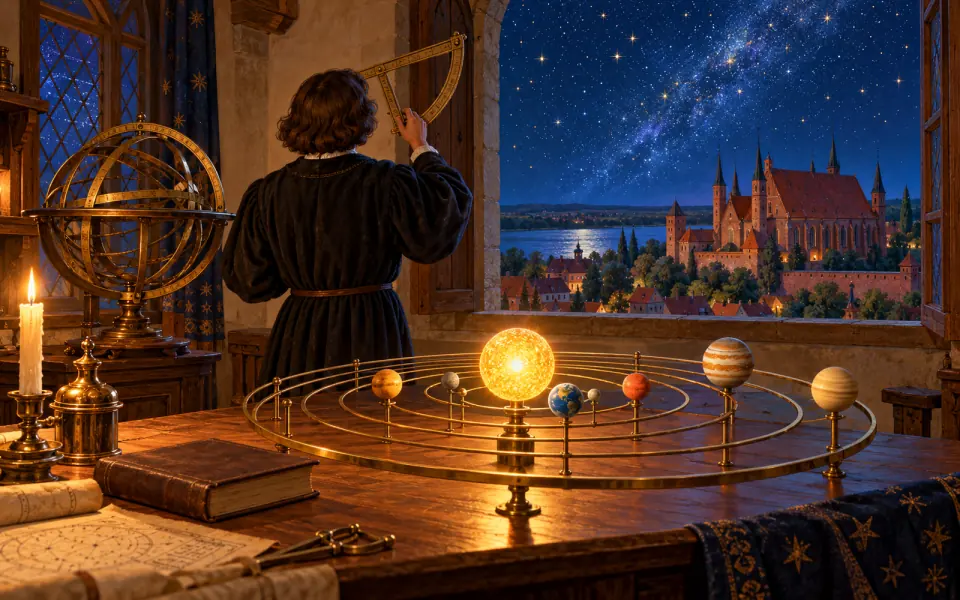
For centuries almost everyone had thought the Earth stood still at the centre of the universe. The Polish astronomer Nicolaus Copernicus, who had also studied in Bologna and Padua, put forward another idea: the Sun is at the centre, and the Earth goes round it together with the other planets, while also spinning on its own axis. His book, On the Revolutions of the Heavenly Spheres, came out in 1543, the year he died. It took more than a century for his idea to be accepted by everyone.
Why it matters It changed humanity's place in the universe and opened the way to modern astronomy.
Source: Treccani, entry “Copernico, Niccolò”
Study card about 5 minutes of reading
The story
A still Earth and a turning sky
For almost two thousand years Europeans had believed that the Earth stood still at the centre of the universe, and that the Sun, the Moon, the planets and the stars moved around it. It seemed an obvious idea: you only have to look at the sky to see the Sun rise and set, and nobody feels the ground move. The most widely used model was that of the Greek astronomer Ptolemy, from the 2nd century AD, who used a complicated combination of circles to predict the positions of the planets with fair accuracy.
Ptolemy's system, however, was very complicated and needed constant adjustments. Some planets, such as Mars, sometimes seem to move backwards in the sky, and to explain this Ptolemy had imagined small circles, called epicycles, turning on top of the big circles.
A canon who studied the stars
Nicolaus Copernicus was born in 1473 in Toruń, in Poland. His father died when he was about ten, and he was brought up by an uncle on his mother's side, who later became a bishop. He studied at the University of Kraków, then in Italy, at Bologna, Padua and Ferrara, where he worked on law and medicine and learned Greek. In Italy he also came across the astronomy taught in the universities. Back in Poland he became a canon, that is, a member of the council of the cathedral of Frombork, and he lived there for the rest of his life, also taking care of administration and medicine.
In his free hours he watched the sky from a tower and did calculations. He realised that everything became simpler if you imagined that the Sun stood still at the centre, and that the Earth was a planet like the others, travelling around the Sun once a year and spinning on its own axis once a day. In this way the backward movements of Mars and Jupiter could be explained without epicycles: they were an effect of perspective, caused by the Earth, which is faster, overtaking the slower planets.
A book that waited thirty years
Before 1514 Copernicus wrote out by hand a short summary of his idea, the “Commentariolus”, and let a few friends read it. The complete book, however, he wrote with great caution and for a long time he did not publish it, perhaps for fear of criticism, or because he wanted to perfect it. What convinced him was a young maths professor from Feldkirch, in what is now Austria, Georg Joachim Rheticus, who joined him at Frombork in 1539 and helped him put the text in order and have it printed in Nuremberg.
“On the Revolutions of the Heavenly Spheres” came out in 1543. It is said that Copernicus received a copy when he was already close to death, on 24 May 1543, but we do not know whether the story is true. In the printed version an unsigned preface was added, written by a Lutheran theologian, Andreas Osiander, which presented the theory as a mere tool for calculation and not as a description of reality. Copernicus, on the other hand, believed it was true.
An idea that others had already had
Copernicus was not the first to think of a system with the Sun at the centre: a Greek astronomer, Aristarchus of Samos, had already suggested it in the 3rd century BC. His idea, however, had been rejected, and Copernicus was the first to develop it with precise calculations. His system had its limits, though: it kept the orbits perfectly circular, and it still needed small epicycles to match the observed data. For this reason it was not at first more accurate than Ptolemy's.
Copernicus was also an economist: he wrote a treatise on the value of money, in which he explained that bad money drives out good, a rule that today is called Gresham's law.
Why it happened
In the Renaissance people were going back to reading ancient texts in Greek and discussing Ptolemy's results. Those who studied his system carefully could see its weak points, and wanted to find a simpler way of explaining the movements of the planets.
Copernicus had the mathematical training, the time to observe and the stubbornness for work lasting decades; and printed books made it possible to circulate the tables and calculations of earlier scholars.
What changed
The idea that the Earth is a moving planet, and not the centre of the universe, changed the way people looked at the sky. We speak of the “Copernican revolution” to mean a change of mentality: humans are no longer at the centre of the cosmos.
In the following century Kepler, Galileo and Newton took up and corrected Copernicus's system. Kepler discovered that orbits are ellipses; Galileo saw with the telescope things that supported it; Newton explained the causes.
For the Church the theory clashed with some passages of the Bible. In 1616 the book was placed on the Index of Forbidden Books “until corrected”, and its supporter Galileo was warned not to defend it. The book was removed from the Index only in 1835.
Key people and places
People
- Nicolaus Copernicus
- Polish astronomer, doctor and economist (1473–1543): he proposed the system with the Sun at the centre.
- Ptolemy
- Greek astronomer of the 2nd century AD: his system with the Earth at the centre was used for fourteen centuries.
- Georg Joachim Rheticus
- Austrian mathematician (1514–1574): he persuaded Copernicus to publish and oversaw the first printing.
- Aristarchus of Samos
- Greek astronomer of the 3rd century BC: he was the first to propose a system with the Sun at the centre.
- Andreas Osiander
- Lutheran theologian (1498–1552): he added the unsigned preface.
Places
- Frombork (Poland)
- The town on the Baltic Sea where Copernicus lived, worked and was buried.
- Toruń (Poland)
- Copernicus's birthplace.
- Nuremberg
- The German city where the book was printed in 1543.
Good to know
- Copernicus waited about thirty years before having his book published.
- The book contained an unsigned preface written by another author, which played down its meaning.
- The first person to propose the Sun at the centre was Aristarchus of Samos, almost eighteen centuries earlier.
- Copernicus's book stayed on the Index of Forbidden Books from 1616 to 1835.
- Copernicus's remains, found in Frombork Cathedral in 2005, were identified in 2008 thanks to DNA.
Find out more
- Wikipedia, “Nicolaus Copernicus” en.wikipedia.org
- Wikipedia, “De revolutionibus orbium coelestium” en.wikipedia.org
- Wikipedia, “Aristarchus of Samos” en.wikipedia.org
- Wikipedia, “Heliocentrism” en.wikipedia.org
Related events
- Galileo turns his telescope to the sky1609 · Early modern ageGalileo saw with the telescope things that supported Copernicus.
- Kepler describes the orbits1609 · Early modern ageKepler corrected the orbits, turning them into ellipses.
- Newton publishes the Principia1687 · Early modern ageNewton explained why the planets move in this way.
- Gutenberg prints the Bibleabout 1455 · Early modern ageCopernicus's book was printed thanks to the printing house of Nuremberg.
Before and after, in the era “Early modern age”
Event 14 of 25
 BeforeRenaissance perspectiveabout 1420
 BeforeBrunelleschi completes the dome1436
 BeforeThe fall of Constantinople1453
 BeforeGutenberg prints the Bibleabout 1455
 BeforeLorenzo de' Medici in Florence1469
 BeforeLeonardo designs machinesabout 1485
 BeforeColumbus's voyage1492
 BeforeVasco da Gama reaches India1498
 BeforeMichelangelo carves David1504
 BeforeRaphael paints the Vatican Rooms1508
 BeforeLuther and the Reformation1517
 BeforeThe conquest of Tenochtitlán1521
 BeforeThe first voyage round the world1522
- You are hereCopernicus puts the Sun at the centre1543
 AfterThe Council of Trent1545–1563
 AfterTomatoes, maize and potatoes reach Europeabout 1550
 AfterThe Gregorian calendar1582
 AfterShakespeare's theatreabout 1590
 AfterRegular newspapers1605
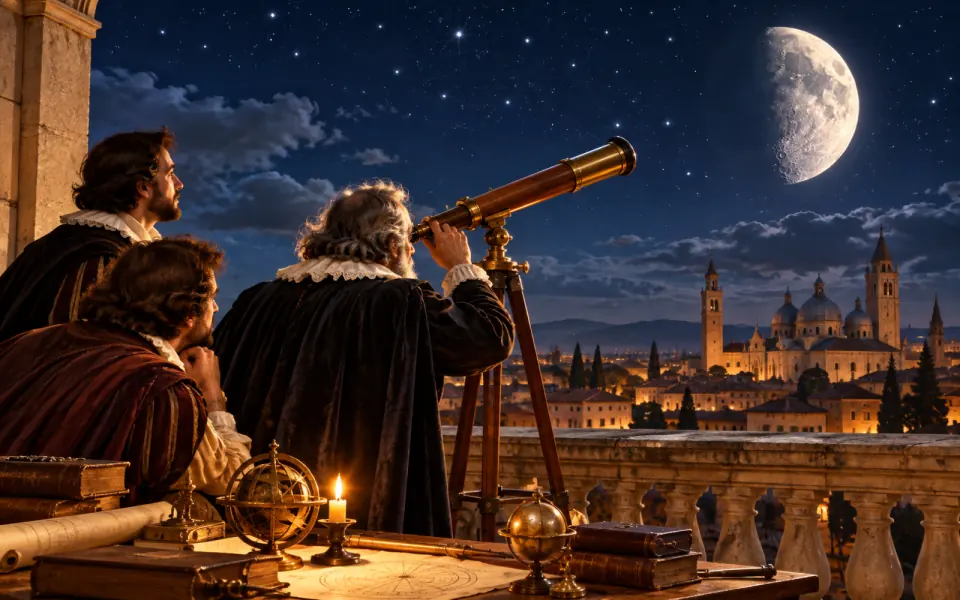 AfterGalileo turns his telescope to the sky1609
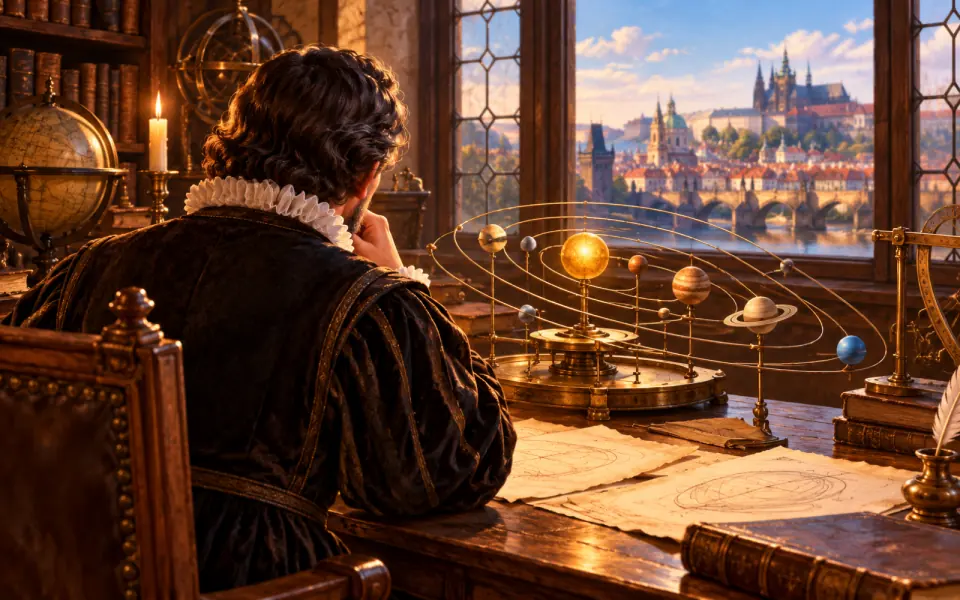 AfterKepler describes the orbits1609
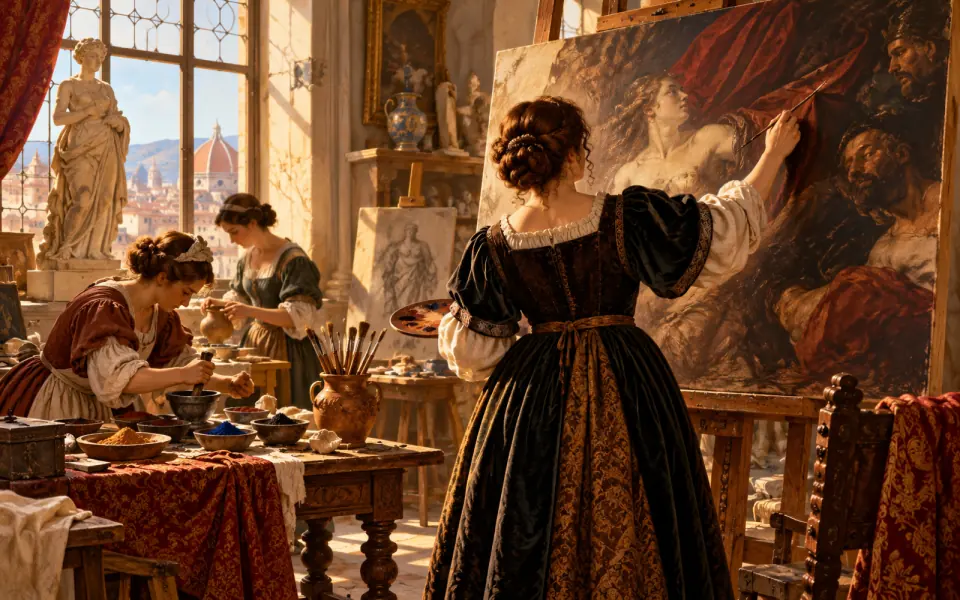 AfterArtemisia Gentileschiabout 1612
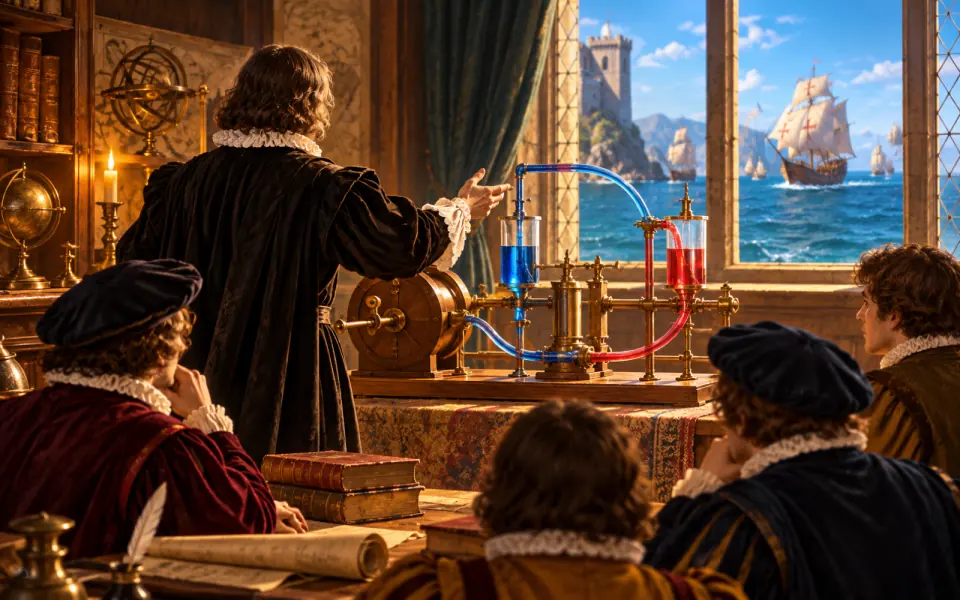 AfterHarvey studies the circulation of the blood1628
 AfterScientific academies1660
 AfterNewton publishes the Principia1687
Listen / Read next
- Music to read by: Cinematic JourneyEpic film-style music, no lyrics, by Ciro Simone IrmiciSpotifyYouTube Music
Meanwhile, elsewhere in the world
Other events of the era “Early modern age”
- Renaissance perspective
- Brunelleschi completes the dome
- The fall of Constantinople
- Gutenberg prints the Bible
- Lorenzo de' Medici in Florence
- Leonardo designs machines
- Columbus's voyage
- Vasco da Gama reaches India
- Michelangelo carves David
- Raphael paints the Vatican Rooms
- Luther and the Reformation
- The conquest of Tenochtitlán
- The first voyage round the world
- The Council of Trent
- Tomatoes, maize and potatoes reach Europe
- The Gregorian calendar
- Shakespeare's theatre
- Regular newspapers
- Galileo turns his telescope to the sky
- Kepler describes the orbits
- Artemisia Gentileschi
- Harvey studies the circulation of the blood
- Scientific academies
- Newton publishes the Principia
