Newton publishes the Principia
1687 Cambridge and London, England
In short
Isaac Newton, a professor at the University of Cambridge, published a book in Latin called the Principia in 1687. In it he explained three laws of motion and the law of universal gravitation: the same force makes an apple fall and keeps the Moon in orbit around the Earth. Using mathematics he was able to calculate the motion of planets and comets and to explain the tides. It was his friend the astronomer Edmond Halley who persuaded him to publish it, paying for the printing out of his own pocket.
Why it matters For the first time the same laws applied on Earth and in the sky: modern physics was born.
Source: Treccani, entry “Newton, Isaac”
Study card about 5 minutes of reading
The story
A question about orbits
In January 1684 in London three members of the Royal Society, Edmond Halley, Christopher Wren and Robert Hooke, were discussing a question that fascinated them: what force keeps the planets in their orbits? Kepler had discovered that the planets move in ellipses, but nobody could explain why. Halley suspected that the force depended on the inverse of the square of the distance from the Sun, that is, that it became four times smaller if the distance doubled, but he could not prove it. Wren, according to tradition, offered a prize to anyone who could, and nobody won it.
In August 1684 Halley made a journey to Cambridge to ask for help from a professor of mathematics who lived a secluded life and published almost nothing: Isaac Newton. He asked him what curve a planet would follow if it were attracted by a force of this kind. According to the story handed down, Newton answered at once: an ellipse. He had already done the calculations, years earlier, but could no longer find the papers. He promised to do them again.
Eighteen months of work
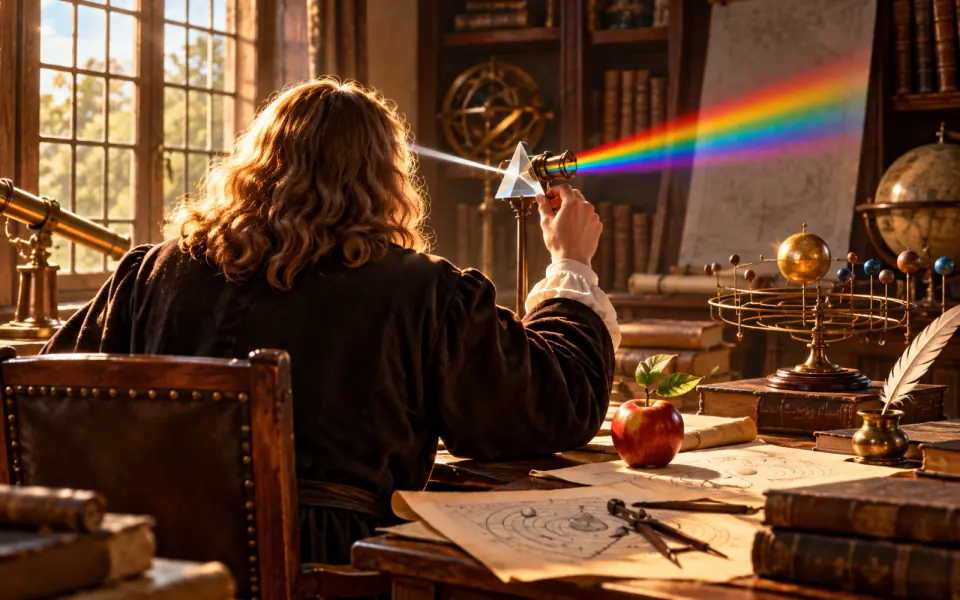
Newton was born in 1642 at Woolsthorpe, in England, into a farming family. He was a solitary boy, fond of mechanics and of building things. At the University of Cambridge he devoted himself to mathematics and physics, and in the years 1665–1666, when the university closed because of the plague, he worked at home and made important discoveries: calculus (a new kind of mathematics for studying things that change), the nature of white light, gravitation. The story of the falling apple is linked to that period: Newton himself told it when he was old, but the apple hitting him on the head is a legend.
After Halley's visit, Newton shut himself in his study and for about eighteen months worked almost without a break, forgetting his meals, according to one of his assistants. The result was a work in three books, in Latin, full of geometrical proofs: the “Philosophiae Naturalis Principia Mathematica”, that is, “Mathematical Principles of Natural Philosophy”. Halley oversaw the printing and paid for it out of his own pocket, because the Royal Society had no funds. The book came out in July 1687.
Three laws and one force
In the Principia Newton set out three laws of motion. The first says that a body at rest stays at rest, and one in motion keeps moving in a straight line at the same speed, unless a force makes it change. The second says that the force acting on a body is equal to its mass multiplied by its acceleration. The third says that to every action there is an equal and opposite reaction: if you push a wall, the wall pushes you.
Then he set out the law of universal gravitation: every body attracts every other body with a force that is greater the greater their masses are and smaller the greater the square of the distance is. The same force that makes an apple fall makes the Moon go around the Earth and the planets around the Sun. From these laws Newton derived Kepler's three laws, explained the tides as an effect of the attraction of the Moon and the Sun, predicted the slightly flattened shape of the Earth and studied the motion of comets.
A difficult book
The Principia were extremely hard to read, even for experts: few people in Europe understood them at once. Newton had written them in a deliberately complicated way, by his own account, to avoid arguments with people who did not understand. But the predictions were so exact that the book soon won everyone over. In 1705 Halley, using Newton's laws, predicted the return of a comet in 1758: it really did come back, though he was already dead, and today it bears his name.
Newton was also involved in quarrels: with Hooke, who claimed that he had had the idea of the inverse-square force, and with the German philosopher Leibniz, who had developed calculus independently. In 1699 he became Master of the Mint, in London, and in 1705 Queen Anne knighted him. He died in 1727 and had a solemn funeral in Westminster Abbey.
Why it happened
The successes of Copernicus, Kepler and Galileo had shown that the sky followed mathematical rules, but the cause still had to be explained. A new kind of mathematics and a simple idea that joined the Earth and the sky were needed.
The network of scientists counted: Halley, Wren and Hooke brought the problem to Newton, who already had the ideas and the ability in his head. Academies and printing also made it possible to bring the results together.
What changed
The Principia unified the physics of the Earth and that of the sky: the same laws apply everywhere. This is the foundation of classical physics, still used today to build bridges, machines and aircraft and to launch satellites and space probes.
It changed the idea of the world: the universe appears as a regular mechanism that can be understood with reason and mathematics. In the 18th century this spirit was one of the engines of the Enlightenment.
Newton's theory was superseded, for speeds close to that of light and for enormous masses, by Einstein's relativity in the 20th century, but in everyday life it is still valid. Newton remains one of the greatest scientists of all time.
Key people and places
People
- Isaac Newton
- English scientist (1642–1727): he discovered universal gravitation and the laws of motion.
- Edmond Halley
- English astronomer (1656–1742): he urged Newton to write the Principia and paid for its printing.
- Robert Hooke
- English scientist (1635–1703): he claimed to have had the idea of the inverse-square force first.
- Gottfried Wilhelm Leibniz
- German philosopher and mathematician (1646–1716): he also developed calculus.
- Christopher Wren
- English astronomer and architect (1632–1723): he offered a prize to anyone who could solve the problem.
Places
- Cambridge
- The city and university where Newton taught and wrote the Principia.
- Woolsthorpe (Lincolnshire)
- The village where Newton was born and where he returned during the plague.
- Westminster Abbey, London
- The church where Newton is buried.
Good to know
- To write the Principia Newton worked for almost eighteen months without a break.
- Halley paid for the printing of the Principia out of his own pocket.
- The famous Halley's comet was predicted with Newton's laws.
- The apple hitting Newton on the head is, in all likelihood, a legend.
- Newton ran the English state Mint from 1699.
Find out more
- Wikipedia, “Isaac Newton” en.wikipedia.org
- Wikipedia, “Philosophiæ Naturalis Principia Mathematica” en.wikipedia.org
- Wikipedia, “Newton's laws of motion” en.wikipedia.org
- Wikipedia, “Newton's law of universal gravitation” en.wikipedia.org
Related events
- Copernicus puts the Sun at the centre1543 · Early modern ageCopernicus had put the Sun at the centre.
- Galileo turns his telescope to the sky1609 · Early modern ageGalileo had studied the motion of bodies.
- Kepler describes the orbits1609 · Early modern ageKepler had found the laws of the orbits that Newton explained.
- Scientific academies1660 · Early modern ageThe Royal Society approved the printing of Newton's work.
Before and after, in the era “Early modern age”
Event 25 of 25
 BeforeRenaissance perspectiveabout 1420
 BeforeBrunelleschi completes the dome1436
 BeforeThe fall of Constantinople1453
 BeforeGutenberg prints the Bibleabout 1455
 BeforeLorenzo de' Medici in Florence1469
 BeforeLeonardo designs machinesabout 1485
 BeforeColumbus's voyage1492
 BeforeVasco da Gama reaches India1498
 BeforeMichelangelo carves David1504
 BeforeRaphael paints the Vatican Rooms1508
 BeforeLuther and the Reformation1517
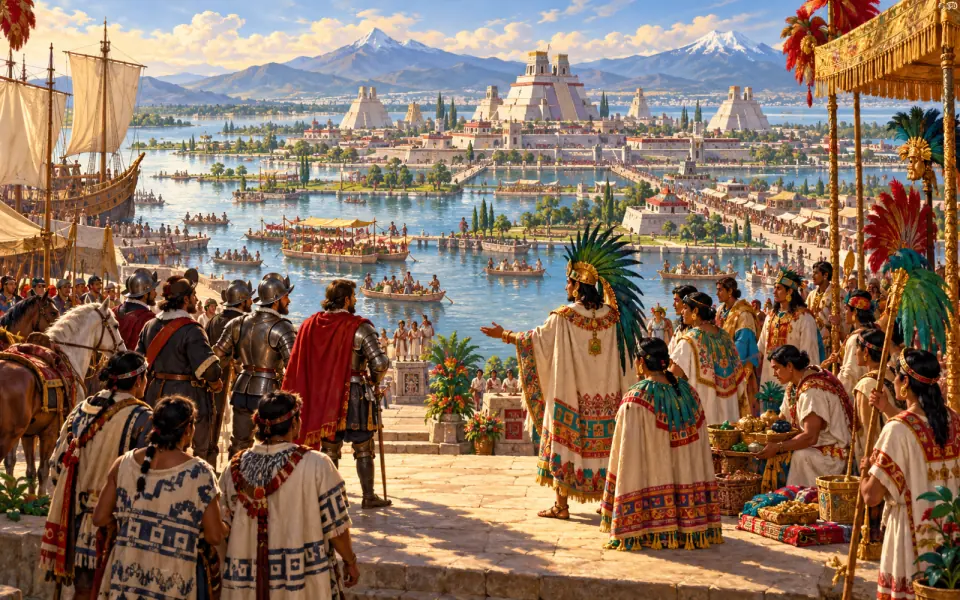 BeforeThe conquest of Tenochtitlán1521
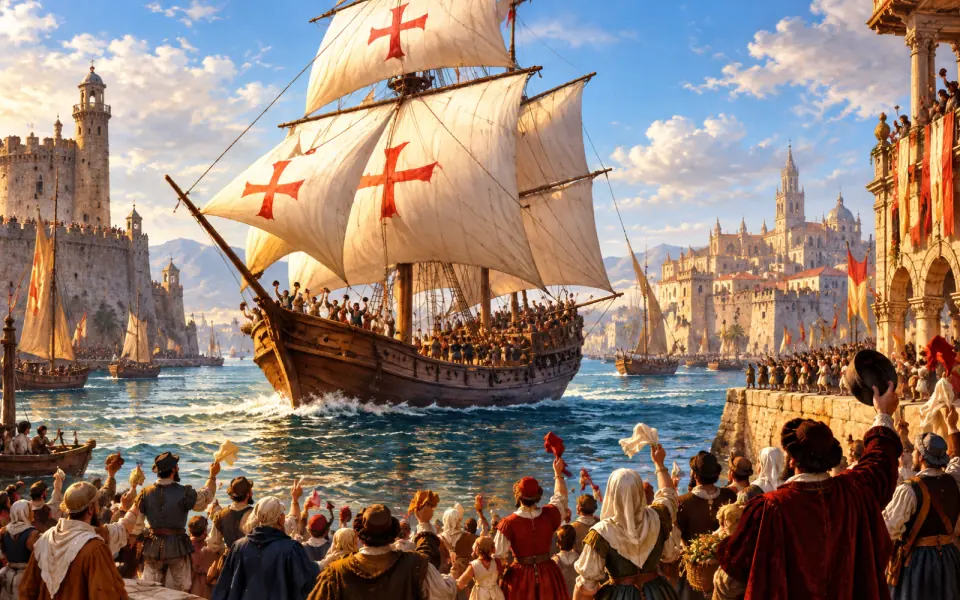 BeforeThe first voyage round the world1522
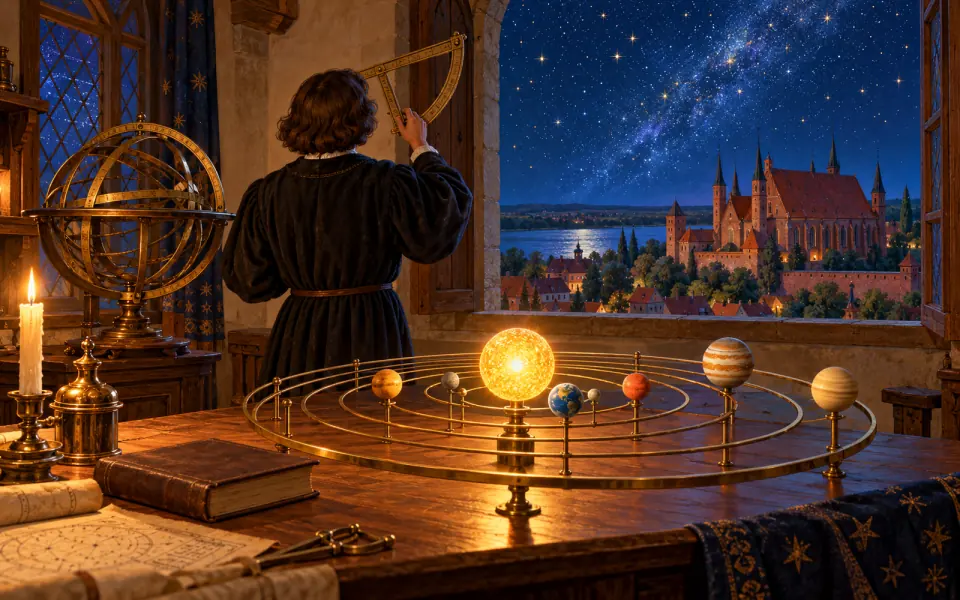 BeforeCopernicus puts the Sun at the centre1543
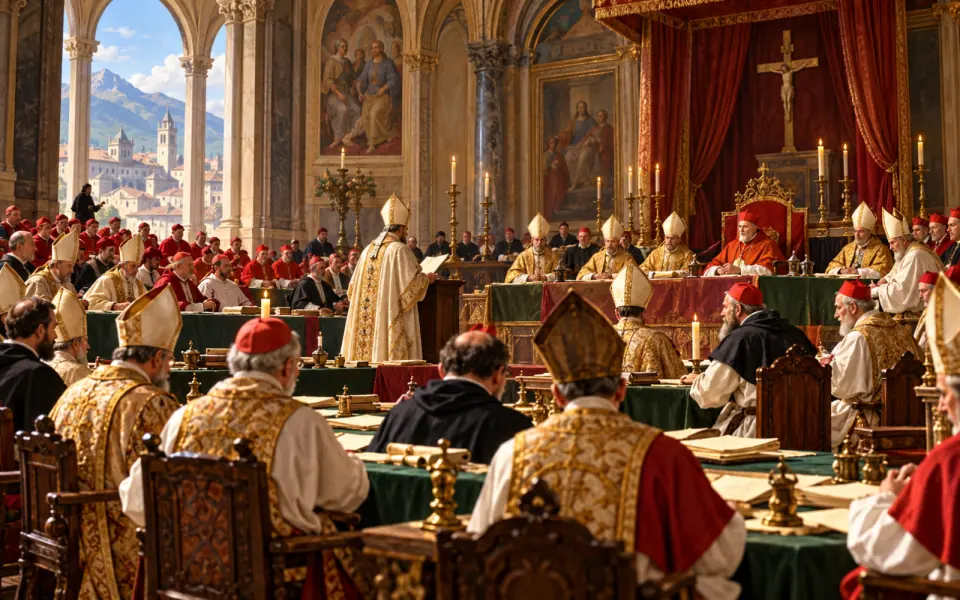 BeforeThe Council of Trent1545–1563
 BeforeTomatoes, maize and potatoes reach Europeabout 1550
 BeforeThe Gregorian calendar1582
 BeforeShakespeare's theatreabout 1590
 BeforeRegular newspapers1605
 BeforeGalileo turns his telescope to the sky1609
 BeforeKepler describes the orbits1609
 BeforeArtemisia Gentileschiabout 1612
 BeforeHarvey studies the circulation of the blood1628
 BeforeScientific academies1660
- You are hereNewton publishes the Principia1687
Listen / Read next
- Music to read by: Cinematic JourneyEpic film-style music, no lyrics, by Ciro Simone IrmiciSpotifyYouTube Music
Meanwhile, elsewhere in the world
Other events of the era “Early modern age”
- Renaissance perspective
- Brunelleschi completes the dome
- The fall of Constantinople
- Gutenberg prints the Bible
- Lorenzo de' Medici in Florence
- Leonardo designs machines
- Columbus's voyage
- Vasco da Gama reaches India
- Michelangelo carves David
- Raphael paints the Vatican Rooms
- Luther and the Reformation
- The conquest of Tenochtitlán
- The first voyage round the world
- Copernicus puts the Sun at the centre
- The Council of Trent
- Tomatoes, maize and potatoes reach Europe
- The Gregorian calendar
- Shakespeare's theatre
- Regular newspapers
- Galileo turns his telescope to the sky
- Kepler describes the orbits
- Artemisia Gentileschi
- Harvey studies the circulation of the blood
- Scientific academies
