The first voyage round the world
1522 Sanlúcar de Barrameda, Spain (departure and return)
In short
In 1519 five ships left Spain under the command of the Portuguese Ferdinand Magellan, to reach the Spice Islands by sailing west. The expedition found the passage south of America, now the Strait of Magellan, and crossed the immense Pacific Ocean. Magellan died in the Philippines and the Basque Juan Sebastián Elcano led the way home. In September 1522 only the ship Victoria returned to Spain, with 18 men, among them Antonio Pigafetta from Vicenza, who kept a diary of the voyage.
Why it matters It proved with a real voyage that you can go all the way round the Earth by sea and that it is much bigger than people had thought.
Source: Treccani, entry “Magellano, Ferdinando”
Study card about 5 minutes of reading
The story
Towards the Spice Islands
After Columbus's voyage, Europeans had realised that between Europe and Asia there was a whole continent. Now everyone wanted to find a passage to sail through from the west, to reach the Moluccas, the Spice Islands, in present-day Indonesia, where cloves and nutmeg grew, worth as much as gold. The Portuguese Ferdinand Magellan, offended by his king who had not given him a reward, offered his services to the King of Spain, Charles I, the future emperor Charles V, and proposed to find the way.
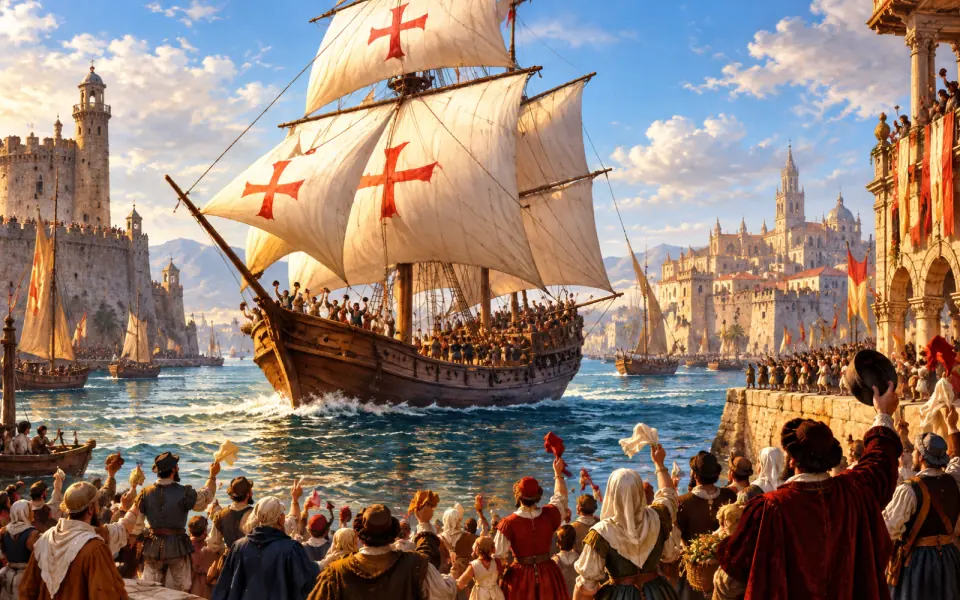
The king agreed. On 20 September 1519, from Sanlúcar de Barrameda, a port near Seville, five ships set out: the Trinidad, commanded by Magellan, the San Antonio, the Concepción, the Victoria and the Santiago. The men numbered about two hundred and forty, from many nations. Among them was a young Italian from Vicenza, Antonio Pigafetta, who kept a diary of the whole voyage.
A winter in the cold
The ships crossed the Atlantic and sailed down the coast of South America. On reaching the furthest point south, in the bay of San Julián, in Patagonia, they had to spend the southern winter. Here the Spanish captains, who could not bear being commanded by a Portuguese, mutinied. Magellan put down the revolt by force: one leader was executed and others were abandoned on shore. Soon afterwards the ship Santiago was wrecked in a storm.
In October–November 1520, after a long search among islands, fogs and currents, the fleet found a narrow, twisting passage to the other ocean, the one now called the Strait of Magellan. During this crossing the ship San Antonio abandoned the expedition and went back to Spain. Three ships remained.
The Pacific
The ocean that opened up before them was calm, and Magellan called it “Pacific”. But it was enormous: the crossing lasted over three months, without finding any islands to stop at. The food ran out, the water went bad, and the sailors ate rats, leather and sawdust. Many fell ill with scurvy and died. In March 1521 they reached the Mariana Islands, and then the Philippines.
Here Magellan allied himself with a local ruler and wanted to help him against a rival. On 27 April 1521, on the island of Mactan, he was killed in battle by the warriors of the chief Lapu-Lapu. The expedition lost its commander, but carried on. One ship, the Concepción, was burned because there were not enough men to handle it. The other two, the Trinidad and the Victoria, reached the Moluccas and filled their holds with cloves.
The return
The Trinidad was in poor condition and stayed behind. The Victoria, commanded by the Basque Juan Sebastián Elcano, went on alone across the Indian Ocean, avoiding the coasts where the Portuguese were, and rounded the Cape of Good Hope. On 6 September 1522 she reached Sanlúcar de Barrameda, almost three years after leaving. Of the roughly two hundred and forty men who had set out, eighteen were left on board, thin and exhausted.
Near home, at the Cape Verde Islands, which belonged to Portugal, Elcano sent a boat ashore to buy food. The Portuguese seized thirteen men, and the Victoria had to set off again in a hurry without them, afraid of being captured.
When they counted the days, they found something strange: in their diary it was Thursday, but ashore it was Friday. They had lost a day by travelling west, because of the Earth's rotation. It was proof, anything but theoretical, that it was possible to go around the world. The sale of the cloves paid for the costs of the whole expedition.
Why it happened
People wanted to reach the Spice Islands without going through the routes controlled by Portugal, and Spain, under the Treaty of Tordesillas, thought that those islands lay in its own half of the world. The wealth they promised was worth many risks.
Progress in maps, navigation instruments and the building of sturdy ships, and the experience of Magellan, who had already been to the East with the Portuguese, made the attempt possible.
What changed
For the first time it was shown in practice that the Earth was round and that the oceans were connected. People understood how big it was: the Pacific was much wider than anyone had thought, and Asia much further from Europe, going west, than Columbus had hoped.
Maps were changed, and new questions arose, such as the date line, which today lies on the meridian opposite Greenwich. Spain began to make claims in the Philippines, which it conquered in 1565 and held for more than three hundred years.
Pigafetta's diary was published and became one of the most widely read travel accounts. Magellan did not complete the voyage around the world, but his name remained linked to the feat, like that of the strait, of a galaxy near our own, the Magellanic Clouds, and of a space probe.
Key people and places
People
- Ferdinand Magellan
- Portuguese navigator (about 1480–1521): he organised and led the expedition, and died in the Philippines.
- Juan Sebastián Elcano
- Basque navigator (about 1486–1526): he brought the Victoria to Spain and completed the circumnavigation.
- Antonio Pigafetta
- Scholar from Vicenza (about 1491–1531): he took part in the voyage and wrote an account of it.
- Lapu-Lapu
- Chief of the island of Mactan: he led the resistance in which Magellan was killed.
- Charles I of Spain
- King of Spain (1500–1558), later the emperor Charles V: he paid for the voyage.
Places
- Sanlúcar de Barrameda (Spain)
- Port of departure and arrival.
- Strait of Magellan
- Passage between the Atlantic and the Pacific, at the tip of South America.
- Mactan (Philippines)
- Island where Magellan died on 27 April 1521.
Good to know
- About 240 men and five ships set out: 18 men came back on a single ship.
- The crew lost a day: on arriving at Cape Verde they thought it was Thursday, but ashore it was Friday.
- The crossing of the Pacific lasted over three months.
- The Magellanic Clouds, visible from the southern hemisphere, carry his name.
- Pigafetta's diary is the main source about the voyage.
Find out more
- Wikipedia, “Ferdinand Magellan” en.wikipedia.org
- Wikipedia, “Juan Sebastián Elcano” en.wikipedia.org
- Wikipedia, “Antonio Pigafetta” en.wikipedia.org
- Wikipedia, “Strait of Magellan” en.wikipedia.org
Related events
- Columbus's voyage1492 · Early modern ageColumbus had opened the route to the west.
- Vasco da Gama reaches India1498 · Early modern ageThe Portuguese had reached Asia by sailing round Africa.
- The conquest of Tenochtitlán1521 · Early modern ageWhile Magellan was sailing, Cortés was conquering Tenochtitlan.
- Copernicus puts the Sun at the centre1543 · Early modern ageCopernicus, in the following decades, put the Sun at the centre of the cosmos.
Before and after, in the era “Early modern age”
Event 13 of 25
 BeforeRenaissance perspectiveabout 1420
 BeforeBrunelleschi completes the dome1436
 BeforeThe fall of Constantinople1453
 BeforeGutenberg prints the Bibleabout 1455
 BeforeLorenzo de' Medici in Florence1469
 BeforeLeonardo designs machinesabout 1485
 BeforeColumbus's voyage1492
 BeforeVasco da Gama reaches India1498
 BeforeMichelangelo carves David1504
 BeforeRaphael paints the Vatican Rooms1508
 BeforeLuther and the Reformation1517
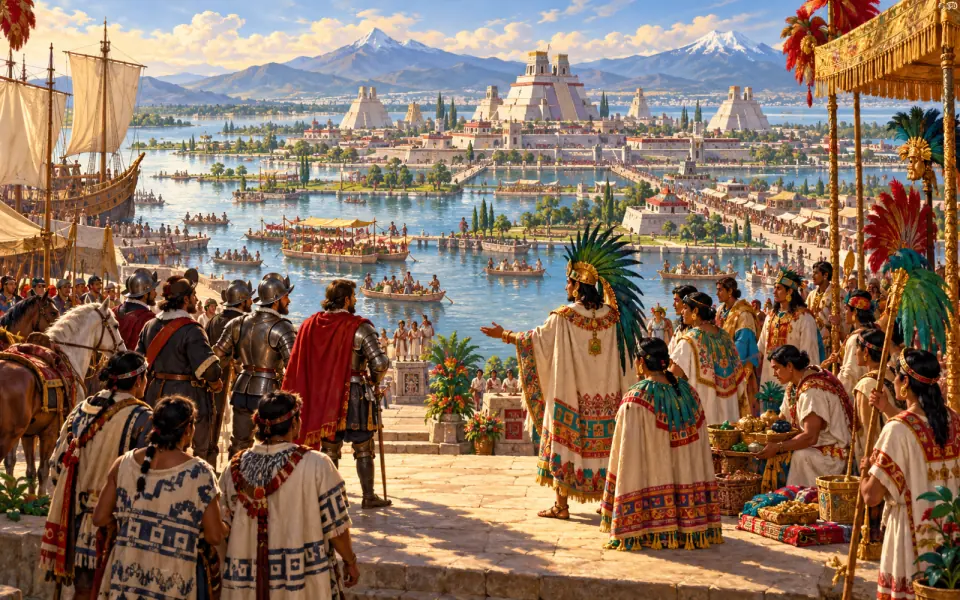 BeforeThe conquest of Tenochtitlán1521
- You are hereThe first voyage round the world1522
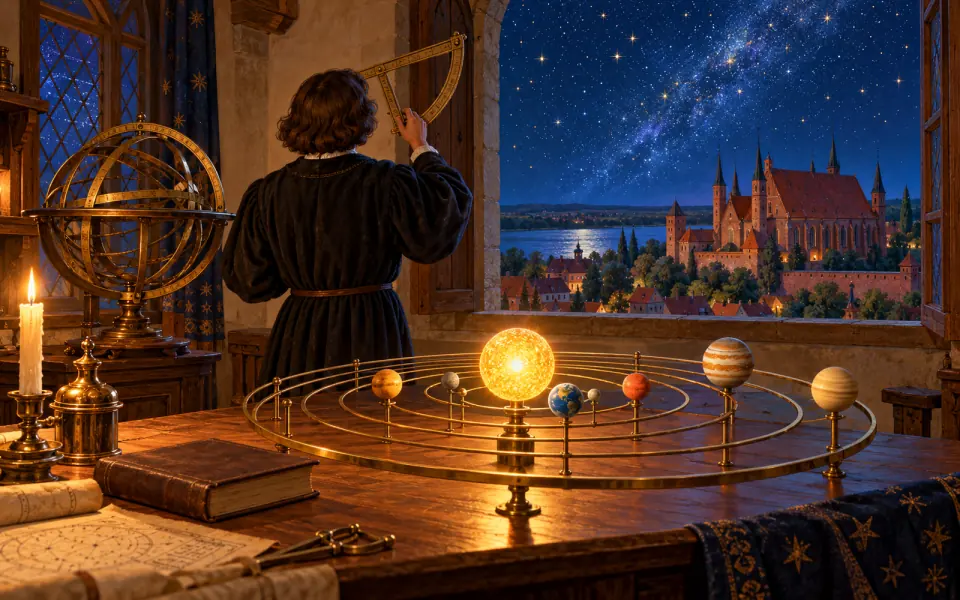 AfterCopernicus puts the Sun at the centre1543
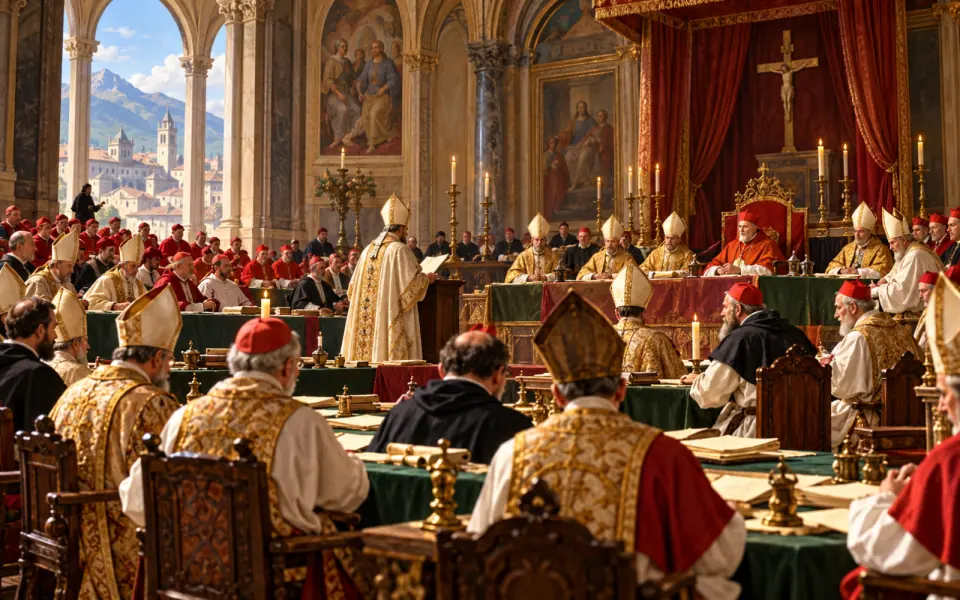 AfterThe Council of Trent1545–1563
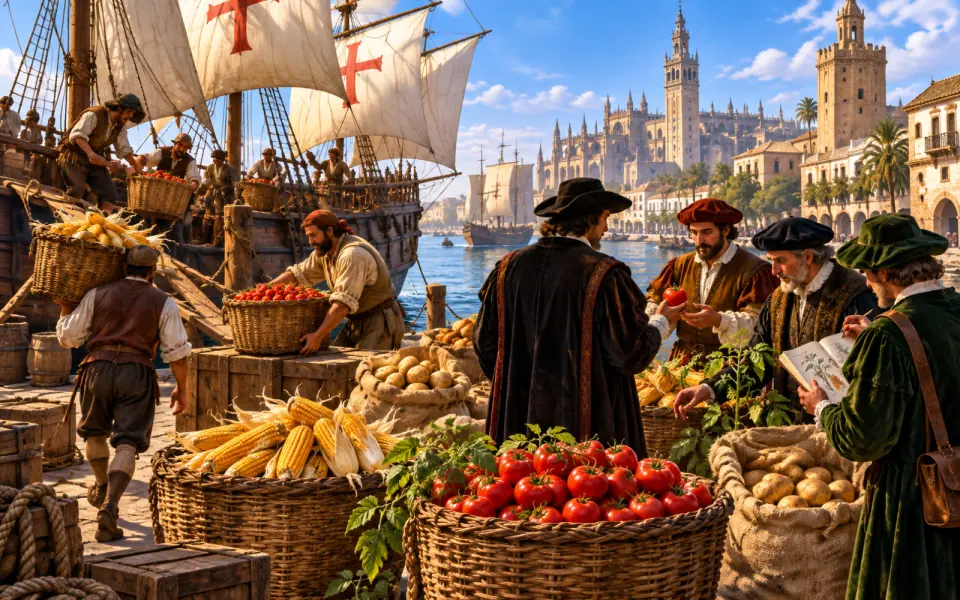 AfterTomatoes, maize and potatoes reach Europeabout 1550
 AfterThe Gregorian calendar1582
 AfterShakespeare's theatreabout 1590
 AfterRegular newspapers1605
 AfterGalileo turns his telescope to the sky1609
 AfterKepler describes the orbits1609
 AfterArtemisia Gentileschiabout 1612
 AfterHarvey studies the circulation of the blood1628
 AfterScientific academies1660
 AfterNewton publishes the Principia1687
Listen / Read next
- Music to read by: Cinematic JourneyEpic film-style music, no lyrics, by Ciro Simone IrmiciSpotifyYouTube Music
Meanwhile, elsewhere in the world
Other events of the era “Early modern age”
- Renaissance perspective
- Brunelleschi completes the dome
- The fall of Constantinople
- Gutenberg prints the Bible
- Lorenzo de' Medici in Florence
- Leonardo designs machines
- Columbus's voyage
- Vasco da Gama reaches India
- Michelangelo carves David
- Raphael paints the Vatican Rooms
- Luther and the Reformation
- The conquest of Tenochtitlán
- Copernicus puts the Sun at the centre
- The Council of Trent
- Tomatoes, maize and potatoes reach Europe
- The Gregorian calendar
- Shakespeare's theatre
- Regular newspapers
- Galileo turns his telescope to the sky
- Kepler describes the orbits
- Artemisia Gentileschi
- Harvey studies the circulation of the blood
- Scientific academies
- Newton publishes the Principia
