The first deliberate burials
about 100,000 years ago Skhul and Qafzeh caves, Israel
In short
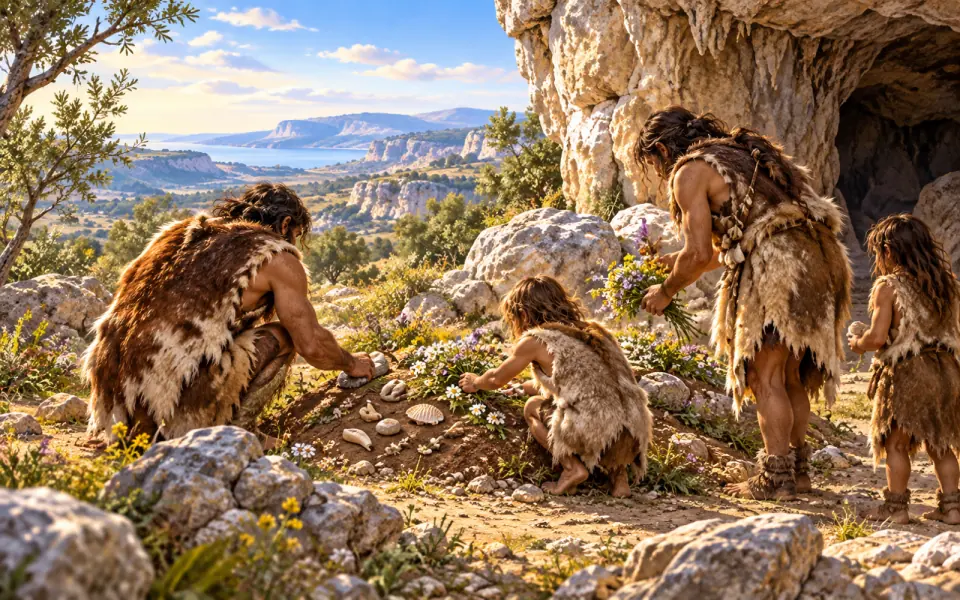
About 100,000 years ago, in the Skhul and Qafzeh caves in Israel, some groups of Homo sapiens buried their dead, sometimes with objects beside them. Neanderthals buried their dead too. A burial made on purpose tells us that those people cared for their loved ones even after death.
Why it matters It is one of the first signs of symbolic thinking, meaning ideas that go beyond practical life.
Source: Smithsonian, Human Origins Program, “Qafzeh: Oldest Intentional Burial”
Study card about 5 minutes of reading
The story
A cave near Nazareth
The hills of Galilee, in northern Israel, hide many caves. One, not far from the town of Nazareth, is called Qafzeh. In the 1930s the French archaeologist René Neuville, a consul in Palestine and a scholar of prehistory, dug there for two seasons and found human skeletons buried in the floor of the cave. Other campaigns, between 1965 and 1979, found more. In all, the remains of some fifteen people have been counted, or of almost thirty by other counts, of all ages, and several burials. They are about 100,000 years old, perhaps a little more.
The skeletons belong to Homo sapiens, but to a very ancient group, with an almost modern face and a skull that was still sturdy. They were not Neanderthals, even though they lived in a region where, at other times, Neanderthals lived too. This is one piece of evidence that the first sapiens left Africa much earlier than was thought, and that the Near East was a land where species met.
The boy with the deer antlers
The most famous grave is that of a boy or girl of twelve or thirteen, called by archaeologists Qafzeh 11. The body was laid in a pit dug on purpose in the ground. On the chest, between the arms, rested the antlers of a big deer, whole and carefully arranged. Another burial shows a young woman with a small child placed at her feet. In some parts of the cave pieces of red ochre, a coloured mineral, had been left, and perforated sea shells that had come from the Mediterranean coast, dozens of kilometres away.
Why are they important? A dug pit, a body carefully arranged, objects beside it: these are actions that only make sense if someone thinks the dead person deserves attention. Archaeologists call them “intentional burials”. We cannot know whether those people believed in another life or simply wanted to say goodbye in a certain way to the one who was leaving. But we can see that there was a ritual.
Skhul and Mount Carmel
About forty kilometres away, on Mount Carmel, near the city of Haifa, there is another cave, Skhul. There, between 1931 and 1932, the American Theodore McCown, who was working with the British archaeologist Dorothy Garrod, found the remains of about ten people. They are roughly the same age, although the dating is a little uncertain and ranges from 120,000 to 80,000 years ago. A male skeleton, called Skhul V, had in his arms the jaw of a wild boar: perhaps an offering, perhaps a symbol of hunting.
The Neanderthals too
We should not think that this was an invention of ours alone. The Neanderthals also buried their dead, at least in some places: the graves at La Chapelle-aux-Saints in France, and at Kebara, also in Israel, about 60,000 years old, show it. The line between the two species, in this, is blurred.
In Africa, the oldest known burial is in Kenya, in Panga ya Saidi cave, near the coast: in 2021 a group of researchers showed that a child of about three, called Mtoto (“child” in Swahili), was laid in a small pit 78,000 years ago, with the body curled up and the head resting on a pillow of perishable material, which has vanished with time but was reconstructed from the position of the bones. One idea is causing debate: in some very recent studies it has been argued that an even older species, Homo naledi, buried its dead in South Africa, but most experts for now are waiting for more evidence.
How to recognise a burial
Archaeologists follow some clues: a pit that was dug and then filled in, a whole skeleton with the bones still in the right places (if a body is left in the open, animals scatter it), a particular position, objects nearby. Even so, doubts are possible, because a body can end up in a hole through natural causes. For this reason every new case is discussed at length.
Why it happened
We do not know why the habit of burying began, but we can imagine some reasons. One is practical: to take a decaying body away from the place where people live and keep it safe from meat-eating animals. Another is emotional: human groups were small, and the loss of one person was a bereavement for everyone.
The third is the most interesting: the ability to think symbolically, that is, to give an action or an object a meaning that goes beyond what you can see. Colouring with ochre, perforating shells to make necklaces, placing a set of antlers beside a body are all symbolic acts.
These abilities developed together with language and life in groups. Telling about death and telling your children “who we were” is already a form of culture.
What changed
Burials are a great piece of luck for science: a body laid in a pit is preserved much better than one left in the open. Today we owe to these graves almost everything we know about the shape of our ancestors' bodies, their illnesses, their diet, and even their DNA.
From a cultural point of view, intentional burial is the first step towards the great funeral rites of history: mounds, pyramids, temples, cemeteries. Every civilisation has its own way of accompanying the dead, and in this sense the grave at Qafzeh is an ancestor of the tombs of the pharaohs and of cemeteries today.
It also tells us something about our nature. The idea that a human being deserves respect even after death is at the basis of many laws and moral codes. Respecting the dead is one of the oldest and most widespread habits of our species.
Key people and places
People
- René Neuville
- French archaeologist (1899–1952), consul of France in Jerusalem. He dug in Qafzeh cave between 1933 and 1935.
- Theodore McCown
- American anthropologist (1908–1969). With Dorothy Garrod he studied the remains in Skhul cave on Mount Carmel.
- Dorothy Garrod
- British archaeologist (1892–1968). She was the first woman to become a professor at Cambridge and directed the excavations on Mount Carmel.
- Maria Martinón-Torres
- Spanish anthropologist. She led the study of little Mtoto, the oldest known burial in Africa.
Places
- Qafzeh Cave (Israel)
- A cave near Nazareth, in Galilee, with burials of Homo sapiens about 100,000 years old.
- Skhul Cave, Mount Carmel (Israel)
- A cave on Mount Carmel, near Haifa, with remains about 120,000 to 80,000 years old.
- Panga ya Saidi (Kenya)
- A cave near the coast of the Indian Ocean where the child Mtoto was buried 78,000 years ago.
Good to know
- The shells found at Qafzeh are marine shells (bivalves of the genus Glycymeris) with a natural hole, some with traces of ochre: they were carried from a coast about 35 kilometres away.
- The ochre used at Qafzeh must have been brought from far away: there was none of that kind in the surroundings, so someone went looking for it on purpose.
- Little Mtoto was buried with his head resting on a pillow of soft material that has not survived, but the bones keep the position that proves it.
- Dorothy Garrod was the first woman to hold a professorial chair at Cambridge, in 1939.
- The word “sepulchre” comes from the Latin sepelire, “to bury”, and “sepulture” has the same root.
Find out more
- Smithsonian, “Qafzeh: Oldest Intentional Burial” (in English) humanorigins.si.edu
- Wikipedia, “Homo sapiens” en.wikipedia.org
- Wikipedia, “Neanderthal” en.wikipedia.org
- Wikipedia, “Homo naledi” en.wikipedia.org
Related events
- Neanderthalsabout 400,000 years ago · PrehistoryThe Neanderthals also buried the dead, in some places.
- The arrival of Homo sapiensabout 300,000 years ago · PrehistoryThe sapiens of Qafzeh were descendants of those born in Africa 200,000 years earlier.
- Homo sapiens leaves Africaabout 60,000 years ago · PrehistoryThese sapiens were among the first to leave Africa, although they left no descendants.
- Egyptian mummificationabout 2600 BC · River civilisationsEgyptian mummies are the extreme development of the idea of preserving the dead.
- The cave art of Sulawesiabout 44,000 years ago · PrehistorySymbolic thought can also be seen in the first drawings on cave walls.
Before and after, in the era “Prehistory”
Event 10 of 25
 BeforeThe first homininsabout 7 million years ago
 BeforeLucy the australopithecineabout 3.2 million years ago
 BeforeThe first stone toolsabout 2.6 million years ago
 BeforeHomo habilisabout 2.4 million years ago
 BeforeHomo erectusabout 1.9 million years ago
 BeforeTaming fireabout 790,000 years ago
 BeforeHomo heidelbergensisabout 600,000 years ago
 BeforeNeanderthalsabout 400,000 years ago
 BeforeThe arrival of Homo sapiensabout 300,000 years ago
- You are hereThe first deliberate burialsabout 100,000 years ago
 AfterHomo sapiens leaves Africaabout 60,000 years ago
 AfterThe needle with an eyeabout 48,000 years ago
 AfterThe first people in Australiaabout 48,000 years ago
 AfterThe cave art of Sulawesiabout 44,000 years ago
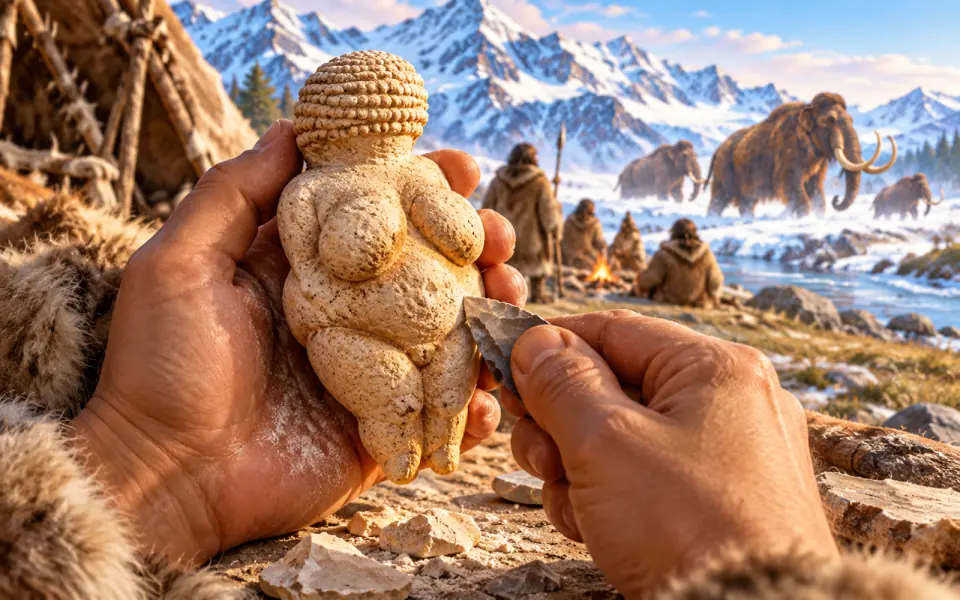 AfterThe Venus of Willendorfabout 28,000 years ago
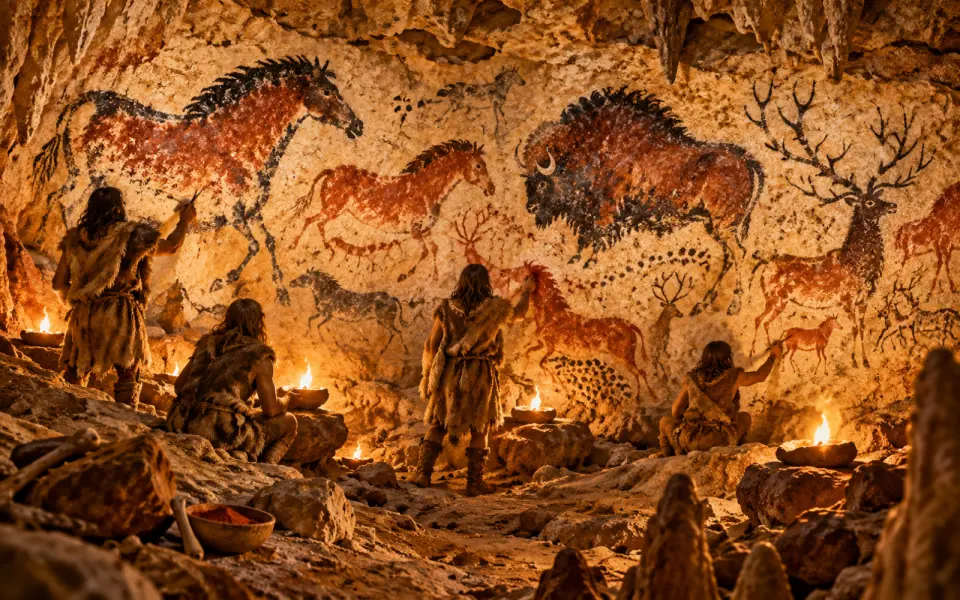 AfterThe Lascaux caveabout 19,000 years ago
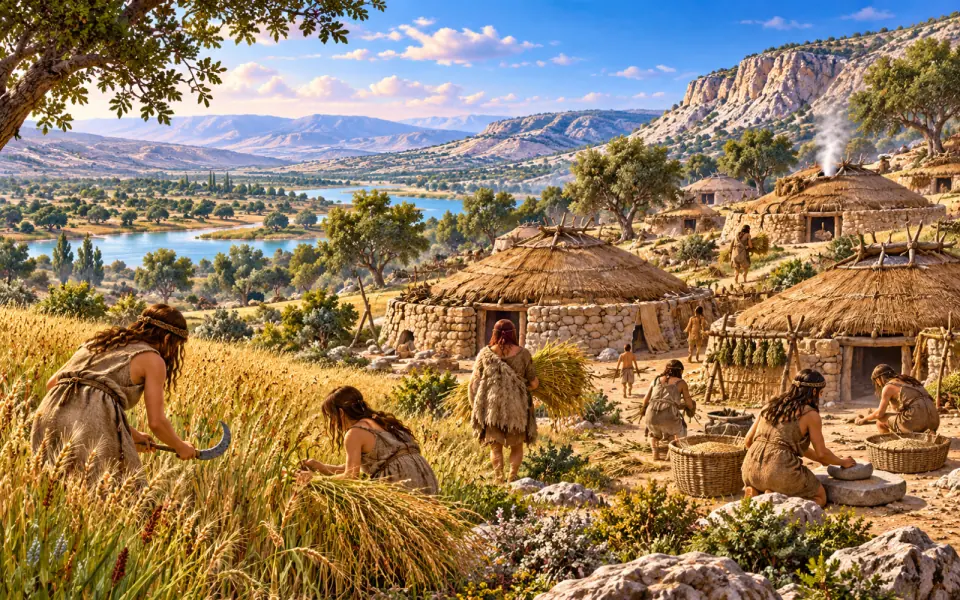 AfterThe first permanent villagesabout 14,000 years ago
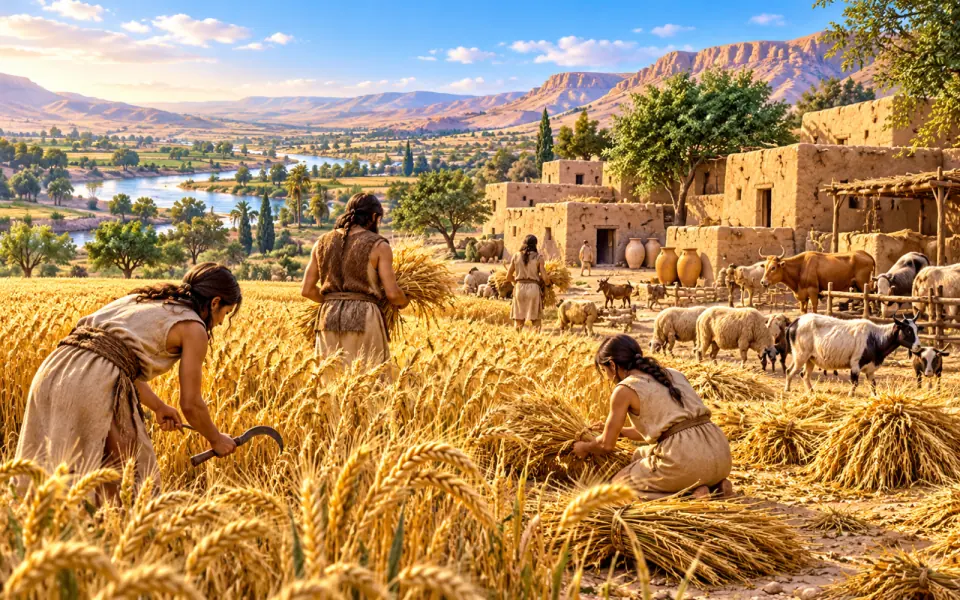 AfterThe Neolithic Revolutionabout 12,000 years ago
 AfterTaming the sheepabout 11,000 years ago
 AfterThe walls of Jerichoabout 10,300 years ago
 AfterPottery spreadsabout 9,000 years ago
 AfterÇatalhöyükabout 9,000 years ago
 AfterWorking with copperabout 7,000 years ago
 AfterThe invention of the wheelabout 5,500 years ago
 AfterThe Bronze Ageabout 5,300 years ago
Listen / Read next
- Music to read by: Cinematic JourneyEpic film-style music, no lyrics, by Ciro Simone IrmiciSpotifyYouTube Music
Meanwhile, elsewhere in the world
Other events of the era “Prehistory”
- The first hominins
- Lucy the australopithecine
- The first stone tools
- Homo habilis
- Homo erectus
- Taming fire
- Homo heidelbergensis
- Neanderthals
- The arrival of Homo sapiens
- Homo sapiens leaves Africa
- The needle with an eye
- The first people in Australia
- The cave art of Sulawesi
- The Venus of Willendorf
- The Lascaux cave
- The first permanent villages
- The Neolithic Revolution
- Taming the sheep
- The walls of Jericho
- Pottery spreads
- Çatalhöyük
- Working with copper
- The invention of the wheel
- The Bronze Age
