Homo habilis
about 2.4 million years ago East Africa (Olduvai Gorge, Tanzania)
In short
Homo habilis lived in East Africa between about 2.4 and 1.4 million years ago. It had a slightly bigger brain than the australopithecines, and its name means ‘handy man’ because for a long time it was thought to have made the first tools. Today scientists are still debating who really invented them.
Why it matters It is one of the first members of our own genus, Homo.

Study card about 5 minutes of reading
The story
A name chosen in a lively discussion
In 1960, in Olduvai Gorge in Tanzania, Jonathan Leakey, son of Louis and Mary Leakey, found some bones of a boy: a piece of skull, teeth, hand bones. They were close to stone tools. This began an idea that the Leakeys had been chasing for decades: perhaps this was the maker of the tools, found at last. In 1964, together with the South African anatomist Phillip Tobias and the Englishman John Napier, who had studied the hand bones, the Leakeys gave the new species the name Homo habilis, that is, “handy man”. The advice on finding the name came from the Australian professor Raymond Dart, the same man who years earlier had described the first australopithecine.
The proposal started an argument. At that time many people thought that the genus Homo had to have a much bigger brain, and that smaller, more primitive fossils all belonged to australopithecines. To accept habilis, the very definition of “human” had to be revised. In the end most experts were convinced, and the species is accepted today, although not by everyone.
What it was like
Homo habilis lived in East Africa between about 2.4 and 1.4 million years ago. It was small: perhaps 1.0 to 1.3 metres tall, with rather long arms and a look that was in part still suited to climbing. Its brain was bigger than that of the australopithecines, between about 500 and 700–800 cubic centimetres, but still about half of ours. The back teeth were small compared with those of many australopithecines: a sign of a diet less based on hard, fibrous foods and perhaps with more meat.
Another surprising fact concerns its place in time. In 2007 a study led by the palaeoanthropologist Fred Spoor showed that a habilis fossil 1.44 million years old, found at Koobi Fora in Kenya, lived at the same time and in the same area as a fossil of Homo erectus. So the two species were not one the descendant of the other, in a line: they lived side by side for hundreds of thousands of years. The tree of our family looks like a bush, not a ladder.
Did it really make the tools?
Today nobody can say for certain. The Gona tools are 2.6 million years old, older than the secure fossils of habilis. Other Homo fossils, such as a jawbone 2.8 million years old found at Ledi-Geraru in Ethiopia and announced in 2015, are even older, but too incomplete to be assigned to a particular species. And there are other species that lived at the same time, such as Homo rudolfensis and Paranthropus boisei, in the same places. The name “handy” remains, but it stands for an idea from 1964 more than a proven fact.
Is habilis really a Homo?
This is an open question too. Some scholars point out that the body, with long arms and the proportions of a climber, looks more like an australopithecine's than ours. For them habilis would be a transitional link, or even an australopithecine. Others remind us that the bigger brain, the smaller teeth and the use of tools bring it closer to our genus. Another proposal is to divide the fossils into several different species, such as rudolfensis. The only way to solve the problem is new finds, and that is why digging in East Africa goes on every year.
One thing is certain: between 2.5 and 1.5 million years ago the human line had already spread into several branches, with different bodies, brains and habits. But from one of these branches, only one, came the genus that led to us.
Why it happened
Habilis was born in a period of strong swings in the African climate. Between 2.8 and 2.4 million years ago the environment became drier and more variable, with grasslands spreading. In such unstable times, being flexible in diet and behaviour was an advantage.
The first Homo began to eat more meat and to use tools to get it. More energy-rich food favoured a bigger brain, which in turn needed even more energy. It is a circle that scholars sometimes call the “expensive tissue hypothesis”: the brain uses a lot of energy, so a good-quality diet is needed.
We do not know exactly, however, how and where the genus Homo arose. The fossils are few and fragmentary, and the answer depends on what is found in the future.
What changed
With Homo habilis human history enters the genus Homo, the one to which Homo erectus, the Neanderthals and we ourselves belong. Even if some scholars now argue about where to place it, the discovery of 1960–64 changed for ever the way humanity is defined: no longer just a big brain, but also the ability to make tools and to adapt.
The case of habilis taught scientists to be careful with labels. Calling a species “handy man” seemed logical in 1964, but it then created the idea, still widespread, that there was one species that invented things and others that sat waiting. Recent data show instead that several species lived side by side and that ingenuity did not belong to just one.
Olduvai Gorge, where habilis was found, became one of the most important places for the study of human origins. Research there continues today, and anyone visiting Tanzania can see the Olduvai museum and the landscape where our distant relatives lived.
Key people and places
People
- Louis Leakey
- British palaeoanthropologist born in Kenya (1903–1972). Convinced that human origins lay in Africa, he worked for decades at Olduvai and in 1964 proposed the name Homo habilis.
- Mary Leakey
- British archaeologist (1913–1996), Louis's wife. She carried out much of the digging at Olduvai and studied the first stone tools.
- Jonathan Leakey
- Son of Louis and Mary. In 1960 he found at Olduvai the first fossils of what would be called Homo habilis.
- Phillip Tobias
- South African anatomist (1925–2012). He studied the brain of habilis and was one of the three authors who named the species in 1964.
Places
- Olduvai Gorge (Tanzania)
- A gorge about 50 kilometres long in the savannah, where the layers of rock show almost two million years of history. The first habilis fossils were found here.
- Koobi Fora (Kenya)
- An area on the eastern shore of Lake Turkana, extremely rich in fossils. A habilis fossil about 1.44 million years old shows that it lived alongside Homo erectus.
- Ledi-Geraru (Ethiopia)
- A site in the Afar where in 2013 a jawbone about 2.8 million years old, assigned to the genus Homo, was found.
Good to know
- The brain of Homo habilis measured about 600 cubic centimetres: almost half of that of a person today, which is about 1,350.
- The species was announced in 1964 in a very respected scientific journal, Nature, in an article of only a few pages signed by Leakey, Tobias and Napier.
- In the hand bones of habilis you can see a strong grip, good for squeezing and holding an object: the hand was already partly modern, while the fingers were curved like those of a climber.
- The first habilis fossil, catalogued as OH 7, also has a nickname: “Johnny's Child”, because it was found by Jonathan, known as Johnny, Leakey.
- At the same time there was also Paranthropus boisei, nicknamed “Nutcracker Man” for its huge molars, which ate mostly tough plants.
Find out more
- Smithsonian, Homo habilis page (in English) humanorigins.si.edu
- Wikipedia, “Homo habilis” en.wikipedia.org
- Wikipedia, “Olduvai Gorge” en.wikipedia.org
- Wikipedia, “Oldowan” en.wikipedia.org
Related events
- The first stone toolsabout 2.6 million years ago · PrehistoryThe name “handy” arose from the idea that habilis had made the first stone tools.
- Lucy the australopithecineabout 3.2 million years ago · PrehistoryLucy and the australopithecines are the ancestors or closest relatives of the first Homo.
- Homo erectusabout 1.9 million years ago · PrehistoryHomo erectus, a contemporary and then successor of habilis, was the first to leave Africa.
- The arrival of Homo sapiensabout 300,000 years ago · PrehistoryHomo sapiens is the last surviving branch of the genus that began with these ancestors.
- Darwin publishes On the Origin of Species1859 · Age of revolutionsDarwin imagined that humans came from older ancestors, a hypothesis confirmed by fossils like these.
Before and after, in the era “Prehistory”
Event 4 of 25
 BeforeThe first homininsabout 7 million years ago
 BeforeLucy the australopithecineabout 3.2 million years ago
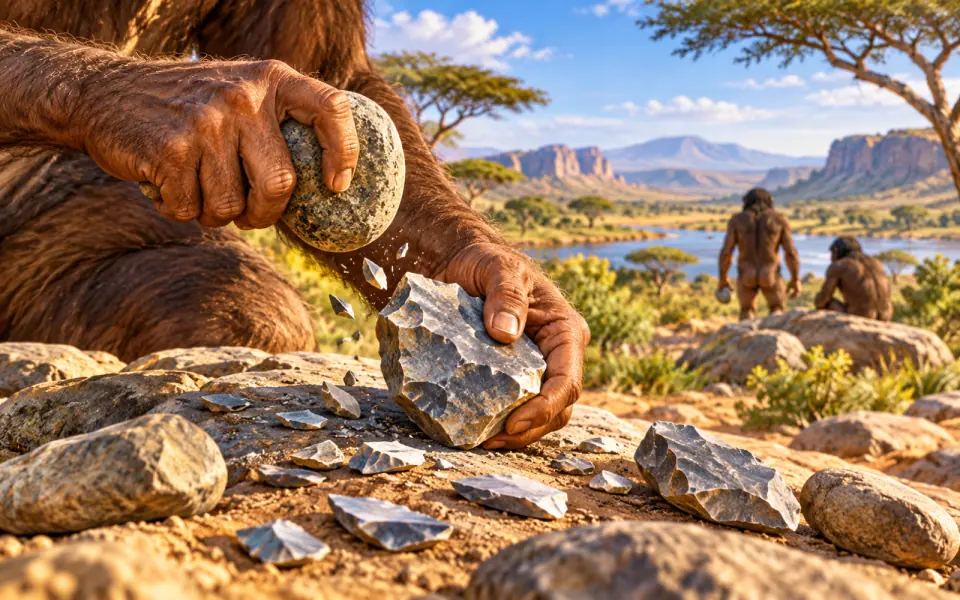 BeforeThe first stone toolsabout 2.6 million years ago
- You are hereHomo habilisabout 2.4 million years ago
 AfterHomo erectusabout 1.9 million years ago
 AfterTaming fireabout 790,000 years ago
 AfterHomo heidelbergensisabout 600,000 years ago
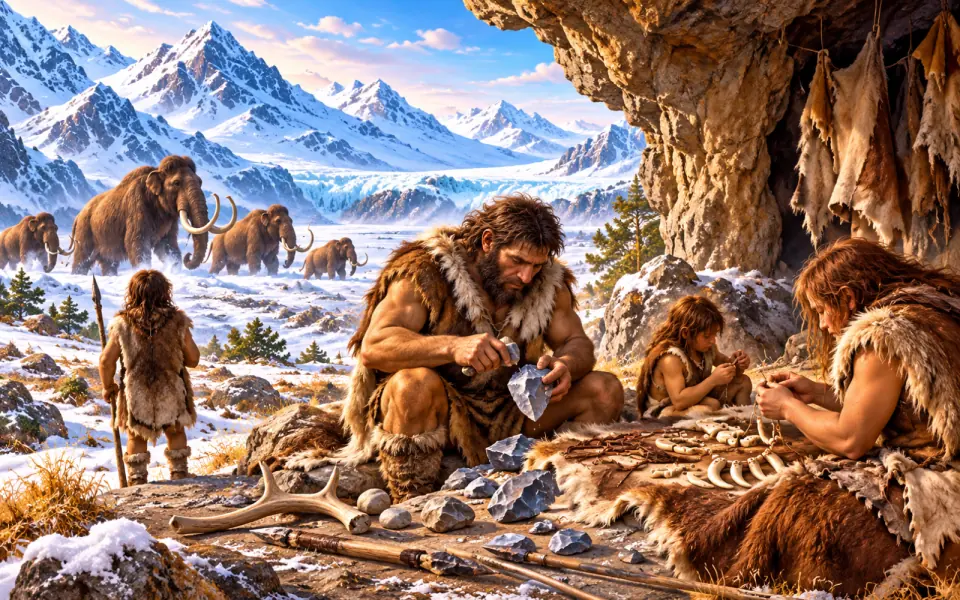 AfterNeanderthalsabout 400,000 years ago
 AfterThe arrival of Homo sapiensabout 300,000 years ago
 AfterThe first deliberate burialsabout 100,000 years ago
 AfterHomo sapiens leaves Africaabout 60,000 years ago
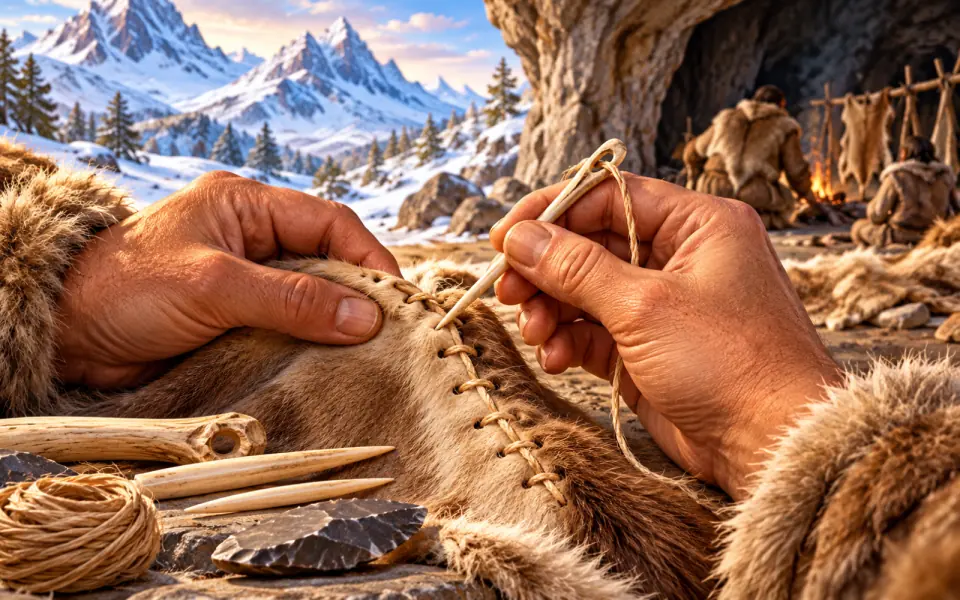 AfterThe needle with an eyeabout 48,000 years ago
 AfterThe first people in Australiaabout 48,000 years ago
 AfterThe cave art of Sulawesiabout 44,000 years ago
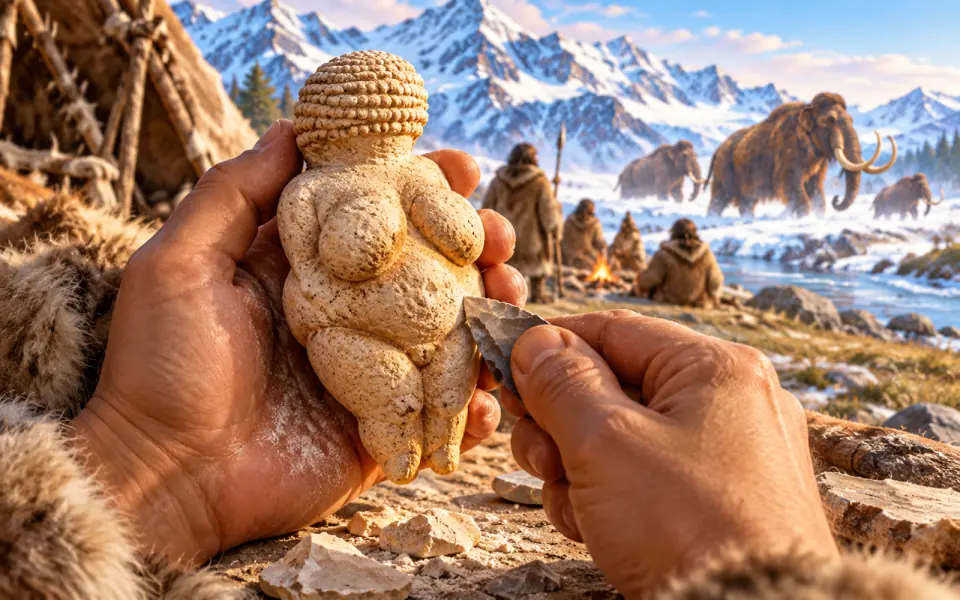 AfterThe Venus of Willendorfabout 28,000 years ago
 AfterThe Lascaux caveabout 19,000 years ago
 AfterThe first permanent villagesabout 14,000 years ago
 AfterThe Neolithic Revolutionabout 12,000 years ago
 AfterTaming the sheepabout 11,000 years ago
 AfterThe walls of Jerichoabout 10,300 years ago
 AfterPottery spreadsabout 9,000 years ago
 AfterÇatalhöyükabout 9,000 years ago
 AfterWorking with copperabout 7,000 years ago
 AfterThe invention of the wheelabout 5,500 years ago
 AfterThe Bronze Ageabout 5,300 years ago
Listen / Read next
- Music to read by: Cinematic JourneyEpic film-style music, no lyrics, by Ciro Simone IrmiciSpotifyYouTube Music
Other events of the era “Prehistory”
- The first hominins
- Lucy the australopithecine
- The first stone tools
- Homo erectus
- Taming fire
- Homo heidelbergensis
- Neanderthals
- The arrival of Homo sapiens
- The first deliberate burials
- Homo sapiens leaves Africa
- The needle with an eye
- The first people in Australia
- The cave art of Sulawesi
- The Venus of Willendorf
- The Lascaux cave
- The first permanent villages
- The Neolithic Revolution
- Taming the sheep
- The walls of Jericho
- Pottery spreads
- Çatalhöyük
- Working with copper
- The invention of the wheel
- The Bronze Age
