The first stone tools
about 2.6 million years ago East Africa (Ethiopia and Kenya)
In short
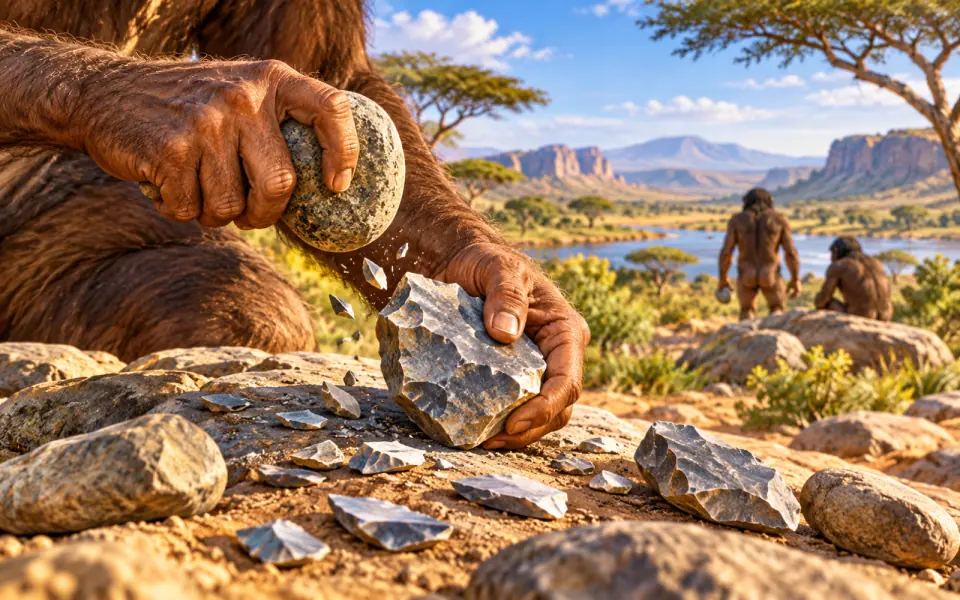
About 2.6 million years ago, in East Africa, someone began chipping pebbles to make sharp edges. These stones were used to cut meat and to break bones to eat the marrow. Some tools found in Kenya may be even older.
Why it matters This is where human technology begins: making an object in order to do something.
Source: Smithsonian, Human Origins Program, “Early Stone Age Tools”
Study card about 5 minutes of reading
The story
A stone that becomes a tool
Take a round pebble and a harder one, and strike the first from the side, hard, in the right spot. A flake breaks off with an edge as sharp as a piece of broken glass. It looks simple, but it is not: you have to choose the right stone, hit it at the right angle and work out in advance how it will break. Yet this action, repeated by someone in East Africa more than two and a half million years ago, is considered the beginning of human technology.
The clearest traces of this working of stone, dated to about 2.6 million years ago, come from the Gona area in Ethiopia, in the Afar region. They are pebbles of volcanic rock with flakes deliberately knocked off, together with the flakes themselves. Archaeologists also remember them by a group name: Oldowan, from Olduvai Gorge in Tanzania, where they were first studied by Louis and Mary Leakey, starting in the 1930s.
How they were used
Oldowan tools are simple: pebbles with a few flakes taken off (“choppers”, from the English “to chop”, to cut with blows), sharp flakes, and stones used as hammers. They do not have a shape decided in advance, and the people who made them mostly wanted a cutting edge. We know what they were for from the marks left on the animal bones found with them: thin cut marks, left by a sharp flake that sliced off the meat, and clean blows where a big stone had broken the bone to get at the marrow, which is very rich in fat.
For someone with no tusks or claws, this was a great advantage. With a sharp stone you could make use of the carcasses left by the big cats, quickly cutting off the best pieces before the predators came back. The meat and marrow brought plenty of calories and protein to the diet, useful for growing a big brain.
Who made them?
It seems natural to think of Homo habilis, whose name means “handy man”. But the first tools are about the same age as the oldest fossils of the genus Homo (a jawbone 2.8 million years old found in Ethiopia in 2015), and even an australopithecine such as Australopithecus garhi, which lived in the same Afar region, is a candidate. The truth is that we still do not know for certain who it was. It may be that more than one species, even among the non-human ones, chipped stone.
Besides, the tools could be even older. In 2015 a team of researchers announced the discovery, at a site called Lomekwi 3, on the western shore of Lake Turkana in Kenya, of chipped stones about 3.3 million years old. They are bigger and less finished than the Oldowan ones, and the scholars who described them call them “Lomekwian”. Not everyone accepts the dating and the origin of the pieces: the debate is open. Some cut marks on bones found at Dikika in Ethiopia, about 3.4 million years old, are also disputed. The safest dates remain those of the Oldowan tools: about 2.6 million years at Gona and, according to a 2022 study, about 2.9 million at Nyayanga in Kenya.
After the simple tools
For almost a million years the tools stayed almost the same. Then, about 1.8–1.7 million years ago (perhaps a little earlier), the first bifaces appeared, that is, hand axes, worked on both faces. This technique is called Acheulean, from the French site of Saint-Acheul, and it already needs a clear idea of the final shape. It is part of the progress we will tell about in the cards on Homo erectus and fire.
Every stone flake is therefore a message that reaches us from far away: it tells us that someone, a very long time ago, first thought about what they wanted to achieve and then acted to achieve it.
Why it happened
Around three million years ago the African climate, according to many studies, grew cooler and drier. Forests shrank and grasslands spread: there was less fruit on the trees and more grazing animals on the savannah. For our ancestors, meat became an opportunity to exploit.
But a hominin with no claws and small teeth could not cut the hide of a dead animal. A flake of stone solved the problem: all you had to do was know how to make one. Those who could do it ate better, and their children had a better chance of surviving.
It should be added that chimpanzees today already use stones to crack nuts and sticks to fish for termites. Using tools, therefore, did not come out of nowhere; our ancestors took it much further, moving from using an object they found to making one.
What changed
With the first tools the relationship between humans and their environment changed. For the first time a species was making what its body lacked: instead of waiting for evolution to give it tusks, it made itself a knife. Since then human technology and biology have influenced each other: hands, brain and tools grew together.
Learning to chip stone takes time and teaching: the young have to watch, try and correct themselves. Some scholars think that passing on this knowledge was one of the first forms of school, and perhaps a push towards communication between individuals.
Chipped stones are also the most numerous documents of prehistory. Stone does not rot, and for millions of years it is the only trace of what human beings did. Archaeologists study it to reconstruct movements, habits and relations between groups, and in many regions the abundance of tools says more than the fossils themselves.
Key people and places
People
- Sileshi Semaw
- Ethiopian archaeologist. In 1997 he led the study of the Gona tools in Ethiopia, dated to about 2.6 million years ago.
- Louis and Mary Leakey
- A British couple, born in Kenya and in Britain, who dug for a long time in Olduvai Gorge and were the first to describe the Oldowan tools.
- Sonia Harmand
- French archaeologist. With her team she announced in 2015 the stones of Lomekwi 3 in Kenya, which may be 3.3 million years old.
Places
- Gona, Afar region (Ethiopia)
- An area of rocks and gorges in the Afar desert where stone tools securely dated to about 2.6 million years ago were found, among the oldest known (at Nyayanga in Kenya, some about 2.9 million years old have been dated).
- Olduvai Gorge (Tanzania)
- A deep cleft in the savannah that gives its name to the Oldowan industry. The Leakeys worked here for a long time.
- Lomekwi, Lake Turkana (Kenya)
- A site on the western shore of Lake Turkana, where chipped stones that may be 3.3 million years old were found.
Good to know
- Today researchers learn to make Oldowan tools by trying it themselves: after a few hours you can get a flake that cuts, but it takes months to do it well.
- The chimpanzees of the Ivory Coast have been using stones as hammer and anvil to crack nuts for over 4,000 years: we know this from the tools found in the ground.
- The word “Oldowan” comes from Olduvai, a name that derives from a word in the Maasai language for a wild plant, the sisal-like sansevieria, that grows in that gorge.
- To get a useful flake people often chose volcanic rock or flint; the first craftsmen sometimes carried the right stone for kilometres.
- Even after millions of years you can recognise a flake by the point where it was struck and by a small bulge left by the blow: these are the signs archaeologists look for to tell it from a stone broken by chance.
Find out more
- Smithsonian, Early Stone Age tools (in English) humanorigins.si.edu
- Wikipedia, “Oldowan” en.wikipedia.org
- Wikipedia, “Olduvai Gorge” en.wikipedia.org
- Wikipedia, “Paleolithic” en.wikipedia.org
Related events
- Lucy the australopithecineabout 3.2 million years ago · PrehistoryLucy lived before the oldest securely dated tools, but she already walked with her hands free.
- Homo habilisabout 2.4 million years ago · PrehistoryHomo habilis, “handy man”, took its name from these tools.
- Homo erectusabout 1.9 million years ago · PrehistoryHomo erectus perfected stoneworking with hand axes.
- Taming fireabout 790,000 years ago · PrehistoryAfter stone, the second great tool was fire.
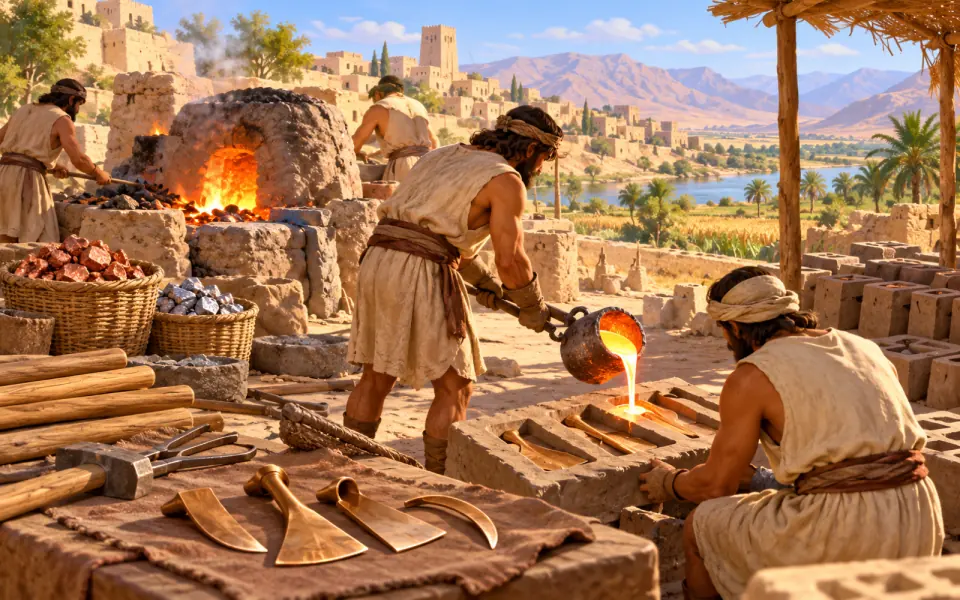
- The Bronze Ageabout 5,300 years ago · PrehistoryThousands of years later, the same action of making tools led to the working of metals.
Before and after, in the era “Prehistory”
Event 3 of 25
 BeforeThe first homininsabout 7 million years ago
 BeforeLucy the australopithecineabout 3.2 million years ago
- You are hereThe first stone toolsabout 2.6 million years ago
 AfterHomo habilisabout 2.4 million years ago
 AfterHomo erectusabout 1.9 million years ago
 AfterTaming fireabout 790,000 years ago
 AfterHomo heidelbergensisabout 600,000 years ago
 AfterNeanderthalsabout 400,000 years ago
 AfterThe arrival of Homo sapiensabout 300,000 years ago
 AfterThe first deliberate burialsabout 100,000 years ago
 AfterHomo sapiens leaves Africaabout 60,000 years ago
 AfterThe needle with an eyeabout 48,000 years ago
 AfterThe first people in Australiaabout 48,000 years ago
 AfterThe cave art of Sulawesiabout 44,000 years ago
 AfterThe Venus of Willendorfabout 28,000 years ago
 AfterThe Lascaux caveabout 19,000 years ago
 AfterThe first permanent villagesabout 14,000 years ago
 AfterThe Neolithic Revolutionabout 12,000 years ago
 AfterTaming the sheepabout 11,000 years ago
 AfterThe walls of Jerichoabout 10,300 years ago
 AfterPottery spreadsabout 9,000 years ago
 AfterÇatalhöyükabout 9,000 years ago
 AfterWorking with copperabout 7,000 years ago
 AfterThe invention of the wheelabout 5,500 years ago
 AfterThe Bronze Ageabout 5,300 years ago
Listen / Read next
- Music to read by: Cinematic JourneyEpic film-style music, no lyrics, by Ciro Simone IrmiciSpotifyYouTube Music
Other events of the era “Prehistory”
- The first hominins
- Lucy the australopithecine
- Homo habilis
- Homo erectus
- Taming fire
- Homo heidelbergensis
- Neanderthals
- The arrival of Homo sapiens
- The first deliberate burials
- Homo sapiens leaves Africa
- The needle with an eye
- The first people in Australia
- The cave art of Sulawesi
- The Venus of Willendorf
- The Lascaux cave
- The first permanent villages
- The Neolithic Revolution
- Taming the sheep
- The walls of Jericho
- Pottery spreads
- Çatalhöyük
- Working with copper
- The invention of the wheel
- The Bronze Age
