The Bronze Age
about 5,300 years ago Near East, then Europe and Italy
In short
Mixing copper with a little tin makes bronze, which is harder and better for weapons and tools. In the Near East the Bronze Age began about 5300 years ago; in Italy and most of Europe about a thousand years later. Tin was rare, and trading it made goods and people travel thousands of kilometres.
Why it matters Bronze changed work, war and trade all around the Mediterranean.
Source: Treccani, Enciclopedia dei ragazzi, “Età del Bronzo”
Study card about 5 minutes of reading
The story
A lucky recipe
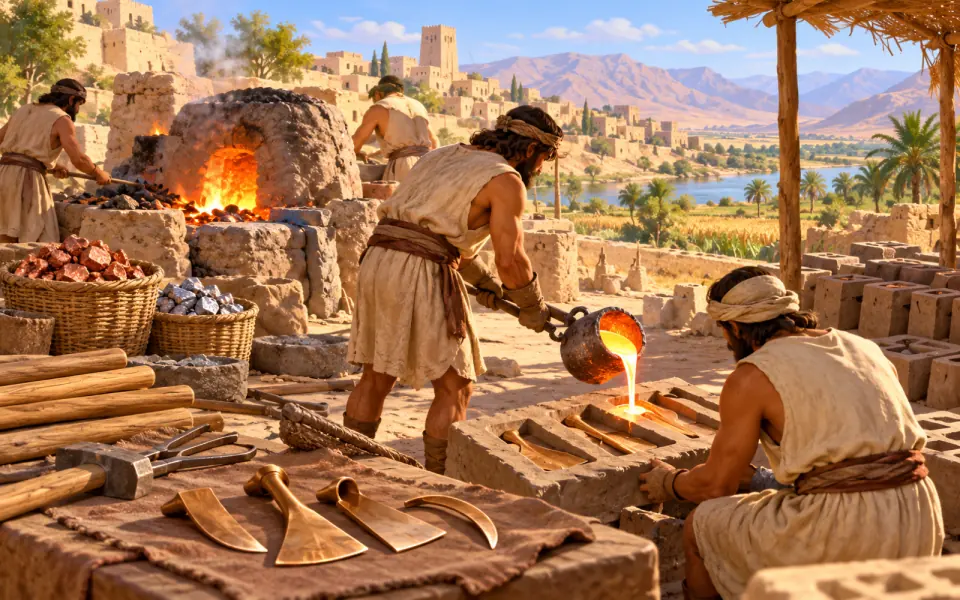
Copper had been a great step forward, but it had a flaw: it is soft. A copper axe bends, a blade goes blunt at once. The craftsmen of the Copper Age had been looking for ways to improve it for some time, and some discovered that by adding a little arsenic, a poisonous mineral, the metal became harder. Then someone, perhaps in Anatolia or Mesopotamia, tried mixing a second metal, tin, into the molten copper. The mixture, which is called an alloy, was much better than the two ingredients separately: harder, easier to pour into moulds, with a lovely golden colour when new. Its name is bronze. The classic recipe is about nine parts copper to one of tin.
Bronze could be melted and cast in moulds, even very complicated ones; when an object broke, it could be melted down again and reused. With bronze people made axes, daggers, swords, spearheads, mirrors, needles, pins, bells, statues. A good blade could be sharpened again many times. It was the best material humanity had ever had.
When it begins
The Bronze Age does not begin at the same moment everywhere. In the Near East it is made to begin by convention around 3300 BC, in Mesopotamia and Anatolia; but in some areas tin bronze spread only later, after 3000 BC. In central and southern Europe, Italy included, it begins around 2300 BC, while in Scandinavia it arrives later still. The end depends on the arrival of iron, between about 1200 and 800 BC, depending on the place.
The period was very long, more than two thousand years in Europe. In this time the first great civilisations in history appeared, which the following cards talk about: Sumerians, Egyptians, the Indus Valley, China, the Minoans. But the Bronze Age is not only that of the great empires: in Italy, for example, it is the time of the stilt villages on the lakes, of the Terramare villages in the Po Plain and, in Sardinia, of the nuraghi.
The problem of tin
There was an obstacle: tin is rare. Copper is found in many countries, but tin is concentrated in very few places. The most important mines of antiquity were in Cornwall, in south-western England, in the Ore Mountains between Germany and Bohemia, in Spain and Brittany, and in the east in central Asia, between Afghanistan and Uzbekistan. People living in the Near East had to have tin brought from thousands of kilometres away.
So the great trade networks of the Bronze Age arose. Caravans of donkeys carried tin from Assur, in Mesopotamia, to the Assyrian merchants who traded in Anatolia, at Kültepe, around 1900 BC: thousands of clay tablets with their accounts have survived. At sea, a ship wrecked at Uluburun, on the coast of Turkey, around 1320 BC, was carrying about ten tonnes of copper in ingots shaped like an ox-hide and one tonne of tin, together with glass, ivory, precious woods and jewellery. The cargo alone tells how important this trade was, and how rich in exchanges the civilisation of the time was.
Weapons, work, wealth
Bronze changed warfare. Swords, which had actually been made earlier, with arsenical copper (the oldest known, from about 3300 BC, were found at Arslantepe in Turkey by the Italian archaeologists of the Sapienza University of Rome), became long, strong weapons in bronze. Work changed too: saw, axe, chisel and awl made of bronze made it possible to build better boats, houses and carts. Farmers had more effective sickles.
Because metals were precious, those who controlled them became powerful. In Bronze Age graves chiefs appear buried with weapons, ornaments and gold objects. Society was becoming more unequal, with elites of warriors and specialised craftsmen. A famous treasure is the Nebra sky disc in Germany, a bronze disc inlaid with gold that shows the Sun, Moon and stars, about 3,600 years old.
Why it happened
The Bronze Age was the result of centuries of experimenting with copper and its ores. Craftsmen knew that some ores gave a harder metal than others, and by trying to mix different ores they arrived at the ideal alloy.
It took a great deal of knowledge: where to find tin, how to extract it (from cassiterite, a dark, heavy stone), how to control the fire, how much metal to pour and into what mould. It was not widespread knowledge: it was kept by specialists, often protected by kings or temples.
The demand for bronze came from the cities and states that were arising. Armies, temples, palaces and merchants needed tools, weapons and prestige objects, and could organise long expeditions to get the materials.
What changed
The Bronze Age saw the birth of the first great civilisations and the first empires. To get metals you needed trade, so ships, roads, writing for the accounts, agreements between states. The world became more connected: the same alloy was found thousands of kilometres apart.
The system also had weak points. Because tin came from a few distant places, it was enough for the routes to be cut to put everyone in crisis. Some scholars think that the breakdown of trade contributed to the great collapse of the Mediterranean civilisations around 1200 BC.
The name “Bronze Age” was born with modern archaeology. From 1816–1819 on, the Dane Christian Jürgensen Thomsen, putting in order the collections of the National Museum in Copenhagen, divided prehistory into three ages: stone, bronze and iron, and published the system in 1836. This scheme, the “three-age system”, is still the basis of school textbooks today.
Key people and places
People
- Christian Jürgensen Thomsen
- Danish archaeologist (1788–1865). He devised the three-age system (stone, bronze, iron) while putting the Copenhagen museum in order.
- Marcella Frangipane
- Italian archaeologist at the Sapienza University of Rome. She has directed the excavations at Arslantepe, in Turkey, where the oldest known swords were found.
Places
- Uluburun (Turkey)
- The southern coast of Turkey, where the wreck of a ship of about 1320 BC with ten tonnes of copper and one of tin was found.
- Kültepe (Turkey)
- An ancient city in Anatolia where Assyrian merchants kept the tablets with the accounts of the tin trade.
- Arslantepe (Turkey)
- A hill near Malatya, in eastern Anatolia, with a palace and the oldest known swords, about 5,300 years old.
- Terramare (Po Plain)
- Bronze Age villages between Emilia and Lombardy, built on wooden foundations and surrounded by ditches.
Good to know
- New bronze is not dark and greenish as we see it on statues: just after casting it has a golden colour, bright like brass.
- The copper ingots of Uluburun were shaped like a spread-out ox-hide, with four “legs” so they could be gripped and carried easily.
- The word “bronze” probably comes from a Persian term, birinj, which meant copper or bronze.
- A modern bell is still made of bronze: the alloy with more tin, about 20 per cent, rings better.
- Bronze does not rust like iron: that is why bronze statues such as the Riace Bronzes, found in the sea in 1972, have survived for over two thousand years.
Find out more
- Wikipedia, “Uluburun shipwreck” en.wikipedia.org
- Wikipedia, “Bronze Age” en.wikipedia.org
- Wikipedia, “Bronze” en.wikipedia.org
- Wikipedia, “Three-age system” en.wikipedia.org
Related events
- Working with copperabout 7,000 years ago · PrehistoryCopper, the first metal, was the basis of bronze.
- The Bronze Age collapseabout 1200 BC · River civilisationsThe decline of the Bronze Age, around 1200 BC, changed the Mediterranean.
- The nuraghi of Sardiniaabout 1600 BC · Sea civilisationsThe nuraghi of Sardinia are Bronze Age constructions.
- The Iron Age beginsabout 1200 BC · Sea civilisationsThe Iron Age followed the Bronze Age.
- War chariotsabout 1700 BC · River civilisationsWar chariots and bronze weapons transformed armies.
Before and after, in the era “Prehistory”
Event 25 of 25
 BeforeThe first homininsabout 7 million years ago
 BeforeLucy the australopithecineabout 3.2 million years ago
 BeforeThe first stone toolsabout 2.6 million years ago
 BeforeHomo habilisabout 2.4 million years ago
 BeforeHomo erectusabout 1.9 million years ago
 BeforeTaming fireabout 790,000 years ago
 BeforeHomo heidelbergensisabout 600,000 years ago
 BeforeNeanderthalsabout 400,000 years ago
 BeforeThe arrival of Homo sapiensabout 300,000 years ago
 BeforeThe first deliberate burialsabout 100,000 years ago
 BeforeHomo sapiens leaves Africaabout 60,000 years ago
 BeforeThe needle with an eyeabout 48,000 years ago
 BeforeThe first people in Australiaabout 48,000 years ago
 BeforeThe cave art of Sulawesiabout 44,000 years ago
 BeforeThe Venus of Willendorfabout 28,000 years ago
 BeforeThe Lascaux caveabout 19,000 years ago
 BeforeThe first permanent villagesabout 14,000 years ago
 BeforeThe Neolithic Revolutionabout 12,000 years ago
 BeforeTaming the sheepabout 11,000 years ago
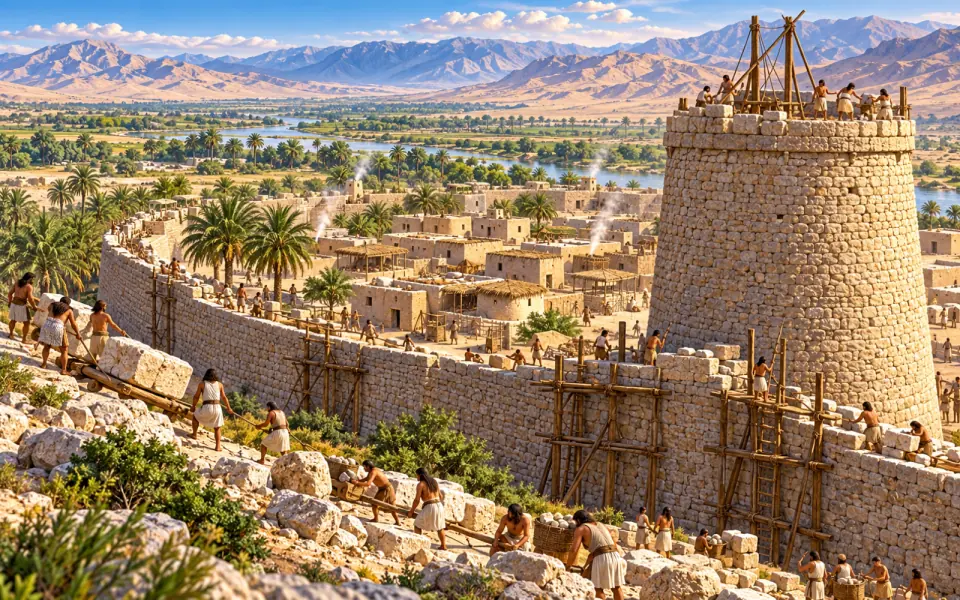 BeforeThe walls of Jerichoabout 10,300 years ago
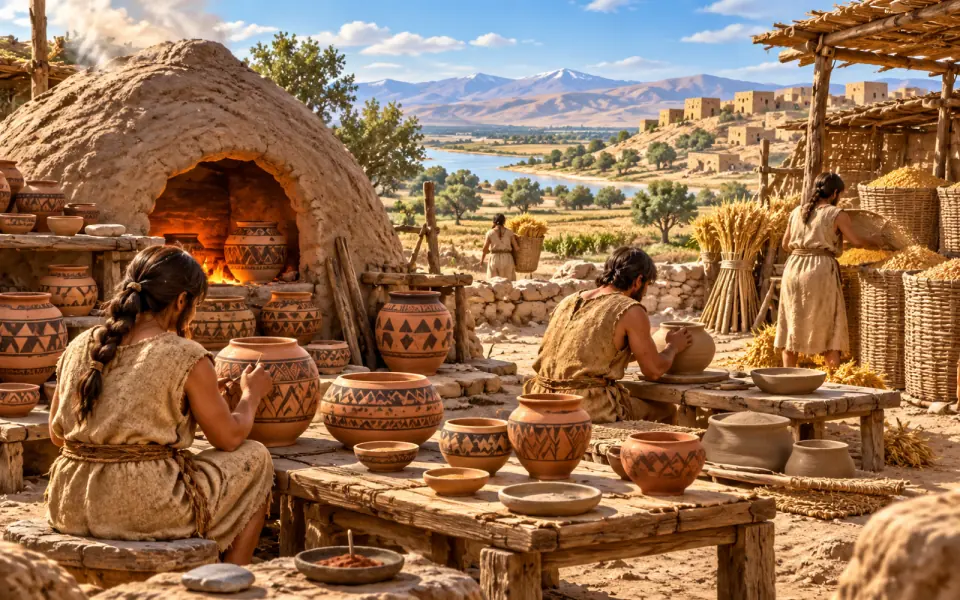 BeforePottery spreadsabout 9,000 years ago
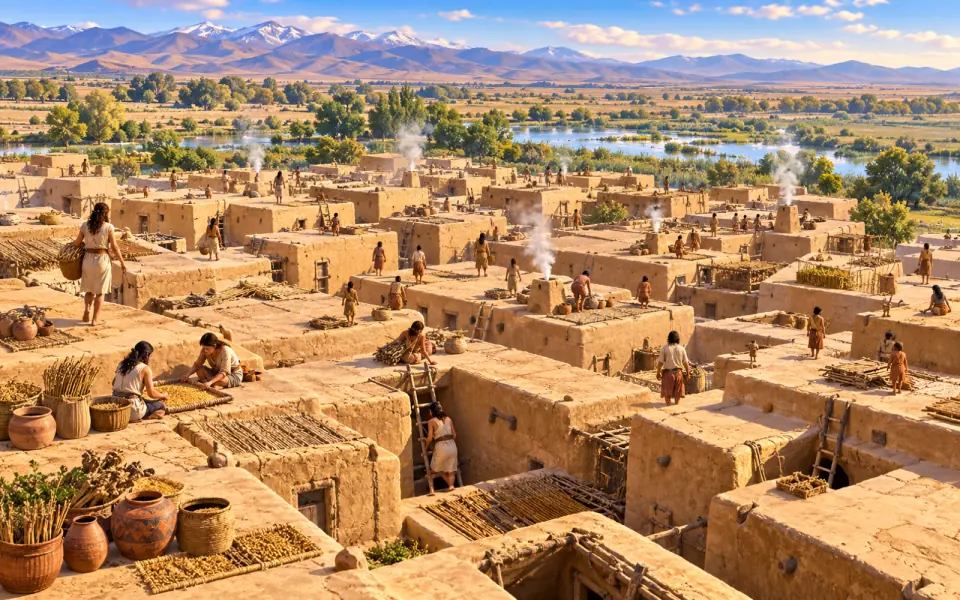 BeforeÇatalhöyükabout 9,000 years ago
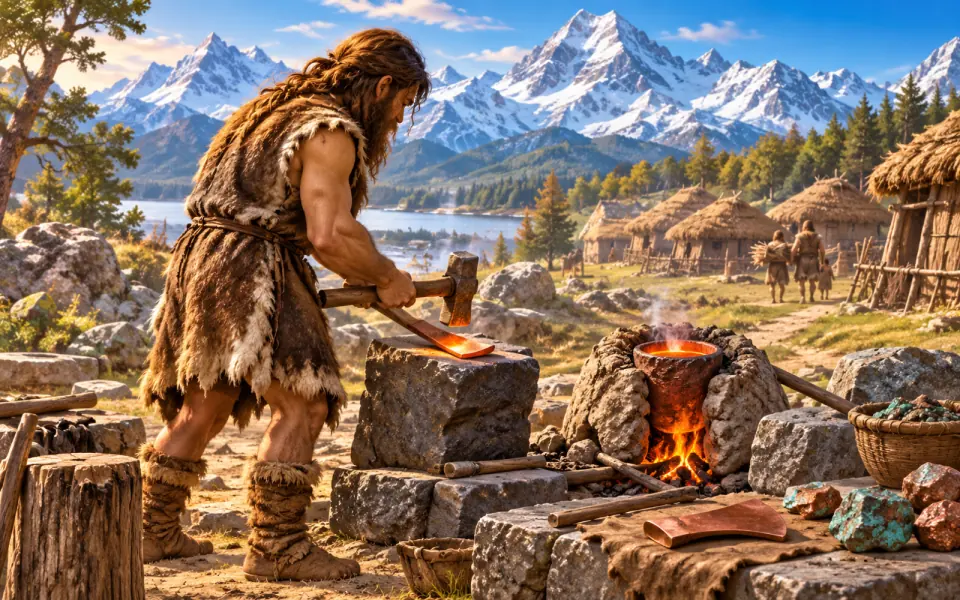 BeforeWorking with copperabout 7,000 years ago
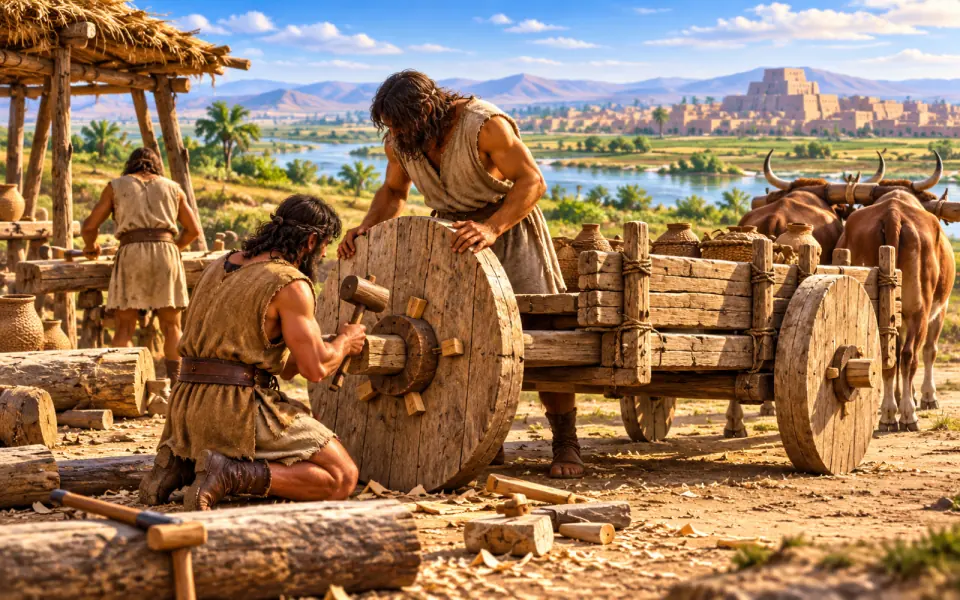 BeforeThe invention of the wheelabout 5,500 years ago
- You are hereThe Bronze Ageabout 5,300 years ago
Listen / Read next
- Music to read by: Cinematic JourneyEpic film-style music, no lyrics, by Ciro Simone IrmiciSpotifyYouTube Music
Meanwhile, elsewhere in the world
Other events of the era “Prehistory”
- The first hominins
- Lucy the australopithecine
- The first stone tools
- Homo habilis
- Homo erectus
- Taming fire
- Homo heidelbergensis
- Neanderthals
- The arrival of Homo sapiens
- The first deliberate burials
- Homo sapiens leaves Africa
- The needle with an eye
- The first people in Australia
- The cave art of Sulawesi
- The Venus of Willendorf
- The Lascaux cave
- The first permanent villages
- The Neolithic Revolution
- Taming the sheep
- The walls of Jericho
- Pottery spreads
- Çatalhöyük
- Working with copper
- The invention of the wheel
