The Iron Age begins
about 1200 BC Anatolia and the eastern Mediterranean
In short
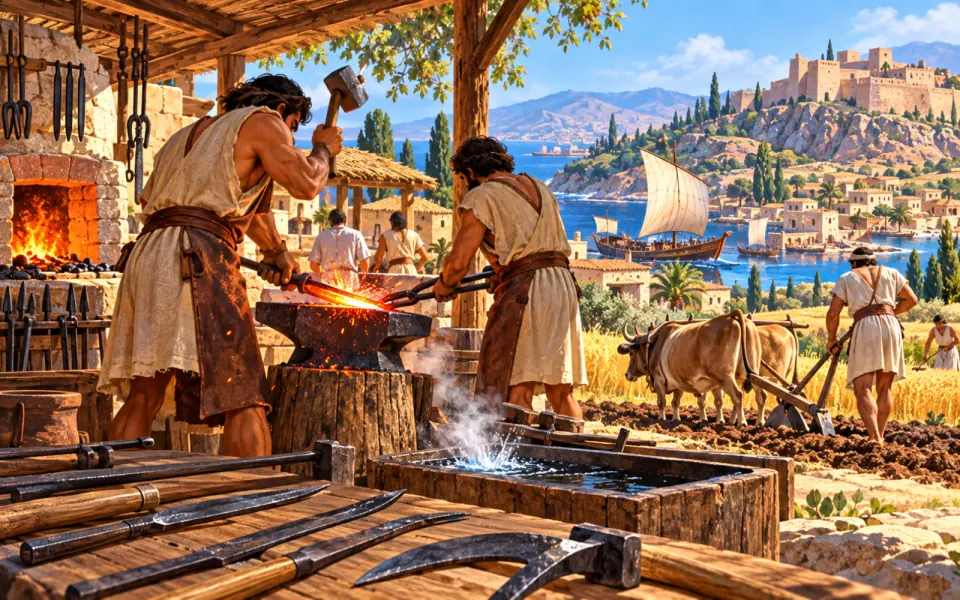
Iron is found in a great many places, unlike the tin needed for bronze, but it is hard to work. It had to be heated in the fire, hammered for a long time and cooled in water to make it hard. The Hittites, in Anatolia, were already working it earlier, but after 1200 BC the technique spread all over the Mediterranean. Iron farm tools and weapons became more and more common.
Why it matters Iron cost less than bronze, so even farmers could have metal tools.
Source: Treccani, entry “Età del ferro”
Study card about 5 minutes of reading
The story
A metal fallen from the sky
Iron was known long before it became important. The first iron objects archaeologists have found were not made by smelting ore, but by working pieces of meteoritic iron, that is, iron that fell from the sky with meteorites. It was very rare and so it was precious. A famous case is the iron dagger found in the tomb of the pharaoh Tutankhamun: tests have shown that the metal came from a meteorite. To make tools and weapons in large quantities, however, people had to learn to extract iron from rocks.
Why iron is difficult
Iron is found in a great many places, far more than tin, which is needed together with copper to make bronze. But getting it out is more complicated. To separate it from the rock you have to heat the ore in a furnace to temperatures above 1,250 degrees, hard to reach for anyone without very good furnaces. Bronze, by contrast, melts at much lower temperatures. And the iron that comes out of the furnace cannot be poured into a mould: it stays a spongy mass full of slag, which the smith has to reheat and beat with a hammer to remove the impurities and shape the object.
In time smiths also discovered how to make steel, an iron with a little carbon, harder and suitable for tools and weapons. We do not know exactly when and where, and the techniques were improved little by little.
What “Iron Age” means
Archaeologists divide prehistory and antiquity into ages, according to the most important material: Stone Age, Bronze Age, Iron Age. But these ages do not begin at the same moment everywhere. The Iron Age is said to begin when, in a place, iron, and in particular steel, becomes the common metal for tools and weapons in place of bronze. In the Near East it is generally placed around 1200 BC, and it lasts until about 550 BC, when the Persian empire of the Achaemenids was born. In Anatolia, the Caucasus and the Balkans the change begins a little earlier, around 1300 BC.
The Hittites and the secret of iron
For a long time people believed that the Hittites, the people of Anatolia, held a monopoly on iron and that this was the secret of their military strength. Today scholars no longer agree: in Anatolia iron objects of the Bronze Age have been found, but no more of them than have been found in Egypt and other countries. The idea of a secret guarded by the Hittites is no longer considered convincing.
Bronze runs into trouble
Why did people move from bronze to iron? One explanation, put forward by the historian Anthony Snodgrass, starts from the shortage of tin. In the centuries around 1300–1200 BC the trade of the eastern Mediterranean was thrown into chaos by wars, destruction and the fall of kingdoms: this is the crisis at the end of the Bronze Age. Without tin, bronze became hard to produce and the metal was recycled into weapons. To replace it, people began to make more iron, and with experience its working improved. Other scholars, such as Leonard Palmer, have thought that iron, being more abundant, allowed larger armies to be equipped. These are hypotheses, and probably several causes acted together.
The spread
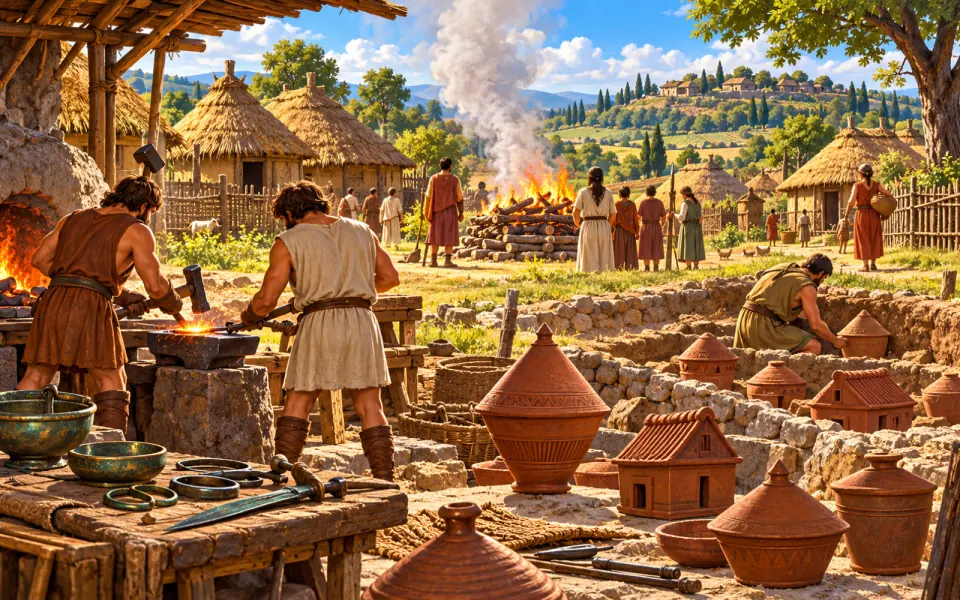
Between the 12th and 11th centuries BC ironworking spread throughout the Mediterranean and reached southern Asia. In Greece the Iron Age is usually placed between about 1200 and 700 BC. In Europe iron arrived at the end of the 11th century BC, probably from the Caucasus, and in about five hundred years it spread north and west. In central Europe the Hallstatt culture, famous for its iron objects, is dated from about 800 BC. In Italy, iron is linked to the Villanovans, who introduced it to the peninsula (the dates differ from source to source, between the 11th and 9th centuries BC for the start of the culture).
Egypt, instead, stayed faithful to bronze for a long time: iron was scarce and considered partly impure, and things changed only after the Assyrian conquest of 671 BC.
What changed in everyday life
Iron was cheaper and easier to find than bronze, and this changed many things. A farmer could have a hoe, a sickle, a plough blade made of metal. A craftsman could have solid tools. A soldier could be armed with a sword. Metal was no longer a luxury for kings and warriors, but entered homes, fields and workshops.
Why it happened
The causes of the Iron Age are still debated. One important but debated explanation is the tin crisis. Bronze is made from copper and tin, and tin was rare: merchants had to bring it from far away. When the wars and destruction around 1200 BC cut the trade routes, getting hold of tin became difficult.
Iron offered a solution: the ore is much more common and does not depend on distant routes. In time smiths learned to work it well, getting a metal often harder than bronze. So a difficulty, together with the wish to have tools and weapons in quantity, pushed people to change material.
What changed
With iron, tools and weapons cost less. Farmers had better tools for breaking up and cultivating the land. Armies too could become larger, because large quantities of precious metal were no longer needed to arm every soldier.
Iron changed the geography of power. Before, whoever controlled the routes of tin and copper commanded the trade in metals. Afterwards, since iron is found almost everywhere, even small peoples far from the great centres could get good weapons and tools.
We still live today in a world of iron and steel: bridges, ships, trains, skyscrapers, machines. The idea that metal could become a material for everyone, and not just for a few, begins in this age.
Key people and places
People
- Anthony Snodgrass
- Historian of Greek archaeology: he proposed that the shortage of tin pushed people towards iron.
- Tutankhamun
- Egyptian pharaoh in whose tomb an iron dagger was found that, according to tests, is of meteoritic origin.
Places
- Anatolia
- The peninsula of present-day Turkey, homeland of the Hittites, where iron was worked before 1200 BC.
- Hallstatt
- A place in Austria that gives its name to an Iron Age culture, dated from about 800 BC.
- Villanova
- A place near Bologna where the tombs of an Italian Iron Age people were discovered.
Good to know
- Tutankhamun's dagger is made of iron, but iron “fallen from the sky”: it comes from a meteorite.
- To get iron you need a temperature above 1,250 degrees, much higher than what is enough to melt bronze.
- Egypt used bronze as its main metal until the Assyrian conquest of 671 BC.
- The Iron Age does not begin in the same year everywhere: in Anatolia it was around 1300 BC, in Egypt after 671 BC.
- Today iron is used mostly in the form of steel, found in almost every building and machine.
Find out more
- Wikipedia, “History of ferrous metallurgy” en.wikipedia.org
- Wikipedia, “Hallstatt culture” en.wikipedia.org
- Wikipedia, “Late Bronze Age collapse” en.wikipedia.org
- Wikipedia, “Iron Age” en.wikipedia.org
Related events
- The Bronze Age collapseabout 1200 BC · River civilisationsThe crisis at the end of the Bronze Age opened the way for iron.
- The Villanovan culture in Italyabout 900 BC · Sea civilisationsThe Villanovans introduced ironworking to Italy.
- The Bronze Ageabout 5,300 years ago · PrehistoryThe Bronze Age that iron replaced.
- Working with copperabout 7,000 years ago · PrehistoryThe use of copper was the first step in the history of metals.
- The Etruscans, lords of the Tyrrhenian Seaabout 700 BC · Sea civilisationsThe Etruscans grew rich thanks to the iron of the island of Elba.
Before and after, in the era “Sea civilisations”
Event 9 of 25
 BeforeMinoan civilisation on Creteabout 2000 BC
 BeforeThe palace of Knossosabout 1900 BC
 BeforeThe Proto-Sinaitic alphabetabout 1800 BC
 BeforeThe eruption of Theraabout 1600 BC
 BeforeThe nuraghi of Sardiniaabout 1600 BC
 BeforeThe gold mask of Mycenaeabout 1550 BC
 BeforeLinear Babout 1450 BC
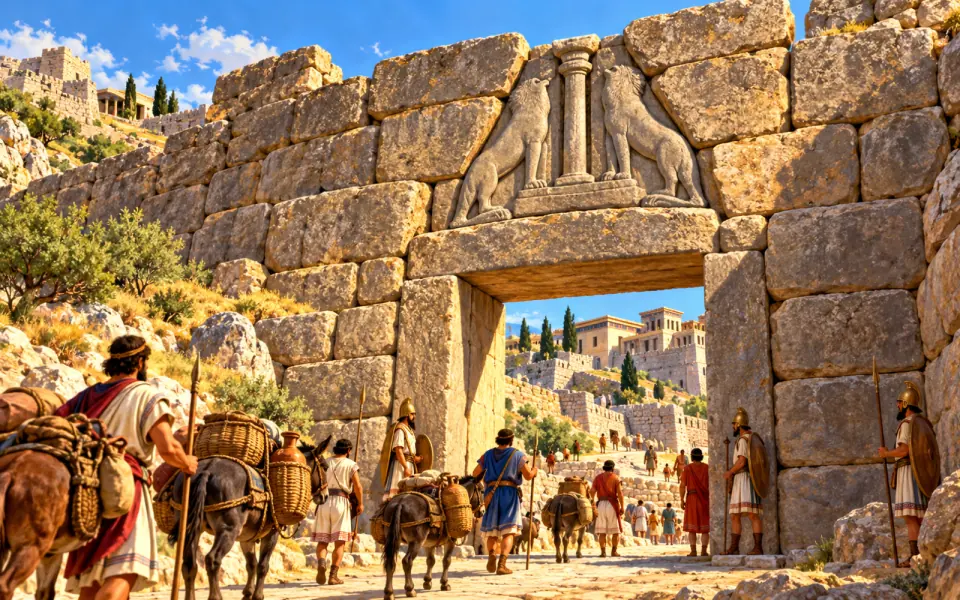 BeforeThe Lion Gate at Mycenaeabout 1250 BC
- You are hereThe Iron Age beginsabout 1200 BC
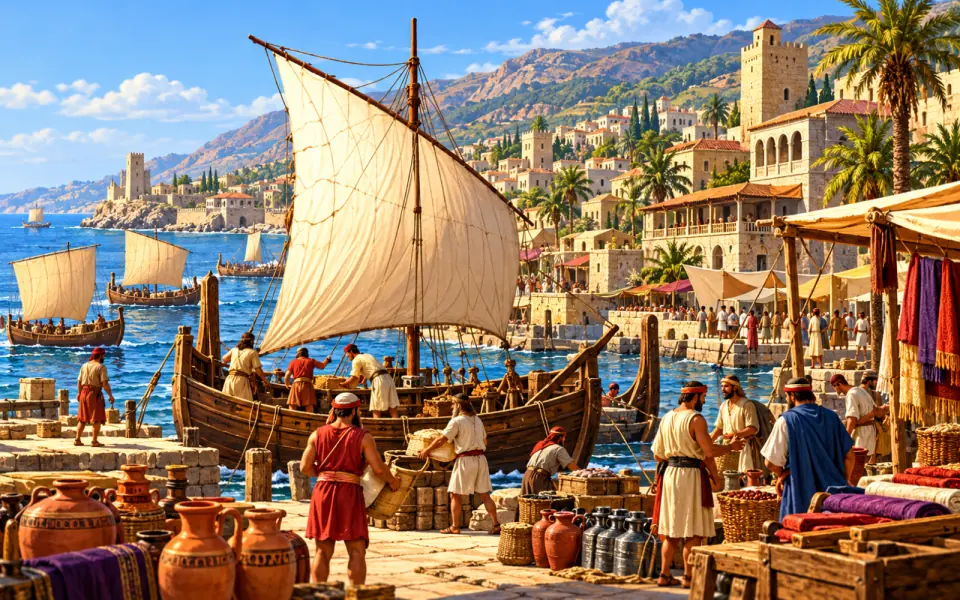 AfterThe Phoenicians spread outabout 1200 BC
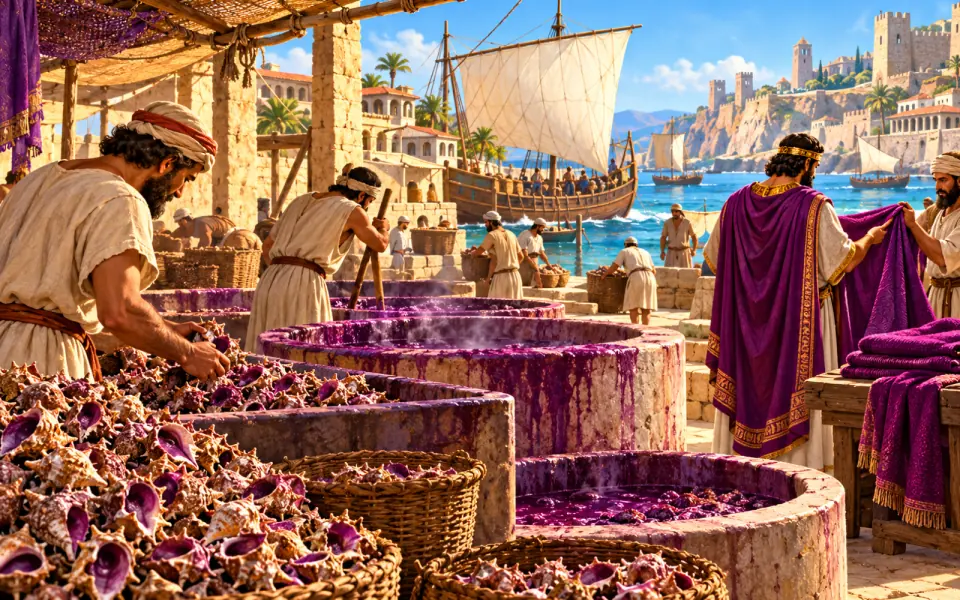 AfterPhoenician purpleabout 1100 BC
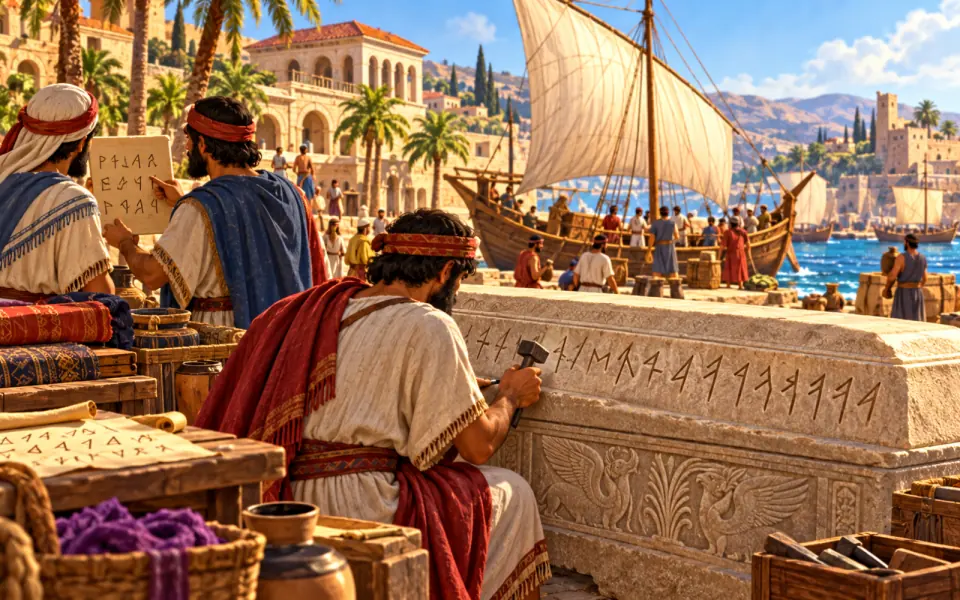 AfterThe Phoenician alphabetabout 1050 BC
 AfterThe Kingdom of Israelabout 1000 BC
 AfterPhoenician seafaringabout 1000 BC
 AfterThe Villanovan culture in Italyabout 900 BC
 AfterTraditional founding of Carthageabout 814 BC
 AfterThe Nora Stoneabout 800 BC
 AfterAmphorae for oil and wineabout 800 BC
 AfterHomer's poems are written downabout 750 BC
 AfterGreek colonies in the Westabout 750 BC
 AfterThe Etruscans, lords of the Tyrrhenian Seaabout 700 BC
 AfterPhoenician glass spreadsabout 600 BC
 AfterCoins in the Mediterraneanabout 600 BC
 AfterThe Babylonian Exileabout 586 BC
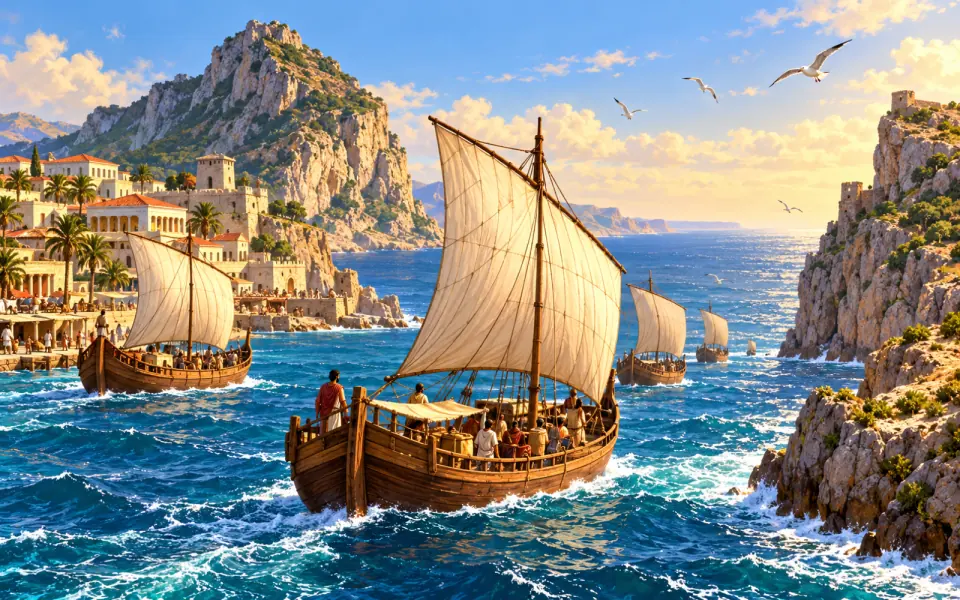 AfterSailing beyond Gibraltarabout 500 BC
Listen / Read next
- Music to read by: Cinematic JourneyEpic film-style music, no lyrics, by Ciro Simone IrmiciSpotifyYouTube Music
Meanwhile, elsewhere in the world
Other events of the era “Sea civilisations”
- Minoan civilisation on Crete
- The palace of Knossos
- The Proto-Sinaitic alphabet
- The eruption of Thera
- The nuraghi of Sardinia
- The gold mask of Mycenae
- Linear B
- The Lion Gate at Mycenae
- The Phoenicians spread out
- Phoenician purple
- The Phoenician alphabet
- The Kingdom of Israel
- Phoenician seafaring
- The Villanovan culture in Italy
- Traditional founding of Carthage
- The Nora Stone
- Amphorae for oil and wine
- Homer's poems are written down
- Greek colonies in the West
- The Etruscans, lords of the Tyrrhenian Sea
- Phoenician glass spreads
- Coins in the Mediterranean
- The Babylonian Exile
- Sailing beyond Gibraltar
