The Villanovan culture in Italy
about 900 BC Villanova, near Bologna (Italy)
In short
The Villanovan culture is named after Villanova, a hamlet near Bologna where a large ancient cemetery was discovered in the mid-1800s. The Villanovans lived in villages of huts in Emilia, Tuscany, Lazio and Campania. They cremated their dead and placed the ashes in clay urns shaped like a double cone or a little hut. They worked iron and bronze, and from their villages the Etruscan cities later grew.
Why it matters They were the direct ancestors of the Etruscans, one of the most important peoples of ancient Italy.
Source: Treccani, entry “Villanoviana, cultura”
Study card about 5 minutes of reading
The story
A cemetery found near Bologna
Between 1853 and 1855, in the countryside of Villanova, near Bologna (the name of Gozzadini's estate), the scholar Giovanni Gozzadini had an ancient cemetery excavated. A great number of tombs came to light: 193, of which 179 held the burnt remains of the dead and 14 a skeleton buried whole. Inside were terracotta urns and objects of bronze and iron. Nobody had ever seen such a collection, and Italian archaeology was struck by it. Scholars said that this culture needed a name, and they gave it that of the place: Villanovan.
Since then, in many other places in Italy, similar tombs have been found. In 1893, for example, a chance discovery brought to light at Verucchio, in Romagna, another great Villanovan cemetery. But the cemetery of Villanova remains the one that gave its name to it all.
When and where
The Villanovan culture is placed between about 900 and 700 BC, although some reconstructions have it begin a few decades earlier or end a few decades later. It spread over a large part of Italy: Emilia-Romagna, Tuscany, Lazio and Campania. It is considered the first phase of Etruscan civilisation and the oldest Iron Age culture in Italy. Before it there was a culture called Proto-Villanovan, which in turn descended from that of the “urnfields” of central Europe.
The double-cone urns
The Villanovans, at least until about 720 BC, cremated their dead. The ashes were collected in a vase of impasto, a coarse hand-made clay, and then buried in a pit dug in the ground. The most common urn has the shape of two cones joined at the base, and for this reason it is called “biconical”. The lid was an upturned bowl or, for warriors' tombs, a real helmet or a terracotta helmet imitating its shape. Some urns had the shape of a small hut with a thatched roof, and they show us what houses were like in those days.
Inside or beside the urn were placed the dead person's objects: fibulae (bronze pins for fastening clothes, a bit like our safety pins), razors, rings, weapons, pieces of armour. Among the bronze objects the crested helmets stand out. From about 800 BC there also appeared inhumation tombs, that is, with the dead person buried without being burnt, and chamber tombs. In the tombs of the richest, amber and glass appeared, brought from far away: a sign that these villages were not isolated.
How they lived
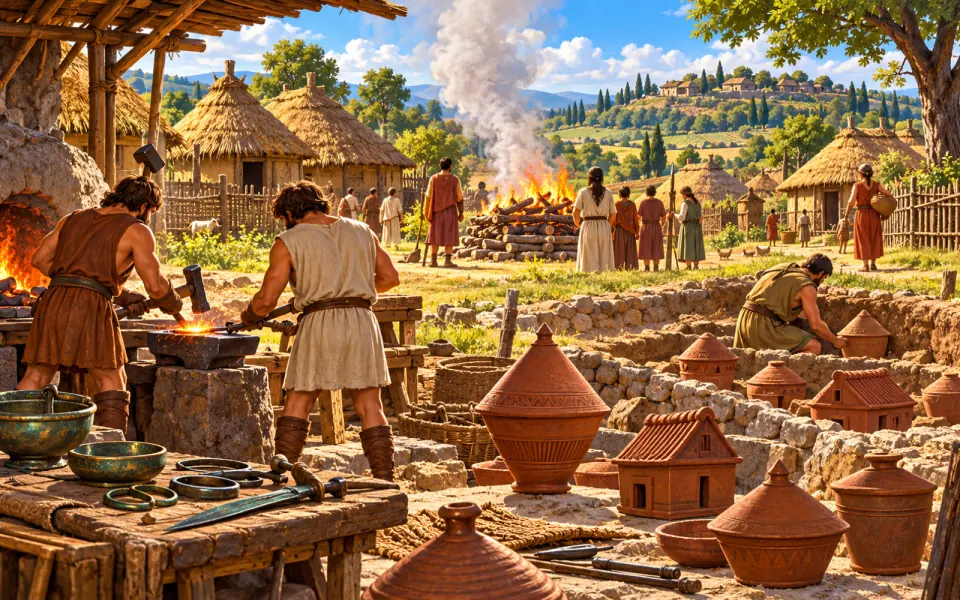
The Villanovans lived in villages of huts. The walls were made of woven branches covered with clay, or of mud bricks, and the roofs were thatched, supported by wooden posts. The huts could be rectangular, oval or round. They worked the land, kept animals, and made pottery and metal objects.
They were among the first in Italy to use iron on a large scale. They went on making pins, razors and weapons from bronze. The chance to get hold of metals, and to trade amber and glass with distant lands, widened the gap between richer and poorer families. In the cemetery of Villanova, for example, six tombs had been placed in an area separate from the others: perhaps the remains of more important people.
From villages to Etruscan cities
Around 720 BC a period began called “Orientalising”, because influences arrived from the East through trade with Greeks and Phoenicians. The huts gave way to real cities, and the tombs of the rich became large and full of luxury objects. From this arose the civilisation we call Etruscan. Most scholars today think that the Etruscans did not arrive from another country, but that their culture was born in Italy, precisely from the Villanovans. The idea has replaced an old tradition, told by the Greeks, according to which the Etruscans had come from Asia.
Why it happened
The Villanovan culture arises from slow changes in the society of central Italy. At the end of the Bronze Age, after the crisis discussed elsewhere, communities reorganised themselves into larger villages, with cultivated fields and ever greater skill in working metals. The Proto-Villanovan culture, which is its immediate origin, was in turn linked to the “urnfield” peoples of central Europe: from there, probably, comes the custom of burning the dead and placing the ashes in an urn.
Contacts with other peoples also counted: in the tombs of the richest, amber and glass appear, brought from far away. Exchanges brought new techniques and new tastes, and made some villages grow more than others.
What changed
The Villanovans were among the first to use iron on a large scale in Italy, and with it new tools and new weapons. Their culture is the first phase of the Etruscan one: from the huts of Villanova and other villages arose the cities of Tarquinia, Cerveteri, Veii and the others.
The Etruscans, in turn, had an enormous influence on the Romans. Some elements of Roman life, such as certain magistracies or the organisation of some social classes, may have an Etruscan model, although scholars debate the details.
The name “Villanovan” shows how archaeologists work: when we do not know the name of a people, we call it by the name of the place where we found its traces.
Key people and places
People
- Giovanni Gozzadini
- Scholar who between 1853 and 1855 excavated the cemetery of Villanova, where he found 193 tombs.
Places
- Villanova (near Bologna)
- A place near Bologna: here the cemetery was discovered that gave its name to the culture.
- Verucchio
- A town in Romagna where in 1893 another great Villanovan necropolis was discovered by chance.
- Tarquinia
- One of the Etruscan cities that grew out of Villanovan villages.
Good to know
- In the cemetery of Villanova there are 193 tombs: 179 with ashes and 14 with a skeleton.
- The double-cone urns could be closed by a terracotta helmet or by a bowl.
- Some urns have the shape of a small hut: they show us what houses were like.
- Six tombs in the cemetery of Villanova were set apart from the others, perhaps because they belonged to more important people.
- The bronze pins called fibulae were used to fasten clothes, as safety pins are today.
Find out more
- Wikipedia, “Proto-Villanovan culture” en.wikipedia.org
- Wikipedia, “Etruscan civilization” en.wikipedia.org
- Wikipedia, “Giovanni Gozzadini” en.wikipedia.org
- Wikipedia, “Villanovan culture” en.wikipedia.org
Related events
- The Etruscans, lords of the Tyrrhenian Seaabout 700 BC · Sea civilisationsThe Etruscans were born from the Villanovan cities.
- The Iron Age beginsabout 1200 BC · Sea civilisationsThe Iron Age in Italy begins with the Villanovans.
- Traditional founding of Romeabout 753 BC · Ancient RomeRome was born in an Italy still marked by the cultures of the Iron Age.
- Greek colonies in the Westabout 750 BC · Sea civilisationsWhile the Villanovans lived in villages, the Greeks were founding the first colonies in Italy.
- The Bronze Ageabout 5,300 years ago · PrehistoryThe Bronze Age from which the Villanovan culture derives.
Before and after, in the era “Sea civilisations”
Event 15 of 25
 BeforeMinoan civilisation on Creteabout 2000 BC
 BeforeThe palace of Knossosabout 1900 BC
 BeforeThe Proto-Sinaitic alphabetabout 1800 BC
 BeforeThe eruption of Theraabout 1600 BC
 BeforeThe nuraghi of Sardiniaabout 1600 BC
 BeforeThe gold mask of Mycenaeabout 1550 BC
 BeforeLinear Babout 1450 BC
 BeforeThe Lion Gate at Mycenaeabout 1250 BC
 BeforeThe Iron Age beginsabout 1200 BC
 BeforeThe Phoenicians spread outabout 1200 BC
 BeforePhoenician purpleabout 1100 BC
 BeforeThe Phoenician alphabetabout 1050 BC
 BeforeThe Kingdom of Israelabout 1000 BC
 BeforePhoenician seafaringabout 1000 BC
- You are hereThe Villanovan culture in Italyabout 900 BC
 AfterTraditional founding of Carthageabout 814 BC
 AfterThe Nora Stoneabout 800 BC
 AfterAmphorae for oil and wineabout 800 BC
 AfterHomer's poems are written downabout 750 BC
 AfterGreek colonies in the Westabout 750 BC
 AfterThe Etruscans, lords of the Tyrrhenian Seaabout 700 BC
 AfterPhoenician glass spreadsabout 600 BC
 AfterCoins in the Mediterraneanabout 600 BC
 AfterThe Babylonian Exileabout 586 BC
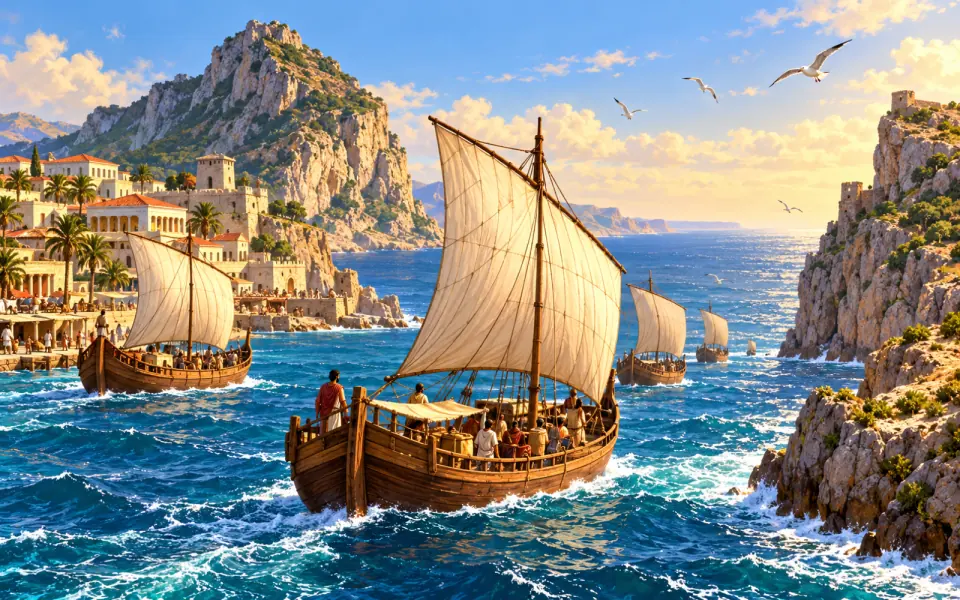 AfterSailing beyond Gibraltarabout 500 BC
Listen / Read next
- Music to read by: Cinematic JourneyEpic film-style music, no lyrics, by Ciro Simone IrmiciSpotifyYouTube Music
Meanwhile, elsewhere in the world
Other events of the era “Sea civilisations”
- Minoan civilisation on Crete
- The palace of Knossos
- The Proto-Sinaitic alphabet
- The eruption of Thera
- The nuraghi of Sardinia
- The gold mask of Mycenae
- Linear B
- The Lion Gate at Mycenae
- The Iron Age begins
- The Phoenicians spread out
- Phoenician purple
- The Phoenician alphabet
- The Kingdom of Israel
- Phoenician seafaring
- Traditional founding of Carthage
- The Nora Stone
- Amphorae for oil and wine
- Homer's poems are written down
- Greek colonies in the West
- The Etruscans, lords of the Tyrrhenian Sea
- Phoenician glass spreads
- Coins in the Mediterranean
- The Babylonian Exile
- Sailing beyond Gibraltar
