Phoenician glass spreads
about 600 BC Sidon and Tyre (now Lebanon)
In short
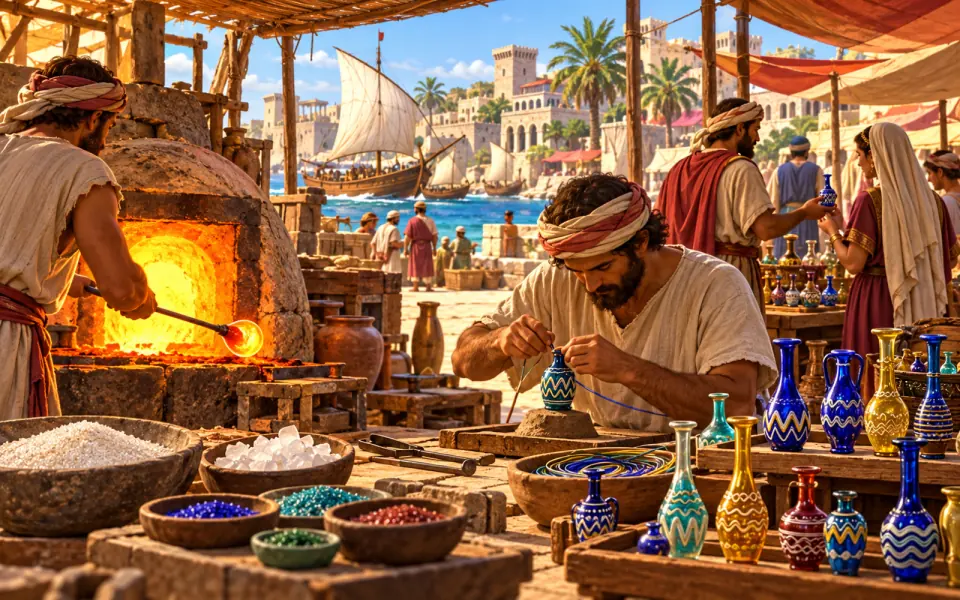
Glass was made by melting sand and soda at very high temperatures. Phoenician craftsmen shaped small coloured bottles around a clay core, decorated them with zigzag threads of glass and sold them filled with perfumes and ointments. The Roman writer Pliny tells that glass was discovered by chance by Phoenician merchants on a beach, but it is only a legend. Blown glass would come much later, in Roman times.
Why it matters The Phoenicians turned glass from a rarity for the few into goods sold all over the Mediterranean.
Source: The Corning Museum of Glass, history of ancient glass
Study card about 5 minutes of reading
The story
A material that seems like magic
Glass is made of very ordinary things, such as sand and the ash of certain plants, but when it is heated to very high temperatures it turns into a transparent, shining material that, when molten, can be shaped. To the people of antiquity it must have seemed like magic. Archaeologists do not know exactly where it was first made. The best evidence points to the coast of northern Syria, Mesopotamia or Egypt. The oldest glass objects we know date from the middle of the 3rd millennium BC, and they are beads.
Ancient glass was made with sand and a substance that helps it melt, soda, obtained from the ash of plants that grow on the coasts. In Egypt and Syria it was done this way; later, in northern Europe, it was replaced by potash, obtained from wood ash. In the Mediterranean soda remained the main ingredient.
How a little vase was made
How do you make a glass container without yet knowing how to blow glass? The ancient masters used the “core” technique. First they shaped a small form out of clay and sand, as big as the inside of the future vase, and fixed it to the end of a metal rod. Then they wound threads of molten glass around the core, in layers. The piece was heated again to make the threads stick, and then, once the vase had cooled, the core was scraped away, leaving the hollow inside. The glassmaker could add threads of other colours and drag them with a point to make zig-zag or festoon decorations, and then attach handles and a foot.
This technique arose, according to the sources, in Mesopotamia in the 16th century BC and was taken up in Egypt. Between the end of the 6th and the 5th century BC it was very widespread in the eastern Mediterranean, and the little vases can be seen today in many museums: small bottles shaped like an amphora or an alabastron, meant for perfumes, oils and ointments. The Metropolitan Museum in New York, for example, keeps an alabastron-shaped flask from the end of the 6th to the 5th century BC with yellow and turquoise zig-zag threads.
Were they really Phoenician?
Here we must be careful. For a long time books said that the coloured flasks were Phoenician production. In reality museums, when they describe them, give a general origin in the eastern Mediterranean, and for some the Greek island of Rhodes has been proposed. It is not proven that a single people made them. It is likely that Phoenician craftsmen, in particular those of cities such as Sidon and Tyre, were among the producers, but the same type of vase was made in various parts of the region.
A story told by Pliny
The Roman writer Pliny the Elder tells a fascinating story. Some Phoenician merchants, landing on the beach near the river Belus with a cargo of natron (a salt used as soda), had no stones to support their pots over the fire and used blocks of natron. The heat made the natron melt with the sand of the beach, and a transparent liquid flowed out: glass. But it is almost certainly a legend. Scholars think it reflects the glass production of the Roman world, which greatly prized the white sand of that area, more than the real origin. Glass had existed for many centuries before the Phoenicians.
Blown glass
The great revolution came later. In the 1st century BC, on the coast of Syria and Palestine, glassblowing was invented: the glassmaker takes a lump of molten glass on a blowpipe and blows into it, like a soap bubble, giving it the shape he wants. The oldest traces of this technique have been found in Jerusalem, and the glassmakers' workshops of the region quickly spread it through the eastern Mediterranean. From then on glass became so cheap and common that it has been said “glass was the plastic of the Romans”. Around AD 100 the use of manganese dioxide made it possible to obtain clear glass, suitable for windows.
Why it happened
Glass arose, in Syria, Mesopotamia or Egypt, from the skill of craftsmen expert at mastering fire: the same who worked pottery and metals. We do not know the exact discovery, but we know that the oldest objects, the beads, were small ornaments.
The spread of glass in the Mediterranean depended on trade. Containers of perfumes and ointments, luxury goods, travelled by sea together with their contents. The more the merchants sold them, the more workshops opened in the ports of Syria, Phoenicia and the Greek islands, and the more the technique improved.
What changed
From core-formed glass people went on to blown glass, which changed the world. Bottles, drinking glasses, vases and, later, windows and lenses became everyday things. Without glass we would have no spectacles, microscopes, telescopes, light bulbs or screens.
Ancient glass also teaches us a great deal about exchanges between peoples. The coloured little vases have been found in tombs and sanctuaries of many Mediterranean countries, a sign of wide trade. Archaeologists use them to date sites and to understand how luxury objects travelled.
Today, in museums, a glass flask more than two thousand years old still keeps its colours. This makes glass one of the most precious materials for archaeologists: it lasts a very long time, and it tells of the taste and technique of those who made it.
Key people and places
People
- Pliny the Elder
- Roman writer of the 1st century AD who told the legend of the Phoenician merchants and glass.
- Glassmakers of Sidon and Tyre
- Craftsmen of the Phoenician cities, probable producers of glass, although we cannot attribute all the little vases to them.
Places
- Sidon
- A Phoenician city on the coast of Lebanon.
- Tyre
- Another great Phoenician city on the coast of Lebanon.
- River Belus
- A river on the eastern coast of the Mediterranean where, according to the legend told by Pliny, Phoenician merchants discovered glass.
- Jerusalem
- The city where the oldest traces of blown glass have been found.
Good to know
- The oldest known glass objects are beads, about 4,500 years old.
- To make an ancient little vase, threads of hot glass were wound around a clay core, then scraped away.
- The story of the Phoenician merchants discovering glass on the beach is a legend told by Pliny.
- Blown glass was invented in the 1st century BC on the coast of Syria and Palestine.
- Glass is said to have been the “plastic of the Romans”, because it became an everyday material.
Find out more
- Wikipedia, “Glass” en.wikipedia.org
- Wikipedia, “Roman glass” en.wikipedia.org
- Wikipedia, “Glassblowing” en.wikipedia.org
- Wikipedia, “History of glass” en.wikipedia.org
Related events
- Phoenician purpleabout 1100 BC · Sea civilisationsPurple was another luxury product of the Phoenician cities.
- The Phoenicians spread outabout 1200 BC · Sea civilisationsThe Phoenicians sold glass all over the Mediterranean.
- Spectaclesabout 1286 · Late Middle AgesSpectacles are an invention made possible by worked glass.
- Galileo turns his telescope to the sky1609 · Early modern ageGalileo used glass lenses to build his telescope.
- Amphorae for oil and wineabout 800 BC · Sea civilisationsAmphorae and little vases travelled together on the same ships.
Before and after, in the era “Sea civilisations”
Event 22 of 25
 BeforeMinoan civilisation on Creteabout 2000 BC
 BeforeThe palace of Knossosabout 1900 BC
 BeforeThe Proto-Sinaitic alphabetabout 1800 BC
 BeforeThe eruption of Theraabout 1600 BC
 BeforeThe nuraghi of Sardiniaabout 1600 BC
 BeforeThe gold mask of Mycenaeabout 1550 BC
 BeforeLinear Babout 1450 BC
 BeforeThe Lion Gate at Mycenaeabout 1250 BC
 BeforeThe Iron Age beginsabout 1200 BC
 BeforeThe Phoenicians spread outabout 1200 BC
 BeforePhoenician purpleabout 1100 BC
 BeforeThe Phoenician alphabetabout 1050 BC
 BeforeThe Kingdom of Israelabout 1000 BC
 BeforePhoenician seafaringabout 1000 BC
 BeforeThe Villanovan culture in Italyabout 900 BC
 BeforeTraditional founding of Carthageabout 814 BC
 BeforeThe Nora Stoneabout 800 BC
 BeforeAmphorae for oil and wineabout 800 BC
 BeforeHomer's poems are written downabout 750 BC
 BeforeGreek colonies in the Westabout 750 BC
 BeforeThe Etruscans, lords of the Tyrrhenian Seaabout 700 BC
- You are herePhoenician glass spreadsabout 600 BC
 AfterCoins in the Mediterraneanabout 600 BC
 AfterThe Babylonian Exileabout 586 BC
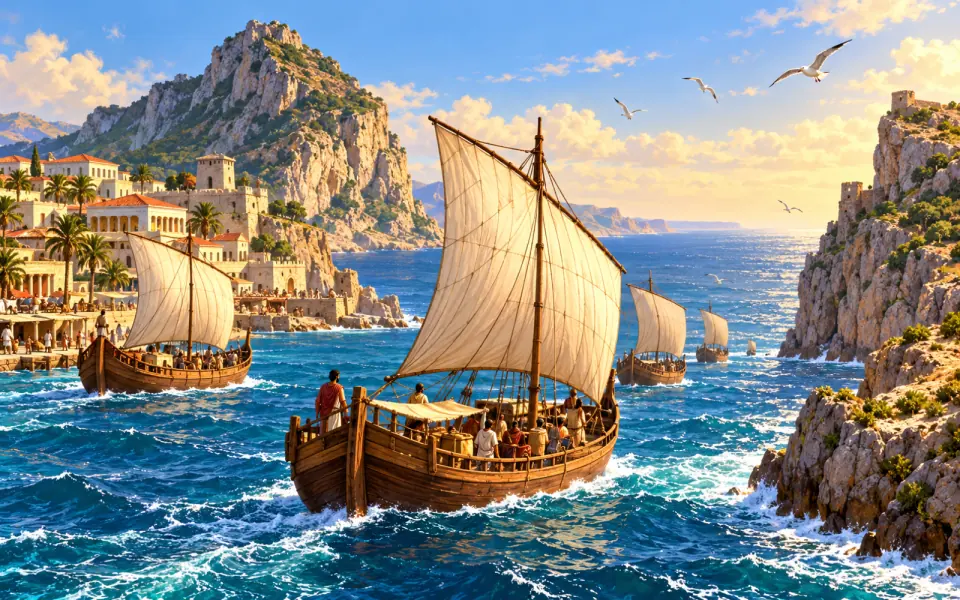 AfterSailing beyond Gibraltarabout 500 BC
Listen / Read next
- Music to read by: Cinematic JourneyEpic film-style music, no lyrics, by Ciro Simone IrmiciSpotifyYouTube Music
Meanwhile, elsewhere in the world
Other events of the era “Sea civilisations”
- Minoan civilisation on Crete
- The palace of Knossos
- The Proto-Sinaitic alphabet
- The eruption of Thera
- The nuraghi of Sardinia
- The gold mask of Mycenae
- Linear B
- The Lion Gate at Mycenae
- The Iron Age begins
- The Phoenicians spread out
- Phoenician purple
- The Phoenician alphabet
- The Kingdom of Israel
- Phoenician seafaring
- The Villanovan culture in Italy
- Traditional founding of Carthage
- The Nora Stone
- Amphorae for oil and wine
- Homer's poems are written down
- Greek colonies in the West
- The Etruscans, lords of the Tyrrhenian Sea
- Coins in the Mediterranean
- The Babylonian Exile
- Sailing beyond Gibraltar
