Phoenician seafaring
about 1000 BC Sidon (now Lebanon) and Mediterranean sea routes
In short
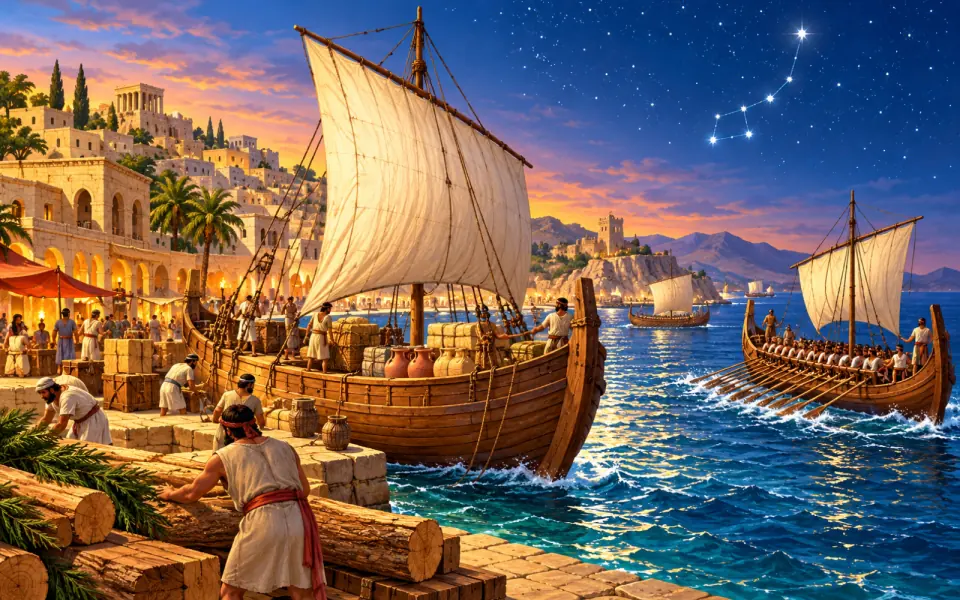
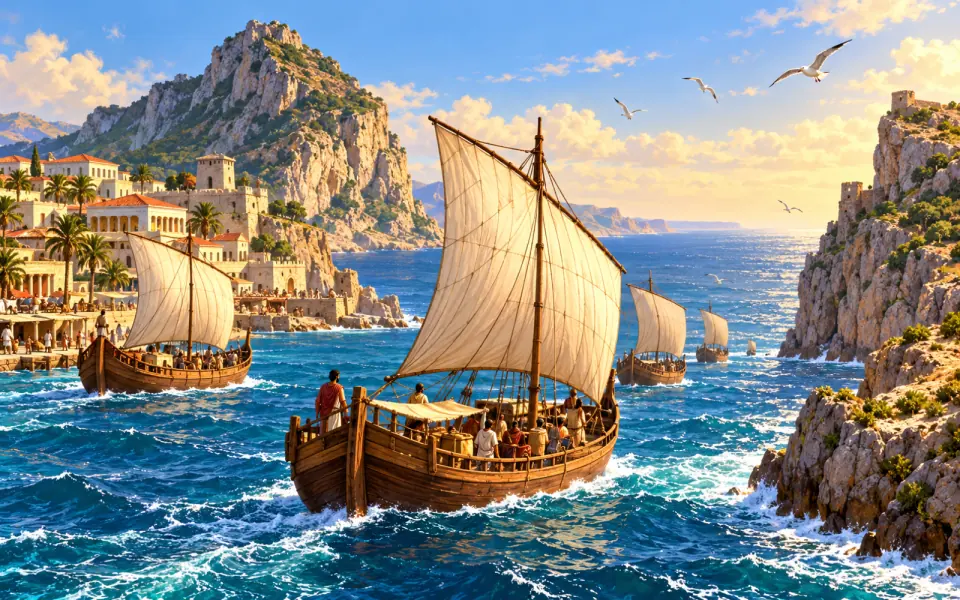
Phoenician cargo ships were broad and round-bellied, while warships were narrow and fast, driven by rows of oarsmen. To find their way at night, Phoenician sailors looked at the stars of the Little Bear, which the Greeks actually called ‘the Phoenician’. They usually sailed along the coasts and stopped in harbours for the night, but they could also cross the open sea. They built their hulls from cedar of Lebanon, a strong, sweet-smelling wood.
Why it matters Their knowledge of the sea and the stars was passed on to the Greeks and Romans.
Source: Encyclopaedia Britannica, “Phoenicia”
Study card about 5 minutes of reading
The story
A people who lived on ships
If we had to choose a single trade for the Phoenicians, it would be sailor. Their cities faced the sea, there was little farmland, and the wood for ships, the cedar of the Lebanon mountains, stood a short way from the harbours. From the beginning of the 2nd millennium BC, as the Treccani encyclopedia notes, the Phoenician cities lived mainly by maritime trade. For many centuries, between Egypt, Spain and Sicily, many of the ships you met on the Mediterranean were Phoenician.
What the ships were like
We have no complete Phoenician ship: wood rots under water and archaeologists have found only wrecks and fragments. We therefore have to reconstruct the hulls from drawings, reliefs and the few wrecks discovered. We know that cargo ships had a deep, rounded hull, to hold a lot of goods. They moved by oars and with a large square sail. The Greeks called them gauloi. Warships were instead long and narrow, with rows of rowers, in order to be fast. The techniques of Phoenician builders spread throughout the Mediterranean and were imitated by other peoples.
A wreck of the 7th century BC (perhaps the early 6th), discovered at Mazarrón, near Cartagena, in Spain, shows that ships of this kind could face long routes.
How they found their way
For a long time people thought the Phoenicians sailed only by day and close to the coast, stopping in harbour in the evening. Today historians have corrected this idea: they also used the Sun, the winds, the currents and the stars. It is said that their reference point was the pole star, in the constellation of the Little Bear, and according to one tradition the Greeks even called it “the Phoenician”. It is not well proven, however, that they were the first to use it at night, and it should be taken as tradition, not as sure fact. They moved with caution in any case, between harbours and coasts that they knew.
Round Africa?
The most fascinating story concerns a voyage that perhaps took place, and perhaps did not. It is told by the Greek historian Herodotus, in the 5th century BC. According to him, the pharaoh Necho II (who reigned from about 610 to 595 BC) sent Phoenician sailors from the Red Sea with an order: to sail south, go round Libya, that is, Africa, and return to Egypt through the Pillars of Hercules, the Strait of Gibraltar.
The voyage, says Herodotus, lasted three years. Each autumn the sailors landed at a suitable spot on the coast, sowed a patch of land and waited for the harvest. Then they cut the grain, loaded it and set off again. In the third year they passed the Pillars of Hercules and came back to Egypt. They also reported something that seemed incredible to Herodotus: as they sailed west, round the southern tip of Africa, they had the Sun on their right, that is, to the north. Herodotus writes that he does not believe it. For us that detail is the most convincing clue: if the sailors were really in the southern hemisphere, the Sun was indeed to the north. An invented story would hardly have predicted it.
Scholars remain divided. Herodotus is the only ancient source, no material proof has been found along the African coast, and Greek and Roman authors already doubted it. It remains, then, a voyage that is plausible but not proven.
Towards the Atlantic
Two voyages are attributed to the Carthaginians, descendants of the Phoenicians: that of Hanno along the coast of West Africa and that of Himilco to the north, along the coasts of Atlantic Europe. We discuss them in another card. They show that the Phoenician seafaring tradition continued at Carthage, and that the Mediterranean was no longer enough for people who knew how to sail.
A famous siege
When Alexander the Great besieged Tyre, in 332 BC, the city defended itself for about seven months before surrendering. After that the routes of the Mediterranean passed largely into the hands of other peoples, first the Greeks and then the Romans.
Why it happened
The Phoenicians had to sail to live. Their cities had little land, and almost everything they needed (grain, metals, precious stones) had to be sought elsewhere, and paid for with timber, glass, cloth and purple. A people with these needs, on a coast full of natural harbours, became expert at sea.
The cedar of Lebanon made the difference. It was a hardy wood, easy to work, and the mountains were close to the shipyards. Building ships stronger and roomier than those of their rivals meant being able to carry more goods and travel further. With experience, each generation of sailors improved the techniques and handed them on to the next.
What changed
Phoenician seafaring united the Mediterranean. Ships carried goods, but also writing, techniques, religious and artistic ideas. Where the Phoenicians stopped, ports and colonies were born, some of which have become cities that still exist today, such as Cadiz.
The Greeks and Romans, who learned a great deal from the Phoenicians and their Carthaginian descendants, used the same routes and similar techniques for their trade and their wars. The naval history of the Mediterranean continues without a break from those sailors to our own day.
The story of the voyage round Africa has become a famous example of how historians work: an ancient text, a detail that seems incredible to its author but that today looks to us like a clue to the truth, and no final proof. It reminds us that the past is reconstructed with patience, accepting that we do not know everything.
Key people and places
People
- Necho II
- Egyptian pharaoh who reigned from about 610 to 595 BC: according to Herodotus he sent the Phoenicians to sail round Africa.
- Herodotus
- Greek historian of the 5th century BC who tells of the voyage and says he does not quite believe it.
- Hanno
- Navigator of Carthage who explored the Atlantic coast of Africa, probably in the 5th century BC.
- Himilco
- Navigator of Carthage who is said to have explored the Atlantic coasts of Europe.
Places
- Sidon and Tyre
- The two great port cities of Phoenicia, from which the ships set out.
- Lebanon Mountains
- Mountains with cedar forests, the wood used to build ships.
- Pillars of Hercules
- Ancient name of the Strait of Gibraltar, the gateway to the Atlantic Ocean.
Good to know
- No Phoenician ship has been found complete: we know them from drawings, reliefs and wrecks.
- Herodotus tells that Necho's sailors sowed and harvested grain along the African coast during the voyage.
- The detail of the Sun “on the right” is for modern scholars a clue in favour of the account, even though Herodotus did not believe it.
- The Greeks called Phoenician cargo ships gauloi.
- Tyre held out against Alexander the Great for about seven months.
Find out more
- Wikipedia, “Phoenicians” en.wikipedia.org
- World History Encyclopedia, “Phoenicia” worldhistory.org
- Livius.org, Herodotus on the first circumnavigation of Africa livius.org
- Wikipedia, “Phoenicia” en.wikipedia.org
Related events
- The Phoenicians spread outabout 1200 BC · Sea civilisationsPhoenician expansion was born from the routes of these ships.
- Sailing beyond Gibraltarabout 500 BC · Sea civilisationsThe Carthaginians pushed the routes beyond Gibraltar.
- Traditional founding of Carthageabout 814 BC · Sea civilisationsCarthage, a Phoenician colony, inherited the seafaring tradition.
- Amphorae for oil and wineabout 800 BC · Sea civilisationsAmphorae were the typical cargo of the ships.
- The conquests of Alexander334–323 BC · Ancient GreeceAlexander besieged Tyre in 332 BC during his conquests.
Before and after, in the era “Sea civilisations”
Event 14 of 25
 BeforeMinoan civilisation on Creteabout 2000 BC
 BeforeThe palace of Knossosabout 1900 BC
 BeforeThe Proto-Sinaitic alphabetabout 1800 BC
 BeforeThe eruption of Theraabout 1600 BC
 BeforeThe nuraghi of Sardiniaabout 1600 BC
 BeforeThe gold mask of Mycenaeabout 1550 BC
 BeforeLinear Babout 1450 BC
 BeforeThe Lion Gate at Mycenaeabout 1250 BC
 BeforeThe Iron Age beginsabout 1200 BC
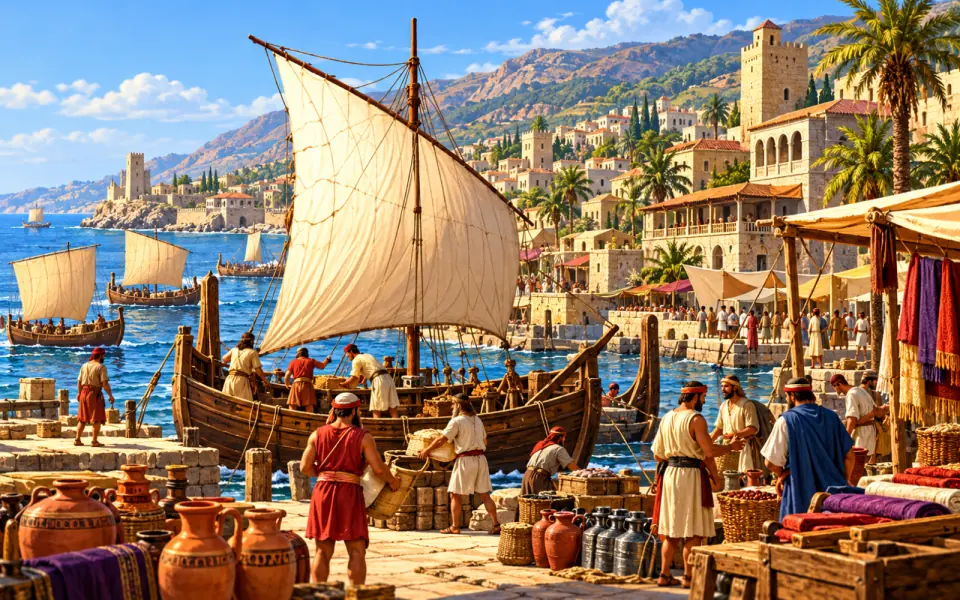 BeforeThe Phoenicians spread outabout 1200 BC
 BeforePhoenician purpleabout 1100 BC
 BeforeThe Phoenician alphabetabout 1050 BC
 BeforeThe Kingdom of Israelabout 1000 BC
- You are herePhoenician seafaringabout 1000 BC
 AfterThe Villanovan culture in Italyabout 900 BC
 AfterTraditional founding of Carthageabout 814 BC
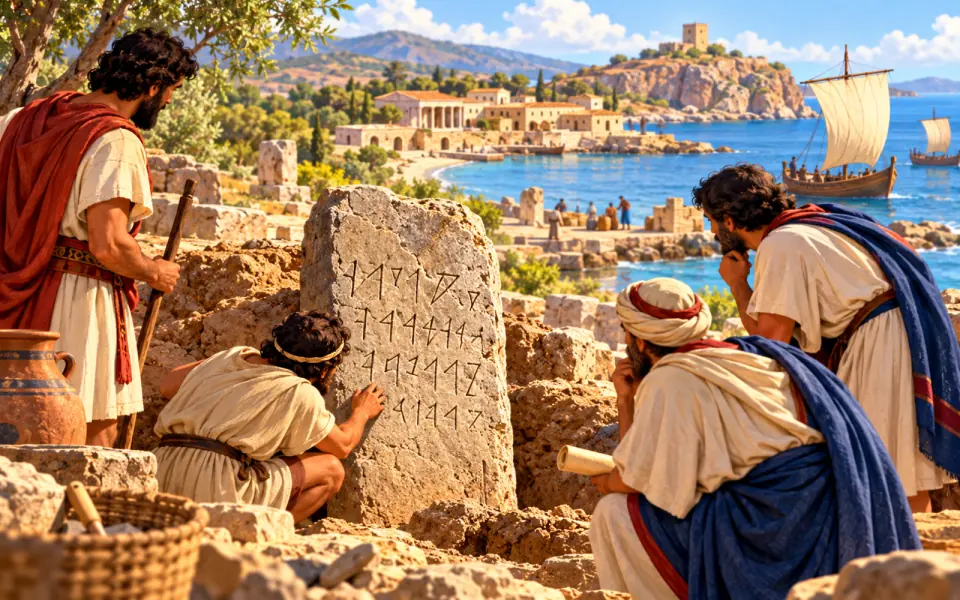 AfterThe Nora Stoneabout 800 BC
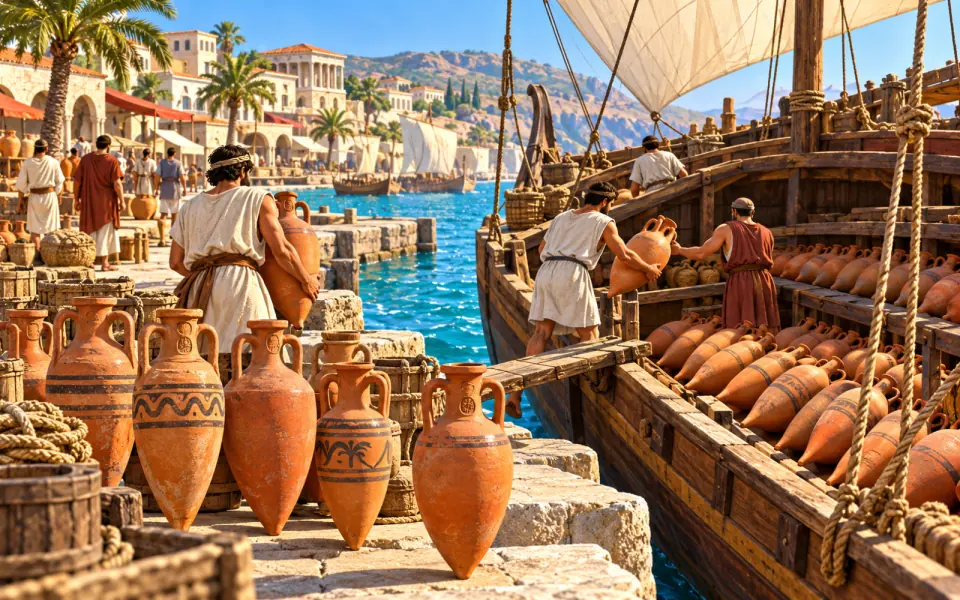 AfterAmphorae for oil and wineabout 800 BC
 AfterHomer's poems are written downabout 750 BC
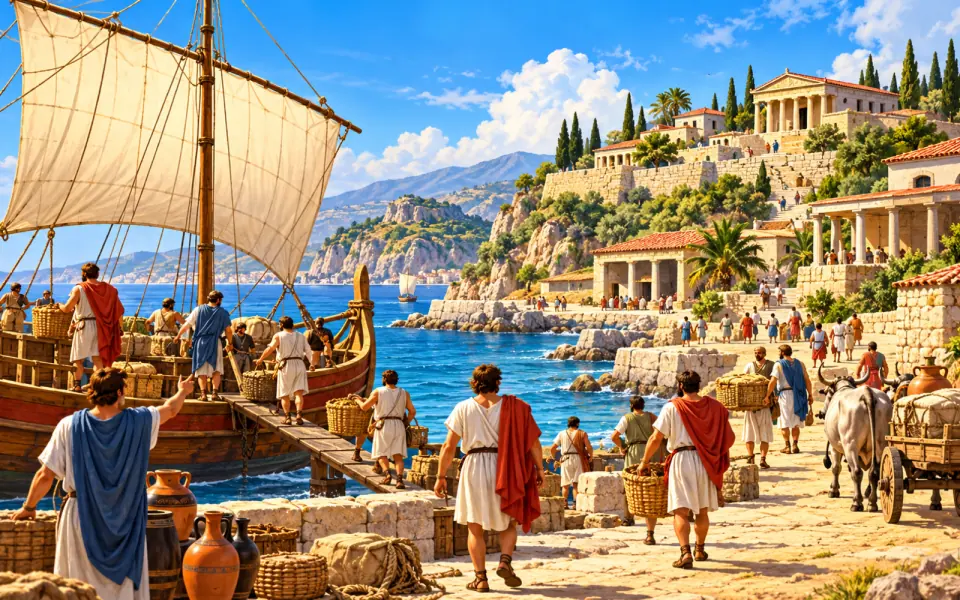 AfterGreek colonies in the Westabout 750 BC
 AfterThe Etruscans, lords of the Tyrrhenian Seaabout 700 BC
 AfterPhoenician glass spreadsabout 600 BC
 AfterCoins in the Mediterraneanabout 600 BC
 AfterThe Babylonian Exileabout 586 BC
 AfterSailing beyond Gibraltarabout 500 BC
Listen / Read next
- Music to read by: Cinematic JourneyEpic film-style music, no lyrics, by Ciro Simone IrmiciSpotifyYouTube Music
Other events of the era “Sea civilisations”
- Minoan civilisation on Crete
- The palace of Knossos
- The Proto-Sinaitic alphabet
- The eruption of Thera
- The nuraghi of Sardinia
- The gold mask of Mycenae
- Linear B
- The Lion Gate at Mycenae
- The Iron Age begins
- The Phoenicians spread out
- Phoenician purple
- The Phoenician alphabet
- The Kingdom of Israel
- The Villanovan culture in Italy
- Traditional founding of Carthage
- The Nora Stone
- Amphorae for oil and wine
- Homer's poems are written down
- Greek colonies in the West
- The Etruscans, lords of the Tyrrhenian Sea
- Phoenician glass spreads
- Coins in the Mediterranean
- The Babylonian Exile
- Sailing beyond Gibraltar
