The conquests of Alexander
334–323 BC From Macedonia (Pella) to India
In short
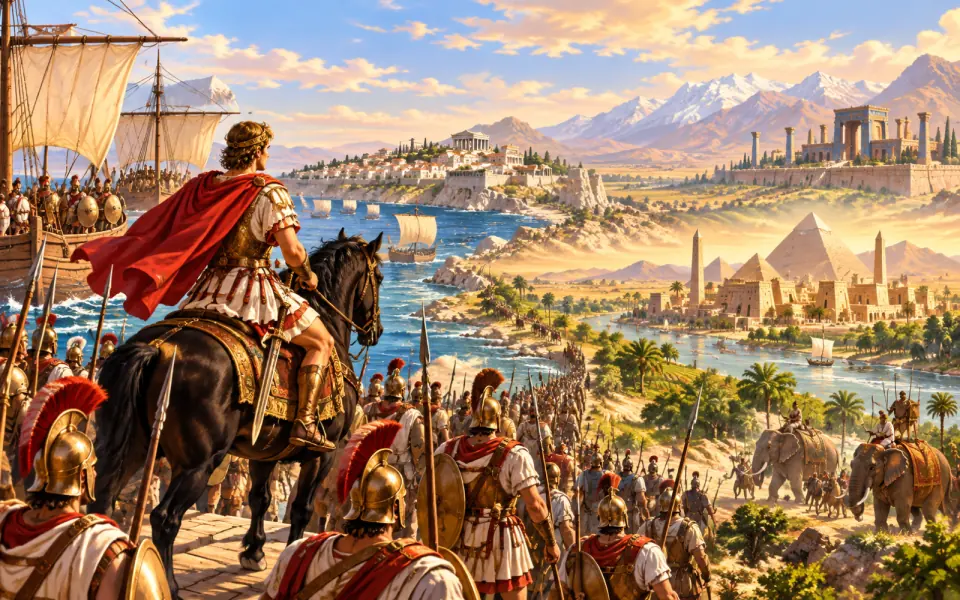
Alexander, King of Macedonia at twenty, crossed the Hellespont with his army in 334 BC to attack the Persian Empire. In a few years he conquered Asia Minor, Egypt, Mesopotamia and Persia, reaching as far as the River Indus. He founded many cities bearing his name, the most famous being Alexandria in Egypt. He died in Babylon in 323 BC, aged only 32, and his empire was divided among his generals.
Why it matters His conquests spread the Greek language and culture from the Mediterranean to Central Asia.
Source: Encyclopaedia Britannica, “Alexander the Great”
Study card about 6 minutes of reading
The story
A prince of Pella
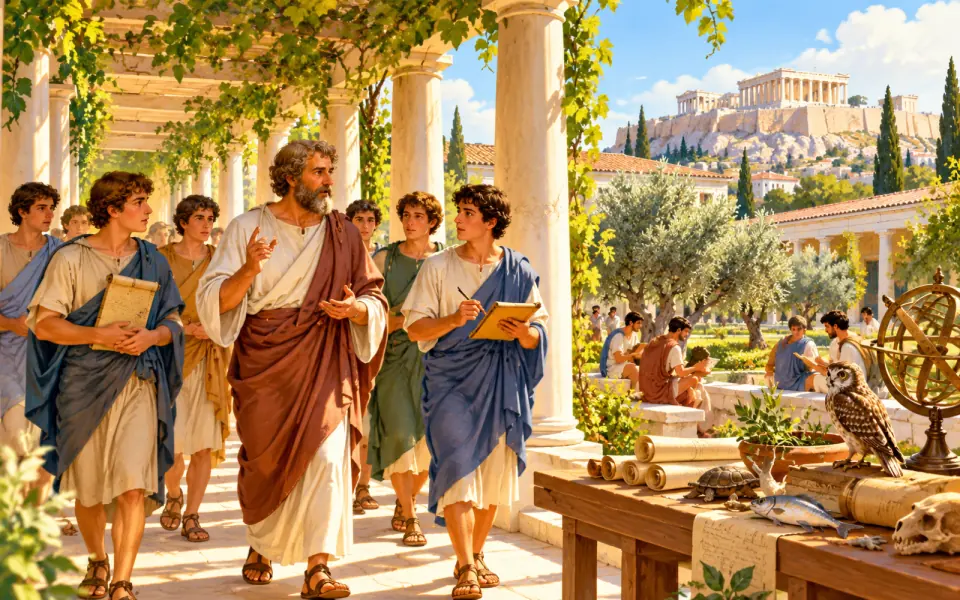
Alexander was born at Pella, the capital of Macedon, in July 356 BC. His father was King Philip II, a very able ruler who had turned Macedon into a power and had subdued the Greek cities; his mother was Olympias, a princess of Epirus. As a boy he had Aristotle as his teacher, for about three years. A famous story tells of Bucephalus, a magnificent horse that nobody could ride. Alexander, at about twelve, tamed it, and the horse stayed with him until its death, in 326 BC.
In 336 BC Philip was assassinated, and Alexander, at only twenty, became king. Then, with the Macedonian army, he decided to carry out his father's plan: to attack the Persian empire.
From Greece to Egypt
In the spring of 334 BC he crossed the Hellespont, the strait that separates Europe from Asia, with his army. The first clash was at the river Granicus: he won, although he risked his life (a sword blow to his helmet narrowly missed him), and sent three hundred enemy suits of armour to Athens as a trophy. In 333 BC, at Issus, he faced King Darius III in person. Darius fled from the battlefield and Alexander captured his family. The ancient sources speak of more than a hundred thousand Persians dead, but modern historians think the figure exaggerated; the Macedonians had, according to the historian Curtius Rufus, about 150 dead.
Then the march went on southwards. The Phoenician city of Tyre resisted for about seven months, in 332 BC, and then Alexander took Gaza too. When he reached Egypt, at the end of that year, he was welcomed as a liberator and recognised as pharaoh. Here, in the Nile delta, he founded the city of Alexandria, planned with the help of the architect Dinocrates of Rhodes. It was the first of many cities that bore his name. He also made a long journey across the desert to the oasis of Siwa, where there was an oracle of the god Ammon: the sources do not agree on what the oracle said.
The fall of the Persian empire
On 1 October 331 BC, at Gaugamela, the decisive clash took place. The Persians were far more numerous: ancient historians speak of hundreds of thousands of soldiers, against about 40,000 Macedonian infantry and 7,000 cavalry (modern historians, however, think of many fewer Persians, between 50,000 and 120,000). Alexander won again, and Darius fled. The Macedonian king entered Babylon and Susa, where he seized enormous quantities of silver and gold. In January 330 BC he reached Persepolis, one of the king's palaces, which was devastated by a fire: the sources debate whether it was ordered or accidental. In the summer of the same year Darius III was killed by his own satraps, the governors of the provinces. Alexander found him dead and gave him a royal burial.
Towards India
Alexander did not stop. He pushed into Central Asia, into Bactria and Sogdiana, where he faced revolts that lasted a long time. In 327 BC he married Roxane, the daughter of a local noble, who was sixteen. In the spring of 326 BC he marched towards India. On the river Hydaspes he defeated King Porus in a hard and bloody battle and founded two cities, one of them Alexandria Bucephalus, in honour of his horse.
Further on, on the river Hyphasis, the army mutinied. The men, tired after years of marches and battles, refused to go any further east. Alexander had to give way. He went down the river Indus to its mouth and then turned back, crossing the harsh Gedrosian desert, while a fleet led by Nearchus explored the Persian Gulf.
A sudden end
In 324 BC, at Susa, Alexander organised a great mass wedding: eighty officers married Persian noblewomen and ten thousand veterans married local women. He wanted to unite Macedonians and Persians into a single people. A few months later his dearest friend, Hephaestion, died. Alexander fell ill at Babylon and died on 10 June 323 BC, shortly before turning thirty-three. The cause is still debated today: malaria, typhoid, poisoning and much else have been suggested, but none is certain.
According to tradition, when asked who should succeed him he answered with a confused phrase that can be understood as “to the strongest”. None of his heirs managed to hold the empire together. Wars broke out between his generals, the Diadochi, that is the “successors”. Ptolemy became pharaoh of Egypt, Seleucus founded the Seleucid empire in 305 BC, Cassander governed Macedon from 316 and became its king in 305 BC.
Why it happened
Philip II had created a new, disciplined and powerful army, and had already united Greece under his command. His plan was to bring war to the Persian empire. When he was assassinated, Alexander had no choice but to carry it on.
Alexander's character weighed too: ambitious and brave, he was wounded several times, as at Issus and Gaza, and at the Granicus he risked his life. The vast Persian empire proved more fragile than it seemed: three great battles, the Granicus, Issus and Gaugamela, were enough to change the balance.
What changed
Alexander's empire did not survive his death, but what he had set in motion changed the world. In the conquered lands kingdoms ruled by Greek and Macedonian dynasties arose, the Hellenistic kingdoms, in Egypt, Syria, Mesopotamia and other regions. In the new cities people spoke Greek, built theatres and gymnasia, and people of different nations met and exchanged ideas.
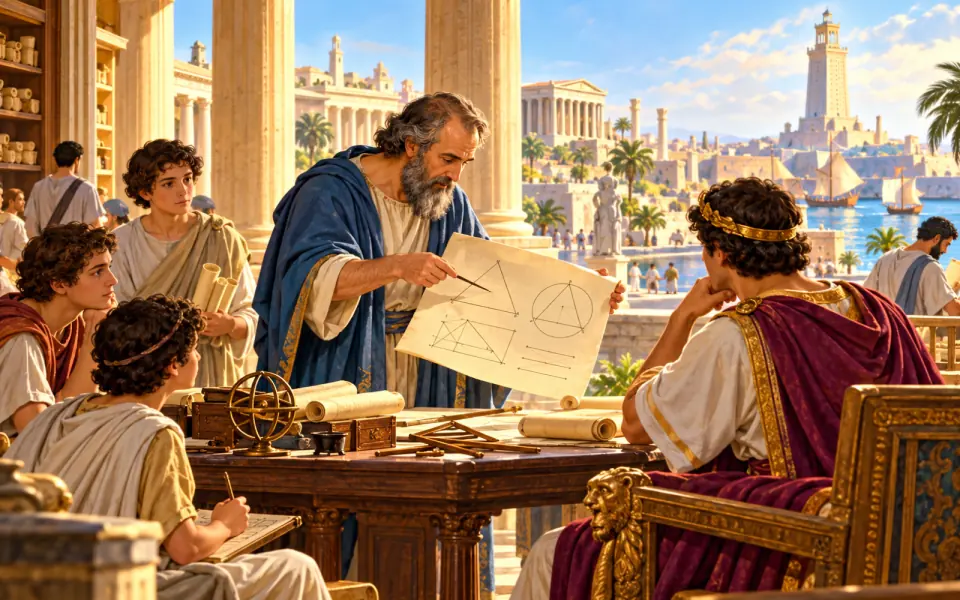
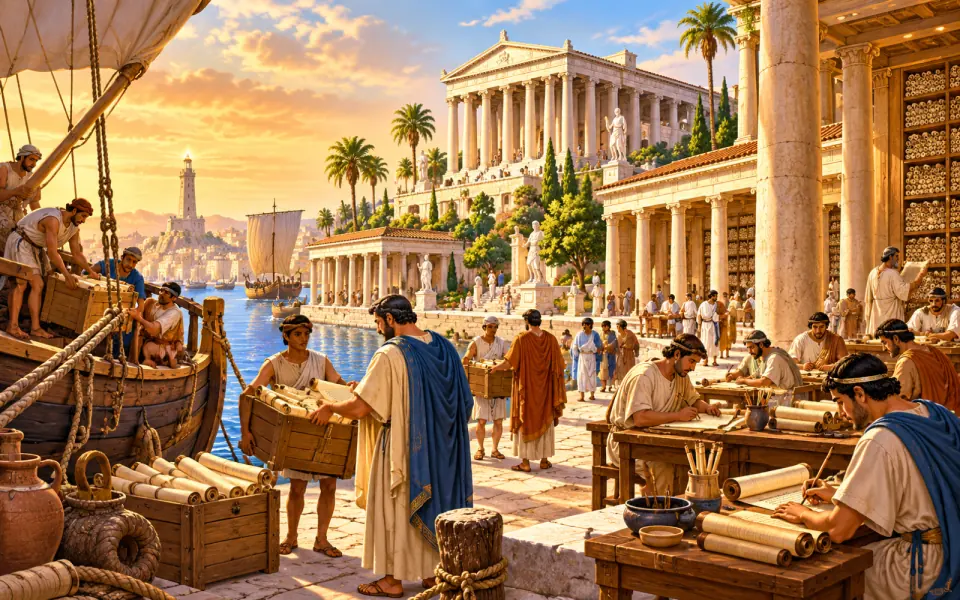
This period is called the Hellenistic age. In cities like Alexandria in Egypt science and letters flourished, with the Library and the Museum, and mathematicians like Euclid appeared. The Greek language became an international language for centuries.
The conquests also had a terrible cost: many cities were destroyed and very many people lost their lives or their freedom. Historians today try not to make Alexander simply a hero: he was a great commander, but his wars brought grief and destruction. Even today his name is legend, and the question of what would have happened had he lived longer fascinates those who study history.
Key people and places
People
- Alexander the Great
- King of Macedon from 336 BC, died at Babylon in 323: he conquered the Persian empire.
- Philip II
- His father, king of Macedon, who united Greece under his command.
- Darius III
- The last king of the Persian empire, defeated at Issus and Gaugamela and killed in 330 BC.
- Porus
- Indian king defeated by Alexander on the river Hydaspes in 326 BC.
- Roxane
- Princess of Bactria whom Alexander married in 327 BC.
Places
- Pella
- The capital of Macedon where Alexander was born.
- Alexandria, Egypt
- The city founded at the end of 332 BC in the Nile delta, which became a great centre of culture.
- Gaugamela
- A place in Mesopotamia where the great Persian army was defeated in 331 BC.
- Babylon
- The great Mesopotamian city where Alexander died on 10 June 323 BC.
- River Hydaspes
- Site of the battle against King Porus, in north-western India.
Good to know
- Alexander became king at twenty and died before the age of thirty-three.
- His horse Bucephalus, according to tradition, was tamed when Alexander was about twelve, and died in 326 BC.
- After the Battle of the Granicus, Alexander sent three hundred enemy suits of armour to Athens as a gift.
- Alexandria in Egypt was planned by the architect Dinocrates of Rhodes.
- At Susa, in 324 BC, a mass wedding was held: eighty Macedonian officers married Persian noblewomen.
Find out more
- Wikipedia, “Alexander the Great” en.wikipedia.org
- Wikipedia, “Battle of Gaugamela” en.wikipedia.org
- Wikipedia, “Hellenistic period” en.wikipedia.org
- Wikipedia, “Wars of the Diadochi” en.wikipedia.org
Related events
- Aristotle founds the Lyceumabout 335 BC · Ancient GreeceAristotle was his teacher.
- Euclid writes the Elementsabout 300 BC · Ancient GreeceEuclid worked in Alexandria, the city founded by Alexander.
- The Library of Alexandriaabout 295 BC · Ancient GreeceThe Library of Alexandria was born in the Hellenistic world created by his conquests.
- The first Greek city-statesabout 800 BC · Ancient GreeceUnder Philip and Alexander the poleis lost their independence.
- The Phoenicians spread outabout 1200 BC · Sea civilisationsAt Tyre, the great Phoenician city, Alexander faced a siege of seven months.
Before and after, in the era “Ancient Greece”
Event 21 of 25
 BeforeThe first Greek city-statesabout 800 BC
 BeforeThe ancient Olympic Gamesabout 776 BC
 BeforeThe Greek alphabetabout 750 BC
 BeforeLife in Spartaabout 700 BC
 BeforeSappho, the poet of Lesbosabout 600 BC
 BeforeThe reforms of Solonabout 594 BC
 BeforeThales studies natureabout 585 BC
 BeforePythagoras at Crotonabout 530 BC
 BeforeCleisthenes and democracyabout 508 BC
 BeforeThe Battle of Marathon490 BC
 BeforeThe Battle of Thermopylae480 BC
 BeforeThe theatre of Aeschylus472 BC
 BeforeThe Age of Pericles461–429 BC
 BeforeThe Parthenon447–432 BC
 BeforeThe Peloponnesian War431–404 BC
 BeforeHerodotus writes the Historiesabout 430 BC
 BeforeHippocrates and medicineabout 400 BC
 BeforeSocrates is condemned399 BC
 BeforePlato's Academyabout 387 BC
 BeforeAristotle founds the Lyceumabout 335 BC
- You are hereThe conquests of Alexander334–323 BC
 AfterEuclid writes the Elementsabout 300 BC
 AfterThe Library of Alexandriaabout 295 BC
 AfterArchimedes of Syracuseabout 250 BC
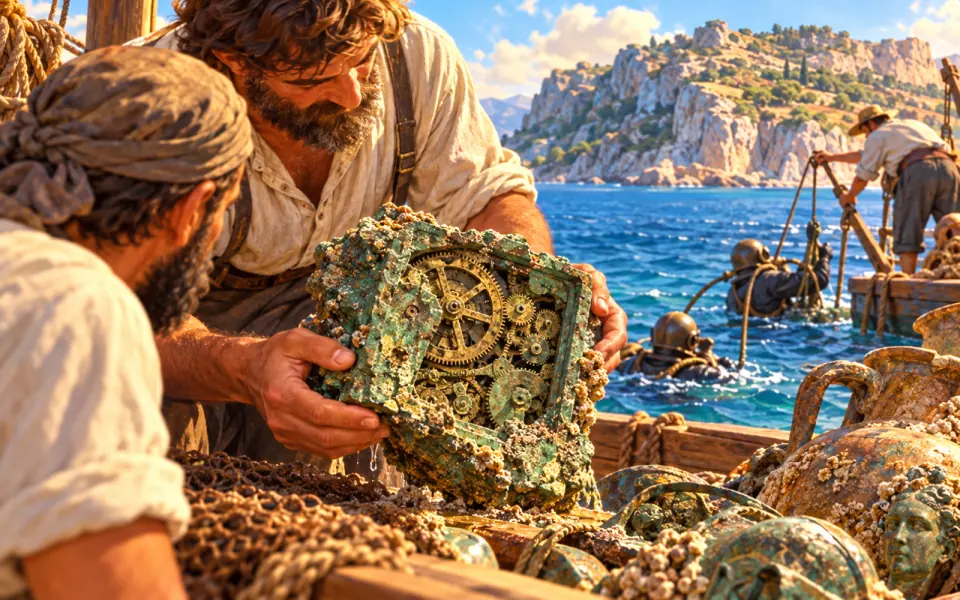 AfterThe Antikythera mechanismabout 100 BC
Listen / Read next
- Music to read by: Cinematic JourneyEpic film-style music, no lyrics, by Ciro Simone IrmiciSpotifyYouTube Music
Meanwhile, elsewhere in the world
Other events of the era “Ancient Greece”
- The first Greek city-states
- The ancient Olympic Games
- The Greek alphabet
- Life in Sparta
- Sappho, the poet of Lesbos
- The reforms of Solon
- Thales studies nature
- Pythagoras at Croton
- Cleisthenes and democracy
- The Battle of Marathon
- The Battle of Thermopylae
- The theatre of Aeschylus
- The Age of Pericles
- The Parthenon
- The Peloponnesian War
- Herodotus writes the Histories
- Hippocrates and medicine
- Socrates is condemned
- Plato's Academy
- Aristotle founds the Lyceum
- Euclid writes the Elements
- The Library of Alexandria
- Archimedes of Syracuse
- The Antikythera mechanism
