The Battle of Thermopylae
480 BC Pass of Thermopylae (Greece)
In short
Ten years after Marathon, the Persian king Xerxes invaded Greece with an enormous army. At the pass of Thermopylae, a narrow strip of land between mountains and sea, the Spartan king Leonidas and a few thousand Greeks held him back for three days. When a traitor showed the Persians a hidden path, Leonidas stayed to fight with his three hundred Spartans and a few allies, and nearly all of them were killed. A few weeks later the Greek fleet won at Salamis.
Why it matters For the Greeks, their sacrifice became the symbol of defending freedom.
Source: Encyclopaedia Britannica, “Battle of Thermopylae”
Study card about 5 minutes of reading
The story
Ten years later
In 490 BC the Athenians had driven back the Persians at Marathon, but the war was not over. The Persian king Darius died and his son, Xerxes I, decided to complete the task: not only to punish Athens, but to conquer Greece. This was the second Persian invasion. For years the empire prepared an enormous army and fleet, and in 480 BC it set them in motion. The Greek cities faced a hard choice: surrender or unite. A group of poleis chose to resist together, and command was given to Sparta, the city with the strongest land army.
A narrow pass between mountain and sea
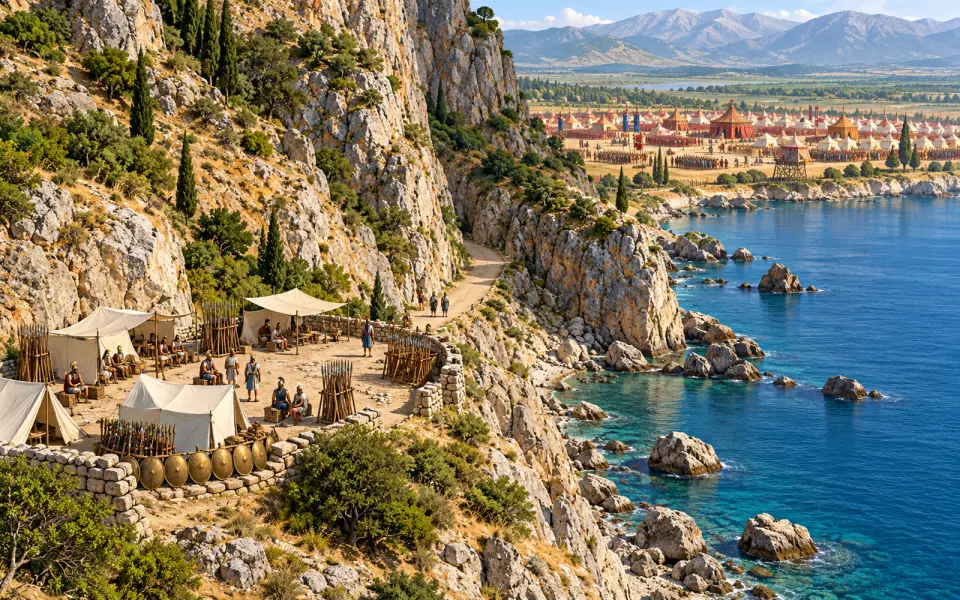
The Greeks decided to stop the Persians at the point where the road from the north into central Greece became narrowest. It was called Thermopylae, between Thessaly and central Greece, between Mount Oeta and the Malian Gulf. There the passage was a strip of land between the mountain and the sea, so narrow that a very large army could not deploy in full. At the same time the Greek fleet was blocking the Persian fleet at Cape Artemisium, not far away, to stop it from outflanking the position by sea.
At Thermopylae the king of Sparta, Leonidas I, was in command. How many men did he have? Herodotus speaks of about 5,200 allies, other ancient authors of more; modern historians think of about 7,000 men in all. Among them were three hundred chosen Spartiates, that is, Leonidas' own soldiers. According to the sources, the Persians were far more numerous. Herodotus gives a fantastic number, over two million soldiers; modern historians estimate between 120,000 and 300,000 men (some even fewer), which is still a great many.
Three days of battle
The battle lasted three days, in mid-August or early September of 480 BC (there are two possible dates, 19–21 August or 8–10 September). On the first two days the Greeks drove back the Persian attacks, including those of the famous “Immortals”, Xerxes' elite troops. In the narrow pass numbers did not count: the Greek soldiers, protected by their shields and long spears, held their position.
But there was a mountain path that went round the pass, called the Anopaea. According to Herodotus a local man named Ephialtes revealed it to the Persians hoping for a reward. His name has become in Greece a synonym for “traitor”. That path was guarded by a thousand soldiers from Phocis, but the Persians took them by surprise and arrived behind the Greeks.
The last day
When Leonidas learned that they were about to be outflanked, he sent most of the army away. He stayed to fight with his three hundred Spartiates, about seven hundred soldiers from the city of Thespiae and a group of Thebans, whose behaviour is unclear. On the third day the Greek rearguard was wiped out. According to Herodotus, very many Persians died in the battle, about twenty thousand, but this number is uncertain too. The victory went to Xerxes, although some historians call it a “costly” victory.
An inscription was later carved at the site, a short epigram composed by the poet Simonides. It asked the traveller to tell the Spartans that their men had fallen obeying the laws of the city. According to one tradition, when the Persian envoy asked Leonidas to hand over his weapons, he answered with the phrase “Molon labe”, “come and take them”. We do not know whether he really said it.
After Thermopylae
The time gained helped the Greeks. After Cape Artemisium the fleet withdrew to the waters of Salamis, in front of Athens, where, towards the end of 480 BC, it defeated the Persian fleet. Xerxes went back to Asia, leaving the general Mardonius in Greece. The following year, 479 BC, the Greeks won the decisive battle at Plataea and Mardonius died. The second invasion was over.
A great memory remained of Thermopylae. A stone lion was set up in honour of Leonidas; forty years later his bones were brought back to Sparta. In 1950 a monument with a bronze statue was put up, and in 1997 another dedicated to the Thespians, who are often forgotten but numbered seven hundred.
Why it happened
The real cause of the battle was the expansion of the Persian empire. After subduing much of Asia, Xerxes wanted to finish his father's enterprise and punish Athens for Marathon. He had the means to do it: an enormous army, a large fleet and the ability to bring food and weapons from far away.
On the Greek side, the choice to stop the Persians at Thermopylae was strategic. A small army could hold out in a narrow pass like that, and the Greek fleet, at Cape Artemisium, prevented the Persian one from landing troops behind the defenders. A more practical fact also weighed: many Greek cities did not want to fight too far from home, and so the plan was to defend themselves halfway.
What changed
From a military point of view, Thermopylae was a defeat: the pass fell and Xerxes could advance towards southern Greece. But the resistance had given time to the Greek fleet, and soon afterwards Salamis changed the course of the war. With the victory at Plataea in 479 BC the Persian threat to mainland Greece ended.
The battle became a symbol. For the Greeks it stood for the courage of those who fight for their own freedom and laws, even knowing they have no hope. That is why Simonides' epigram was remembered for centuries.
Today the story of Thermopylae is very well known, also through books and films that made the “three hundred Spartans” popular. Historians remind us, however, that they were not alone: there were thousands of allies and, to the very end, the seven hundred Thespians. The real lesson is that a lost battle can help to win the war, if it gains time and strengthens the will to resist.
Key people and places
People
- Xerxes I
- King of Persia, son of Darius: he led the second invasion of Greece in 480 BC.
- Leonidas I
- King of Sparta, commander of the Greeks at Thermopylae, where he died with his men.
- Ephialtes of Trachis
- The man who, according to Herodotus, revealed the mountain path to the Persians; his name is a synonym for traitor.
- Simonides
- The poet who wrote the epigram carved in memory of the fallen.
- Mardonius
- Persian general left in Greece by Xerxes; he died at Plataea in 479 BC.
Places
- Thermopylae
- A narrow pass between mountains and sea in central Greece, named after its hot springs.
- Cape Artemisium
- A point on the island of Euboea where the Greek fleet faced the Persian one in those same days.
- Salamis
- Island in front of Athens where the Greek fleet won at the end of 480 BC.
- Anopaea path
- The mountain path that allowed the Persians to outflank the defenders.
Good to know
- The pass of Thermopylae saw other battles: in 279 BC the Greeks tried to stop the Gauls of Brennus, and in 191 BC the Romans defeated King Antiochus III.
- Herodotus speaks of over two million Persian soldiers, but modern historians estimate between 120,000 and 300,000 (some even fewer).
- With the Spartans there were about seven hundred soldiers from Thespiae, who fought to the very end.
- Simonides' epigram asks the passer-by to tell the Spartans that their men lie there because they obeyed the laws.
- The name of Ephialtes has become the symbol of the traitor.
Find out more
- Wikipedia, “Battle of Thermopylae” en.wikipedia.org
- Wikipedia, “Xerxes I” en.wikipedia.org
- Wikipedia, “Herodotus” en.wikipedia.org
- Wikipedia, “Sparta” en.wikipedia.org
Related events
- The Battle of Marathon490 BC · Ancient GreeceMarathon was the first Greek victory against the Persians, ten years earlier.
- The theatre of Aeschylus472 BC · Ancient GreeceAeschylus, in The Persians, told of Xerxes' defeat at Salamis.
- Life in Spartaabout 700 BC · Ancient GreeceSparta and its military education shaped Leonidas' soldiers.
- Herodotus writes the Historiesabout 430 BC · Ancient GreeceHerodotus is our main source on the battle.
- The Peloponnesian War431–404 BC · Ancient GreeceLater Athens and Sparta, allies against the Persians, fought each other.
Before and after, in the era “Ancient Greece”
Event 11 of 25
 BeforeThe first Greek city-statesabout 800 BC
 BeforeThe ancient Olympic Gamesabout 776 BC
 BeforeThe Greek alphabetabout 750 BC
 BeforeLife in Spartaabout 700 BC
 BeforeSappho, the poet of Lesbosabout 600 BC
 BeforeThe reforms of Solonabout 594 BC
 BeforeThales studies natureabout 585 BC
 BeforePythagoras at Crotonabout 530 BC
 BeforeCleisthenes and democracyabout 508 BC
 BeforeThe Battle of Marathon490 BC
- You are hereThe Battle of Thermopylae480 BC
 AfterThe theatre of Aeschylus472 BC
 AfterThe Age of Pericles461–429 BC
 AfterThe Parthenon447–432 BC
 AfterThe Peloponnesian War431–404 BC
 AfterHerodotus writes the Historiesabout 430 BC
 AfterHippocrates and medicineabout 400 BC
 AfterSocrates is condemned399 BC
 AfterPlato's Academyabout 387 BC
 AfterAristotle founds the Lyceumabout 335 BC
 AfterThe conquests of Alexander334–323 BC
 AfterEuclid writes the Elementsabout 300 BC
 AfterThe Library of Alexandriaabout 295 BC
 AfterArchimedes of Syracuseabout 250 BC
 AfterThe Antikythera mechanismabout 100 BC
Listen / Read next
- Music to read by: Cinematic JourneyEpic film-style music, no lyrics, by Ciro Simone IrmiciSpotifyYouTube Music
Meanwhile, elsewhere in the world
Other events of the era “Ancient Greece”
- The first Greek city-states
- The ancient Olympic Games
- The Greek alphabet
- Life in Sparta
- Sappho, the poet of Lesbos
- The reforms of Solon
- Thales studies nature
- Pythagoras at Croton
- Cleisthenes and democracy
- The Battle of Marathon
- The theatre of Aeschylus
- The Age of Pericles
- The Parthenon
- The Peloponnesian War
- Herodotus writes the Histories
- Hippocrates and medicine
- Socrates is condemned
- Plato's Academy
- Aristotle founds the Lyceum
- The conquests of Alexander
- Euclid writes the Elements
- The Library of Alexandria
- Archimedes of Syracuse
- The Antikythera mechanism
