The Battle of Marathon
490 BC Marathon, Attica (Greece)
In short
The Persian king Darius sent a large army against Athens, which had helped the Greek cities that rebelled against him. The Athenians, helped by the small city of Plataea, faced the Persians on the plain of Marathon and won. According to legend, a messenger ran all the way to Athens to announce the victory and died as soon as he arrived. In his memory, the modern Olympics include the marathon, a race of more than 42 kilometres.
Why it matters It showed that the Persians, the greatest empire of the time, could be beaten.
Source: Encyclopaedia Britannica, “Battle of Marathon”
Study card about 6 minutes of reading
The story
A revenge years in the making
The Battle of Marathon begins with a revolt. The Greek cities of Ionia, on the coast of present-day Turkey, were subject to the great Persian empire. Between 499 and 493 BC they rebelled, and Athens and Eretria, a city on the island of Euboea, sent ships to help them. The revolt was crushed, but the king of Persia, Darius I, did not forget the insult. In 490 BC he sent out a naval expedition under the generals Datis and Artaphernes, with the aim of punishing Athens and Eretria. Along the way the Persians took the island of Naxos and destroyed Eretria. Then they landed on the plain of Marathon, about forty kilometres from Athens by road.
The two armies
How many Persians were there? The historian Herodotus speaks of six hundred ships, but does not say how many soldiers landed. Later ancient sources give enormous figures, up to six hundred thousand men, but modern scholars think they are exaggerated. Today's estimates range from 20,000–30,000 infantry, plus cavalry, whose numbers are much debated. The Athenians were about 9,000–10,000 hoplites, the soldiers with shield and spear, helped by about a thousand men from Plataea, a small allied city.
The Athenian army was commanded by ten generals, one per tribe, and by the polemarch Callimachus, a magistrate with military duties. It was Miltiades, one of the ten generals, who got the decree to give battle approved. According to Herodotus, the deciding vote was that of the polemarch Callimachus.
The battle
For a few days the two armies stayed facing each other. Then the Athenians attacked. The exact date is not certain: it is August or September of 490 BC, and some scholars suggest 11 or 12 September. According to the most widely followed reconstruction, the Athenians drew up the centre thinner, four ranks deep, and the wings stronger, eight deep. The centre gave way, as planned, and the advancing Persians pushed into it. The two Athenian wings, meanwhile, had driven back the enemy at the sides; then they closed in like a pair of pincers on the Persian centre, which was surrounded. The Persians fled towards their ships.
Historians still argue about the details. One hypothesis holds that part of the Persian army, including the cavalry, had already been put on board before the clash, to move on Athens by sea. Another recalls a signal made with a shield, given by someone to warn the Persians; Herodotus reports it as a fact, but many modern scholars doubt it.
The dead were 192 Athenians and, according to Herodotus, 6,400 Persians, a number scholars consider uncertain. Among the Athenian dead was Callimachus. Then the Athenians had to move fast: the Persians, back on their ships, tried to reach Athens directly, but the Athenians ran back to the city and prevented a landing. The Persians gave up and returned to Asia.
Pheidippides and the marathon
Two very famous stories were born around Marathon. The first is that of the runner Pheidippides (or Philippides): before the battle the Athenians sent him to Sparta to ask for help. The distance between Athens and Sparta is about 220–240 kilometres, and the story says he covered it in a very short time. This is tradition, but the fact that a runner was sent to Sparta is already told by Herodotus.
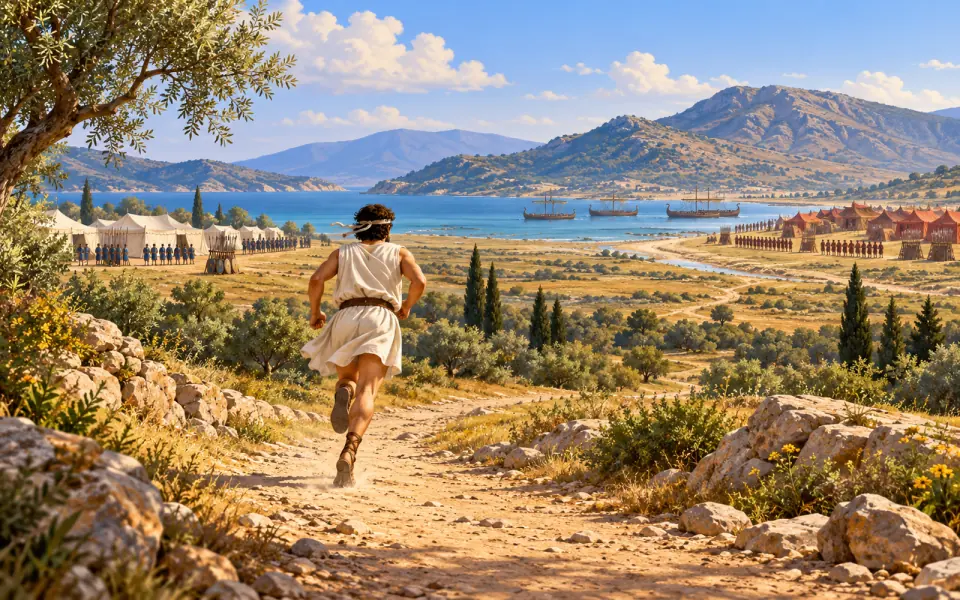
The second story, the more famous one, says that a messenger ran from Marathon to Athens to announce the victory and that, as soon as he arrived, he died of exhaustion. Historians do not consider it a historical fact: it is told by Plutarch and then by Lucian of Samosata, centuries later, and it is probably the result of several old stories merging. Yet it gave its name to the longest race in athletics: the marathon.
Remembering the battle
The Athenians who fell were buried on the battlefield, under a great mound, the Soros, which can still be seen. According to one scholar, slabs with the names of the 192 dead, divided by tribe, were placed on top of the mound. The playwright Aeschylus fought at Marathon; on his tomb he wanted to be remembered only for this, and not for his tragedies. Tradition also told that the god Pan appeared in the battle to frighten the Persians: for this reason the Athenians dedicated a cult to him near the Acropolis.
Why it happened
The most immediate cause was the revolt of the Greek cities of Asia Minor against Persia. Athens and Eretria, by sending ships to help them, had set themselves against a huge empire, the largest of the time. For Darius I a punishment was necessary, to keep all the subject peoples under control.
But there was also a deeper reason. The Persian empire had already expanded westwards and the Greek coastal cities and the islands were under its rule. Athens, free and proud, was a dangerous example for those who were subject. For the Athenians, on the other hand, the challenge was to defend their freedom and their way of governing themselves, which with Cleisthenes had become more participatory.
What changed
The victory gave the Athenians great confidence in themselves. It showed that the Persians were not invincible, and that an army of free citizens could beat an empire. In Athens the feat was remembered for generations, in poems, paintings and speeches.
In fact the war did not end. Ten years later, in 480 BC, the new Persian king Xerxes came back with a much larger army, and the Greeks had to fight at Thermopylae, Salamis and Plataea. But without Marathon perhaps Athens would not have had the strength to organise the resistance.
Marathon lives on in our sport too. In 1896 Michel Bréal proposed including in the first modern Olympics a race recalling the messenger's run, and Pierre de Coubertin supported it. The first Olympic marathon, in Athens, was won by the Greek Spyridon Louis. The official distance of 42.195 kilometres was only fixed in 1921.
Key people and places
People
- Darius I
- King of Persia who sent the expedition of 490 BC to punish Athens and Eretria.
- Miltiades
- Athenian commander who got the decision to give battle approved.
- Callimachus
- Polemarch of Athens, a military magistrate: he died at Marathon.
- Pheidippides
- Athenian runner sent to Sparta to ask for help; legend confuses him with the messenger said to have announced the victory.
- Aeschylus
- The great writer of tragedies: he fought at Marathon and had only that battle remembered on his tomb.
Places
- Marathon
- A plain on the eastern coast of Attica, about forty kilometres from Athens by road.
- Eretria
- City on the island of Euboea, an ally of Athens, destroyed by the Persians before the battle.
- Plataea
- A small city of Boeotia that sent about a thousand men to help the Athenians.
- The Soros
- The great mound on the battlefield, where the Athenian dead were buried.
Good to know
- The Athenians who fell at Marathon were 192, and their names, divided by tribe, were placed on their tomb.
- Pheidippides did not run from Marathon to Athens: the most reliable tradition sends him from Athens to Sparta, more than two hundred kilometres.
- The official length of the marathon, 42.195 kilometres, was only set in 1921.
- Aeschylus, the great writer of tragedies, wanted only the memory of having fought at Marathon on his tomb, not that of his tragedies.
Find out more
- Wikipedia, “Battle of Marathon” en.wikipedia.org
- Wikipedia, “Pheidippides” en.wikipedia.org
- Wikipedia, “Herodotus” en.wikipedia.org
- Wikipedia, “Aeschylus” en.wikipedia.org
Related events
- The Battle of Thermopylae480 BC · Ancient GreeceTen years later Xerxes came back with a larger army: the Battle of Thermopylae.
- The theatre of Aeschylus472 BC · Ancient GreeceAeschylus, who had fought at Marathon, wrote “The Persians”.
- Herodotus writes the Historiesabout 430 BC · Ancient GreeceHerodotus told the story of the battle in his Histories.
- Cleisthenes and democracyabout 508 BC · Ancient GreeceThe Athens of Cleisthenes defended its freedom at Marathon.
- The ancient Olympic Gamesabout 776 BC · Ancient GreeceThe marathon is an Olympic event today.
Before and after, in the era “Ancient Greece”
Event 10 of 25
 BeforeThe first Greek city-statesabout 800 BC
 BeforeThe ancient Olympic Gamesabout 776 BC
 BeforeThe Greek alphabetabout 750 BC
 BeforeLife in Spartaabout 700 BC
 BeforeSappho, the poet of Lesbosabout 600 BC
 BeforeThe reforms of Solonabout 594 BC
 BeforeThales studies natureabout 585 BC
 BeforePythagoras at Crotonabout 530 BC
 BeforeCleisthenes and democracyabout 508 BC
- You are hereThe Battle of Marathon490 BC
 AfterThe Battle of Thermopylae480 BC
 AfterThe theatre of Aeschylus472 BC
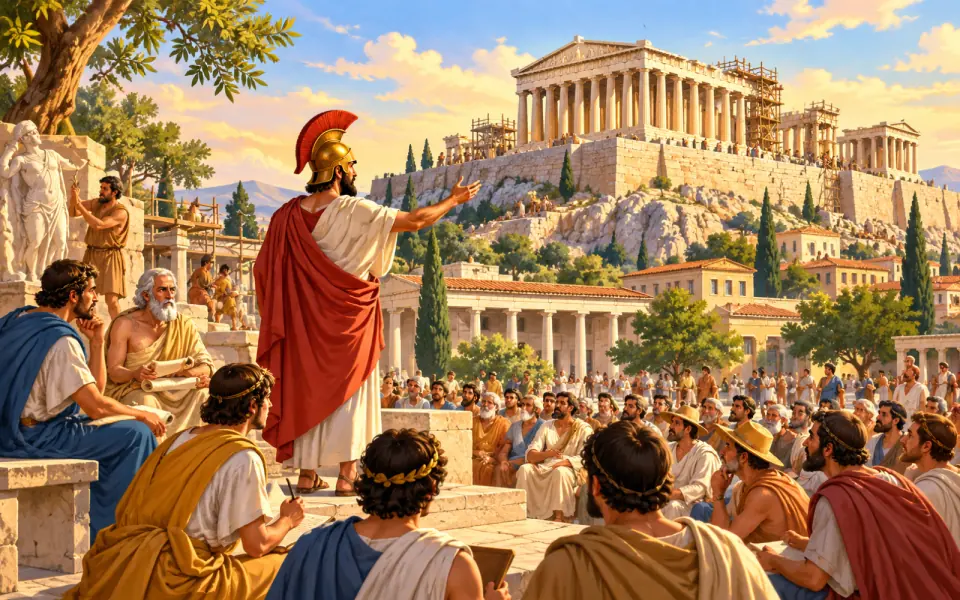 AfterThe Age of Pericles461–429 BC
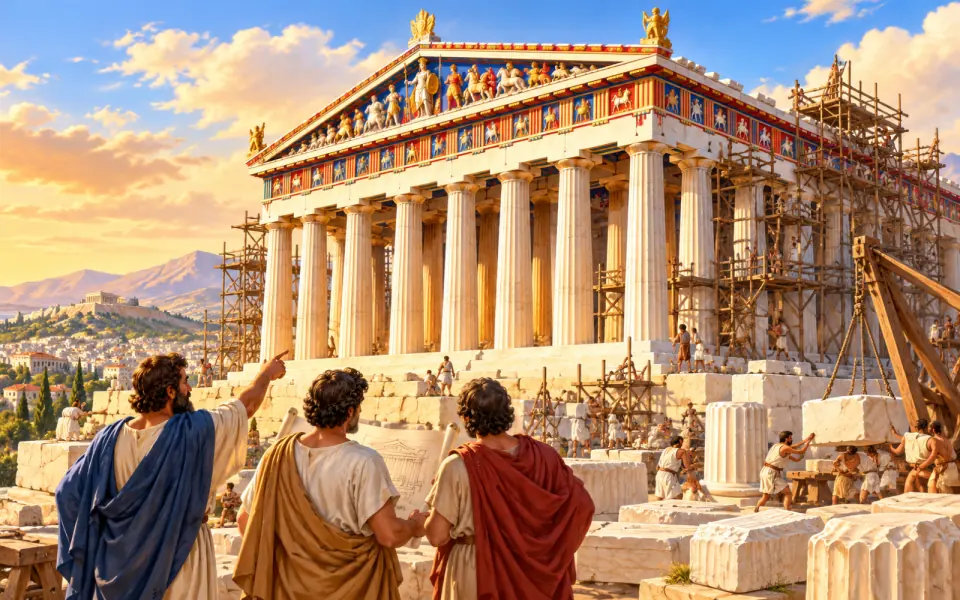 AfterThe Parthenon447–432 BC
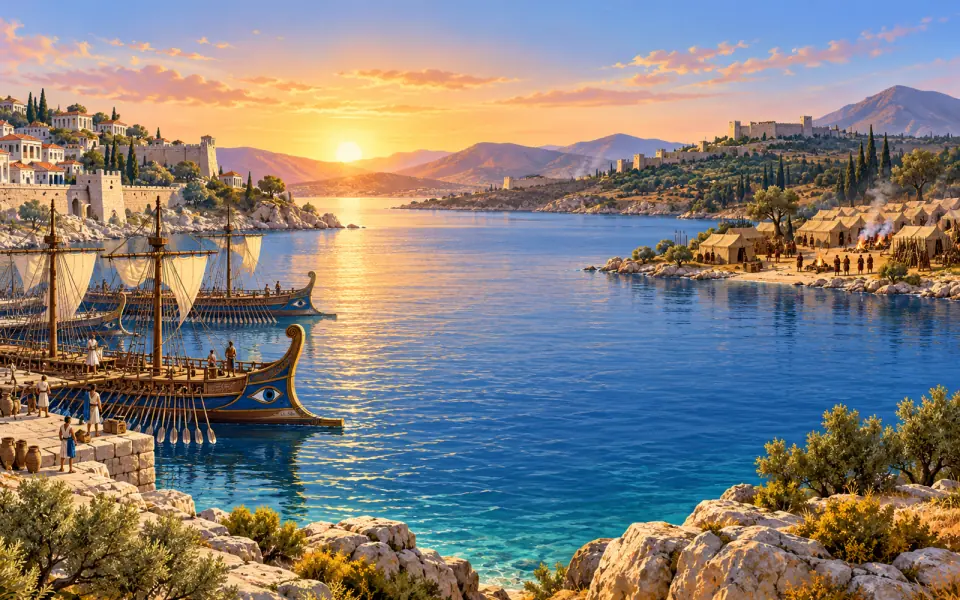 AfterThe Peloponnesian War431–404 BC
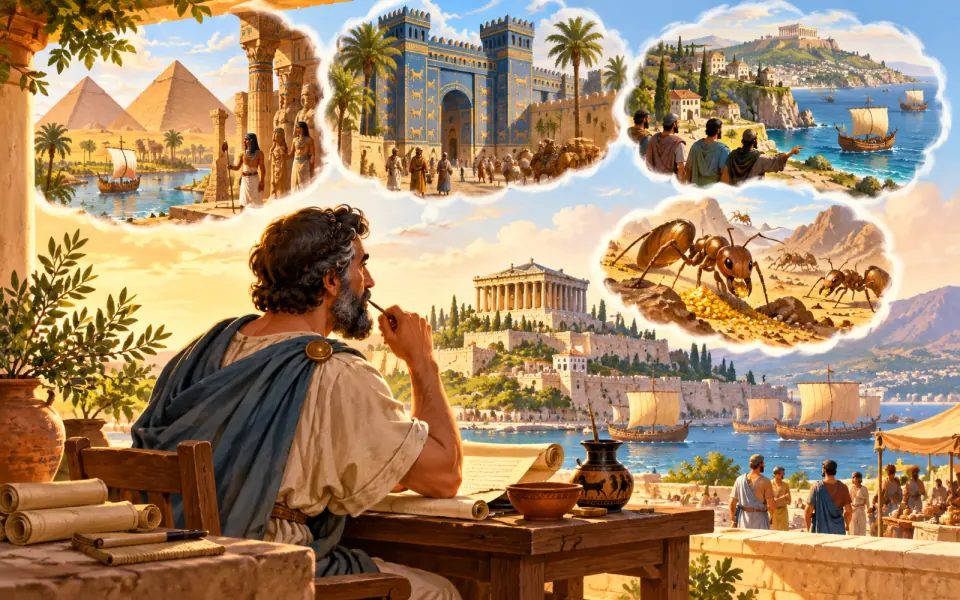 AfterHerodotus writes the Historiesabout 430 BC
 AfterHippocrates and medicineabout 400 BC
 AfterSocrates is condemned399 BC
 AfterPlato's Academyabout 387 BC
 AfterAristotle founds the Lyceumabout 335 BC
 AfterThe conquests of Alexander334–323 BC
 AfterEuclid writes the Elementsabout 300 BC
 AfterThe Library of Alexandriaabout 295 BC
 AfterArchimedes of Syracuseabout 250 BC
 AfterThe Antikythera mechanismabout 100 BC
Listen / Read next
- Music to read by: Cinematic JourneyEpic film-style music, no lyrics, by Ciro Simone IrmiciSpotifyYouTube Music
Meanwhile, elsewhere in the world
Other events of the era “Ancient Greece”
- The first Greek city-states
- The ancient Olympic Games
- The Greek alphabet
- Life in Sparta
- Sappho, the poet of Lesbos
- The reforms of Solon
- Thales studies nature
- Pythagoras at Croton
- Cleisthenes and democracy
- The Battle of Thermopylae
- The theatre of Aeschylus
- The Age of Pericles
- The Parthenon
- The Peloponnesian War
- Herodotus writes the Histories
- Hippocrates and medicine
- Socrates is condemned
- Plato's Academy
- Aristotle founds the Lyceum
- The conquests of Alexander
- Euclid writes the Elements
- The Library of Alexandria
- Archimedes of Syracuse
- The Antikythera mechanism
