The Greek alphabet
about 750 BC Euboea and Greek colonies (Greece and Italy)
In short
The Greeks borrowed their alphabet from the Phoenicians, but with an important new idea: they added vowels. Some Phoenician signs for sounds that did not exist in Greek thus became alpha, epsilon and omicron. Even the names alpha and beta come from the Phoenician words for ‘ox’ and ‘house’. One of the oldest pieces of Greek writing is scratched on a small cup found on Ischia, ‘Nestor's Cup’.
Why it matters With vowels every word could be written the way it was said, and our own alphabet comes from this one.
Source: Encyclopaedia Britannica, “Greek alphabet”
Study card about 6 minutes of reading
The story
After the silence, writing again
In the Bronze Age the Greeks of the palaces, in Crete and at Mycenae, already had a script: Linear B, used by scribes to count sacks of grain, sheep and jars. When the palaces collapsed, that system was lost and for centuries almost nothing was written in Greece. Then, after the year 1000 BC, writing came back in a new form. It was simpler, shorter and much easier to learn: the Greek alphabet.
A loan from the Phoenicians
The Greeks did not invent it on their own. They took it from the Phoenicians, the sea traders who had an alphabet of twenty-two signs, one for each sound. The Phoenician system was already a great invention: instead of hundreds of signs, you only had to learn a few letters. From the Phoenicians the Greeks took much more than the shapes. They also took the names: the first Phoenician letter, “aleph”, meant “ox” and became alpha; the second, “bet”, meant “house” and became beta. In Greek these names no longer meant anything: they were just the names of the letters. Putting the first two together, alpha and beta, gave us the word “alphabet”.
The great novelty: vowels
Phoenician was written without vowels: the reader worked out the word from the context. For Semitic languages this worked well, but not for Greek, because vowels are very important. The Greeks had a simple and brilliant idea. Some Phoenician letters stood for sounds that did not exist in Greek, so they adapted them to write the vowels. That is how alpha, epsilon, iota, omicron and upsilon were born. Later, in eastern Greek, eta and omega were added too. With this step every sound of the language had its own sign, and every word could be written as it was pronounced. The classical Greek alphabet has 24 letters: seven vowels and seventeen consonants.
When and where?
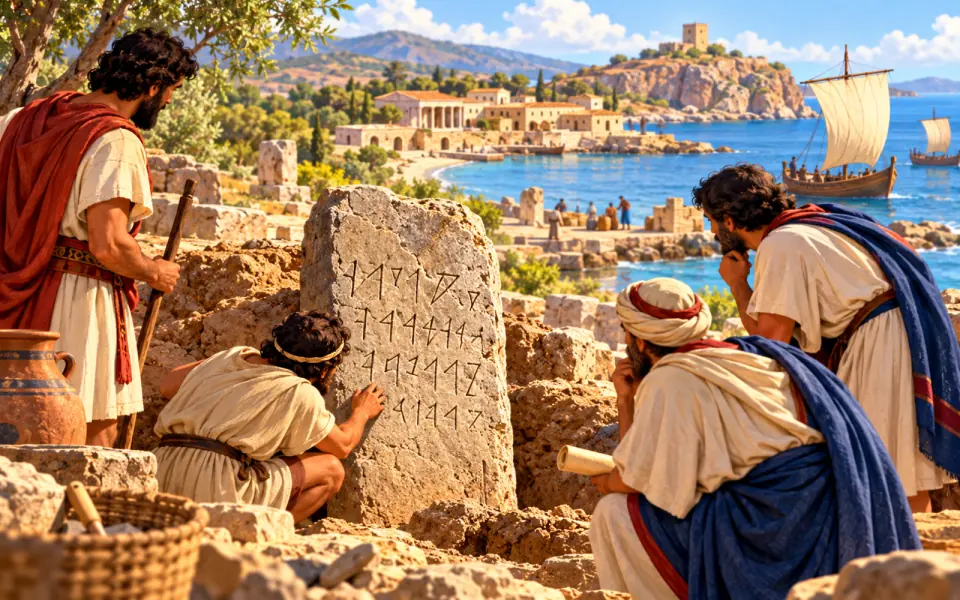
We cannot give the exact year in which the Greeks adopted the alphabet. The oldest Greek inscriptions that have come down to us date from the 8th century BC. Some scholars think the alphabet had already appeared in the 9th, but so far no clear proof has been found. That is why the site says “about 750 BC”: it is an approximate date, which marks the time when alphabetic writing was already in use. The Greeks themselves told how the alphabet had been brought by the hero Cadmus, a Phoenician prince, but that is a myth rather than history.
Nestor's Cup
One of the oldest and most beautiful Greek inscriptions is on a small ceramic cup, “Nestor's Cup”. It was discovered in the mid-1950s (1955) on Ischia, in a tomb in a cemetery of ancient Pithekoussai, one of the first Greek colonies in Italy. The cup probably comes from Rhodes, but the inscription was carved later, by someone who could write in the Euboean alphabet, the one used by the people of the island of Euboea. The inscription dates from the last quarter of the 8th century BC. It contains three lines of verse, written from right to left as the Phoenicians did, and it alludes to a famous cup mentioned in the Iliad, Nestor's. Whoever carved it, perhaps during a banquet, was therefore remembering the poems of Homer.
Many variants, one alphabet
In the early centuries each region wrote in its own way. There were different versions of some letters, and the direction of writing changed too: the Phoenicians wrote from right to left, while the Greeks moved first to “ox-turning” writing (one line in one direction and the next in the opposite direction, like a farmer ploughing) and then to the left-to-right direction we use too. Among the variants, two were decisive. The Ionian one, used in the cities on the coast of present-day Turkey, was officially adopted by Athens in 403 or 402 BC, and from there it became the Greek alphabet for everyone. The western one, used in the colonies of Italy, was taken up by the Etruscans.
From Greek to Latin to English
From the Etruscans the alphabet passed to the Romans, who adapted it to Latin. The result is the alphabet you are reading now: our A comes from alpha, our B from beta. The letters Y and Z were added by the Romans in the 1st century BC to write Greek words. From the Ionian variant, on the other hand, come the Coptic alphabet and the Cyrillic one, used today in Russia and other countries (Cyrillic grew out of Greek letters, with some letters added, taken from Glagolitic, for Slavic sounds that Greek did not have).
Why it happened
On the Mediterranean the Greeks met the Phoenicians all the time, carrying goods of every kind. To buy and sell, keep accounts and send messages, you needed a convenient way of writing, and the Phoenician alphabet was far more practical than the old systems with hundreds of signs.
After the collapse of the palaces, Mycenaean writing had disappeared, and there were no longer scribes to teach it. Paradoxically, this helped: the Greeks could start again from a simpler system, without having to defend old habits. An alphabet with few signs was learned quickly and was no longer a skill reserved for officials, but could be used by many more people, for example to write verses, names and dedications.
What changed
The alphabet with vowels made reading much easier and more accurate. It was a tool suited both to everyday life and to poetry. Within a few centuries the Greeks wrote laws on stone, wrote down the poems of Homer and produced philosophy, history and theatre. Without such a simple system it would have been much harder for so many ideas to circulate.
The Greek alphabet had children all over Europe. From the western variant came Etruscan and then Latin, and from that our alphabet, used today by billions of people. From the Ionian variant come modern Greek and, with some additions, Cyrillic. Even today Greek letters are used by mathematicians and scientists: alpha, beta, pi and omega are in school books and on computer keyboards.
Key people and places
People
- Cadmus
- A hero of myth: according to Greek legend he brought the alphabet from Phoenicia to Greece. It is a tradition, not a historical fact.
- Giorgio Buchner
- German archaeologist who excavated on Ischia and found Nestor's Cup.
- Nestor
- King of Pylos in the Iliad: his great cup is mentioned in the poem, and the inscription from Ischia jokes about exactly that.
Places
- Phoenicia
- The coast of present-day Lebanon, home of the traders who had invented an alphabet of twenty-two signs.
- Euboea
- A large Greek island close to Attica: its alphabet was used in the colonies of the West.
- Ischia (Pithekoussai)
- An island in the Bay of Naples, home to one of the first Greek colonies in Italy; Nestor's Cup was found here.
- Athens
- In 403–402 BC it officially adopted the Ionian alphabet, which became the standard for the whole of Greece.
Good to know
- The word “alphabet” comes from the first two Greek letters, alpha and beta.
- Alpha and beta come from the Phoenician letters aleph and bet, which meant “ox” and “house”: in Greek they became simple letter names.
- The classical Greek alphabet has 24 letters: 7 vowels and 17 consonants.
- At first the Greeks also wrote “like an ox ploughing”, with one line from right to left and the next from left to right, like the furrows of a ploughed field.
- The inscription on Nestor's Cup, on Ischia, recalls the cup of King Nestor described in the Iliad, and it has the rhythm of verse: poetry and writing were born almost together.
Find out more
- Wikipedia, “Greek alphabet” en.wikipedia.org
- Wikipedia, “Phoenician alphabet” en.wikipedia.org
- Wikipedia, “Nestor's Cup” en.wikipedia.org
Related events
- The Phoenician alphabetabout 1050 BC · Sea civilisationsThe Phoenicians had invented the alphabet from which the Greeks took their letters.
- Linear Babout 1450 BC · Sea civilisationsBefore the alphabet, the Mycenaean Greeks wrote in Linear B.
- Homer's poems are written downabout 750 BC · Sea civilisationsThe Homeric poems, composed to be spoken, were put into writing thanks to the alphabet.
- Greek colonies in the Westabout 750 BC · Sea civilisationsThe Greek colonies in the West brought the alphabet to Italy.
- Traditional founding of Romeabout 753 BC · Ancient RomeThrough the Etruscans the Greek alphabet reached Rome.
Before and after, in the era “Ancient Greece”
Event 3 of 25
 BeforeThe first Greek city-statesabout 800 BC
 BeforeThe ancient Olympic Gamesabout 776 BC
- You are hereThe Greek alphabetabout 750 BC
 AfterLife in Spartaabout 700 BC
 AfterSappho, the poet of Lesbosabout 600 BC
 AfterThe reforms of Solonabout 594 BC
 AfterThales studies natureabout 585 BC
 AfterPythagoras at Crotonabout 530 BC
 AfterCleisthenes and democracyabout 508 BC
 AfterThe Battle of Marathon490 BC
 AfterThe Battle of Thermopylae480 BC
 AfterThe theatre of Aeschylus472 BC
 AfterThe Age of Pericles461–429 BC
 AfterThe Parthenon447–432 BC
 AfterThe Peloponnesian War431–404 BC
 AfterHerodotus writes the Historiesabout 430 BC
 AfterHippocrates and medicineabout 400 BC
 AfterSocrates is condemned399 BC
 AfterPlato's Academyabout 387 BC
 AfterAristotle founds the Lyceumabout 335 BC
 AfterThe conquests of Alexander334–323 BC
 AfterEuclid writes the Elementsabout 300 BC
 AfterThe Library of Alexandriaabout 295 BC
 AfterArchimedes of Syracuseabout 250 BC
 AfterThe Antikythera mechanismabout 100 BC
Listen / Read next
- Music to read by: Cinematic JourneyEpic film-style music, no lyrics, by Ciro Simone IrmiciSpotifyYouTube Music
Meanwhile, elsewhere in the world
Other events of the era “Ancient Greece”
- The first Greek city-states
- The ancient Olympic Games
- Life in Sparta
- Sappho, the poet of Lesbos
- The reforms of Solon
- Thales studies nature
- Pythagoras at Croton
- Cleisthenes and democracy
- The Battle of Marathon
- The Battle of Thermopylae
- The theatre of Aeschylus
- The Age of Pericles
- The Parthenon
- The Peloponnesian War
- Herodotus writes the Histories
- Hippocrates and medicine
- Socrates is condemned
- Plato's Academy
- Aristotle founds the Lyceum
- The conquests of Alexander
- Euclid writes the Elements
- The Library of Alexandria
- Archimedes of Syracuse
- The Antikythera mechanism
