Archimedes of Syracuse
about 250 BC Syracuse, Sicily (Italy)
In short
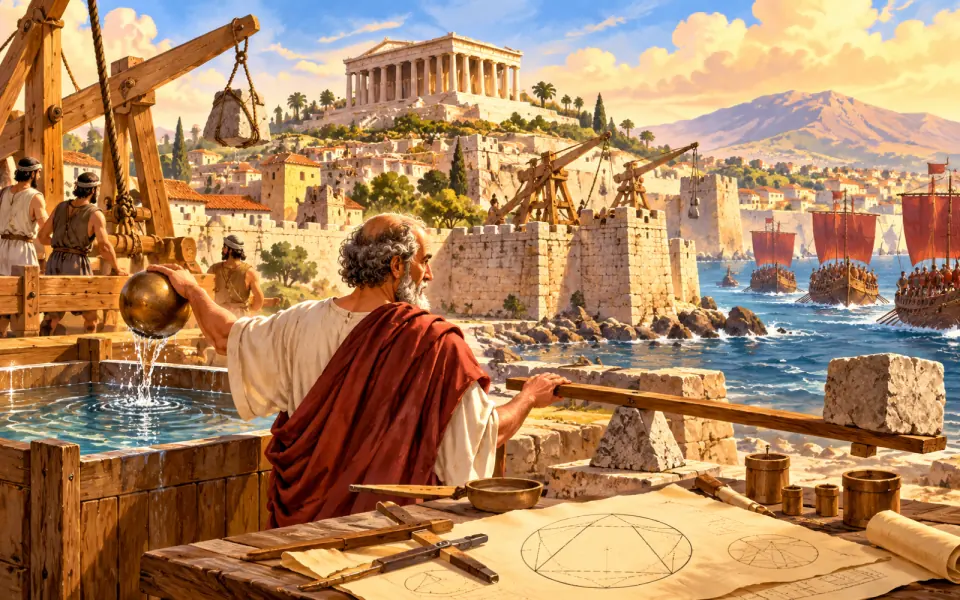
Archimedes of Syracuse was a mathematician, physicist and inventor. He discovered why an object placed in water is pushed upwards, and he studied levers, saying, according to tradition: “Give me a place to stand and I will move the world.” He worked out the value of pi with great accuracy. When the Romans besieged Syracuse he designed machines to defend the city, and he died during its capture, in 212 BC.
Why it matters His discoveries about levers and floating are still studied at school today.
Source: Treccani, entry “Archimede”
Study card about 5 minutes of reading
The story
A genius from Syracuse
Syracuse, in the 3rd century BC, was one of the largest and richest cities in the Mediterranean, a Greek colony in Sicily ruled by King Hieron II. Here, around 287 BC, Archimedes was born. We know little about his life: we know mainly his works and the stories the ancients handed down about him. He was a mathematician, physicist and inventor. That is why our site gives “about 250 BC”: it is not a precise year, but the period of his full activity. He died in 212 BC.
“Eureka!”
The most famous story about Archimedes concerns a crown. It is told by the Roman writer Vitruvius, much later. King Hieron II had had a gold crown made and wanted to know whether the goldsmith had cheated him by mixing some silver with the gold. Archimedes had to find out without damaging it. While taking a bath, he noticed that the water in the tub overflowed in proportion to the part of his body that was immersed, and he understood how to solve the problem. He cried “eureka!”, that is “I have found it!”. Scholars think the method was more probably a comparison in water between the crown and an equal weight of gold. Vitruvius' tale is an anecdote rather than a documented fact.
The real discovery is written in the treatise “On Floating Bodies”, which founds hydrostatics, the study of the equilibrium of liquids. From it comes “Archimedes' principle”: a body immersed in a fluid receives an upward push. This is the reason why a very heavy iron ship floats and a small stone sinks.
The lever and the screw
Archimedes also studied the lever, in the treatise “On the Equilibrium of Planes”: he proved with mathematics why a large weight can be lifted with a small one, if the fulcrum is well chosen. He is also credited with (or studied) the Archimedes screw, which perhaps existed before him: a tube wound in a spiral inside a cylinder that, when turned, lifts water. It was used to irrigate fields and, according to the ancients, to empty the water from the hold of an enormous ship built by Hieron, the Syracusia.
Numbers and figures
He was a very great mathematician. In the “Measurement of a Circle” he calculated the ratio between the circumference and the diameter, what we now call pi, and proved that it lies between 3 + 10/71 (about 3.1408) and 3 + 1/7 (about 3.1429). For that time it was an extraordinary precision. He also proved that the volume of a sphere is two thirds of that of the cylinder that exactly contains it.
In the treatise “The Sand Reckoner” he asked himself a curious question: how many grains of sand would it take to fill the whole universe, as far as the sphere of the fixed stars? To write it he had to invent a new way of expressing large numbers. In another work, the “Method”, written in the form of a letter to his friend Eratosthenes, he explains how he found his results: first with a mechanical argument, imagining figures and weights, and then he proved them rigorously.
The machines of the siege
In 212 BC the Romans, under the consul Marcellus, captured Syracuse after a long siege. According to the ancient historians Polybius, Livy and Plutarch, during the siege the machines designed by Archimedes were very useful for the defence. People speak of an “iron hand”, a hook that grabbed enemy ships. Another legend, told much later, says he had built mirrors to concentrate the Sun's light and set the ships on fire. Scholars regard this story as a legend. In 1973 an experiment with 70 mirrors managed to set fire to a model ship at about 50 metres, but it is not certain that the ancients could have done it.
His death
When the Romans entered the city, Archimedes was killed by a soldier. There are several versions. In the most famous he was drawing geometric figures in the sand and is said to have told the soldier not to spoil his drawing. Livy and Plutarch tell that the consul Marcellus was very sorry about his death and had him buried.
Archimedes had asked for a sphere inscribed in a cylinder to be carved on his tomb, in memory of his best-loved discovery. More than a century later the Roman politician Cicero, when he was quaestor in Sicily, found the tomb, covered in brambles, thanks precisely to that drawing.
Why it happened
Archimedes lived in a Syracuse that loved technology. King Hieron II needed engineers to build ships, war machines and public works, and protected scholars. Archimedes' talent was put at the service of the city.
What made his results possible was Greek mathematics, already advanced: Euclid had written the “Elements” a few decades earlier, and Archimedes used its methods of proof. Alexandria was close, at least by letter: from the “Method” we know that he exchanged ideas with Eratosthenes, one of the most important scholars of the Mouseion. So the discoveries of mathematics and those of mechanics met in his mind.
What changed
Archimedes' discoveries have entered school textbooks. Archimedes' principle explains why ships, balloons and submarines float or rise. The law of the lever is the basis of many simple machines. The idea of the Archimedes screw is the basis of machines still used today.
In mathematics, Archimedes joined intuitive reasoning, with imaginary figures and weights, to rigorous proofs: two ways of working that mathematicians still use today.
The story of his writings is an adventure. The “Method” was believed lost. It was rediscovered in 1906 by the scholar Johan Heiberg in a medieval manuscript in which the original text had been scraped off and covered by a prayer: a “palimpsest”. The codex was then lost, reappeared in the 1990s and was sold at auction in 1998.
Key people and places
People
- Archimedes
- Mathematician, physicist and inventor from Syracuse (about 287–212 BC).
- Hieron II
- King of Syracuse, who commissioned the crown and the great ship Syracusia.
- Marcellus
- Roman consul who captured Syracuse in 212 BC and had Archimedes buried.
- Eratosthenes
- Scientist of Alexandria, to whom Archimedes addressed the “Method”.
- Cicero
- Roman writer who, as quaestor, found Archimedes' tomb.
Places
- Syracuse
- The great Greek city of Sicily where Archimedes was born and died.
- Alexandria, Egypt
- The city of the Mouseion, with which Archimedes exchanged ideas by letter.
Good to know
- Archimedes estimated pi between 3+10/71 and 3+1/7, that is between about 3.1408 and 3.1429.
- On his tomb there was a sphere inside a cylinder, because he had proved that the volume of the sphere is two thirds of that of the cylinder.
- In the “Sand Reckoner” he calculated how many grains of sand it would take to fill the universe, and to do so he invented a new system for large numbers.
- One of Archimedes' works, the “Method”, was found in 1906 in a medieval prayer book written over the original text.
- In 1973 an experiment with 70 mirrors managed to set fire to a model ship at about 50 metres, but the story of Archimedes' mirrors remains a legend.
Find out more
- Wikipedia, “Archimedes” en.wikipedia.org
- Wikipedia, “Archimedes Palimpsest” en.wikipedia.org
- Wikipedia, “Euclid” en.wikipedia.org
Related events
- Euclid writes the Elementsabout 300 BC · Ancient GreeceEuclid was Archimedes' teacher in method.
- The Library of Alexandriaabout 295 BC · Ancient GreeceEratosthenes, librarian of Alexandria, received his letters.
- Hannibal crosses the Alps218 BC · Ancient RomeThe siege of Syracuse took place in the years of the war between Rome and Hannibal.
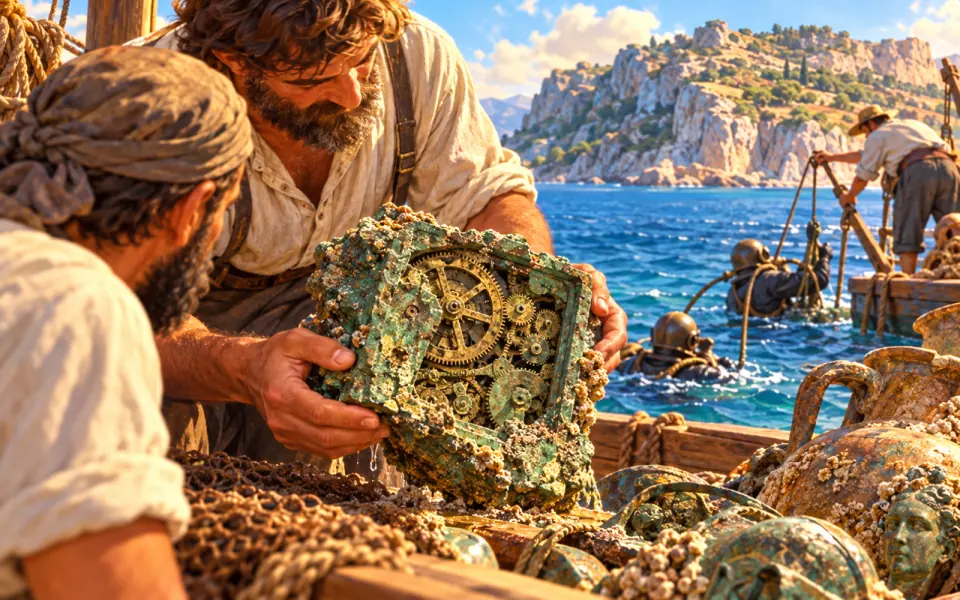
- The Antikythera mechanismabout 100 BC · Ancient GreeceThe Antikythera mechanism shows the level of Greek technology; some scholars suggest a link with Syracuse.
- Greek colonies in the Westabout 750 BC · Sea civilisationsSyracuse was one of the colonies founded by the Greeks in the West.
Before and after, in the era “Ancient Greece”
Event 24 of 25
 BeforeThe first Greek city-statesabout 800 BC
 BeforeThe ancient Olympic Gamesabout 776 BC
 BeforeThe Greek alphabetabout 750 BC
 BeforeLife in Spartaabout 700 BC
 BeforeSappho, the poet of Lesbosabout 600 BC
 BeforeThe reforms of Solonabout 594 BC
 BeforeThales studies natureabout 585 BC
 BeforePythagoras at Crotonabout 530 BC
 BeforeCleisthenes and democracyabout 508 BC
 BeforeThe Battle of Marathon490 BC
 BeforeThe Battle of Thermopylae480 BC
 BeforeThe theatre of Aeschylus472 BC
 BeforeThe Age of Pericles461–429 BC
 BeforeThe Parthenon447–432 BC
 BeforeThe Peloponnesian War431–404 BC
 BeforeHerodotus writes the Historiesabout 430 BC
 BeforeHippocrates and medicineabout 400 BC
 BeforeSocrates is condemned399 BC
 BeforePlato's Academyabout 387 BC
 BeforeAristotle founds the Lyceumabout 335 BC
 BeforeThe conquests of Alexander334–323 BC
 BeforeEuclid writes the Elementsabout 300 BC
 BeforeThe Library of Alexandriaabout 295 BC
- You are hereArchimedes of Syracuseabout 250 BC
 AfterThe Antikythera mechanismabout 100 BC
Listen / Read next
- Music to read by: Cinematic JourneyEpic film-style music, no lyrics, by Ciro Simone IrmiciSpotifyYouTube Music
Meanwhile, elsewhere in the world
Other events of the era “Ancient Greece”
- The first Greek city-states
- The ancient Olympic Games
- The Greek alphabet
- Life in Sparta
- Sappho, the poet of Lesbos
- The reforms of Solon
- Thales studies nature
- Pythagoras at Croton
- Cleisthenes and democracy
- The Battle of Marathon
- The Battle of Thermopylae
- The theatre of Aeschylus
- The Age of Pericles
- The Parthenon
- The Peloponnesian War
- Herodotus writes the Histories
- Hippocrates and medicine
- Socrates is condemned
- Plato's Academy
- Aristotle founds the Lyceum
- The conquests of Alexander
- Euclid writes the Elements
- The Library of Alexandria
- The Antikythera mechanism
