The Parthenon
447–432 BC Acropolis of Athens (Greece)
In short
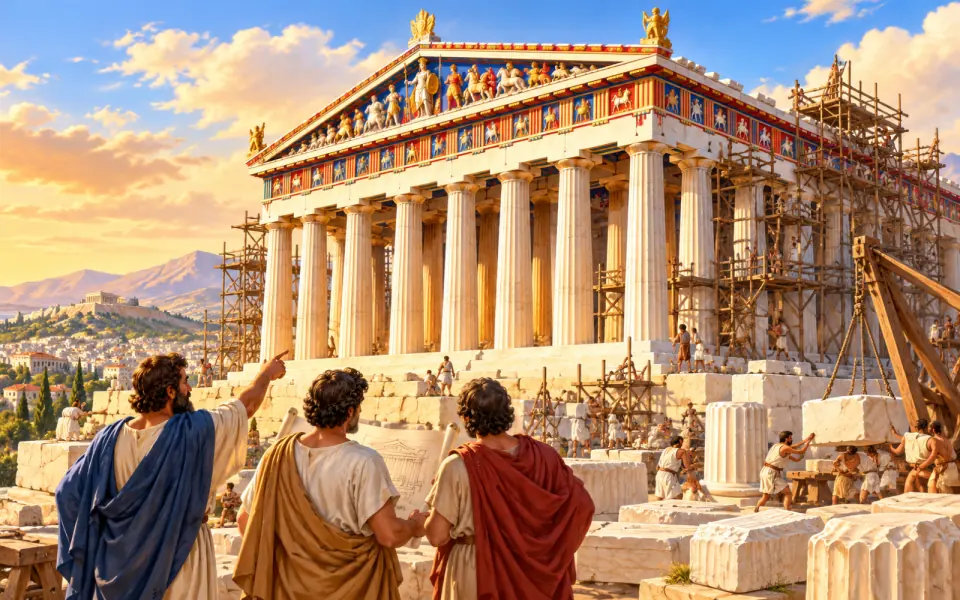
On the Acropolis of Athens, in 447 BC, work began on the Parthenon, the temple of the goddess Athena Parthenos, meaning ‘the maiden’. The work was led by the sculptor Phidias with the architects Ictinus and Callicrates. The columns bulge slightly and the floor is a little curved: small tricks to make the building look perfectly straight to anyone looking at it. Originally the statues and carvings were painted in bright colours.
Why it matters It has become the symbol of ancient Greece and of the very idea of classical beauty.
Source: UNESCO, “Acropolis, Athens”
Study card about 6 minutes of reading
The story
The temple on the hill
The Acropolis of Athens is a rocky hill that towers over the city. For centuries it was the sacred place of Athens, with temples and sanctuaries dedicated to the protecting gods. In 480 BC, during the second Persian invasion, Xerxes' Persians sacked Athens and devastated the sanctuaries on the hill. When the threat passed and Athens became rich and powerful, Pericles decided to rebuild it on a grand scale. The centrepiece of the project was a new temple for Athena, the goddess of the city: the Parthenon. The name comes from “Parthenos”, which in Greek means “virgin”, one of Athena's titles.
Work began in 447 BC. The temple was finished, in its main parts, in 438 BC, while the sculpted decoration was completed in 432 BC. In less than fifteen years the Athenians built a building that is still considered one of the most perfect ever made. The architects were Ictinus and Callicrates. The sculptor Phidias, a friend of Pericles, had a directing role: he looked after the decorations and the statue of the goddess.
What it is like
The Parthenon is a Doric temple, that is, built in the simplest and sturdiest style of Greek architecture, with columns without a base and a plain capital. It has eight columns on the short sides and seventeen on the long sides. It measures about 69.5 by 30.9 metres, and the outer columns are more than ten metres high and almost two wide at the base. It was a very large building, entirely of marble.
The Greek builders had an almost obsessive idea of perfection. That is why the temple has some “optical corrections”: small tricks that fool the eye. The floor, for example, is not perfectly flat, but rises slightly in the middle, because a perfectly horizontal line seen from far away would seem to sag downwards. The columns are slightly wider in the middle (this swelling is called “entasis”), they lean a little inwards and the decorated slabs are narrower towards the corners. The result is a building that, to those who look at it, seems perfectly straight and harmonious.
The sculptures
The decorations were a true encyclopedia of myths. On the outer side ran 92 metopes, marble slabs with scenes carved almost in the round. On the east side they told of the fight between the gods and the giants, on the west that between the Greeks and the Amazons, on the south that against the centaurs and on the north the Trojan War. Inside the colonnade, along the walls of the cella (the main room of the temple), ran a frieze 160 metres long, of which about 130 survive. It showed a procession, that of the festivals in honour of Athena, the Panathenaea. The two pediments, the triangles above the façades, showed the birth of Athena (to the east) and the contest between Athena and Poseidon for possession of Athens (to the west).
In the darkness of the cella stood the statue of the goddess, about twelve metres high, made of gold and ivory over a wooden core. It was called Athena Parthenos, and was the work of Phidias. Today it no longer exists.
We imagine the Parthenon as white, but originally it was coloured. The sculptures and some parts of the building were painted in bright colours and had metal attachments. The colours have disappeared with time.
A long history
For centuries the Parthenon remained a temple. In Byzantine times it was turned into a church dedicated to the Mother of God. After the Ottoman conquest (1458), it became a mosque, with a minaret. The worst damage came in 1687, during a siege by the Venetians led by Francesco Morosini. The Ottomans were using the Parthenon as a gunpowder store. On the night between 26 and 27 September a bomb hit it and caused an explosion that broke the building and destroyed the roof. The Parthenon was left in ruins.
At the beginning of the 19th century the English diplomat Lord Elgin obtained permission to take sculptures from the Acropolis, and his men carried off about half of those that remained. Today many are in the British Museum in London: 15 metopes, 17 figures from the pediments and about 75 metres of frieze. The Greek Ministry of Culture says that 56 blocks of the frieze are in London and 40 in Athens. Since 1983 Greece has officially asked for their return, and the discussion is still open: some think they belong in London and others in Athens.
Why it happened
The practical cause was the destruction of the old temples by the Persians. The Athenians, returning to a damaged city, felt they had to rebuild the sacred places and show gratitude to the gods who had helped them to victory.
But there was also a political reason. Pericles wanted to make Athens the most beautiful and important city in Greece, and to show everyone the wealth that came from the Delian League. A great temple on top of the city said that Athens was powerful and protected by its goddess. Besides, the works gave a living to thousands of people: sculptors, stonecutters, marble carriers, smiths.
What changed
The Parthenon became the model of classical architecture. Its proportions between the parts, the order of the columns and the harmony of the whole have been studied and imitated for centuries: by the Romans, then by the architects of the Renaissance and of Neoclassicism. Many public buildings today, such as banks, courts and museums, use columns and pediments that recall its own.
Today the temple is the symbol of Athens and of Greece. Together with the other monuments of the Acropolis it attracts visitors from all over the world every year. The Acropolis has been a UNESCO World Heritage Site since 1987, and since 2009 a new Acropolis Museum, at the foot of the hill, houses the sculptures that remain in Greece.
The question of the Elgin Marbles has opened a worldwide debate on a difficult question: who do works of art carried away in past ages belong to? Museums, governments and the public go on arguing, and the answer depends on how one balances a country's right to its own history against the value of showing ancient art in much-visited museums.
Key people and places
People
- Phidias
- The most celebrated Greek sculptor: he looked after the decoration of the Parthenon and the statue of Athena.
- Ictinus and Callicrates
- The architects of the Parthenon.
- Pericles
- The politician who promoted the rebuilding of the Acropolis.
- Lord Elgin
- The English diplomat who in the 19th century took about half of the remaining sculptures to London.
- Francesco Morosini
- Venetian commander during the siege of 1687, when the Parthenon exploded.
Places
- Acropolis of Athens
- The sacred hill of the city, where the Parthenon stands.
- British Museum, London
- The museum where most of the sculptures taken by Lord Elgin are kept.
- Acropolis Museum
- The museum in Athens that keeps the Parthenon sculptures remaining in Greece.
Good to know
- The floor of the Parthenon is slightly curved and the columns are a little swollen: they are tricks to make the building look perfectly straight.
- The 92 metopes of the Parthenon tell of four great battles of myth, from the fight with the centaurs to the Trojan War.
- The statue of Athena that stood inside the temple was about twelve metres high and made of gold and ivory.
- The Parthenon exploded in 1687 because the Ottomans kept gunpowder in it and a Venetian bomb hit it.
- Originally the sculptures of the Parthenon were painted in bright colours.
Find out more
- Wikipedia, “Parthenon” en.wikipedia.org
- Wikipedia, “Acropolis of Athens” en.wikipedia.org
- Wikipedia, “Elgin Marbles” en.wikipedia.org
- Acropolis of Athens, official site (in English) acropolisofathens.gr
Related events
- The Age of Pericles461–429 BC · Ancient GreeceThe Parthenon was born from Pericles' building programme.
- The Battle of Marathon490 BC · Ancient GreeceThe temples of the Acropolis were rebuilt after the Persian wars.
- The Pantheonabout AD 125 · Ancient RomeThe Pantheon in Rome is another great temple of antiquity, which drew on Greek architecture.
- Renaissance perspectiveabout 1420 · Early modern ageThe ordered proportions of the Parthenon inspired perspective and the search for harmony in the Renaissance.
Before and after, in the era “Ancient Greece”
Event 14 of 25
 BeforeThe first Greek city-statesabout 800 BC
 BeforeThe ancient Olympic Gamesabout 776 BC
 BeforeThe Greek alphabetabout 750 BC
 BeforeLife in Spartaabout 700 BC
 BeforeSappho, the poet of Lesbosabout 600 BC
 BeforeThe reforms of Solonabout 594 BC
 BeforeThales studies natureabout 585 BC
 BeforePythagoras at Crotonabout 530 BC
 BeforeCleisthenes and democracyabout 508 BC
 BeforeThe Battle of Marathon490 BC
 BeforeThe Battle of Thermopylae480 BC
 BeforeThe theatre of Aeschylus472 BC
 BeforeThe Age of Pericles461–429 BC
- You are hereThe Parthenon447–432 BC
 AfterThe Peloponnesian War431–404 BC
 AfterHerodotus writes the Historiesabout 430 BC
 AfterHippocrates and medicineabout 400 BC
 AfterSocrates is condemned399 BC
 AfterPlato's Academyabout 387 BC
 AfterAristotle founds the Lyceumabout 335 BC
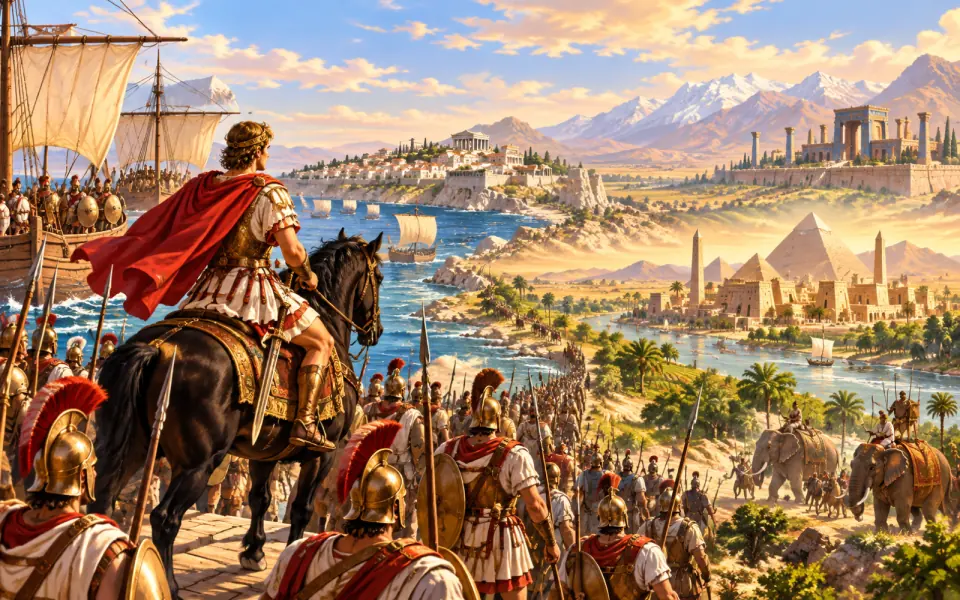 AfterThe conquests of Alexander334–323 BC
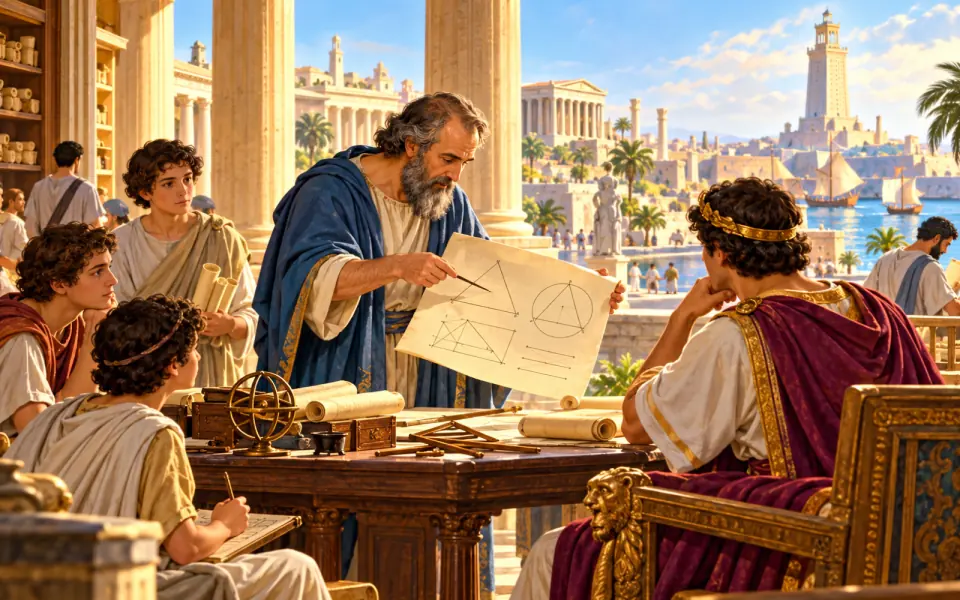 AfterEuclid writes the Elementsabout 300 BC
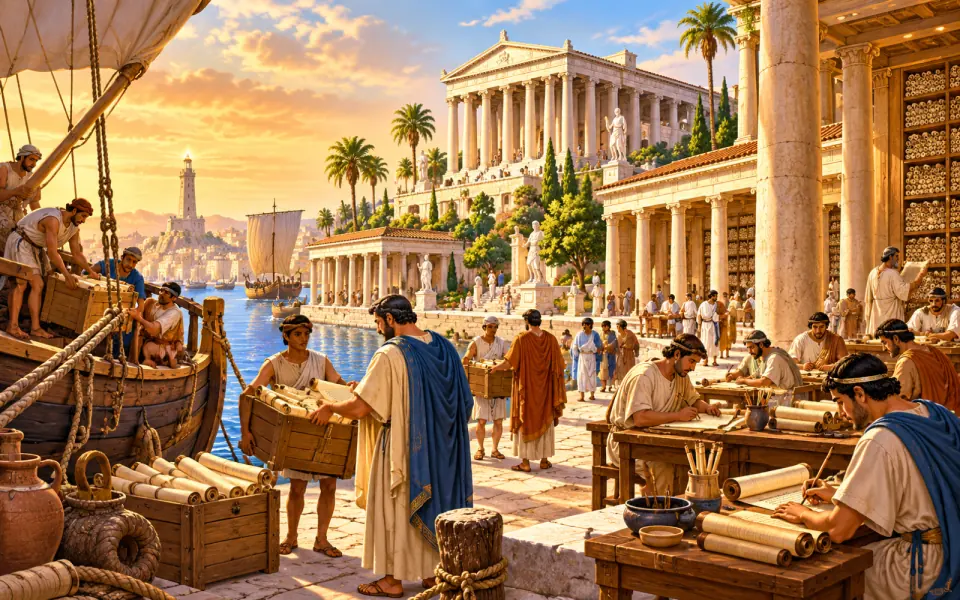 AfterThe Library of Alexandriaabout 295 BC
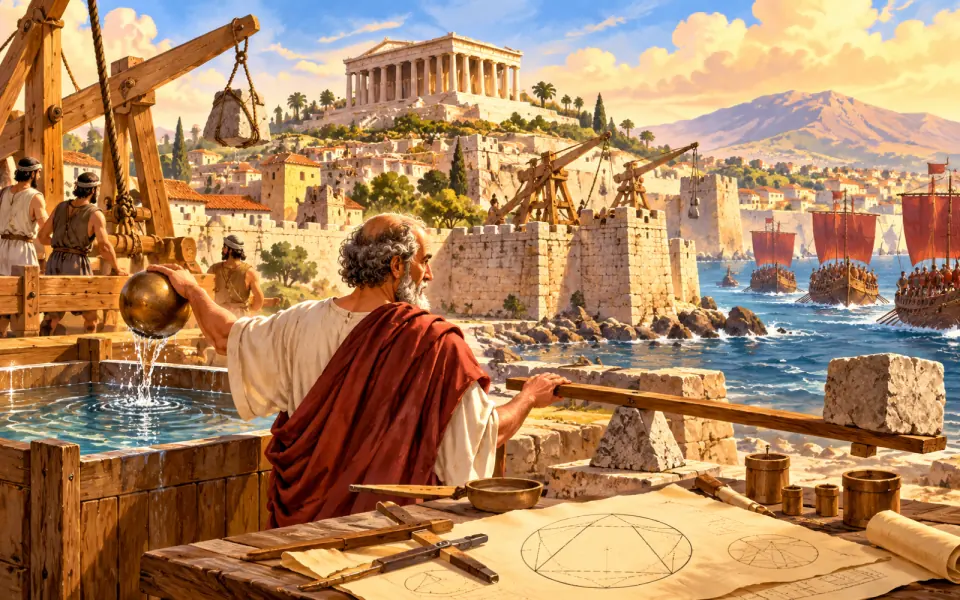 AfterArchimedes of Syracuseabout 250 BC
 AfterThe Antikythera mechanismabout 100 BC
Listen / Read next
- Music to read by: Cinematic JourneyEpic film-style music, no lyrics, by Ciro Simone IrmiciSpotifyYouTube Music
Meanwhile, elsewhere in the world
Other events of the era “Ancient Greece”
- The first Greek city-states
- The ancient Olympic Games
- The Greek alphabet
- Life in Sparta
- Sappho, the poet of Lesbos
- The reforms of Solon
- Thales studies nature
- Pythagoras at Croton
- Cleisthenes and democracy
- The Battle of Marathon
- The Battle of Thermopylae
- The theatre of Aeschylus
- The Age of Pericles
- The Peloponnesian War
- Herodotus writes the Histories
- Hippocrates and medicine
- Socrates is condemned
- Plato's Academy
- Aristotle founds the Lyceum
- The conquests of Alexander
- Euclid writes the Elements
- The Library of Alexandria
- Archimedes of Syracuse
- The Antikythera mechanism
