Cleisthenes and democracy
about 508 BC Athens (Greece)
In short
In 508 BC the Athenian Cleisthenes reorganised the city into ten tribes, mixing citizens from the coast, the countryside and the town. In this way no powerful family could rule on its own any more. Important decisions were made by the assembly, where every adult male citizen could speak and vote. Women, foreigners and slaves, however, were still left out.
Why it matters The word ‘democracy’ means ‘power of the people’, and its journey begins here.
Source: Encyclopaedia Britannica, “Cleisthenes of Athens”
Study card about 6 minutes of reading
The story
After the tyrant
To understand Cleisthenes' achievement we must go back to Athens in the years when tyrants ruled. A tyrant, for the Greeks, was someone who had taken power by force, without being elected. After Pisistratus, Athens had been governed by his sons, the Pisistratids. In 511 or 510 BC a group of nobles, led by the powerful Alcmaeonid family, managed to drive them out with the help of the Spartan army commanded by King Cleomenes I. Cleisthenes, an Alcmaeonid who had been sent into exile, was able to return to Athens.
The regained freedom, however, did not bring peace at once. Two nobles competed for command: Isagoras, backed by the aristocrats, and Cleisthenes himself, who sought the support of the people. Isagoras asked Sparta for help again and Cleisthenes had to leave once more. But when Isagoras wanted to rule with only a few, the Athenians rose up, forced him to leave the city and called Cleisthenes back. This is the moment when you can see that the people no longer wanted to be commanded by a small group of families.
A reform that started from the tribes
Around 508–507 BC Cleisthenes carried out his great reform. The problem was this: the noble families had enormous power, also thanks to the old division of the citizens into four tribes based on birth. Cleisthenes had a simple and revolutionary idea: change the map. He divided Attica, the territory of Athens, into three large zones: the city, the coast and the inland. Each zone was split into ten groups of villages and neighbourhoods, called trittyes. The demes, that is the individual villages and neighbourhoods, became the basic unit: every citizen was registered in his deme, and this membership passed to his sons. In place of the father's name, the name of the deme began to be used in documents.
Then came the cleverest step. The new tribes were ten, and each included three trittyes, one from each zone. The trittyes did not have to be next to one another: a tribe could therefore contain people from the city, the coast and the countryside, even tens of kilometres apart. In this way no tribe was dominated by a powerful family, because each group was a mosaic of people with different interests. Each tribe was given the name of a local hero, chosen with the help of the Pythia, the priestess of Delphi, from a list of a hundred names.
How the new Athens worked
The reform changed the institutions too. Solon's council of the Four Hundred was replaced by one of Five Hundred members, the Boule: fifty from each tribe, chosen by lot. Lots were used, and not elections, because it was thought they guaranteed impartiality. Each tribe, in turn, led the council for a tenth of the year, and every day a different citizen presided over it. The Boule prepared proposals for laws, supervised the magistrates and dealt with everyday business.
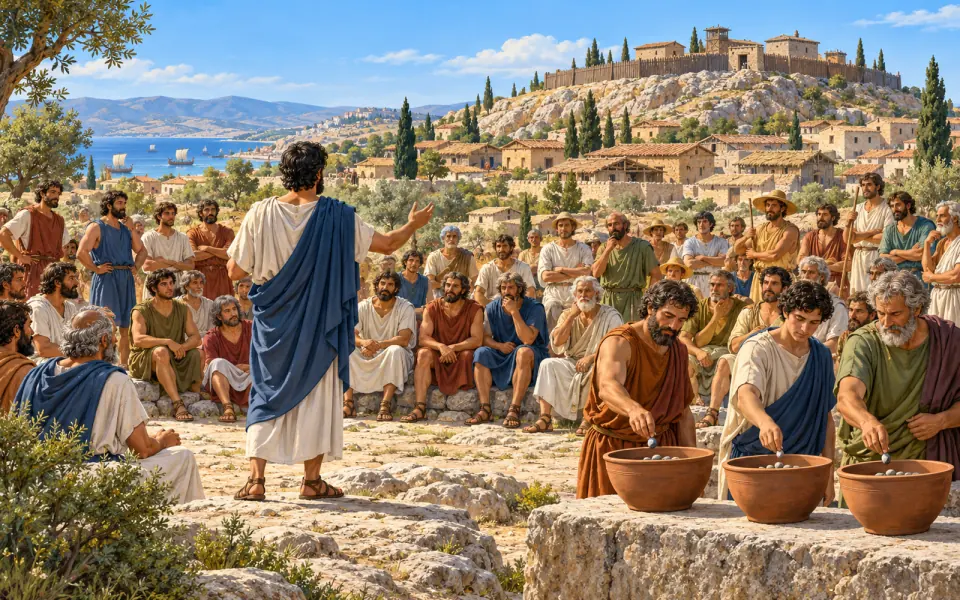
Important decisions belonged to the assembly of the people, the ecclesia, open to all adult male citizens, which met several times a month and voted on laws, elected magistrates, and decided on war and peace. The ten strategoi, that is the generals, were elected and not chosen by lot, because a war cannot be left to chance. The people's courts, too, were made up of jurors chosen by lot.
Ostracism
According to tradition, a particular invention is linked to Cleisthenes' reform: ostracism. Once a year the assembly could decide to send into exile for ten years a citizen considered dangerous to democracy. Each person wrote the name on a potsherd, called an “ostrakon” (from which our “ostracism” comes). For the vote to be valid at least six thousand voters had to be present. The exile did not lose his property and after ten years could return. It was first used in 487 BC. It was meant to protect the city from anyone who wanted to become a tyrant, but over time it was also used as a weapon in struggles between factions.
Who was left out
We call the system that arose “democracy”, but we must remember its limits. Only adult men born in Athens took part in political life. Women, slaves and foreigners were excluded. For Cleisthenes the key word was “isonomia”, that is “equality before the law”: all citizens were to have the same rights. The word “democracy” came later. A few decades later, with the reforms of Ephialtes (462 BC) and Pericles, Athenian democracy grew even broader: Cleisthenes' system had been a stage, not a point of arrival.
Why it happened
After the fall of the Pisistratids Athens was a battlefield between rival families. The aristocrats wanted to return to power as before, and those who had brought down the tyrant did not want to replace him with a new master. Cleisthenes realised that the people, that is the farmers, craftsmen and sailors, could become the decisive force, and decided to rely on them.
The reform of the tribes was designed to break the old ties of blood and clientage. As long as a noble could count on his relatives and neighbours, it was easy for him to become a new tyrant. Mixing citizens from different areas in a single tribe, and giving each a place in a council and an assembly, was a way of making politics less dependent on birth and friendships.
What changed
With Cleisthenes Athens changed its organisation for good. The system of ten tribes, the Boule of the Five Hundred and the assembly remained the heart of Athenian life for almost two centuries. A few years later, in 490 BC, this Athens of citizens faced the Persians at Marathon.
The reform opened the way to later decisions. Ephialtes and Pericles widened the citizens' participation in the courts and the magistracies, and Athenian democracy reached its peak in the 5th century BC. Ostracism and the use of lots, used in various ways, continued to mark the city's politics.
Today's world owes Athens a great debt. Words like “democracy”, “politics” and “assembly” and ideas like equality before the law and the citizens' vote come from here. Today, however, democracies are very different: women vote too, slavery does not exist and a parliament is elected instead of gathering everyone in a square. Understanding Cleisthenes helps us see how far we have come, and how much it takes to truly extend rights to everyone.
Key people and places
People
- Cleisthenes
- Athenian politician of the Alcmaeonids, author of the reform of 508–507 BC that began democracy.
- Isagoras
- Athenian noble, rival of Cleisthenes, who asked Sparta for help in order to rule.
- Cleomenes I
- King of Sparta: he helped drive the tyrants out of Athens and then intervened in favour of Isagoras.
- Pisistratus and his sons
- The family of tyrants of Athens, whose rule ended in 511–510 BC.
Places
- Athens
- The polis of Attica where the reform took place.
- Attica
- The territory around Athens, divided by Cleisthenes into city, coast and inland.
- Delphi
- Sanctuary of Apollo where the Pythia chose the names of the heroes of the ten tribes.
Good to know
- The word “ostracism” comes from “ostrakon”, the potsherd on which the Athenians wrote the name of the person to be sent into exile.
- The ten tribes of Athens bore the names of heroes chosen by the Pythia of Delphi from a hundred names: Erechtheis, Aegeis, Pandionis, Leontis and so on.
- The councillors of the Boule were chosen by lot: any citizen could be picked.
- To use ostracism at least six thousand voters were needed, and the exile could return after ten years without having lost his property.
Find out more
- Wikipedia, “Cleisthenes” en.wikipedia.org
- Wikipedia, “Athenian democracy” en.wikipedia.org
- Wikipedia, “Ostracism” en.wikipedia.org
- Wikipedia, “Isagoras” en.wikipedia.org
Related events
- The reforms of Solonabout 594 BC · Ancient GreeceSolon had already opened Athenian politics to all income classes.
- The Age of Pericles461–429 BC · Ancient GreecePericles carried democracy forward after Cleisthenes.
- The Battle of Marathon490 BC · Ancient GreeceThe free Athenians fought with strength at Marathon.
- The first Greek city-statesabout 800 BC · Ancient GreeceThe reform concerns the organisation of a polis.
- The French Revolution1789–1799 · Age of revolutionsThe French Revolution took up the idea that power belongs to the citizens.
Before and after, in the era “Ancient Greece”
Event 9 of 25
 BeforeThe first Greek city-statesabout 800 BC
 BeforeThe ancient Olympic Gamesabout 776 BC
 BeforeThe Greek alphabetabout 750 BC
 BeforeLife in Spartaabout 700 BC
 BeforeSappho, the poet of Lesbosabout 600 BC
 BeforeThe reforms of Solonabout 594 BC
 BeforeThales studies natureabout 585 BC
 BeforePythagoras at Crotonabout 530 BC
- You are hereCleisthenes and democracyabout 508 BC
 AfterThe Battle of Marathon490 BC
 AfterThe Battle of Thermopylae480 BC
 AfterThe theatre of Aeschylus472 BC
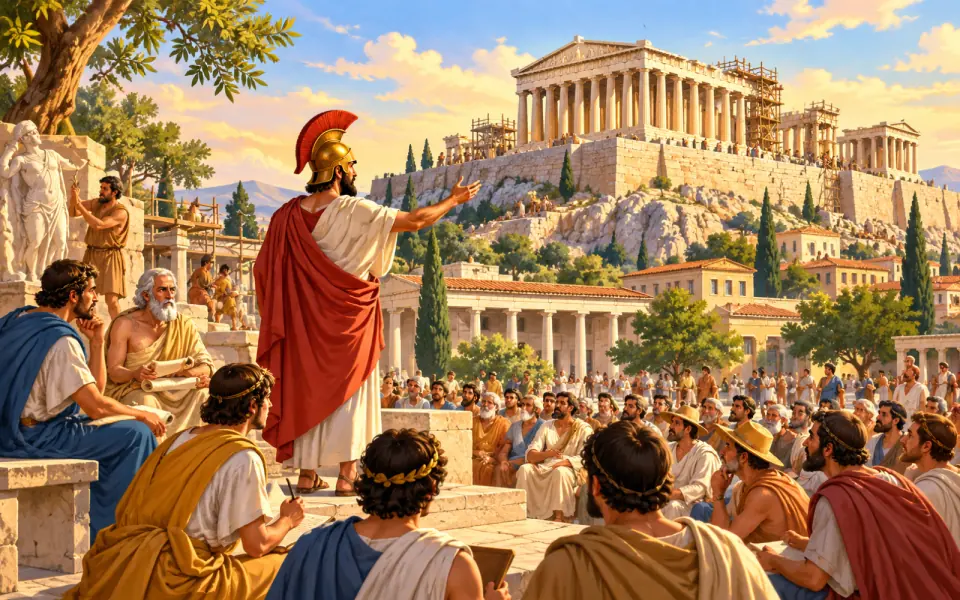 AfterThe Age of Pericles461–429 BC
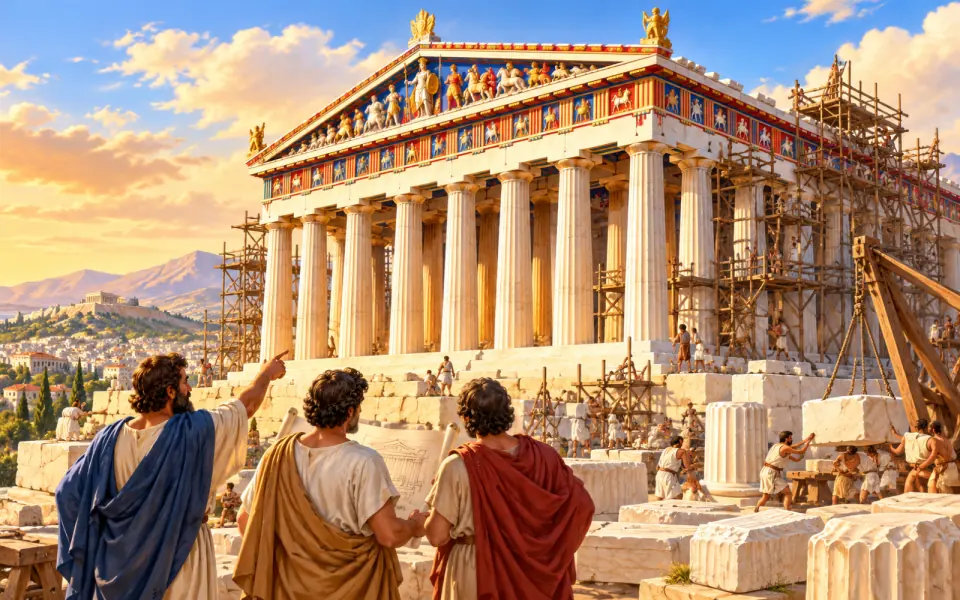 AfterThe Parthenon447–432 BC
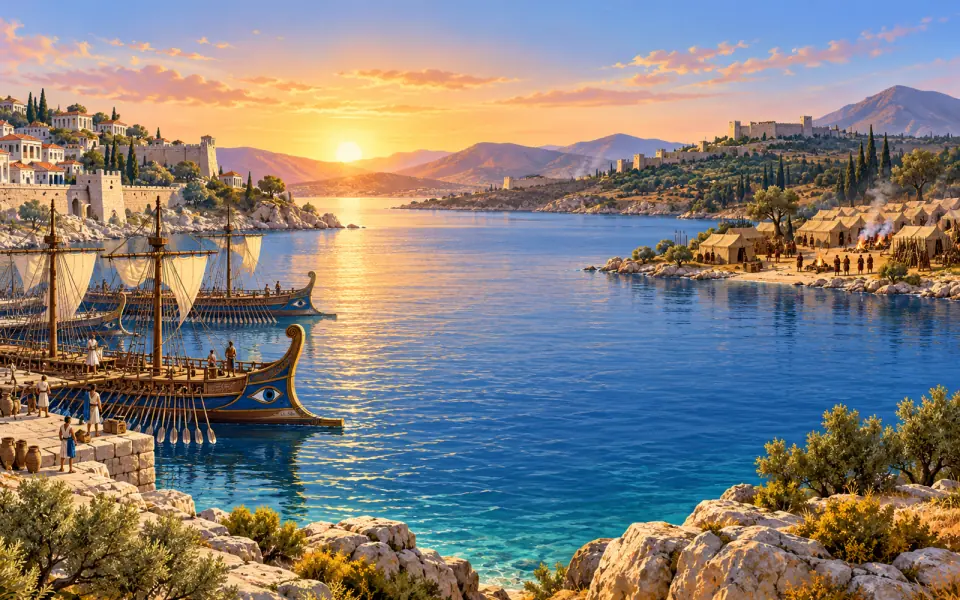 AfterThe Peloponnesian War431–404 BC
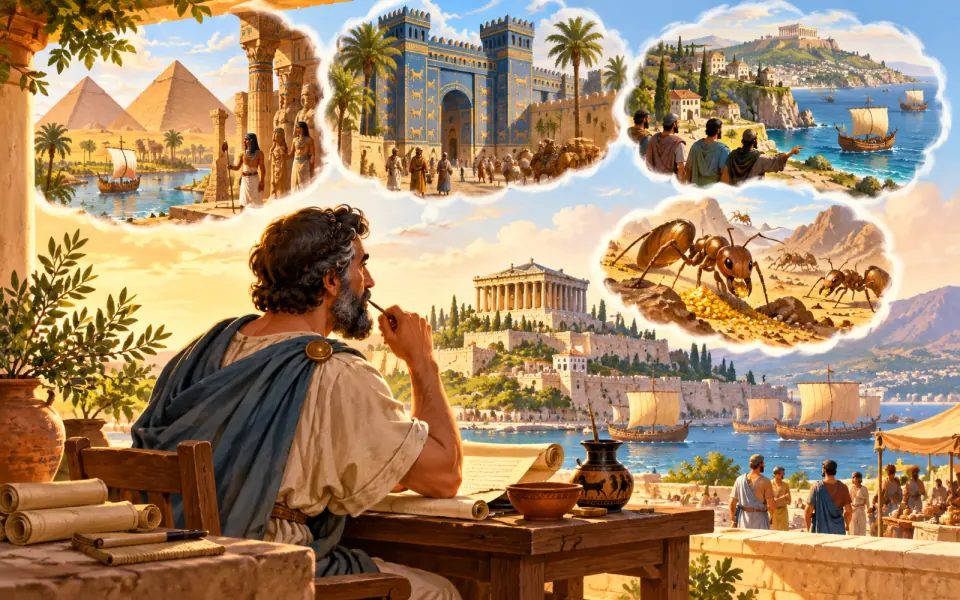 AfterHerodotus writes the Historiesabout 430 BC
 AfterHippocrates and medicineabout 400 BC
 AfterSocrates is condemned399 BC
 AfterPlato's Academyabout 387 BC
 AfterAristotle founds the Lyceumabout 335 BC
 AfterThe conquests of Alexander334–323 BC
 AfterEuclid writes the Elementsabout 300 BC
 AfterThe Library of Alexandriaabout 295 BC
 AfterArchimedes of Syracuseabout 250 BC
 AfterThe Antikythera mechanismabout 100 BC
Listen / Read next
- Music to read by: Cinematic JourneyEpic film-style music, no lyrics, by Ciro Simone IrmiciSpotifyYouTube Music
Meanwhile, elsewhere in the world
Other events of the era “Ancient Greece”
- The first Greek city-states
- The ancient Olympic Games
- The Greek alphabet
- Life in Sparta
- Sappho, the poet of Lesbos
- The reforms of Solon
- Thales studies nature
- Pythagoras at Croton
- The Battle of Marathon
- The Battle of Thermopylae
- The theatre of Aeschylus
- The Age of Pericles
- The Parthenon
- The Peloponnesian War
- Herodotus writes the Histories
- Hippocrates and medicine
- Socrates is condemned
- Plato's Academy
- Aristotle founds the Lyceum
- The conquests of Alexander
- Euclid writes the Elements
- The Library of Alexandria
- Archimedes of Syracuse
- The Antikythera mechanism
