The Peloponnesian War
431–404 BC Greece (Athens against Sparta)
In short
Athens, powerful at sea, and Sparta, extremely strong on land, fought each other for almost thirty years, dragging nearly all the Greek cities in with them. At the start of the war a terrible epidemic struck Athens, crowded with refugees, and killed Pericles too. The Athenians attempted a great expedition against Syracuse, in Sicily, which ended in disaster. In the end Sparta, helped by Persian money, won, and Athens had to pull down its Long Walls.
Why it matters The war left the Greek cities exhausted and divided, opening the way for new conquerors.
Source: Encyclopaedia Britannica, “Peloponnesian War”
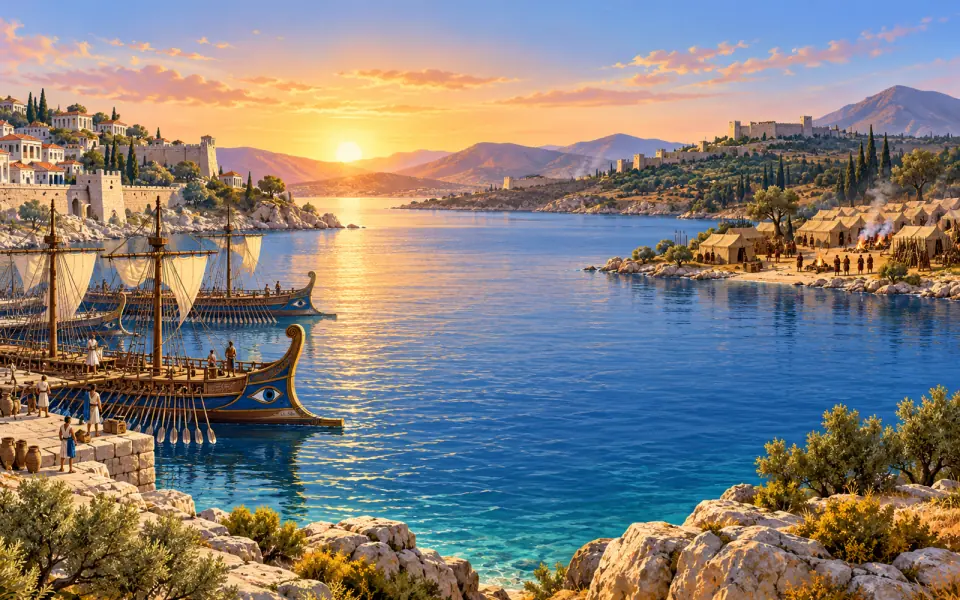
Study card about 5 minutes of reading
The story
Two powers, two ways of life
After the victory over the Persians, Greece found itself with two cities much stronger than the others. Athens was a sea power: it had the best fleet, led the Delian League and its allies paid it tribute. Sparta was a land power, with a formidable army and at the head of another alliance, the Peloponnesian League. Athens was a democracy, Sparta a city of soldiers with two kings. They were different in everything, and each feared the other.
Thucydides, the Athenian historian who lived through that war and told its story, wrote that the real cause was not the individual incidents but the growth of Athens' power, which frightened Sparta. The pretexts, instead, were others. Athens had supported the city of Corcyra against Corinth. Then there had been tension around Potidaea, a colony of Corinth that was under Athenian control: when Potidaea refused to obey Athens, the city was besieged. To these were added disputes with Megara. So, in 431 BC, war broke out.
Ten years of attacks and counterattacks
Pericles' strategy was simple. The Spartans were extremely strong in battle, so Athens should not face them: the inhabitants of Attica would take refuge inside the Long Walls, while the fleet brought supplies and attacked the coasts of the Peloponnese. The Spartans would devastate the fields, then tire and negotiate. The first phase of the war, from 431 to 421 BC, is called the “Archidamian” after Archidamus II, the Spartan king who led the invasions.
In the summer of 430 BC a terrible epidemic broke out in an overcrowded Athens. Thucydides described it in his book. According to one estimate, about a third of the population died. Among the victims was Pericles, in 429. After him Athens found itself with less cautious leaders. In 421 BC the Peace of Nicias was signed, meant to last fifty years, but it did not hold.
The disaster in Sicily
In 415 BC the Athenians decided on a bold move: to send a great fleet to Sicily, against powerful Syracuse. A brilliant and ambitious politician, Alcibiades, supported the venture; Nicias, who led the party of peace and the moderates, was against it. 134 triremes, the warships, set out under the command of three generals: Alcibiades, Nicias and Lamachus. Soon after the departure, the scandal of the Herms (mutilated sacred statues) broke out in Athens, Alcibiades was accused and fled to Sparta. Nicias besieged Syracuse, but Lamachus died and help arrived from Sparta and Corinth, the general Gylippus, who defeated the Athenians. A second expedition, led by Demosthenes, ended even worse.
It was a catastrophe: Athens lost an enormous number of ships and men, many of whom remained prisoners in Sicily.
Sparta and the Persians' money
After 413 BC the war entered its final phase, called the “Decelean”. Sparta urged Athens' allies to rebel, and obtained financial help from the Persians, who wanted to see Athens weakened. With that money it built a fleet. Athens made further mistakes, and the situation collapsed. In 405 BC, at Aegospotami, the Spartans, commanded by Lysander, took the Athenian fleet of about 180 ships by surprise and destroyed it: according to Xenophon only nine triremes were saved.
The surrender
Without a fleet, and with its main supply route cut, Athens was trapped. After some months of siege by land and sea the city surrendered, in 404 BC. The Spartans demanded: hand over the whole fleet, except twelve ships; dissolve the Delian League; tear down the Long Walls; accept a Spartan garrison; recall the exiles and adopt an oligarchic government. This government, led by Critias, has gone down in history as the “Thirty Tyrants”. The war, which had lasted about twenty-seven years, was over.
Why it happened
The causes were deep and older than the episodes that set the war off. After the Persians Athens had become too strong: it led an alliance of tribute-paying cities and had a fleet without rivals. Sparta and its allies, especially Corinth, felt threatened, and feared that Athens wanted to impose its rule on the whole of Greece.
What made the war break out were specific incidents: Athenian help to Corcyra against Corinth, the siege of Potidaea, the measures against Megara. For Thucydides, though, they were only occasions. The real spring was the fear that the power of a growing city caused in the other: a theme that scholars have taken up many times to read the conflicts of later centuries too.
What changed
The war destroyed trust between the Greek poleis. Athens lost its empire, its walls and its fleet, and suffered the regime of the Thirty Tyrants. Sparta gained power over much of Greece, but governing an empire was a different thing from winning a war, and after a few years fighting between the cities began again. So Athens, Sparta and Thebes weakened one another.
All this made it easier for a power from the north, Macedonia, to rise and in the 4th century BC subdue Greece. The freedom of the poleis, which had survived the Persians, did not survive their own internal wars.
For the history of culture, the war had a paradoxical effect: Thucydides wrote his work, which is considered a model of history writing based on the search for facts. Xenophon also told the final part. Even today we know a great deal about the war thanks to them. Curiously, a real peace treaty was never signed, and only in 1996 did the mayors of Athens and Sparta sign a symbolic document to officially close it.
Key people and places
People
- Thucydides
- Athenian historian who lived through the war and told its story; his work stops at 411 BC.
- Pericles
- Leader of Athens at the start of the war: he died of plague in 429 BC.
- Alcibiades
- Brilliant and controversial Athenian politician: he promoted the expedition to Sicily and then went over to Sparta.
- Nicias
- Athenian general, against the expedition to Sicily but then its commander; he signed the peace of 421.
- Lysander
- Spartan commander who won at Aegospotami in 405 BC.
Places
- Syracuse
- Great Greek city of Sicily, where the Athenian expedition ended in disaster.
- Aegospotami
- A place on the Dardanelles strait where the Athenian fleet was destroyed in 405 BC.
- Potidaea and Corcyra
- The two cities whose conflicts pushed the crisis over the edge.
- Long Walls
- Walls that protected Athens: tearing them down was the sign of its defeat.
Good to know
- Thucydides described in his book the terrible epidemic of Athens, which today we cannot identify with certainty.
- For the expedition to Sicily 134 triremes set out, an enormous fleet for the time.
- At Aegospotami, according to Xenophon, only 9 of the roughly 180 Athenian triremes were saved.
- After the war Athens was allowed to keep only 12 ships.
- In 1996 the mayors of Athens and Sparta signed a document declaring over a war that had never had a peace treaty.
Find out more
- Wikipedia, “Peloponnesian War” en.wikipedia.org
- Wikipedia, “Thucydides” en.wikipedia.org
- Wikipedia, “Sparta” en.wikipedia.org
- Wikipedia, “Sicilian Expedition” en.wikipedia.org
Related events
- The Age of Pericles461–429 BC · Ancient GreecePericles led Athens at the start of the war.
- Life in Spartaabout 700 BC · Ancient GreeceSparta was Athens' great adversary.
- Socrates is condemned399 BC · Ancient GreeceSocrates was put on trial in the Athens that emerged from the war.
- The conquests of Alexander334–323 BC · Ancient GreeceWith Greece weakened, the Macedonia of Philip and Alexander rose.
- The Parthenon447–432 BC · Ancient GreeceThe Parthenon was built in the years of prosperity before the war.
Before and after, in the era “Ancient Greece”
Event 15 of 25
 BeforeThe first Greek city-statesabout 800 BC
 BeforeThe ancient Olympic Gamesabout 776 BC
 BeforeThe Greek alphabetabout 750 BC
 BeforeLife in Spartaabout 700 BC
 BeforeSappho, the poet of Lesbosabout 600 BC
 BeforeThe reforms of Solonabout 594 BC
 BeforeThales studies natureabout 585 BC
 BeforePythagoras at Crotonabout 530 BC
 BeforeCleisthenes and democracyabout 508 BC
 BeforeThe Battle of Marathon490 BC
 BeforeThe Battle of Thermopylae480 BC
 BeforeThe theatre of Aeschylus472 BC
 BeforeThe Age of Pericles461–429 BC
 BeforeThe Parthenon447–432 BC
- You are hereThe Peloponnesian War431–404 BC
 AfterHerodotus writes the Historiesabout 430 BC
 AfterHippocrates and medicineabout 400 BC
 AfterSocrates is condemned399 BC
 AfterPlato's Academyabout 387 BC
 AfterAristotle founds the Lyceumabout 335 BC
 AfterThe conquests of Alexander334–323 BC
 AfterEuclid writes the Elementsabout 300 BC
 AfterThe Library of Alexandriaabout 295 BC
 AfterArchimedes of Syracuseabout 250 BC
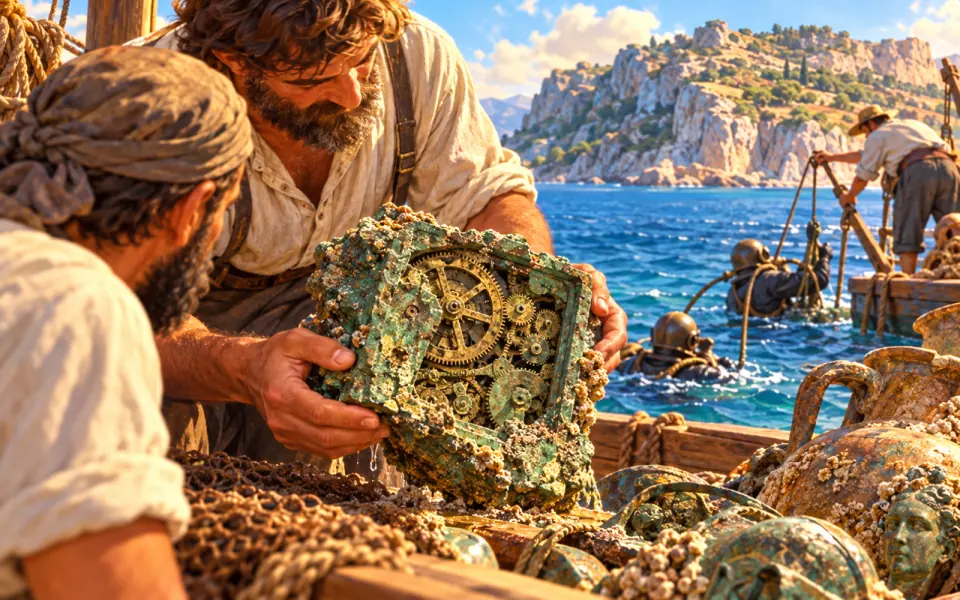 AfterThe Antikythera mechanismabout 100 BC
Listen / Read next
- Music to read by: Cinematic JourneyEpic film-style music, no lyrics, by Ciro Simone IrmiciSpotifyYouTube Music
Meanwhile, elsewhere in the world
Other events of the era “Ancient Greece”
- The first Greek city-states
- The ancient Olympic Games
- The Greek alphabet
- Life in Sparta
- Sappho, the poet of Lesbos
- The reforms of Solon
- Thales studies nature
- Pythagoras at Croton
- Cleisthenes and democracy
- The Battle of Marathon
- The Battle of Thermopylae
- The theatre of Aeschylus
- The Age of Pericles
- The Parthenon
- Herodotus writes the Histories
- Hippocrates and medicine
- Socrates is condemned
- Plato's Academy
- Aristotle founds the Lyceum
- The conquests of Alexander
- Euclid writes the Elements
- The Library of Alexandria
- Archimedes of Syracuse
- The Antikythera mechanism
