The Pantheon
about AD 125 Rome
In short
The Pantheon we see today was rebuilt in the time of the emperor Hadrian, replacing an older temple put up by Agrippa. Its concrete dome is 43 metres across and remained the largest in the world for more than a thousand years. At the top there is a round opening about nine metres wide, the oculus, which is the only source of light. Since the 7th century the building has been a church, and that is one reason it has survived so well.
Why it matters Architects of every age, from Brunelleschi to Michelangelo, have studied it to learn how to build domes.
Source: Treccani, entry “Pantheon”
Study card about 5 minutes of reading
The story
The temple of all the gods
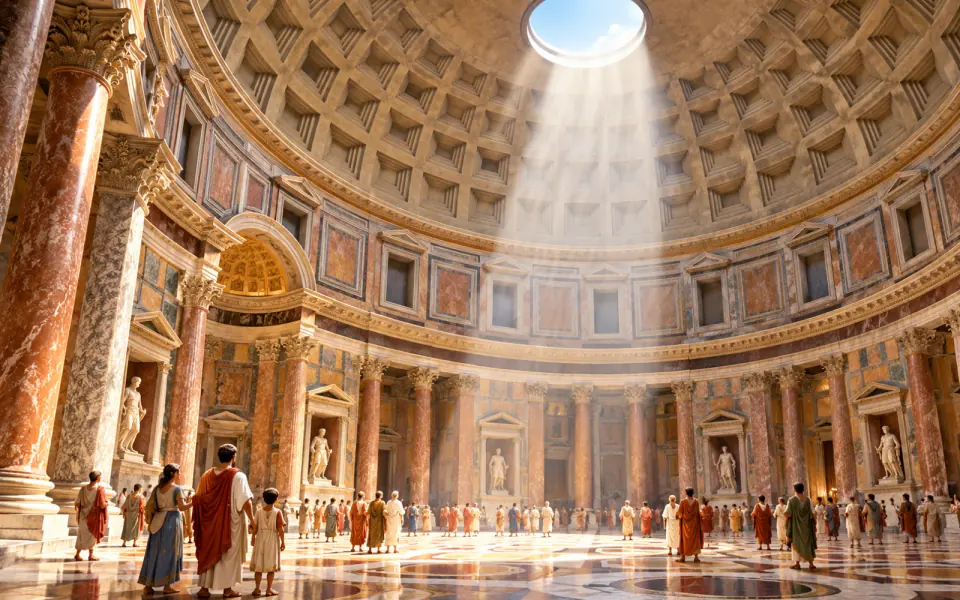
Walk into the Pantheon and look up. Above you is an enormous dome, with no columns or supports, and right at the top an open circle through which the light of the sky comes in. It is one of the best-preserved ancient buildings in the world. Its name comes from Greek and means “of all the gods”.
The Pantheon we see today is not the first. A first temple was built around 27–25 BC by Marcus Vipsanius Agrippa, friend and son-in-law of Augustus, in the Campus Martius, the part of Rome where many public monuments stood. It was very different: it had a rectangular plan, measured about 44 metres by 20, was built of travertine and faced with marble. That temple burned down in AD 80, was restored under the emperor Domitian and destroyed again, after a lightning strike, around 110, under Trajan.
A building site of many years
The rebuilding of the present building took place under Trajan and Hadrian. Scholars do not agree on the dates: the reconstruction must have taken a period between about 112 and 128, and the dedication of the temple may have been made between 125 and 127. Many scholars think that the work began under Trajan, around 114, and was finished by Hadrian: this is suggested by the brick stamps, that is, the maker's marks pressed into the bricks, which date mostly from the last years of Trajan and the first of Hadrian. For this reason the date is approximate, around 125.
On the façade, however, Hadrian did not put his own name. You can still read today Agrippa's inscription, carried over onto the new building: M·AGRIPPA·L·F·COS·TERTIVM·FECIT, that is, “Marcus Agrippa, son of Lucius, consul for the third time, built it”. It is a way of respecting the past.
Outside: the portico
The entrance is a great portico, the pronaos, with 16 Corinthian columns. Eight are of grey granite, quarried at Mons Claudianus, and eight of pink granite, quarried at Aswan, both in Egypt. Think what an effort it was to carry enormous columns from Egypt to Rome. The entrance door is of bronze, 4.45 metres wide and 7.53 high: it is considered the oldest and most imposing bronze door still in use in Rome.
Inside: the rotunda
Beyond the portico opens the great circular hall, the rotunda. The cylinder of the walls is 21.72 metres high, which is the same as the radius of the hall. The dome has a diameter of about 43.4 metres, and its interior height is equal to the diameter. This means that a sphere would fit perfectly inside the hall. For centuries it was the largest dome in the world, and even today it is the largest ever built in unreinforced concrete, that is, without iron bars inside.
The dome is decorated with five rows of coffers, that is, sunken panels, 28 in each row, getting smaller as they go up. The number 28 was considered perfect by the ancients. The coffers are not only beautiful: they lighten the weight.
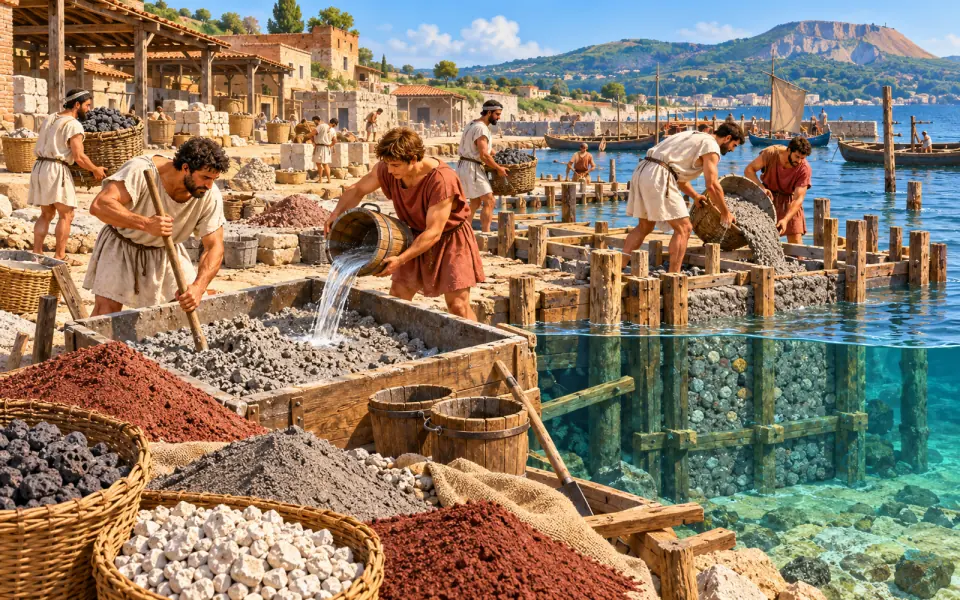
The secret lies in the material. The concrete is not the same everywhere: at the bottom it is heavier, with pieces of travertine and tuff; as you go up it becomes lighter, with pumice and volcanic lapilli. The thickness of the shell decreases from about 6 metres at the base to a little over a metre near the top. In this way the overall weight is less and the dome does not collapse.
At the top is the oculus, a large circular opening. It is the only source of light in the building, apart from the door. The smooth band surrounding it measures about 9 metres across.
From temple to church
The Pantheon has been preserved almost intact because it was never abandoned. In 608 the Eastern emperor Phocas gave it to Pope Boniface IV, who in 609 turned it into a church, dedicated to St Mary and the Martyrs, the Sancta Maria ad Martyres. Today it is still a church. Inside lie the painter Raphael, the painter Annibale Carracci, the kings of Italy Victor Emmanuel II and Umberto I, and Queen Margherita.
Why it happened
Rome, in Hadrian's time, was at the height of its power. The empire was at peace, rich, and the emperors wanted to leave monuments that showed the greatness of the state. The Pantheon came from the wish to rebuild a revered temple, destroyed by lightning, in a bigger and safer form.
The architecture was made possible by concrete, the material the Romans knew how to use better than anyone. With that technique, an architect could cover a vast hall without columns, using the dome. The building is a true demonstration of how advanced the Roman builders were.
What changed
The Pantheon became a model. In the following centuries architects went to study it to learn how to make a dome. In many cities of the world there are churches and palaces with a portico of columns and a dome that recall its design.
It stayed standing because it was turned into a church. This makes us think how reuse saved many ancient buildings: buildings that still served some purpose were repaired, those abandoned became quarries of material.
Today anyone who walks in and looks at the oculus sees the same opening that the Romans saw, and understands how far technique, mathematics and the sense of space had already advanced two thousand years ago.
Key people and places
People
- Marcus Vipsanius Agrippa
- Friend and son-in-law of Augustus: he built the first Pantheon around 27–25 BC. His name is still on the façade.
- Hadrian
- Emperor from AD 117 to 138: under him the Pantheon was rebuilt in its present form.
- Pope Boniface IV
- In 609 he turned the Pantheon into a church, after the emperor Phocas had given it to him.
- Raphael
- Painter of the Renaissance: he is buried in the Pantheon.
Places
- Campus Martius
- Flat area of Rome where Agrippa built the first Pantheon.
- Aswan
- City in southern Egypt, near the quarries from which the eight pink granite columns of the portico came.
- Mons Claudianus
- Quarry in the eastern desert of Egypt from which the eight grey granite columns came.
Good to know
- The dome is as high inside as it is wide: a perfect sphere would fit in the hall.
- In the dome there are five rows of 28 coffers: 28 was considered a perfect number.
- The concrete becomes lighter towards the top, with pumice and volcanic lapilli.
- On the façade there is still the name of Agrippa, even though the present building was rebuilt by Hadrian.
- The bronze door is the oldest still in use in Rome.
Find out more
- World History Encyclopedia, “Pantheon” worldhistory.org
- Wikipedia, “Pantheon, Rome” en.wikipedia.org
- Wikipedia, “Hadrian” en.wikipedia.org
- Wikipedia, “Marcus Vipsanius Agrippa” en.wikipedia.org
Related events
- Roman concreteabout 150 BC · Ancient RomeThe dome of the Pantheon is the masterpiece of Roman concrete.
- Brunelleschi completes the dome1436 · Early modern ageCenturies later, Brunelleschi built a great dome in Florence, admired as much as the Roman ones.
- Trajan's ColumnAD 113 · Ancient RomeTrajan's Column was inaugurated a few years before the rebuilding of the Pantheon.
- The Colosseum opensAD 80 · Ancient RomeThe Colosseum and the Pantheon are the two most visited ancient buildings in Rome.
- Hagia Sophia in ConstantinopleAD 537 · Early Middle AgesHagia Sophia in Constantinople, centuries later, had a great dome in its turn.
Before and after, in the era “Ancient Rome”
Event 20 of 25
 BeforeTraditional founding of Romeabout 753 BC
 BeforeBirth of the Roman Republicabout 509 BC
 BeforeThe Laws of the Twelve Tablesabout 450 BC
 BeforeThe Appian Way312 BC
 BeforeThe First Punic War264–241 BC
 BeforeHannibal crosses the Alps218 BC
 BeforePlautus and comedyabout 200 BC
 BeforeRoman concreteabout 150 BC
 BeforeThe Aqua Marcia aqueduct144–140 BC
 BeforeSpartacus leads the revolt73–71 BC
 BeforeCaesar crosses the Rubicon49 BC
 BeforeThe Julian calendar46 BC
 BeforeThe murder of Julius Caesar44 BC
 BeforeAugustus, the first emperor27 BC
 BeforeThe Pax Romana27 BC – AD 180
 BeforeVirgil and the Aeneid19 BC
 BeforePompeii buried by VesuviusAD 79
 BeforeThe Colosseum opensAD 80
 BeforeTrajan's ColumnAD 113
- You are hereThe Pantheonabout AD 125
 AfterGalen, a doctor in Romeabout AD 162
 AfterThe Baths of CaracallaAD 216
 AfterThe book with pages (the codex)about AD 300
 AfterThe Edict of MilanAD 313
 AfterFall of the Western Roman EmpireAD 476
Listen / Read next
- Music to read by: Cinematic JourneyEpic film-style music, no lyrics, by Ciro Simone IrmiciSpotifyYouTube Music
Meanwhile, elsewhere in the world
Other events of the era “Ancient Rome”
- Traditional founding of Rome
- Birth of the Roman Republic
- The Laws of the Twelve Tables
- The Appian Way
- The First Punic War
- Hannibal crosses the Alps
- Plautus and comedy
- Roman concrete
- The Aqua Marcia aqueduct
- Spartacus leads the revolt
- Caesar crosses the Rubicon
- The Julian calendar
- The murder of Julius Caesar
- Augustus, the first emperor
- The Pax Romana
- Virgil and the Aeneid
- Pompeii buried by Vesuvius
- The Colosseum opens
- Trajan's Column
- Galen, a doctor in Rome
- The Baths of Caracalla
- The book with pages (the codex)
- The Edict of Milan
- Fall of the Western Roman Empire
