Trajan's Column
AD 113 Forum of Trajan, Rome
In short
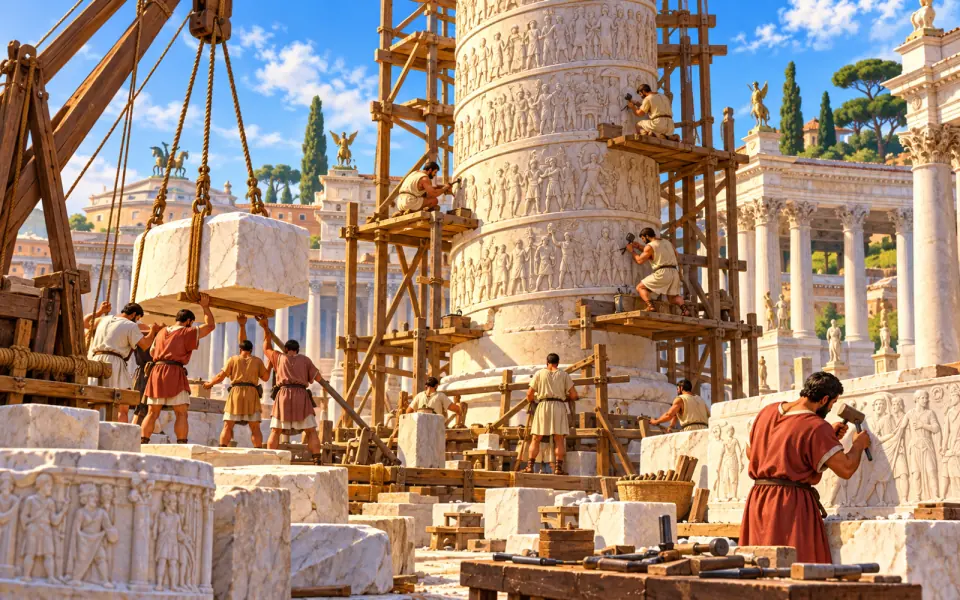
In the forum built by the emperor Trajan a marble column about 30 metres high was unveiled. A carved band about 200 metres long winds up around the shaft, like a story told in pictures. It tells of Trajan's two wars against the Dacians, a people who lived in what is now Romania. There are more than 2500 figures: soldiers building bridges, camps, sea voyages and battles.
Why it matters Its scenes are a precious source for learning how Roman soldiers were dressed and armed.
Source: Encyclopaedia Britannica, “Trajan's Column”
Study card about 5 minutes of reading
The story
A marble comic strip thirty metres tall
If you go to Rome, near Piazza Venezia, you can see a very tall column of white marble, with a carved strip that winds round the shaft from the base to the top, like a ribbon. That strip is a story: a long “comic strip” carved in stone, telling of a war. It is Trajan's Column, inaugurated on 12 May AD 113, as recorded in the ancient registers called the Fasti Ostienses.
The column was built to commemorate the victories of the emperor Trajan against the Dacians, a people who lived in present-day Romania. It was part of a large complex, the Forum of Trajan, designed by the architect Apollodorus of Damascus. The column stood in a courtyard behind the great Basilica Ulpia, between two buildings thought to have been libraries. Its base also recalled a feat of engineering: it showed the height of the saddle of ground between the Capitoline and the Quirinal, before the hill was dug away to make room for the Forum.
The measurements
The shaft of the column is 100 Roman feet high, that is, about 29.8 metres. With the pedestal and the statue that stood on top, the total height reached about 38–40 metres. It is not a single block: it is made of some twenty enormous blocks of Carrara marble (17 drums in the shaft), that is, white marble quarried in Tuscany, each weighing tens of tonnes; the diameter is 3.83 metres. These blocks were carried to Rome and lifted one on top of another: an incredible feat for the time.
Inside the column there is a spiral staircase of 185 steps, climbing to the top. It is lit by some forty small windows, cut along the frieze. At the base there was a small chamber that held the ashes of Trajan and of his wife Plotina: the emperor, who died in AD 117, was buried right under his column.
The carved story
Around the shaft winds a carved band about 200 metres long, making about 23 turns. It contains over a hundred scenes (155 according to the Colosseum Archaeological Park, 114 in another count), with about 2,500 figures. So that people looking from below could see even the highest scenes well, the sculptor made them grow in height: from the base, where the band is about 89 centimetres high, to about 1.25 metres at the top.
The story is about two wars. The first, between AD 101 and 102, and the second, between 105 and 106. Scholars have numbered the scenes: the first 57 tell of the first war and those from 59 to 114 the second. You can see soldiers building roads and bridges, camps, marches, sacrifices to the gods, rivers crossed on bridges of boats, sieges, battles, voyages on ships, prisoners. Trajan appears many times, speaking to the soldiers or listening to his advisers.
The king of the Dacians, Decebalus, is also present several times. We see him speaking to his men, and in one of the last scenes the end of his story is shown: he takes his own life so as not to be taken prisoner. The sculptors show the enemies with respect, as brave men.
One detail: we do not know the author of the frieze. Scholars call him by a conventional name, the “Master of Trajan's Exploits”. There is no proof that it was Apollodorus, the architect of the Forum, but the two probably worked together.
How it was and how it is
Today the column is white, but originally the reliefs were painted in bright colours. The colours have disappeared completely. At the top, originally, there was a bronze statue of Trajan. In 1587 Pope Sixtus V, with the architect Domenico Fontana, replaced it with a bronze statue of St Peter, which can still be seen today.
About eighty years later, between 180 and 193, another column was raised in Rome, that of Marcus Aurelius, which took Trajan's as its model. Its frieze winds round fewer times than Trajan's, and the figures are larger and more deeply cut.
Why it happened
Trajan wanted to take the war to Dacia, on the borders of the empire. After two campaigns, between AD 101 and 106, he managed to defeat King Decebalus. It was the most important victory of his reign and he wanted to celebrate it as it deserved.
The Romans had a tradition of recording victories with monuments, such as arches and columns. Trajan wanted a column that not only celebrated the victory but told its story in rich detail, and that also held his ashes.
What changed
Trajan's Column is a most precious source. From its scenes we know how Roman soldiers were dressed and armed, how they built bridges and fortifications, and how the army looked on the march. The Dacians too are shown in detail.
It was a model for later monuments: the column of Marcus Aurelius, built about eighty years later, took it as an example. For scholars and artists it has been a school.
The fact that it has survived almost intact, while so many other things have been lost, makes us feel close to that world. Walking beneath it, we can still read a story carved two thousand years ago. It is a work of history, of art and of technique.
Key people and places
People
- Trajan
- Roman emperor from AD 98 to 117. He conquered Dacia and had the Forum and the column built.
- Decebalus
- King of the Dacians, Trajan's enemy. He is shown several times on the column.
- Apollodorus of Damascus
- Architect of the Forum of Trajan. It is not known whether he also designed the column.
- Plotina
- Trajan's wife: her ashes were placed together with those of the emperor in the base.
Places
- Forum of Trajan
- The great complex with the Basilica Ulpia, the libraries and the column, in the centre of Rome.
- Dacia
- Region corresponding roughly to present-day Romania, conquered by Trajan after two wars.
- Carrara
- Place in Tuscany from which the marble of the blocks came.
Good to know
- The frieze is about 200 metres long and winds about 23 times round the shaft.
- The column is about 30 metres high in the shaft: exactly 100 Roman feet.
- About 2,500 figures can be counted, among soldiers, enemies, horses and ships.
- A spiral staircase with 185 steps climbs inside, with some forty small windows.
- Since 1587 on top there has been a statue of St Peter, in place of the one of Trajan.
Find out more
- Wikipedia, “Trajan's Column” en.wikipedia.org
- World History Encyclopedia, “Trajan” worldhistory.org
- Wikipedia, “Trajan's Forum” en.wikipedia.org
- Wikipedia, “Column of Marcus Aurelius” en.wikipedia.org
Related events
- The Pax Romana27 BC – AD 180 · Ancient RomeTrajan's wars were fought on the borders, while inside the empire there was peace.
- The Pantheonabout AD 125 · Ancient RomeA few years later, under Hadrian, the Pantheon was rebuilt.
- The Colosseum opensAD 80 · Ancient RomeLike the Colosseum, the column celebrates the power of Rome and of its emperors.
- Virgil and the Aeneid19 BC · Ancient RomeLike the Aeneid, the column tells a story in the form of art.
- The reign of Ramesses IIabout 1279–1213 BC · River civilisationsRamesses II celebrated his deeds with great reliefs, as Trajan did.
Before and after, in the era “Ancient Rome”
Event 19 of 25
 BeforeTraditional founding of Romeabout 753 BC
 BeforeBirth of the Roman Republicabout 509 BC
 BeforeThe Laws of the Twelve Tablesabout 450 BC
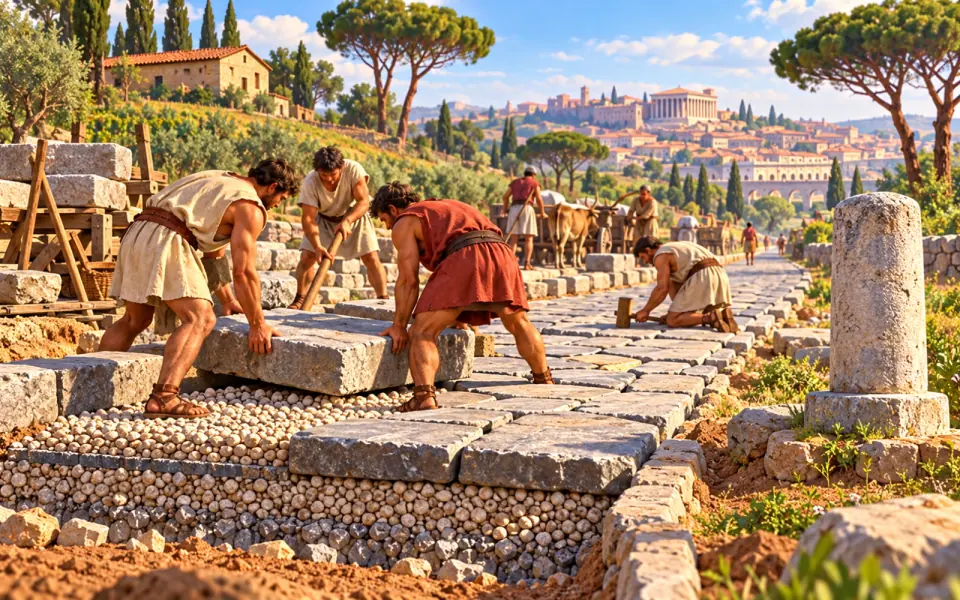 BeforeThe Appian Way312 BC
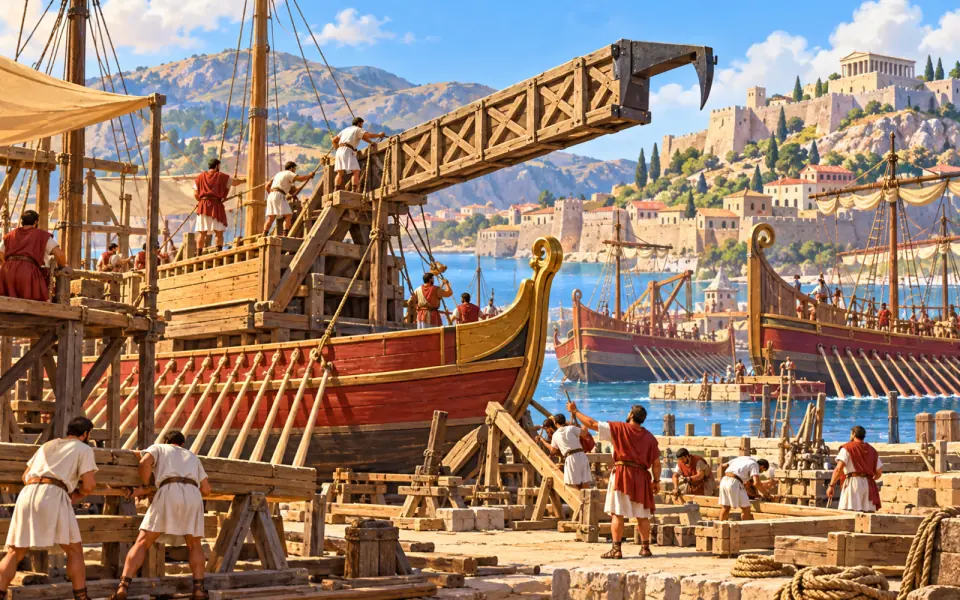 BeforeThe First Punic War264–241 BC
 BeforeHannibal crosses the Alps218 BC
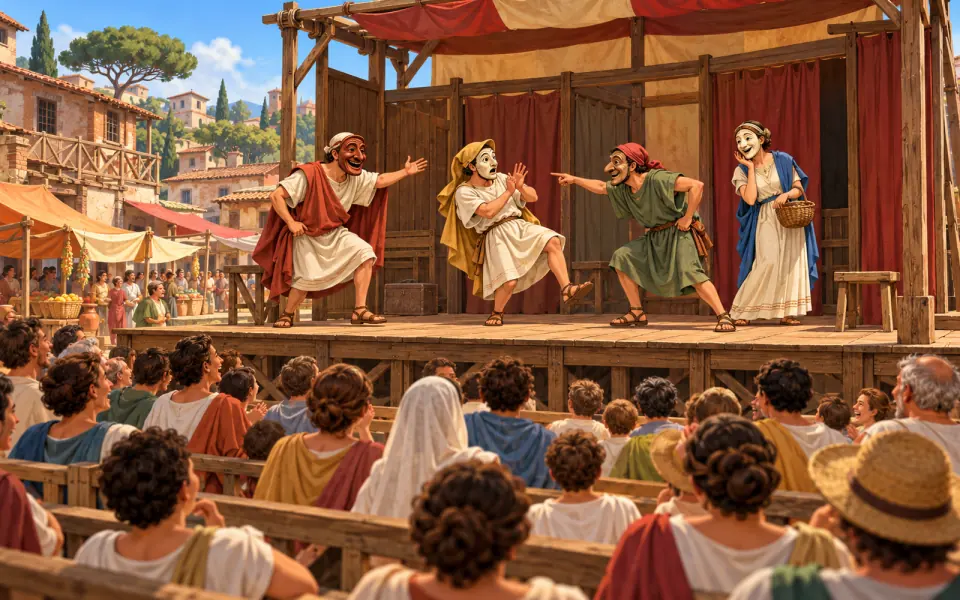 BeforePlautus and comedyabout 200 BC
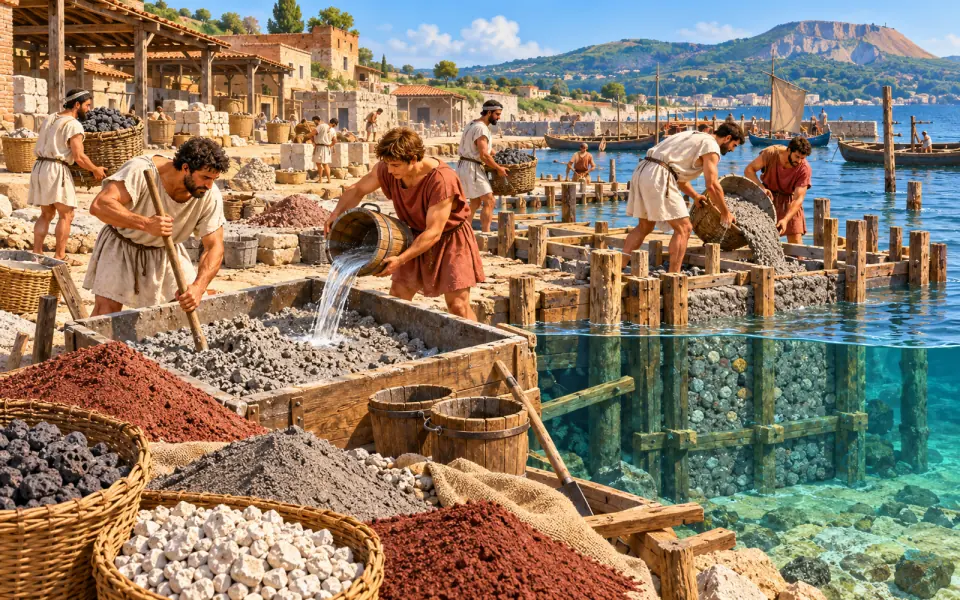 BeforeRoman concreteabout 150 BC
 BeforeThe Aqua Marcia aqueduct144–140 BC
 BeforeSpartacus leads the revolt73–71 BC
 BeforeCaesar crosses the Rubicon49 BC
 BeforeThe Julian calendar46 BC
 BeforeThe murder of Julius Caesar44 BC
 BeforeAugustus, the first emperor27 BC
 BeforeThe Pax Romana27 BC – AD 180
 BeforeVirgil and the Aeneid19 BC
 BeforePompeii buried by VesuviusAD 79
 BeforeThe Colosseum opensAD 80
- You are hereTrajan's ColumnAD 113
 AfterThe Pantheonabout AD 125
 AfterGalen, a doctor in Romeabout AD 162
 AfterThe Baths of CaracallaAD 216
 AfterThe book with pages (the codex)about AD 300
 AfterThe Edict of MilanAD 313
 AfterFall of the Western Roman EmpireAD 476
Listen / Read next
- Music to read by: Cinematic JourneyEpic film-style music, no lyrics, by Ciro Simone IrmiciSpotifyYouTube Music
Meanwhile, elsewhere in the world
Other events of the era “Ancient Rome”
- Traditional founding of Rome
- Birth of the Roman Republic
- The Laws of the Twelve Tables
- The Appian Way
- The First Punic War
- Hannibal crosses the Alps
- Plautus and comedy
- Roman concrete
- The Aqua Marcia aqueduct
- Spartacus leads the revolt
- Caesar crosses the Rubicon
- The Julian calendar
- The murder of Julius Caesar
- Augustus, the first emperor
- The Pax Romana
- Virgil and the Aeneid
- Pompeii buried by Vesuvius
- The Colosseum opens
- The Pantheon
- Galen, a doctor in Rome
- The Baths of Caracalla
- The book with pages (the codex)
- The Edict of Milan
- Fall of the Western Roman Empire
