Augustus, the first emperor
27 BC Rome
In short
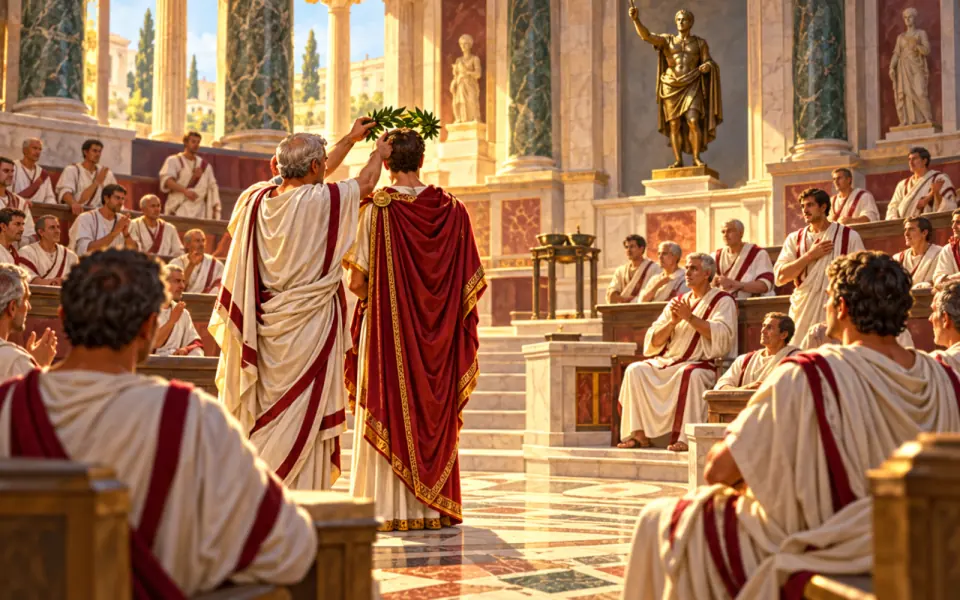
Octavian, Caesar's adopted son, defeated his rivals and was left as the most powerful man in Rome. In 27 BC the Senate gave him the title Augustus, meaning ‘worthy of reverence’. He did not want to be called king: he preferred the name princeps, ‘first citizen’, but in reality he decided almost everything. The month of August still bears his name.
Why it matters With him Rome passed from republic to empire, a form of government that lasted for centuries.
Source: Treccani, entry “Augusto”
Study card about 5 minutes of reading
The story
A boy, a will, a name
In March 44 BC, when Julius Caesar was killed, nobody could have imagined that the young man who would become the most powerful man in Rome was an eighteen-year-old boy. His name was Gaius Octavius and he had been born in Rome on 23 September 63 BC. When Caesar's will was opened it was discovered that the dictator had adopted him and named him his heir. From that moment Octavius took the name Gaius Julius Caesar Octavianus (Octavian) and claimed the inheritance: his claims were approved by an assembly of the people, the comitia curiata.
Octavian was young and inexperienced, but he proved to be intelligent, patient and very skilled in politics. His name, Caesar's, brought him the support of the soldiers and veterans who had fought for his adoptive father.
From the triumvirate to Actium
After Caesar's assassination, Octavian allied with two powerful men, Mark Antony and Marcus Aemilius Lepidus. The three formed what historians call the Second Triumvirate, a three-way alliance to govern and to avenge Caesar. Together they defeated Brutus and Cassius at Philippi. But in time the alliance broke down. Lepidus left the scene, and Antony, who had settled in Egypt beside Queen Cleopatra, became Octavian's rival.
The decisive clash was the battle of Actium, in Greece, in 31 BC. Octavian won, and soon afterwards Antony and Cleopatra, followed to Egypt, took their own lives. After almost a century of civil wars, Octavian was the sole master of the Roman world.
27 BC: “Augustus”
Octavian was skilful and knew well that the Romans hated the idea of a king. Caesar had been killed for exactly that. So he never took that title. In 27 BC he officially handed his powers back to the Senate, in a solemn gesture, and the Senate, in exchange, gave him a military command over many provinces and conferred on him the honorary title of Augustus, which means “worthy of reverence”. Historians mark the beginning of his rule at 16 January 27 BC.
What did he want to be called? He preferred princeps, which means “the first”, that is, the first among the citizens. Since 28 BC he had already been princeps senatus, the first of the senators. Officially the Republic continued: there were still consuls, the Senate, elections. In reality he took the important decisions. This system of government is called the principate, and it is the beginning of the Roman Empire.
How he governed
Augustus organised the administration with great care. In the provinces he sent governors chosen by himself, the legates, alongside the proconsuls appointed by the Senate. Egypt, very rich in grain, was entrusted to a prefect, that is, a trusted official, so that no senator could become too powerful there. He reformed taxes and the currency. In Rome he looked after the supply of food, water and the look of the city. He is credited with the saying in which he boasted of having found a Rome of brick and left it of marble: it is a figure of speech, but it gives the idea of the many monuments he had built.
A famous monument is also linked to him, the Ara Pacis, the “Altar of Peace”, wanted by the Senate in 13 BC to celebrate Augustus's return from a long expedition in Spain and southern Gaul, and inaugurated on 30 January 9 BC. Augustus also wrote an account of his deeds, the Res gestae: it is a kind of official autobiography, in which he tells of his victories with great pride and few shadows.
His name in the months
In 8 BC the month that was called Sextilis was dedicated to Augustus and took the name Augustus: it is our August.
The last day
Augustus died on 19 August AD 14 at Nola, in Campania, and is buried in the Mausoleum that he had had built in Rome. His adoptive son Tiberius succeeded him on the throne. Livia Drusilla, his third and last wife since 38 BC, is not mentioned in the Res gestae.
Why it happened
After decades of civil wars, the Romans were tired. The old institutions of the Republic could no longer guarantee peace: generals with personal armies fought each other. Octavian promised order and security, and for many this was more important than the old freedoms.
Octavian then had the ability to respect the forms of the Republic. He did not have himself called king, he kept the Senate and the magistracies, but he obtained control of the army and of the most important provinces. It was a political skill that nobody before him had had.
What changed
With Augustus, Rome passed from Republic to empire. The system he invented lasted for centuries: his successors were called emperors and their power became more and more obvious. His government began a long period of peace inside the empire, the Pax Romana.
Augustus changed the face of the city, built buildings, and left a better organised administration. The Res gestae and the monuments, like the Ara Pacis, show us how he wanted to be remembered: as the bringer of peace and prosperity.
His legacy reaches us today. The month of August bears his name. The word “emperor” comes from the military title imperator. And the model of the leader who keeps up the appearance of a free system but concentrates power is a theme that historians and political scientists still study today.
Key people and places
People
- Augustus (Octavian)
- Born in 63 BC as Gaius Octavius, Caesar's heir, first Roman emperor. He died in AD 14.
- Mark Antony
- Roman general, ally and then rival of Octavian; defeated at Actium in 31 BC.
- Livia Drusilla
- Third and last wife of Augustus from 38 BC.
- Tiberius
- Adoptive son of Augustus and his successor.
Places
- Actium
- Place in Greece where, in 31 BC, Octavian won the decisive battle against Antony.
- Rome
- The city that Augustus, according to the saying attributed to him, found made of brick and left made of marble.
- Nola
- Town in Campania where Augustus died on 19 August AD 14.
Good to know
- The name “Augustus” means “worthy of reverence” and was an honorary title, not a family name.
- The month of August was called Sextilis, the “sixth” month, until it was dedicated to Augustus in 8 BC.
- Augustus boasted of having found Rome made of brick and left it made of marble.
- Augustus died at Nola, in Campania, on 19 August AD 14.
- The Altar of Peace was decided by the Senate on 4 July 13 BC and dedicated on 30 January 9 BC.
Find out more
- World History Encyclopedia, “Augustus” worldhistory.org
- Wikipedia, “Augustus” en.wikipedia.org
- Wikipedia, “Ara Pacis” en.wikipedia.org
- Wikipedia, “Battle of Actium” en.wikipedia.org
Related events
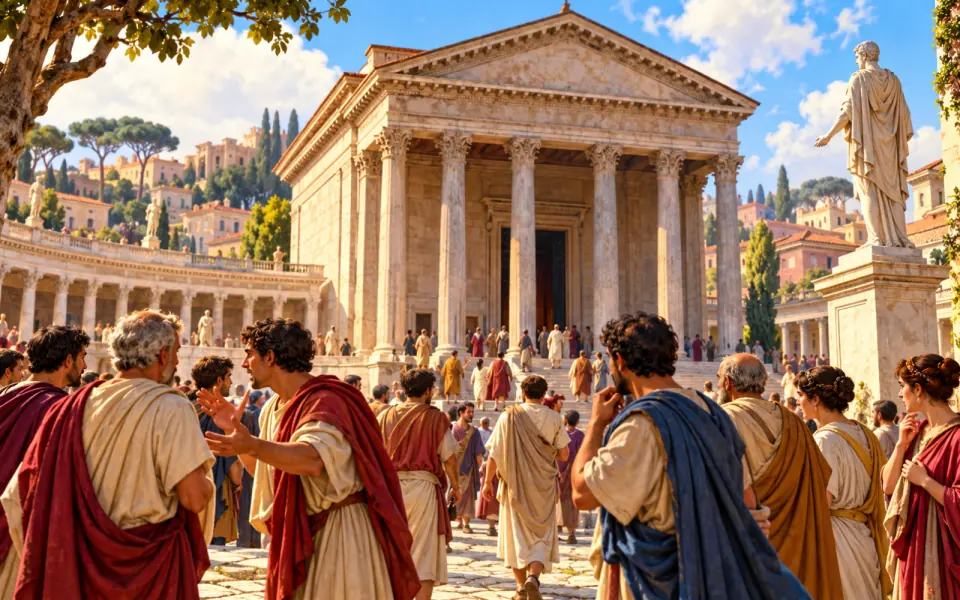
- The murder of Julius Caesar44 BC · Ancient RomeAugustus was the adoptive heir of Caesar, killed in 44 BC.
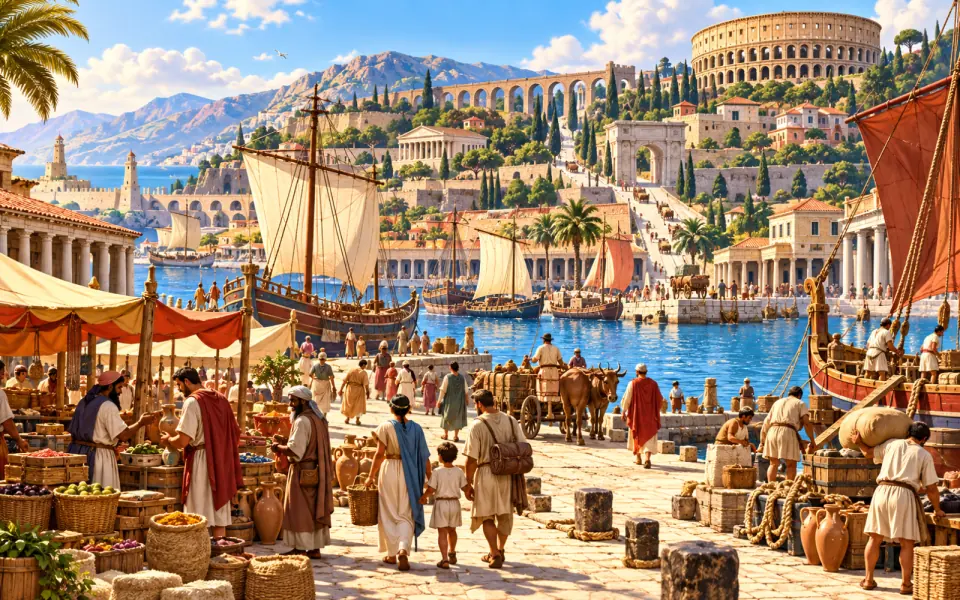
- The Pax Romana27 BC – AD 180 · Ancient RomeWith Augustus the empire's long peace begins.
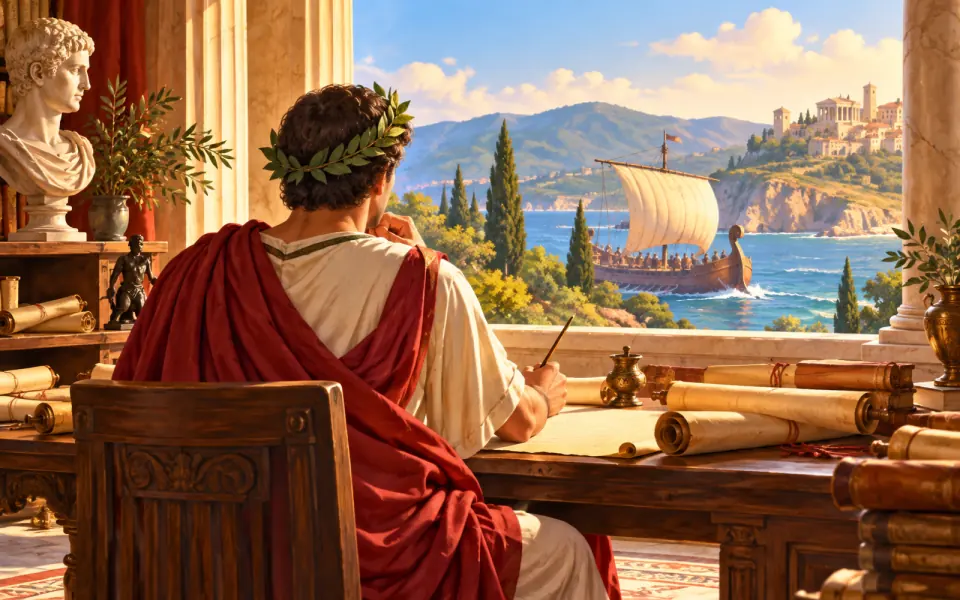
- Virgil and the Aeneid19 BC · Ancient RomeAugustus had Virgil's Aeneid published.
- Birth of the Roman Republicabout 509 BC · Ancient RomeWith him, after almost five centuries, the system of the Republic ended.
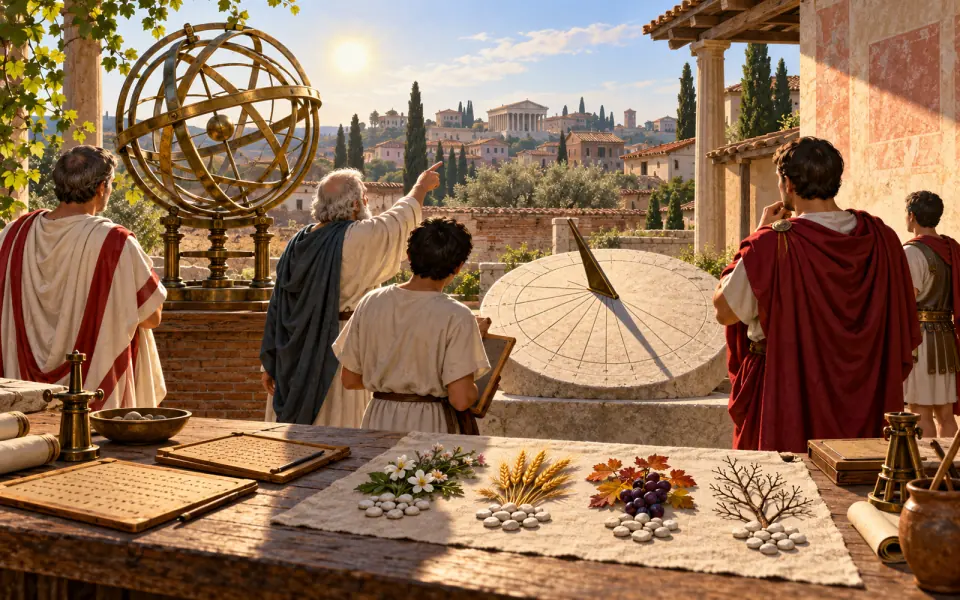
- The Julian calendar46 BC · Ancient RomeLike Caesar, Augustus too left his name to a month of the calendar.
Before and after, in the era “Ancient Rome”
Event 14 of 25
 BeforeTraditional founding of Romeabout 753 BC
 BeforeBirth of the Roman Republicabout 509 BC
 BeforeThe Laws of the Twelve Tablesabout 450 BC
 BeforeThe Appian Way312 BC
 BeforeThe First Punic War264–241 BC
 BeforeHannibal crosses the Alps218 BC
 BeforePlautus and comedyabout 200 BC
 BeforeRoman concreteabout 150 BC
 BeforeThe Aqua Marcia aqueduct144–140 BC
 BeforeSpartacus leads the revolt73–71 BC
 BeforeCaesar crosses the Rubicon49 BC
 BeforeThe Julian calendar46 BC
 BeforeThe murder of Julius Caesar44 BC
- You are hereAugustus, the first emperor27 BC
 AfterThe Pax Romana27 BC – AD 180
 AfterVirgil and the Aeneid19 BC
 AfterPompeii buried by VesuviusAD 79
 AfterThe Colosseum opensAD 80
 AfterTrajan's ColumnAD 113
 AfterThe Pantheonabout AD 125
 AfterGalen, a doctor in Romeabout AD 162
 AfterThe Baths of CaracallaAD 216
 AfterThe book with pages (the codex)about AD 300
 AfterThe Edict of MilanAD 313
 AfterFall of the Western Roman EmpireAD 476
Listen / Read next
- Music to read by: Cinematic JourneyEpic film-style music, no lyrics, by Ciro Simone IrmiciSpotifyYouTube Music
Meanwhile, elsewhere in the world
Other events of the era “Ancient Rome”
- Traditional founding of Rome
- Birth of the Roman Republic
- The Laws of the Twelve Tables
- The Appian Way
- The First Punic War
- Hannibal crosses the Alps
- Plautus and comedy
- Roman concrete
- The Aqua Marcia aqueduct
- Spartacus leads the revolt
- Caesar crosses the Rubicon
- The Julian calendar
- The murder of Julius Caesar
- The Pax Romana
- Virgil and the Aeneid
- Pompeii buried by Vesuvius
- The Colosseum opens
- Trajan's Column
- The Pantheon
- Galen, a doctor in Rome
- The Baths of Caracalla
- The book with pages (the codex)
- The Edict of Milan
- Fall of the Western Roman Empire
