The book with pages (the codex)
about AD 300 Roman Empire
In short
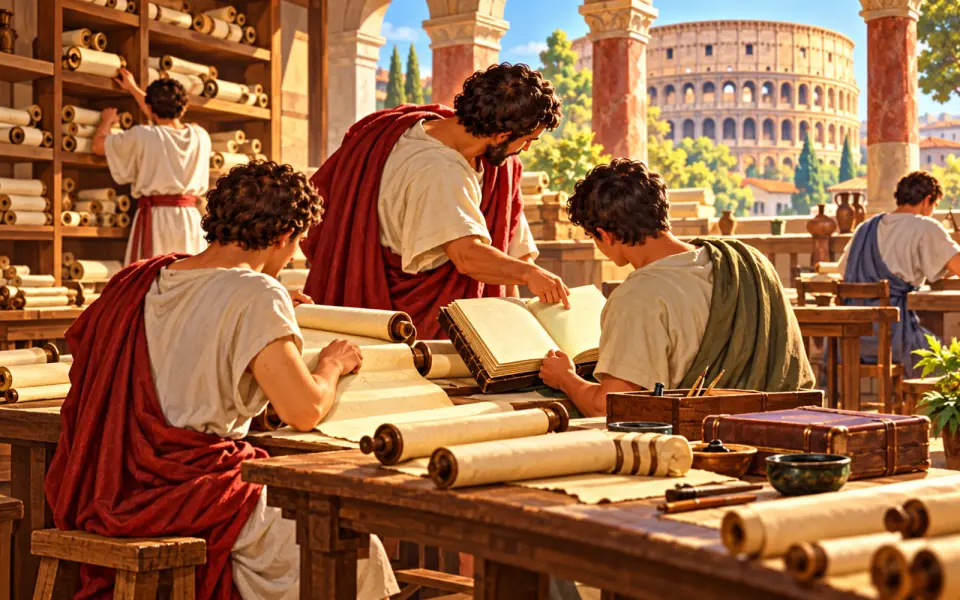
For centuries books were papyrus scrolls, sometimes several metres long, that had to be unrolled with both hands. Little by little a new form spread: sheets folded and sewn together, with a cover, called the codex. It made finding a passage easier, both sides of the page could be written on and it took up less space. Christians used it very early on for their holy texts. By around AD 300 the codex, often made of parchment, was overtaking the scroll.
Why it matters The book you hold in your hands today, with pages to turn, comes straight from the codex of ancient times.
Source: Encyclopaedia Britannica, “Codex”
Study card about 5 minutes of reading
The story
Reading a book ten metres long
Try to imagine that your favourite book is a long ribbon wound on two sticks. To read it you would have to hold one stick in one hand and one in the other, unrolling a little at a time, and to go back and reread a passage you would have to wind everything back. This is how the Romans read, for many centuries. Their book was called a volumen: a scroll, made of sheets of papyrus or parchment glued one after another and wound round a rod. From volumen comes our word “volume”.
Some of the oldest Latin scrolls we know come from the excavations at Herculaneum, the city buried by the eruption of Vesuvius in AD 79. But for very long texts, such as a great poem or a history, the scroll was not convenient: more than one scroll was needed, and finding a particular passage was tiring.
From tablets to the codex
The new idea came from an everyday object. The Romans wrote notes, accounts and letters on wooden tablets covered with wax, joined together with rings or thin leather strips. This block of tablets was called a codex, a word that comes from caudex, “tree trunk”. Then someone had the idea of replacing the wooden tablets with sheets of parchment or papyrus, folded and sewn together: this is how the codex was born, the book with pages that we know.
Around AD 84–86 the poet Martial, in Rome, gives us valuable evidence: he recommends to his readers a new edition of his poems in codex form, saying that it takes up little space and is easily held in one hand. Scholars also think that already in the 1st century notebooks of folded parchment were in use, called in Latin pugillares membranei, as ancestors of the book with pages.
Why the codex won
The codex had many practical advantages. You could write on both sides of the sheet, so less material was needed. It took up less space and was easier to carry. Above all, it let you find the place you wanted at once: you leafed through it, instead of unrolling. For people who had to consult texts of law, medicine or religion, it was a great help.
The first Christians adopted it early. It seems that already from the 2nd century many of their texts, such as the Gospels, were written in codices, and the codex became the usual form for sacred books. Scholars debate how much the Christians counted in its spread: perhaps it was not only a religious choice, but also a practical one, linked to the kind of community that produced those texts. Books in codex form were also easier to copy and carry.
Parchment, that is, animal skin prepared for writing, suited this kind of book very well, better than papyrus, which was damaged by folding. Its name recalls the city of Pergamum, where according to the tradition it was perfected. Around the year 300, according to several reconstructions, codices were by now equal in number to scrolls; in the following centuries they replaced them almost entirely. Some scholars place their final dominance in the 4th century, others even later.
How a codex was made
The sheets were folded and slotted one inside another to form quires. A sheet folded in two was called a bifolium; with two bifolia you made a duernion, with three a ternion, with four a quaternion, also called a quire: from this comes the word for “exercise book” in Italian, quaderno. The Romans numbered the leaves, that is, the sheets, and not the individual pages, distinguishing the front (recto) from the back (verso). In ancient Rome codices were often copied by educated slaves; in the Middle Ages they were copied mostly by monks, in scriptoria, the writing rooms of convents and abbeys. Some codices were illuminated, that is, decorated with pictures and gold letters. One of the most beautiful is the Codex Rossanensis.
A new way of reading
The codex also changed the way of reading. With the scroll you read from beginning to end, in order. With the codex you could jump from one chapter to another, compare two passages, put in a marker. Later people began to number the pages and to make indexes. The oldest codices that survive are Egyptian and date from a period between the end of the 1st and the 2nd century AD.
Why it happened
The Romans had been writing for centuries on wax tablets joined together, and that block format was already familiar. The idea of using it for longer texts, replacing the tablets with sheets of parchment, therefore came naturally.
In addition, the scroll caused practical problems for long texts or ones consulted often. With the spread of Christianity, and with the need to read and quote the sacred texts, a format that let you find a passage quickly became even more useful.
What changed
The codex is the direct ancestor of the modern book. When you open a book, turn the pages and look for a chapter in the index, you are using an invention born in Roman antiquity. The format lasted for almost two thousand years, even through the revolution of printing: Gutenberg, in the 15th century, printed books that had the same form as codices.
In the Middle Ages the codices copied by monks preserved ancient literature. Many texts we read today have come down to us only because they were copied into parchment codices, while the more fragile papyrus scrolls were largely lost.
The words we use also recall this story: “volume”, “quire”, “codex” (also in the sense of a collection of laws, such as a civil code), “page” and “folio”.
Key people and places
People
- Martial
- Latin poet of the 1st century AD who recommends to readers a work of his in codex form, handy to hold in one hand.
- Copyist monks
- In the Middle Ages they copied codices by hand in the scriptoria of convents and abbeys.
Places
- Herculaneum
- City buried by Vesuvius in AD 79: some of the oldest known Latin papyrus scrolls come from here.
- Pergamum
- City in Asia Minor that gives its name to parchment.
- Scriptorium
- The room of copyists in a monastery, where codices were copied and illuminated.
Good to know
- The word “codex” comes from the Latin caudex, which meant “tree trunk”.
- The Italian word for exercise book, “quaderno”, takes its name from the quaternion, a quire of four folded sheets.
- Some of the oldest Latin scrolls we know were found at Herculaneum, carbonised by the eruption.
- The oldest surviving codices are Egyptian and date from between the end of the 1st and the 2nd century AD.
- The Codex Rossanensis is one of the most beautiful illuminated codices of the Byzantine age.
Find out more
- Wikipedia, “Codex” en.wikipedia.org
- Wikipedia, “Rossano Gospels” en.wikipedia.org
- Wikipedia, “Scroll” en.wikipedia.org
- Wikipedia, “Parchment” en.wikipedia.org
Related events
- The Carolingian Renaissanceabout AD 790 · Early Middle AgesUnder Charlemagne monks copied codices in a clear script, Carolingian minuscule.
- The Book of Kellsabout AD 800 · Early Middle AgesThe Book of Kells is an illuminated codex of the early Middle Ages.
- Gutenberg prints the Bibleabout 1455 · Early modern ageGutenberg printed books with the same form as codices.
- The Diamond Sutra, oldest dated printed bookAD 868 · Early Middle AgesIn China, in 868, the Diamond Sutra was printed, a book in scroll form.
- Cuneiform writingabout 3200 BC · River civilisationsBefore books there were the clay tablets of the Sumerians.
Before and after, in the era “Ancient Rome”
Event 23 of 25
 BeforeTraditional founding of Romeabout 753 BC
 BeforeBirth of the Roman Republicabout 509 BC
 BeforeThe Laws of the Twelve Tablesabout 450 BC
 BeforeThe Appian Way312 BC
 BeforeThe First Punic War264–241 BC
 BeforeHannibal crosses the Alps218 BC
 BeforePlautus and comedyabout 200 BC
 BeforeRoman concreteabout 150 BC
 BeforeThe Aqua Marcia aqueduct144–140 BC
 BeforeSpartacus leads the revolt73–71 BC
 BeforeCaesar crosses the Rubicon49 BC
 BeforeThe Julian calendar46 BC
 BeforeThe murder of Julius Caesar44 BC
 BeforeAugustus, the first emperor27 BC
 BeforeThe Pax Romana27 BC – AD 180
 BeforeVirgil and the Aeneid19 BC
 BeforePompeii buried by VesuviusAD 79
 BeforeThe Colosseum opensAD 80
 BeforeTrajan's ColumnAD 113
 BeforeThe Pantheonabout AD 125
 BeforeGalen, a doctor in Romeabout AD 162
 BeforeThe Baths of CaracallaAD 216
- You are hereThe book with pages (the codex)about AD 300
 AfterThe Edict of MilanAD 313
 AfterFall of the Western Roman EmpireAD 476
Listen / Read next
- Music to read by: Cinematic JourneyEpic film-style music, no lyrics, by Ciro Simone IrmiciSpotifyYouTube Music
Meanwhile, elsewhere in the world
Other events of the era “Ancient Rome”
- Traditional founding of Rome
- Birth of the Roman Republic
- The Laws of the Twelve Tables
- The Appian Way
- The First Punic War
- Hannibal crosses the Alps
- Plautus and comedy
- Roman concrete
- The Aqua Marcia aqueduct
- Spartacus leads the revolt
- Caesar crosses the Rubicon
- The Julian calendar
- The murder of Julius Caesar
- Augustus, the first emperor
- The Pax Romana
- Virgil and the Aeneid
- Pompeii buried by Vesuvius
- The Colosseum opens
- Trajan's Column
- The Pantheon
- Galen, a doctor in Rome
- The Baths of Caracalla
- The Edict of Milan
- Fall of the Western Roman Empire
