The gold mask of Mycenae
about 1550 BC Mycenae, Peloponnese (Greece)
In short
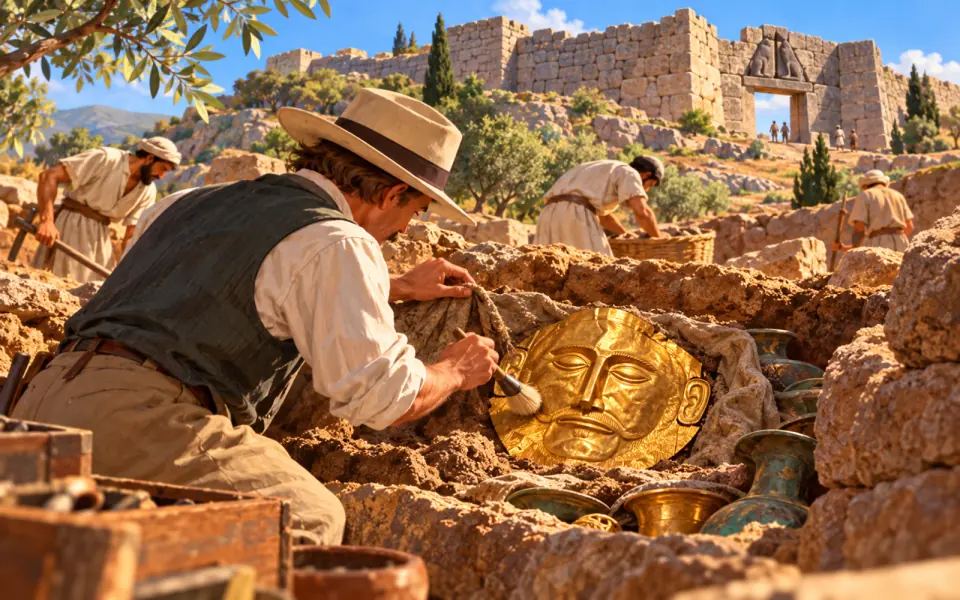
In 1876 the German archaeologist Heinrich Schliemann dug up some royal tombs inside the walls of Mycenae and found a gold mask lying on a dead man's face. Schliemann was convinced it was a portrait of Agamemnon, the king in the Iliad. Today we know the mask is about three centuries older than the Trojan War told by Homer. But the name has stuck, and the mask can be admired in the National Archaeological Museum in Athens.
Why it matters It shows how much gold and power the first Greek kings of the Bronze Age had.
Source: National Archaeological Museum of Athens, Mycenaean gallery
Study card about 6 minutes of reading
The story
A man obsessed with Homer
Heinrich Schliemann was born in Germany in 1822, into a modest family, and as a young man worked as a shop boy and as a cabin boy on a ship. Then, through hard work and study, he became a rich merchant: first in St Petersburg, in Russia, then all over the world, among other things trading in gold dust in California in 1851. He learned languages with a speed that amazed his contemporaries: he said he could learn one in about six weeks, and by the end of his life he spoke, besides German, English, French, Dutch, Spanish, Portuguese, Italian, Russian, Swedish, Polish, Greek, Latin and Arabic.
He was passionate about the poems of Homer and believed that Troy, Mycenae and King Agamemnon had really existed. With his earnings he retired from business and devoted himself to archaeology. In 1870 he began to dig in the hill of Hissarlik, in Turkey, where the amateur archaeologist Frank Calvert thought Troy lay. In 1873, the evening before stopping work, he found a treasure of gold, which he named “Priam's Treasure”. In 1876 he moved on to Mycenae.
The dig at Mycenae
Mycenae is a small town in Greece, in the Peloponnese, dominated by a fortress built on top of a hill. Homer remembers it as the city of Agamemnon, the leader of the Greeks in the Trojan War. To get permission to dig, Schliemann had to accept that a Greek archaeologist, Panagiotis Stamatakis, would work alongside him, appointed by the Greek Archaeological Society to supervise the work.
Inside the walls, near the great gate, Schliemann found a circular enclosure of stone slabs, now called Grave Circle A. Beneath the ground there were deep tombs, dug like wells into the earth and called “shaft graves”. The dead were accompanied by weapons and precious objects. On some faces the dead wore gold masks. The most famous was found in Grave V.
The mask
The mask is made from a single sheet of gold hammered over a wooden form; then the details, such as the eyebrows, eyes, moustache and beard, were engraved. It shows a serious face with very strong features. The story goes that Schliemann sent a telegram to the King of Greece, George I, with the words “I have gazed upon the face of Agamemnon”. The sentence is reported, but historians regard it as an attributed quotation, not a certain one.
It was enthusiasm with no basis. Today we know that the mask dates from the 16th century BC, that is, three or four hundred years before the Trojan War, which, if it happened, belongs around 1200 BC. The man buried there could not have been Agamemnon, and in fact we do not know who he was. The name “Mask of Agamemnon” has stayed only out of habit.
Doubts and criticism
Some scholars have even doubted the authenticity of the mask. Two researchers, William Calder III and David Traill, argued that it might not be ancient, recalling that Schliemann was in some cases accused of adding objects to his digs and that the mask is different from the others. Most archaeologists disagree, however: the work was watched by witnesses, other masks were found in the same dig, and the workmanship has similarities with objects that are certainly ancient, such as a gold rhyton in the shape of a lion's head.
Judgement on Schliemann too is complex. He was a brilliant and tenacious man, but also vain and not very rigorous. He admitted that he had invented the story of his wife Sophia carrying the treasure away at Troy in her shawl: at that moment she was in Athens. His methods were called “brutal”: at Troy he dug so deep that he destroyed important layers, and he did not take enough notes. Another archaeologist, Carl Blegen, defended him by pointing out that the science of excavation did not yet exist in 1876. With his collaborator Wilhelm Dörpfeld, Schliemann went on to dig at Tiryns and again at Troy, and he died in Naples in December 1890.
Who were the lords of the tombs?
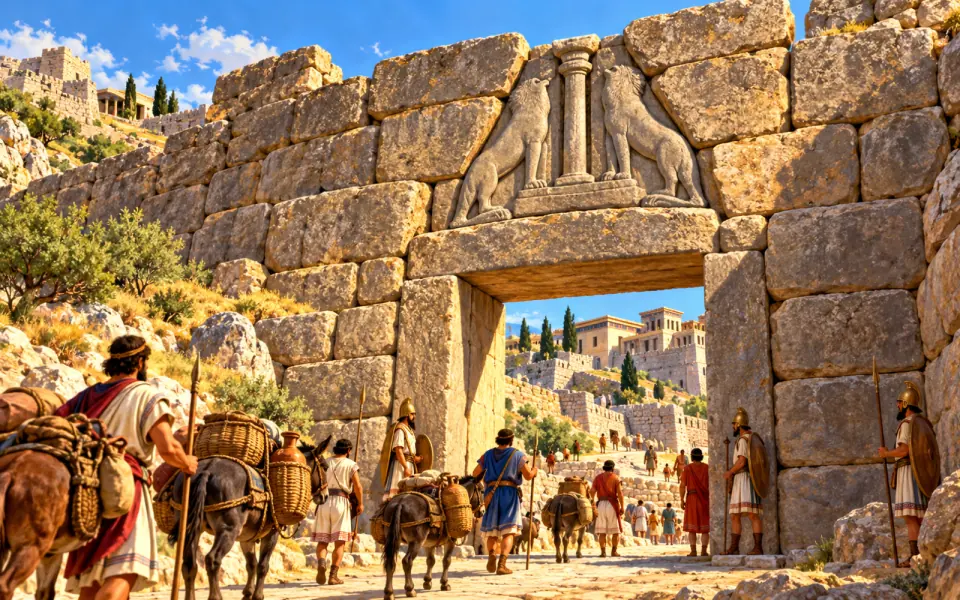
The tombs of Grave Circle A belong to the first kings of whom we have any trace on mainland Greece, perhaps a dynasty of warriors and chiefs. In the tombs there were weapons and luxury objects: a sign of a society led by warriors, used to war and in contact with distant lands. Grave Circle A lies inside the walls of the citadel, near the Lion Gate, which we discuss in another card.
Why it happened
Why the first Greek kings had so much gold is an open question. Scholars think that in the middle of the 2nd millennium BC the chiefs of the Peloponnese grew rich through war, plunder and the trade in metals and precious objects along the routes of the Mediterranean. In that period contacts with Crete were frequent, and many forms of Mycenaean art imitate Minoan ones.
In a society where power was in the hands of warriors, showing off gold even in death was a way of saying who you had been. The mask is not a portrait: it is a way of showing the dead man's status to those who came to honour him. The fact that it was made from a single piece of hammered gold shows the great skill of the goldsmiths, who perhaps had learned their craft by watching Cretan masters.
What changed
Schliemann's discoveries at Mycenae showed for the first time, in a spectacular way, that in Bronze Age Greece there had been a rich and powerful civilisation, long before classical Greece. The world of Homer stopped being only a story and became, at least in part, an object of study. From the name of the city, that civilisation is now called Mycenaean.
The Schliemann case also taught a lesson about method. Anyone who looks only for confirmation of an idea risks being wrong: the mask was not Agamemnon's, and “Priam's Treasure” belonged to a Troy more than a thousand years older than the war of the poems. The archaeologists who came after learned to dig with far more method.
Today the Mask of Agamemnon is in the National Archaeological Museum in Athens and is one of the symbolic images of ancient Greece.
Key people and places
People
- Heinrich Schliemann
- German merchant and archaeologist (1822–1890): he dug at Troy, Mycenae and Tiryns; he was a pioneer but also much criticised for his methods.
- Panagiotis Stamatakis
- Greek archaeologist appointed to supervise Schliemann's dig at Mycenae in 1876.
- Sophia Schliemann
- Heinrich's Greek wife, married in 1869 when she was about 17; they had two children.
- Agamemnon
- King of Mycenae in the Iliad and leader of the Greeks against Troy; a figure of myth, and we do not know whether he ever existed.
Places
- Mycenae
- A fortified citadel in the Peloponnese, centre of the Mycenaean kings; a World Heritage Site.
- Grave Circle A
- A circular enclosure of royal tombs inside the walls of Mycenae, dug by Schliemann in 1876.
- National Archaeological Museum of Athens
- The museum in Athens where the gold mask is kept.
- Hissarlik
- A hill in Turkey that Schliemann dug from 1870, identified with ancient Troy.
Good to know
- Schliemann said he could learn a new language in about six weeks.
- Heinrich and Sophia's children were called Andromache and Agamemnon, like characters in Homer's poems.
- The famous sentence about the face of Agamemnon may never have been written in the way we remember it.
- The mask is made from a single sheet of gold hammered over a wooden form.
- He admitted inventing the story of Sophia's shawl in which, at Troy, she supposedly hid the treasure.
Find out more
- Wikipedia, “Grave Circle A, Mycenae” en.wikipedia.org
- Wikipedia, “Mycenae” en.wikipedia.org
- Wikipedia, “Heinrich Schliemann” en.wikipedia.org
- Wikipedia, “Mask of Agamemnon” en.wikipedia.org
Related events
- The Lion Gate at Mycenaeabout 1250 BC · Sea civilisationsThe Lion Gate was the entrance to the citadel next to the tombs.
- Linear Babout 1450 BC · Sea civilisationsThe Mycenaeans wrote in Linear B, a script later deciphered.
- Homer's poems are written downabout 750 BC · Sea civilisationsHomer tells of Agamemnon in the poems that inspired Schliemann.
- The Bronze Age collapseabout 1200 BC · River civilisationsThe Mycenaean kingdoms ended in the crisis at the end of the Bronze Age.
- The palace of Knossosabout 1900 BC · Sea civilisationsThe first Mycenaean kings had contacts with the Minoan palaces of Crete.
Before and after, in the era “Sea civilisations”
Event 6 of 25
 BeforeMinoan civilisation on Creteabout 2000 BC
 BeforeThe palace of Knossosabout 1900 BC
 BeforeThe Proto-Sinaitic alphabetabout 1800 BC
 BeforeThe eruption of Theraabout 1600 BC
 BeforeThe nuraghi of Sardiniaabout 1600 BC
- You are hereThe gold mask of Mycenaeabout 1550 BC
 AfterLinear Babout 1450 BC
 AfterThe Lion Gate at Mycenaeabout 1250 BC
 AfterThe Iron Age beginsabout 1200 BC
 AfterThe Phoenicians spread outabout 1200 BC
 AfterPhoenician purpleabout 1100 BC
 AfterThe Phoenician alphabetabout 1050 BC
 AfterThe Kingdom of Israelabout 1000 BC
 AfterPhoenician seafaringabout 1000 BC
 AfterThe Villanovan culture in Italyabout 900 BC
 AfterTraditional founding of Carthageabout 814 BC
 AfterThe Nora Stoneabout 800 BC
 AfterAmphorae for oil and wineabout 800 BC
 AfterHomer's poems are written downabout 750 BC
 AfterGreek colonies in the Westabout 750 BC
 AfterThe Etruscans, lords of the Tyrrhenian Seaabout 700 BC
 AfterPhoenician glass spreadsabout 600 BC
 AfterCoins in the Mediterraneanabout 600 BC
 AfterThe Babylonian Exileabout 586 BC
 AfterSailing beyond Gibraltarabout 500 BC
Listen / Read next
- Music to read by: Cinematic JourneyEpic film-style music, no lyrics, by Ciro Simone IrmiciSpotifyYouTube Music
Meanwhile, elsewhere in the world
Other events of the era “Sea civilisations”
- Minoan civilisation on Crete
- The palace of Knossos
- The Proto-Sinaitic alphabet
- The eruption of Thera
- The nuraghi of Sardinia
- Linear B
- The Lion Gate at Mycenae
- The Iron Age begins
- The Phoenicians spread out
- Phoenician purple
- The Phoenician alphabet
- The Kingdom of Israel
- Phoenician seafaring
- The Villanovan culture in Italy
- Traditional founding of Carthage
- The Nora Stone
- Amphorae for oil and wine
- Homer's poems are written down
- Greek colonies in the West
- The Etruscans, lords of the Tyrrhenian Sea
- Phoenician glass spreads
- Coins in the Mediterranean
- The Babylonian Exile
- Sailing beyond Gibraltar
