Magna Carta
1215 Runnymede, near London (England)
In short
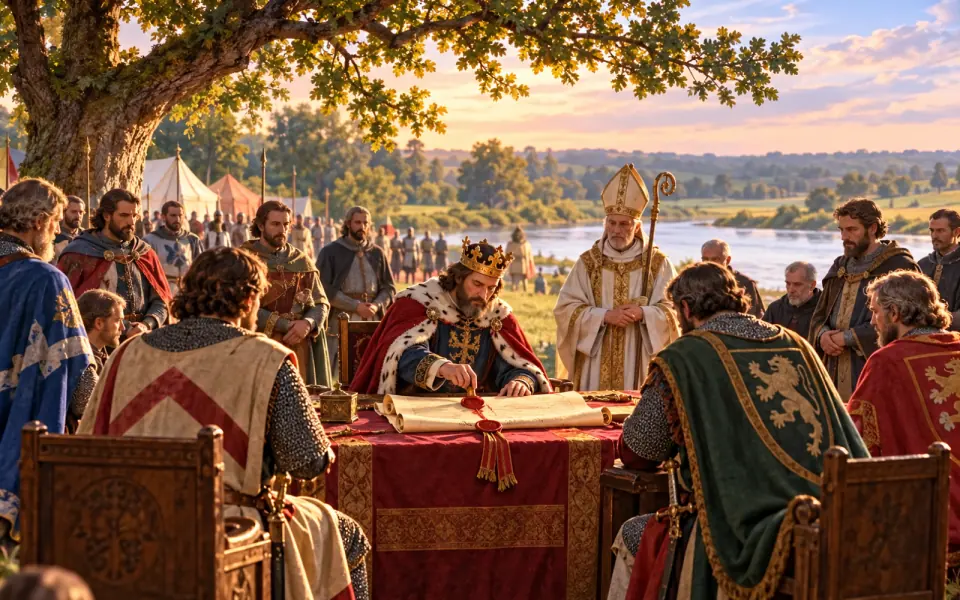
In June 1215, in the meadow at Runnymede beside the Thames, King John of England was forced by his barons to agree to a document. Magna Carta, meaning ‘Great Charter’, established that even the king had to obey the law. One of its clauses said that no free man could be imprisoned without a proper trial. The Pope cancelled it after a few weeks, but it was reissued several times in the following years.
Why it matters It is seen as one of the first steps towards citizens' rights and modern constitutions.
Source: British Library, “Magna Carta”
Study card about 5 minutes of reading
The story
A king in trouble
John of England, called John Lackland, had become king in 1199 after his brother Richard the Lionheart. He was not a popular king. In 1204 he lost Normandy and most of the territories the English held in France, to the advantage of the French king. To win them back he needed a great deal of money, and he demanded from the barons, the great nobles of the kingdom, taxes that grew ever higher and were often arbitrary. He took hostages, confiscated lands and imprisoned his enemies.
He was also at odds with the Church: he refused to accept the Archbishop of Canterbury chosen by Pope Innocent III, and from 1208 to 1214 England lay under an interdict, that is, without most public religious ceremonies. In the end the king gave way. In 1214 he tried to recover France, but was defeated at Bouvines. He went home with no lands and poorer than before.
The barons rebel
Many barons had had enough. In the spring of 1215 they rebelled, and in May they occupied London. The king, outnumbered, agreed to negotiate. The two sides met on 15 June 1215 at Runnymede, a meadow on the banks of the Thames not far from Windsor. There the king put his seal on a long document, drawn up in Latin by advisers, which listed the barons' demands. He did not sign it, because in those days kings used a seal, not a signature.
The document, which had 63 clauses, was not made to defend the rights of everyone. Many clauses dealt with very concrete problems of the nobles: how much they had to pay when they inherited land, how widows were to be treated, which courts had authority. But some phrases had a greater meaning.
Immediately after the ceremony, the king's scribes copied the text by hand several times and sent it to the bishops and officials of the various counties, who had to read it out in public. The copies were written in Latin, with abbreviations, on parchment. Nobody could have imagined that some of those parchments would be kept for eight hundred years.
The phrases that made history
One clause says that the king cannot impose certain taxes without the consent of the kingdom, an idea that would later become the principle “no taxation without representation”. Another, famous one, says that no free man may be arrested, imprisoned or stripped of his possessions except by the lawful judgement of his peers or by the law of the land. Another states that the king will not sell, and will not deny to anyone, justice.
The king was not above the law: this was the central point. To check that the document was respected, the barons created a committee of twenty-five of their own number, with the power to force the king, even by force of arms, to keep the agreement.
A failure that became a symbol
At the time, Magna Carta failed. John had no intention of respecting it, and asked the pope to annul it. Innocent III declared it void, with a bull of August 1215, because it had been extorted by force. A civil war broke out, the First Barons' War. John died in October 1216. His son Henry III, still a child, was crowned, and his advisers reissued the charter, with some changes, in 1216, 1217 and 1225. The 1217 version was called “Magna Carta”, that is, “Great Charter”, to distinguish it from another, smaller one, the Charter of the Forest.
At Runnymede, in 1957, the American Bar Association built a small memorial in memory of the charter, a sign of the importance it has had in the United States too.
Today four original copies of 1215 survive: two at the British Library in London, one in Lincoln Cathedral and one in Salisbury Cathedral. Of the original clauses only three remain in force in England.
Why it happened
English kings needed money for wars and took it through taxes and fines. John, who had lost his prestige after defeats and quarrels with the pope, went too far, and the barons decided to set limits.
In England, even before, the idea existed that the king should respect the ancient customs of the kingdom, and a similar document had been granted by Henry I in 1100.
What changed
In time Magna Carta became the symbol of a fundamental principle: even those who govern must obey the law. In the 1600s English jurists, such as Edward Coke, used it in Parliament's struggle against the Stuart kings.
It influenced important documents: the Petition of Right (1628), Habeas Corpus, the English Bill of Rights (1689), the Constitution of the United States and the Universal Declaration of Human Rights of 1948.
It was not at once a document for everyone: serfs, who were the majority, were not “free men” and did not have those rights. It took centuries for the principles to be extended to all.
Key people and places
People
- John Lackland
- King of England from 1199 to 1216 (1166-1216): he sealed the charter in 1215.
- Innocent III
- Pope from 1198 to 1216: he annulled the charter.
- Stephen Langton
- Archbishop of Canterbury (about 1150-1228): he helped to mediate and to draft the text.
- Henry III
- King from 1216 to 1272 (1207-1272): John's son, he had the charter reissued.
- Edward Coke
- English jurist (1552-1634): in the 1600s he used the charter against the king.
Places
- Runnymede
- Meadow on the banks of the Thames where the king put his seal, on 15 June 1215.
- British Library, London
- Holds two of the four original copies of 1215.
Good to know
- Kings of the time used a seal, not a signature.
- Magna Carta had 63 clauses.
- Four original copies of 1215 still exist.
- The pope annulled Magna Carta in 1215, after a few weeks.
- The name “Magna Carta” was used from 1217, to distinguish it from the Charter of the Forest.
Find out more
- Wikipedia, “Magna Carta” en.wikipedia.org
- Wikipedia, “John, King of England” en.wikipedia.org
- Wikipedia, “Habeas corpus” en.wikipedia.org
- Wikipedia, “Pope Innocent III” en.wikipedia.org
Related events
- The Bayeux Tapestryabout 1070 · Late Middle AgesJohn was a descendant of William the Conqueror.
- The Hundred Years' War1337–1453 · Late Middle AgesThe wars between England and France went on with the Hundred Years' War.
- Frederick Barbarossa1155 · Late Middle AgesThe Emperor Barbarossa too had had to accept limits on his power.
- The Italian communesabout 1100 · Late Middle AgesThe Italian communes too had given themselves rules and councils.
Before and after, in the era “Late Middle Ages”
Event 15 of 25
 BeforeThe growth of medieval townsabout 1050
 BeforeThe East–West Schism1054
 BeforeThe Bayeux Tapestryabout 1070
 BeforeThe University of Bolognaabout 1088
 BeforeThe First Crusade1096–1099
 BeforeThe Italian communesabout 1100
 BeforeRomanesque cathedralsabout 1100
 BeforeWatermills and windmillsabout 1100
 BeforeGothic style at Saint-Denis1144
 BeforeHildegard of Bingenabout 1150
 BeforePaper arrives in Europeabout 1150
 BeforeFrederick Barbarossa1155
 BeforeFrancis of Assisiabout 1182
 BeforeFibonacci and the Liber abaci1202
- You are hereMagna Carta1215
 AfterThe gold florin1252
 AfterMarco Polo sets off for Asia1271
 AfterSpectaclesabout 1286
 AfterThe Hanseatic League and northern tradeabout 1300
 AfterGiotto paints in Paduaabout 1305
 AfterDante begins the Divine Comedyabout 1307
 AfterThe Hundred Years' War1337–1453
 AfterThe Black Death1347–1352
 AfterPublic mechanical clocksabout 1350
 AfterJoan of Arc1429
Listen / Read next
- Music to read by: Cinematic JourneyEpic film-style music, no lyrics, by Ciro Simone IrmiciSpotifyYouTube Music
Meanwhile, elsewhere in the world
Other events of the era “Late Middle Ages”
- The growth of medieval towns
- The East–West Schism
- The Bayeux Tapestry
- The University of Bologna
- The First Crusade
- The Italian communes
- Romanesque cathedrals
- Watermills and windmills
- Gothic style at Saint-Denis
- Hildegard of Bingen
- Paper arrives in Europe
- Frederick Barbarossa
- Francis of Assisi
- Fibonacci and the Liber abaci
- The gold florin
- Marco Polo sets off for Asia
- Spectacles
- The Hanseatic League and northern trade
- Giotto paints in Padua
- Dante begins the Divine Comedy
- The Hundred Years' War
- The Black Death
- Public mechanical clocks
- Joan of Arc
