The growth of medieval towns
about 1050 Europe (for example Florence, Venice, Bruges)
In short
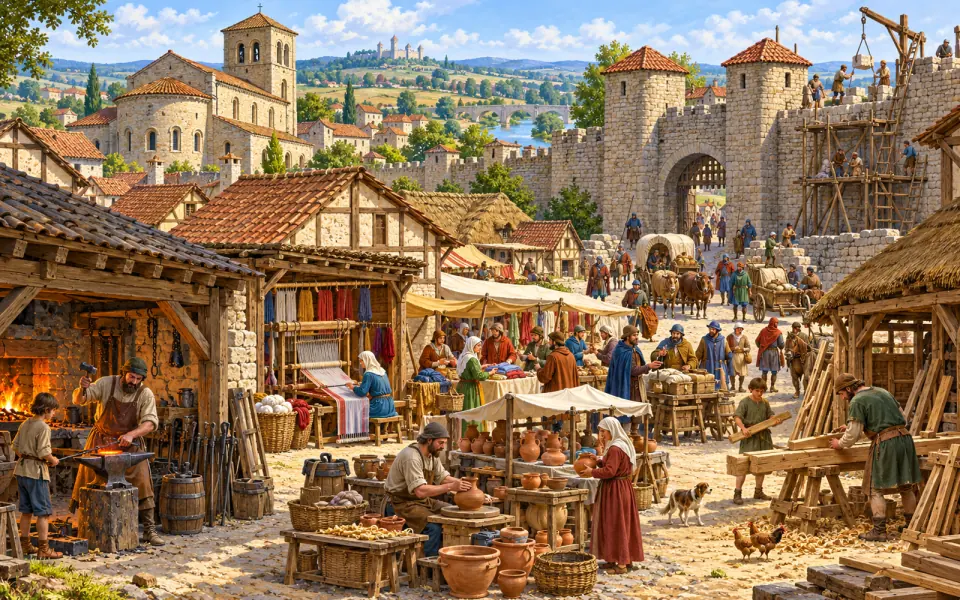
After the year 1000, harvests in Europe improved and the population grew. Many people left the countryside and moved to the towns, which filled up with workshops, markets and building sites. Craftsmen and merchants joined together in associations, the guilds, which set rules and prices for each trade. To defend themselves, towns built new and ever wider walls.
Why it matters In the towns trade, schools and new ideas came back to life, and a class of merchants and craftsmen took shape.
Source: Encyclopaedia Britannica, “Europe, history of”
Study card about 4 minutes of reading
The story
After the year 1000: more food, more people
In the early centuries of the Middle Ages, Europe was a continent of countryside, with isolated villages, huge forests and small towns, often just a cluster of houses around a church or a castle. After the year 1000 things began to change. The climate became a little milder and wars of invasion, such as those of the Vikings and the Magyars, became rarer. Work in the fields improved too.
Farmers began to use the heavy plough with a mouldboard, which turned the soil over more deeply, especially on the northern plains, where the ground is thick and wet. The yoke and the stiff collar let horses pull without choking, and watermills ground the grain without human effort. The three-field system, that is, letting a third of the fields rest each year, made the soil more fertile. More food meant less hunger and more children surviving: according to estimates, the population of Europe grew from about thirty-five million around the year 1000 to about eighty million in the 1300s.
The market and the walls
People who could not find land to work moved elsewhere. Many went to the places where people met to exchange goods: crossroads, rivers, ports, and the foot of castles and monasteries. Markets grew up there, first weekly, then daily. Craftsmen such as blacksmiths, weavers, shoemakers and bakers settled near the markets to sell what they made. Where there had once been a few houses, within a few decades there were hundreds.
The new towns surrounded themselves with walls, often more than once, because as the population grew wider walls were built. Inside the walls were narrow streets, tall houses of stone and wood, the market square, the cathedral or main church and, later, the town hall. In the evening the gates were shut, and at night nobody could go in or out.
Bells marked the day: they rang at dawn to open the gates and the market, at midday, and in the evening to close them, and also to warn of a fire, an attack or a meeting of the council. People who had no clock, and nobody did, ran their lives by that sound.
Air that makes you free
Living in a town was different from living in the countryside. A German saying, formulated later but based on medieval rules, said that “town air makes you free”: under many rules, a peasant who ran away from his lord and managed to live in a town for a year and a day became free. In towns people paid with money, not with work in the fields, and you could become rich through trade.
Craftsmen and merchants joined together in associations called guilds (in Italy, “arti”), which set prices, checked the quality of work and helped members in difficulty. A boy learned a trade by being an apprentice in a workshop, then worked as a journeyman, and finally, if he was good, could become a master. Some towns grew rich through trade: Venice with its ships to the East, Bruges and Ghent with wool and cloth, Florence with its banks and fabrics.
The hard side of the town
Towns were also dirty and dangerous. Rubbish ended up in the street, well water could be polluted, fires were frequent because many houses were made of wood, and diseases spread easily. There were many poor people, and in some districts poverty was plain to see. Yet people kept coming: the town promised work, protection, festivals, and a new idea, that of being citizens, with rights and duties, and not just subjects.
Why it happened
The growth of population and farming brought a surplus, that is, more food than the farmers needed, and this allowed a part of the population to take up other trades, such as those of craftsman and merchant.
With the end of the great invasions and with safer roads and rivers, trade started up again, and towns were born and grew where trade routes met.
What changed
Towns became the engine of European society: banks, universities, the first schools for lay people, Gothic cathedrals and a new social class, that of merchants and craftsmen, which we call the middle class (the bourgeoisie), all began there.
In Italy and Flanders the citizens began to govern themselves, creating the communes, and fought wars to defend their independence from lords and emperors.
The money-based economy spread: gold coins, bills of exchange and account books appeared. European towns grew rich, until in the 1300s famine and plague halted the growth.
Key people and places
People
- Merchants
- People who bought and sold goods, even over long distances: they were among the leading figures in the growth of towns.
- Craftsmen
- Manual workers who made objects in workshops: blacksmiths, weavers, shoemakers, bakers.
- Guilds
- Trade associations: they set rules, prices and the quality of work.
Places
- Venice
- City on the water that grew rich through trade with the East.
- Florence
- Tuscan city rich from wool cloth and banking.
- Bruges (Flanders)
- Belgian city of wool cloth and international markets.
Good to know
- A peasant who lived in a town for a year and a day became free, under many rules.
- The population of Europe grew from about 35 million (the year 1000) to about 80 million (1300), according to estimates.
- Town walls were often extended when the population grew.
- In Italian towns the guilds were called “arti”.
- In the evening the town gates were shut and nobody could enter.
Find out more
- Wikipedia, “Stadtluft macht frei” en.wikipedia.org
- Wikipedia, “Three-field system” en.wikipedia.org
- Wikipedia, “Guild” en.wikipedia.org
- Wikipedia, “Bruges” en.wikipedia.org
Related events
- The Italian communesabout 1100 · Late Middle AgesIn the Italian communes the citizens began to govern themselves.
- Watermills and windmillsabout 1100 · Late Middle AgesWater mills and windmills helped farming and industry.
- The gold florin1252 · Late Middle AgesIn Florence the banks minted the gold florin.
- The Hanseatic League and northern tradeabout 1300 · Late Middle AgesThe Hanseatic League linked the towns of the North.
Before and after, in the era “Late Middle Ages”
Event 1 of 25
- You are hereThe growth of medieval townsabout 1050
 AfterThe East–West Schism1054
 AfterThe Bayeux Tapestryabout 1070
 AfterThe University of Bolognaabout 1088
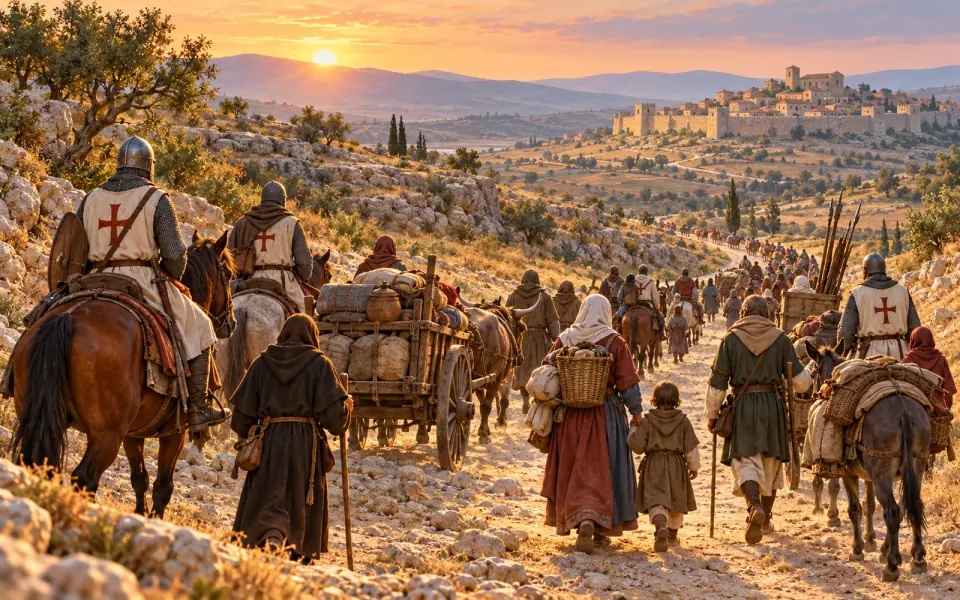 AfterThe First Crusade1096–1099
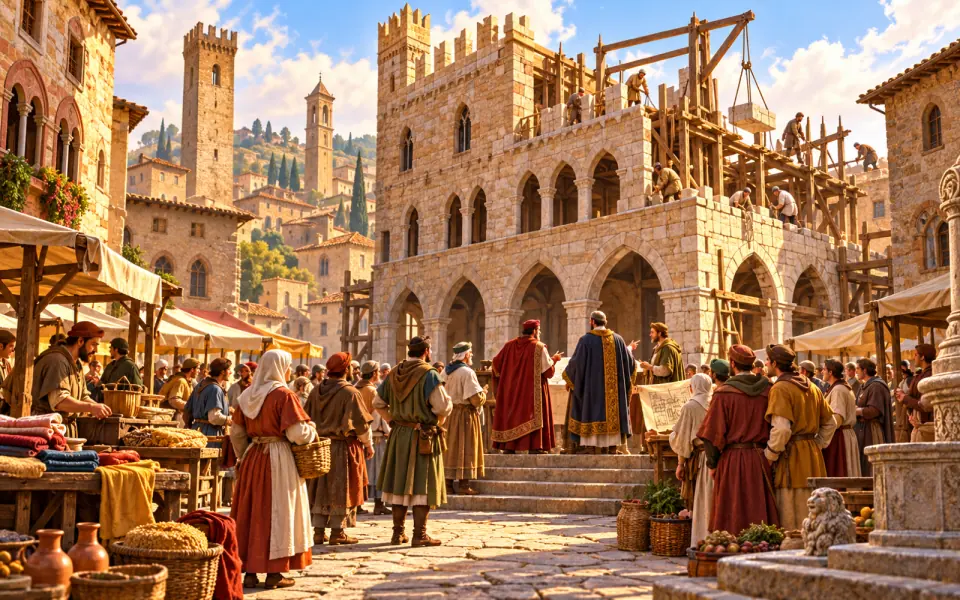 AfterThe Italian communesabout 1100
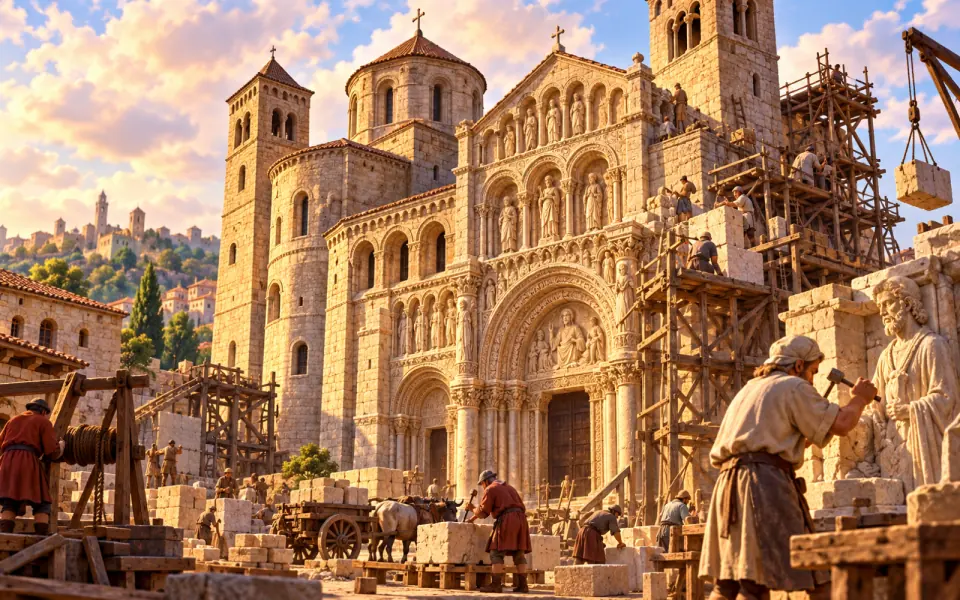 AfterRomanesque cathedralsabout 1100
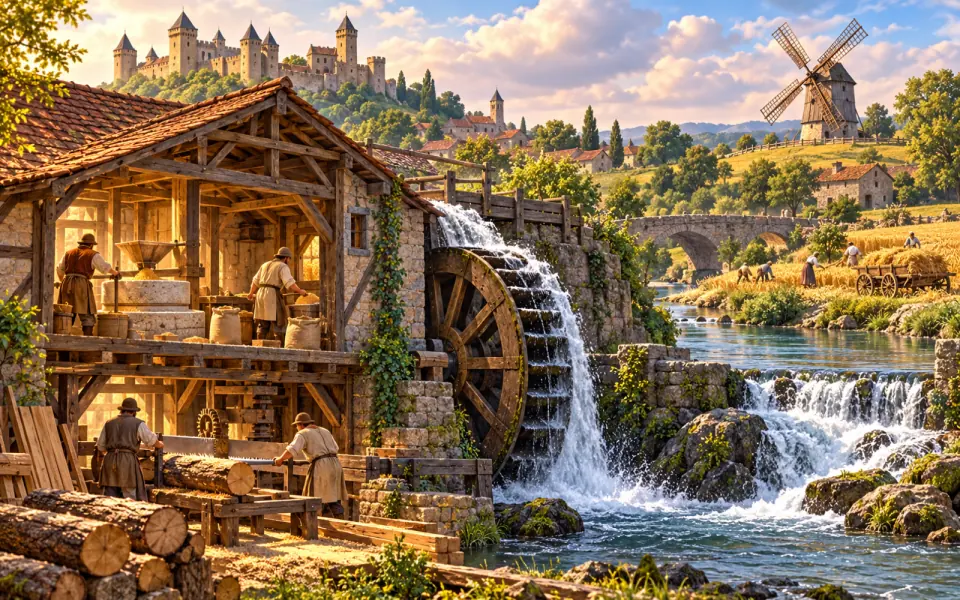 AfterWatermills and windmillsabout 1100
 AfterGothic style at Saint-Denis1144
 AfterHildegard of Bingenabout 1150
 AfterPaper arrives in Europeabout 1150
 AfterFrederick Barbarossa1155
 AfterFrancis of Assisiabout 1182
 AfterFibonacci and the Liber abaci1202
 AfterMagna Carta1215
 AfterThe gold florin1252
 AfterMarco Polo sets off for Asia1271
 AfterSpectaclesabout 1286
 AfterThe Hanseatic League and northern tradeabout 1300
 AfterGiotto paints in Paduaabout 1305
 AfterDante begins the Divine Comedyabout 1307
 AfterThe Hundred Years' War1337–1453
 AfterThe Black Death1347–1352
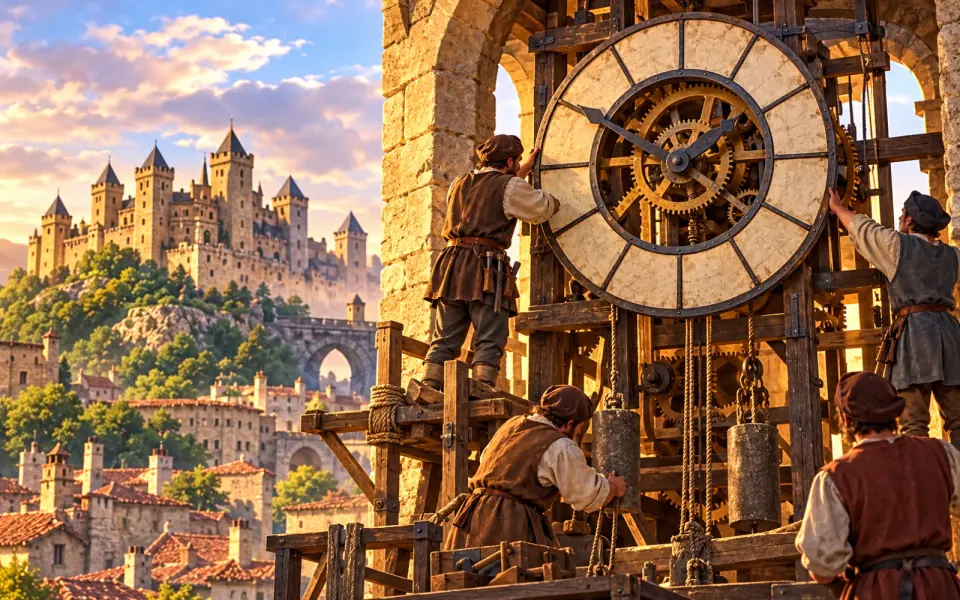 AfterPublic mechanical clocksabout 1350
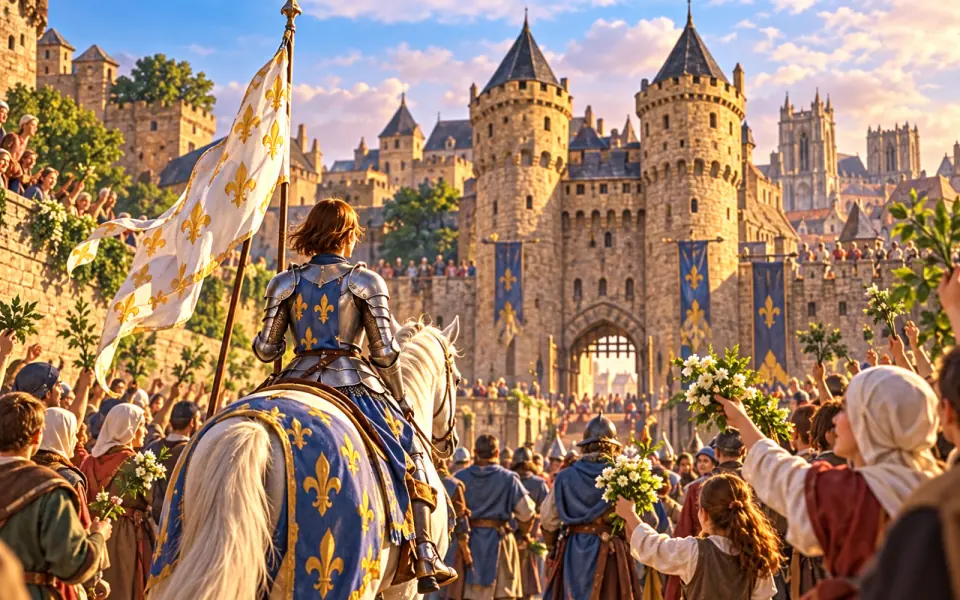 AfterJoan of Arc1429
Listen / Read next
- Music to read by: Cinematic JourneyEpic film-style music, no lyrics, by Ciro Simone IrmiciSpotifyYouTube Music
Meanwhile, elsewhere in the world
Other events of the era “Late Middle Ages”
- The East–West Schism
- The Bayeux Tapestry
- The University of Bologna
- The First Crusade
- The Italian communes
- Romanesque cathedrals
- Watermills and windmills
- Gothic style at Saint-Denis
- Hildegard of Bingen
- Paper arrives in Europe
- Frederick Barbarossa
- Francis of Assisi
- Fibonacci and the Liber abaci
- Magna Carta
- The gold florin
- Marco Polo sets off for Asia
- Spectacles
- The Hanseatic League and northern trade
- Giotto paints in Padua
- Dante begins the Divine Comedy
- The Hundred Years' War
- The Black Death
- Public mechanical clocks
- Joan of Arc
