Public mechanical clocks
about 1350 European towns (for example Padua and Milan)
In short
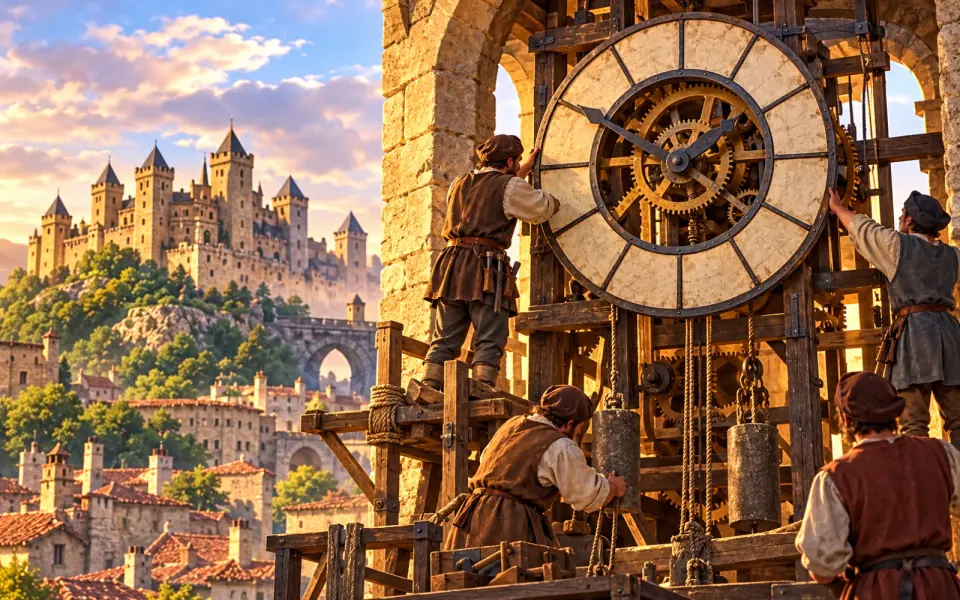
Mechanical clocks worked thanks to a weight that slowly dropped and a device, the escapement, that controlled its fall. In the 14th century towns began to put them on towers, often with a bell that struck the hours. In Padua Giovanni Dondi built the Astrarium, which also showed the movements of the Sun, the Moon and the planets. Before then people mostly followed the church bells, which marked the hours of prayer.
Why it matters Having the same time for everyone changed the rhythm of work, markets and town life.
Source: Encyclopaedia Britannica, “Clock”
Study card about 5 minutes of reading
The story
How time was measured
For thousands of years time was measured by looking at the sky. The sundial showed the hours with the shadow of the Sun, but did not work at night or when it was cloudy. For the night there were the sand hourglass, the water clock and graduated candles. In monasteries, alarms and bells marked the hours of prayer: the monk in charge got up, looked at the stars or at the water running down, and rang the bell.
“Temporary hours” were also used: the day, from dawn to dusk, was divided into twelve hours equal to one another, and the night into another twelve. But since a summer day lasts much longer than a winter one, temporary hours were longer in summer and shorter in winter. A good rule for life in the fields, but not very practical for people doing business.
The machine that strikes the hour
At the end of the 1200s, perhaps in Italy or in England, someone invented the first mechanical clock. We do not know who it was: no document speaks of it clearly. It was a machine made of toothed wheels, driven by a weight hung on a rope. The weight came down slowly, turning the gears, and a mechanism called an “escapement” made it come down in regular steps, one after another. This mechanism, the first of its kind, served to regulate time.
The first clocks had neither hands nor dial: they served only to make a bell ring at regular intervals, reminding the monks to pray. The English “clock” and the French “cloche” derive from a medieval word meaning “bell”, and recall this origin. In time a dial with a hand was added, and then more hands.
The clocks of the towns
In the 1300s the Italian, Flemish and German towns competed to build a public clock on the town hall tower or the church bell tower. In Milan in 1335-1336 one was put up at the church of San Gottardo, and a chronicler wrote that it struck the twenty-four hours of the day, something that seemed extraordinary. In Padua, around 1344, one was built on the tower of the palace of the Carrara lords. Paris, Strasbourg, London and many other towns followed.
These clocks measured hours that were always equal, twenty-four in a day, in summer as in winter. Daily life changed as a result: markets opened and closed at the right hour, cloth workers in Flanders were paid by the hour, and the clock bells said when work began and when it stopped. Time, once tied to the Sun and the Church, became a good that could be counted, used and paid for.
For the people who lived around the tower, the clock was an incredible novelty: a machine that seemed to work by itself, day and night, with nobody running it. Many stopped to watch it, and in some towns the clock tower became the symbol of the commune, sometimes more important than the government palace.
Clocks and astronomy
Some clocks also showed the movements of the Sun, the Moon and the planets. Giovanni Dondi dall'Orologio, a physician and astronomer of Padua, built between 1348 and 1364 a very complicated “astrarium”, with seven dials for the seven planets then known, and wrote a book to explain how it was made. The astronomical clock of Prague, installed in 1410 on the town hall, still works today, with a procession of statues that appears every hour.
The first clocks were not very accurate: they could be wrong by a quarter of an hour or more a day, and had to be set every day by looking at the Sun. True accuracy came in 1656 with the pendulum clock, devised by the Dutchman Christiaan Huygens on the basis of Galileo's studies.
Why it happened
The towns were growing, and trade and craft activities required time to be organised with precision, and equal hours were more convenient for people who had to make appointments, pay wages and open markets, even in winter.
The gears and weights used in mills and in building-site machines already existed, and skilled metalworkers were by now able to build complex mechanisms.
What changed
The mechanical clock transformed life in European towns. Time began to be seen as something measurable and precious, and the habit of being punctual was born. Some historians say it was clock time that put order into the lives of merchants and set it apart from that of the Church.
The mechanisms of clocks, with their gears, springs and weights, were the model for many other machines and slowly led to pocket watches, wristwatches and precision instruments. In the 1600s scientists began to measure time in experiments too, and this made modern physics possible.
A new trade was born, that of the clockmaker, and clock mechanisms also inspired the image of the universe as a great clock.
Key people and places
People
- Giovanni Dondi dall'Orologio
- Physician and astronomer of Padua (1330-1388): he built an astrarium with seven dials.
- Jacopo Dondi
- Giovanni's father (about 1290-1359): according to tradition he made the clock of the Padua tower around 1344.
- Christiaan Huygens
- Dutch physicist (1629-1695): he devised the first pendulum clock in 1656.
- Galvano Fiamma
- Milanese chronicler (1283-1344): he described the clock of San Gottardo of 1335-1336.
Places
- Padua
- City where one of the first public clocks was built around 1344.
- Milan
- City with the clock of San Gottardo, which struck the hours in 1335-1336.
- Prague
- City with the astronomical clock of 1410.
Good to know
- The first mechanical clocks had neither hands nor dial: they struck the hour with a bell.
- The astronomical clock of Prague has been working since 1410.
- Temporary hours were longer in summer and shorter in winter.
- The pendulum clock was devised in 1656.
- The English word “clock” recalls the bell: it comes from a medieval word meaning “bell”.
Find out more
- Wikipedia, “Clock” en.wikipedia.org
- Wikipedia, “Giovanni Dondi dall'Orologio” en.wikipedia.org
- Wikipedia, “Prague astronomical clock” en.wikipedia.org
- Wikipedia, “Escapement” en.wikipedia.org
Related events
- Watermills and windmillsabout 1100 · Late Middle AgesThe gears of mills inspired those of clocks.
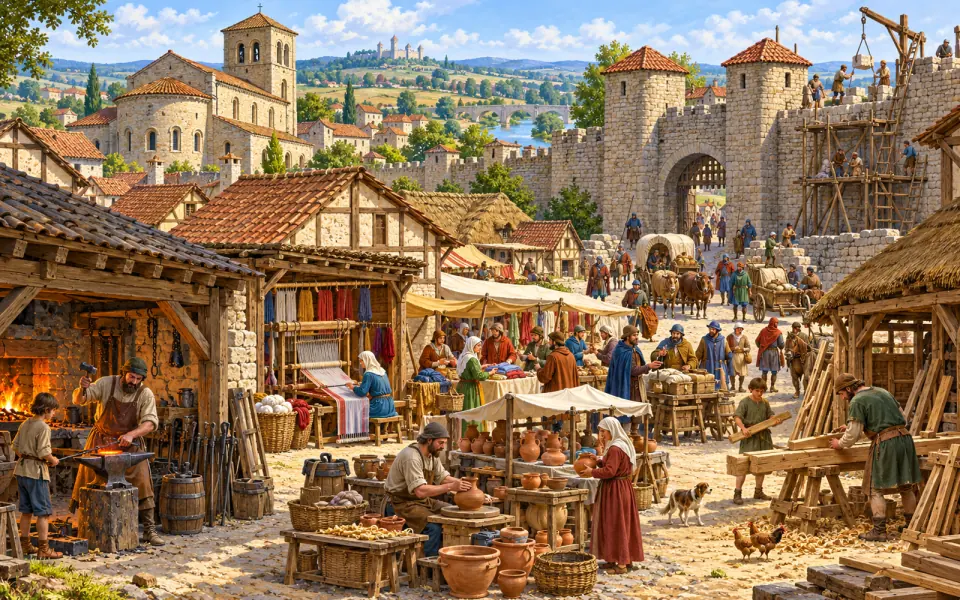
- The growth of medieval townsabout 1050 · Late Middle AgesMedieval towns needed to mark out working time.
- Spectaclesabout 1286 · Late Middle AgesSpectacles were invented in the same period.
- Fibonacci and the Liber abaci1202 · Late Middle AgesThe Liber Abaci spread across Europe the numbers and calculations that were also needed to divide and count the hours.
Before and after, in the era “Late Middle Ages”
Event 24 of 25
 BeforeThe growth of medieval townsabout 1050
 BeforeThe East–West Schism1054
 BeforeThe Bayeux Tapestryabout 1070
 BeforeThe University of Bolognaabout 1088
 BeforeThe First Crusade1096–1099
 BeforeThe Italian communesabout 1100
 BeforeRomanesque cathedralsabout 1100
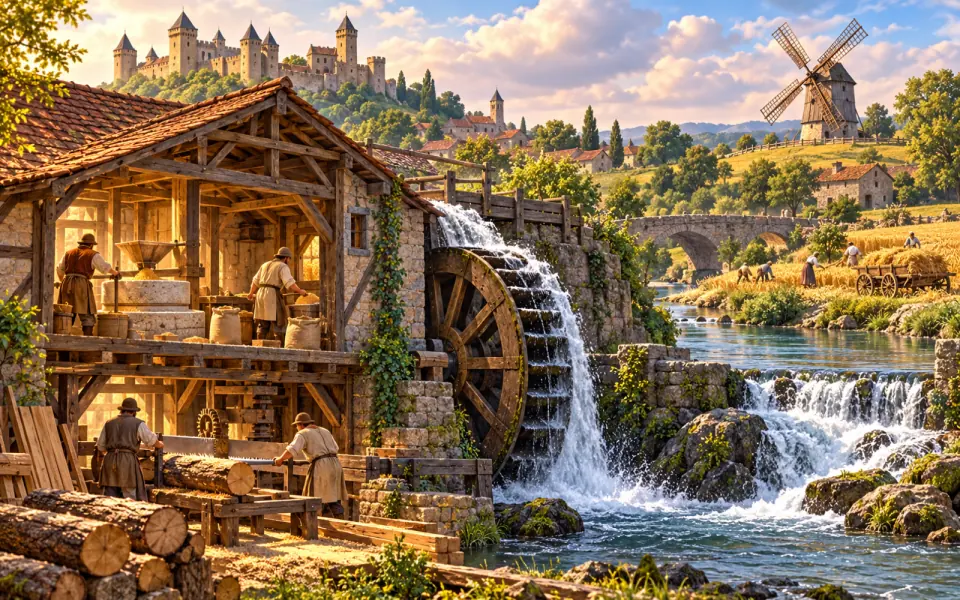 BeforeWatermills and windmillsabout 1100
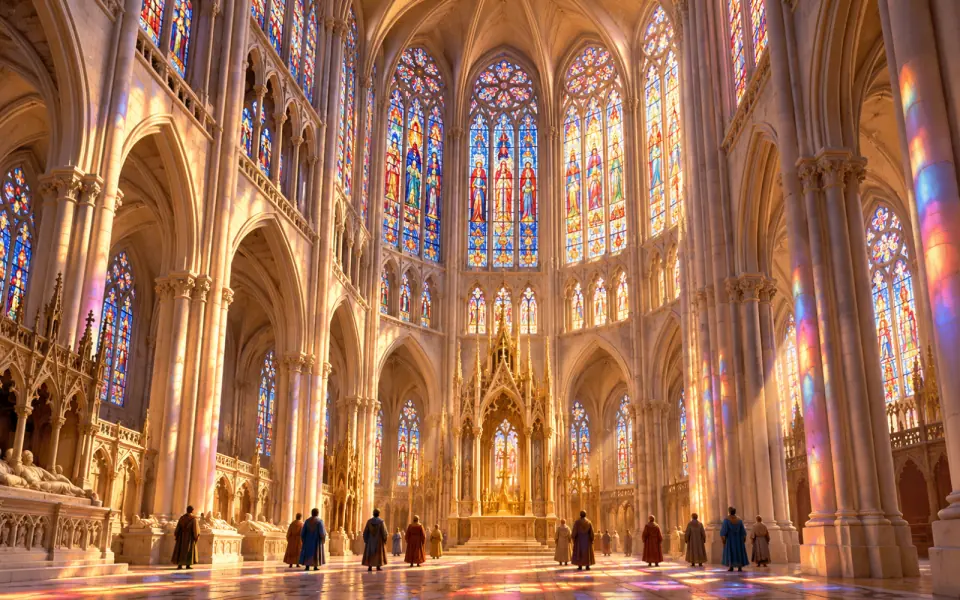 BeforeGothic style at Saint-Denis1144
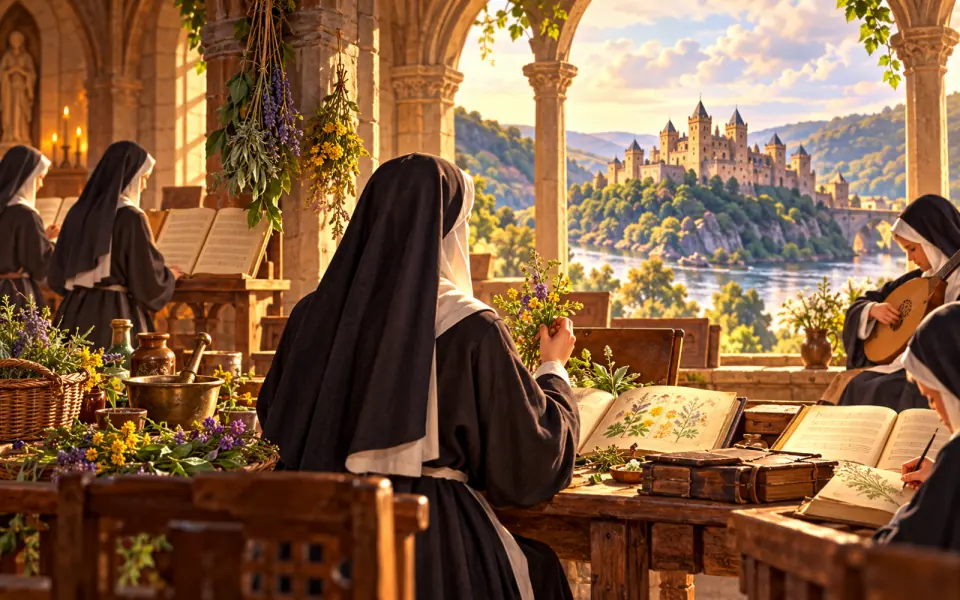 BeforeHildegard of Bingenabout 1150
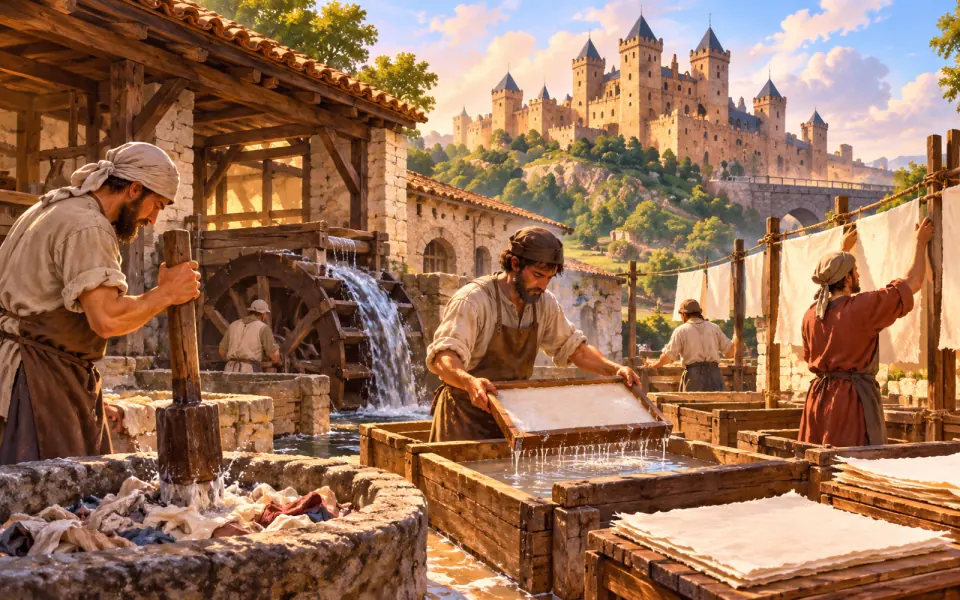 BeforePaper arrives in Europeabout 1150
 BeforeFrederick Barbarossa1155
 BeforeFrancis of Assisiabout 1182
 BeforeFibonacci and the Liber abaci1202
 BeforeMagna Carta1215
 BeforeThe gold florin1252
 BeforeMarco Polo sets off for Asia1271
 BeforeSpectaclesabout 1286
 BeforeThe Hanseatic League and northern tradeabout 1300
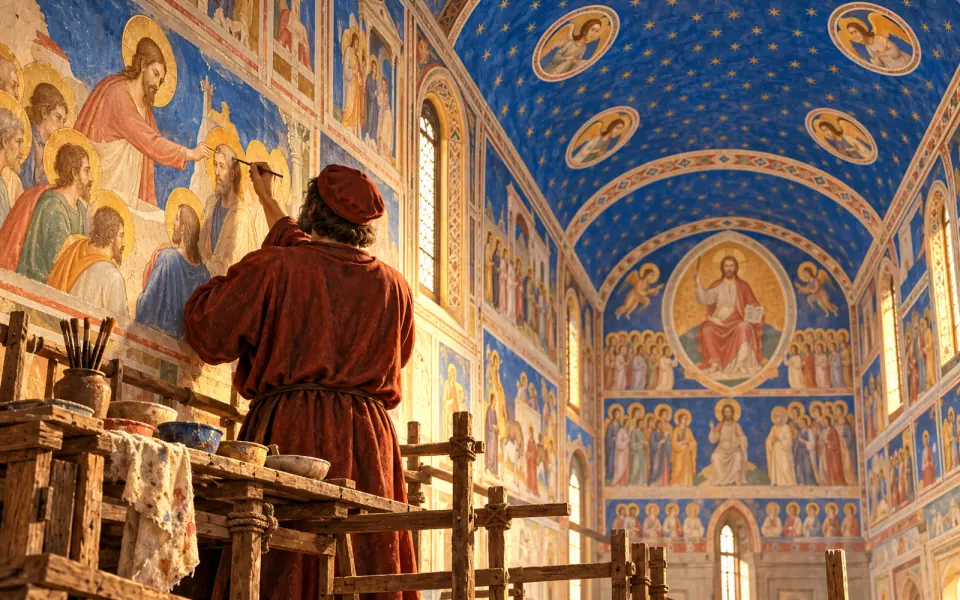 BeforeGiotto paints in Paduaabout 1305
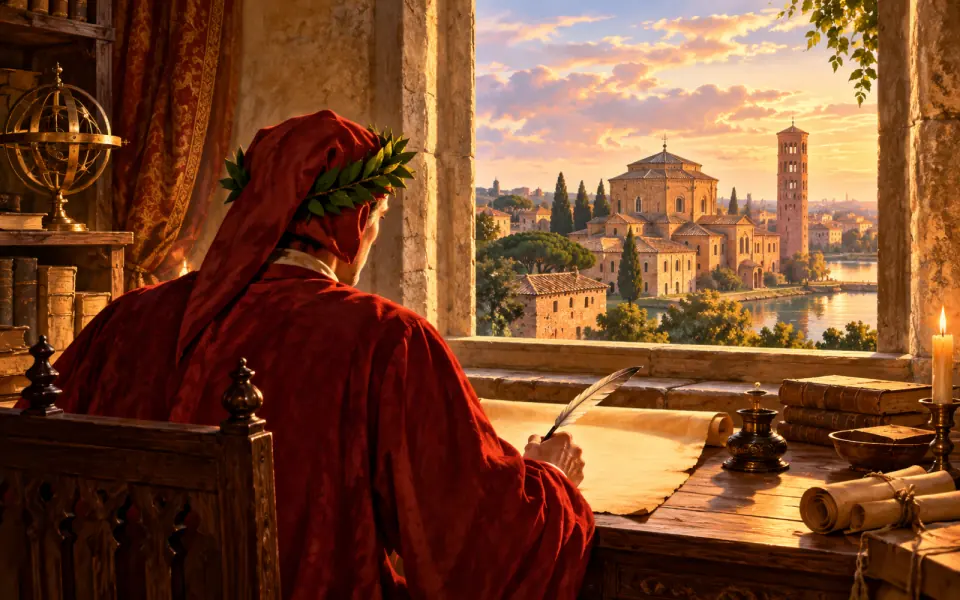 BeforeDante begins the Divine Comedyabout 1307
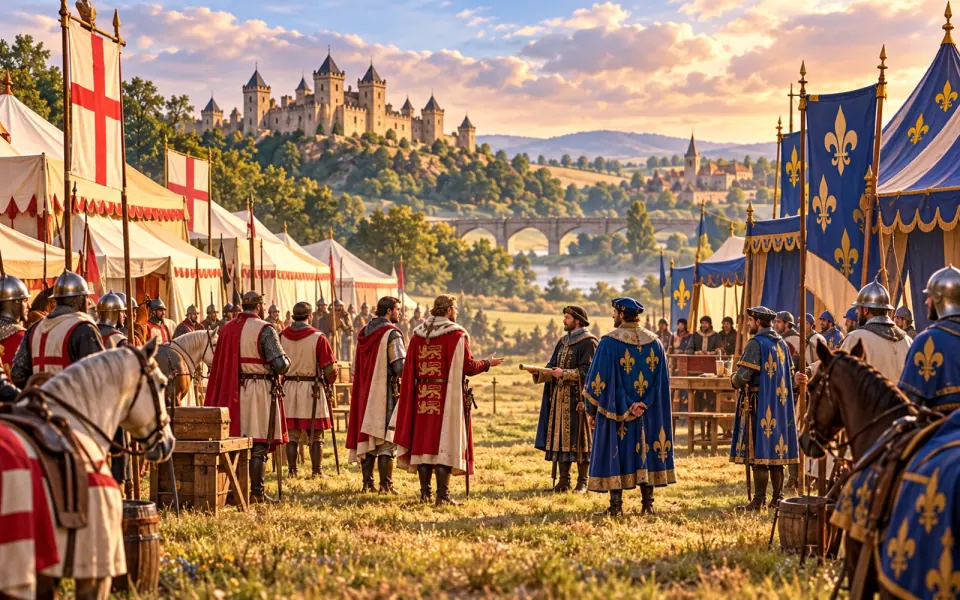 BeforeThe Hundred Years' War1337–1453
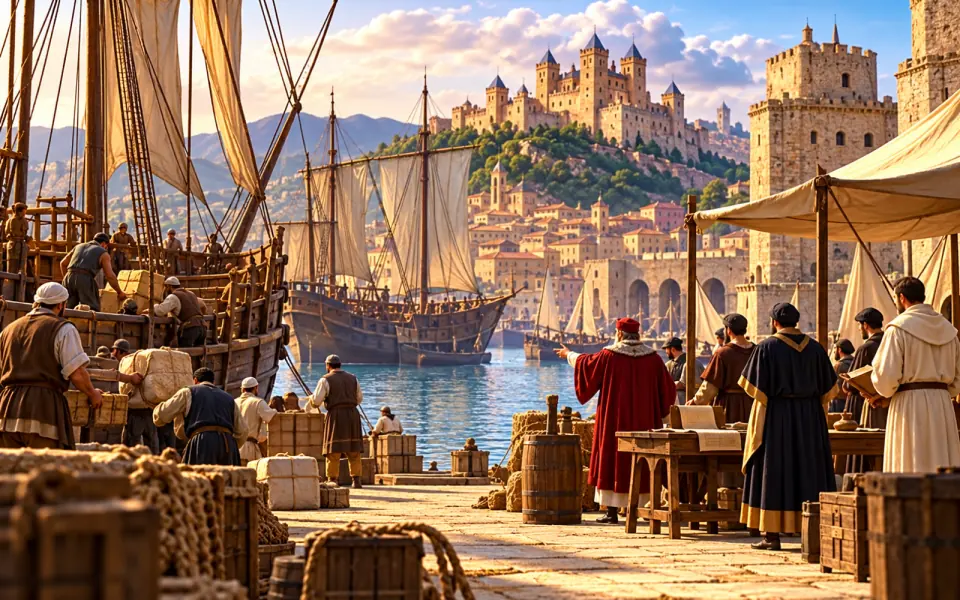 BeforeThe Black Death1347–1352
- You are herePublic mechanical clocksabout 1350
 AfterJoan of Arc1429
Listen / Read next
- Music to read by: Cinematic JourneyEpic film-style music, no lyrics, by Ciro Simone IrmiciSpotifyYouTube Music
Meanwhile, elsewhere in the world
Other events of the era “Late Middle Ages”
- The growth of medieval towns
- The East–West Schism
- The Bayeux Tapestry
- The University of Bologna
- The First Crusade
- The Italian communes
- Romanesque cathedrals
- Watermills and windmills
- Gothic style at Saint-Denis
- Hildegard of Bingen
- Paper arrives in Europe
- Frederick Barbarossa
- Francis of Assisi
- Fibonacci and the Liber abaci
- Magna Carta
- The gold florin
- Marco Polo sets off for Asia
- Spectacles
- The Hanseatic League and northern trade
- Giotto paints in Padua
- Dante begins the Divine Comedy
- The Hundred Years' War
- The Black Death
- Joan of Arc
