Joan of Arc
1429 Orléans, France
In short
Joan was a girl from a village on the edge of Lorraine, in north-eastern France. She said she heard the voices of some saints asking her to help the King of France against the English. At about seventeen she persuaded Charles VII to give her armour, and she led the troops who freed Orléans. Soon afterwards Charles was crowned king at Reims, but in 1430 Joan was captured, and the following year she was put on trial and sentenced to death. Later she was declared innocent, and in 1920 she was made a saint.
Why it matters She has become the symbol of France and an example of courage.
Source: Encyclopaedia Britannica, “Saint Joan of Arc”
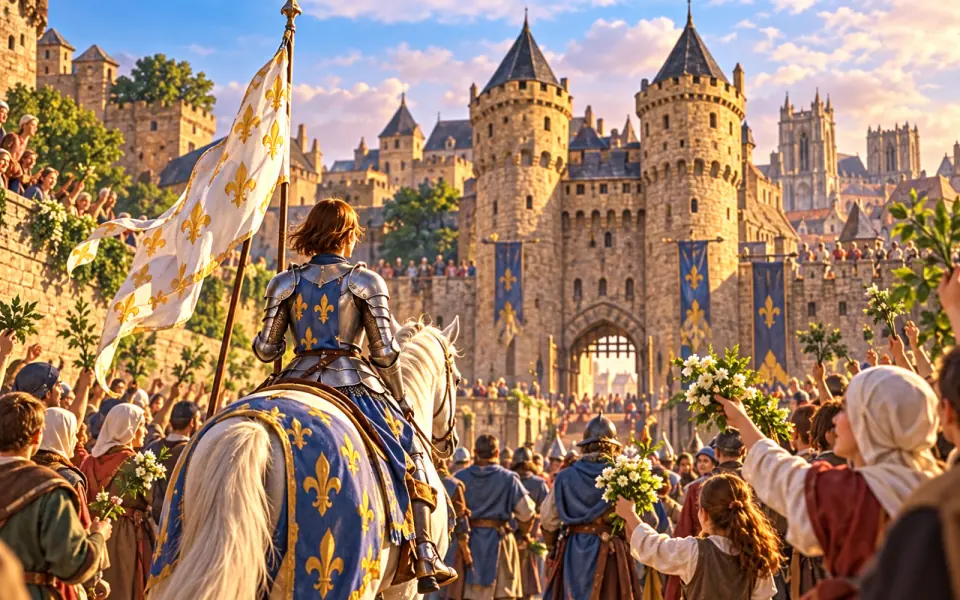
Study card about 5 minutes of reading
The story
A country girl
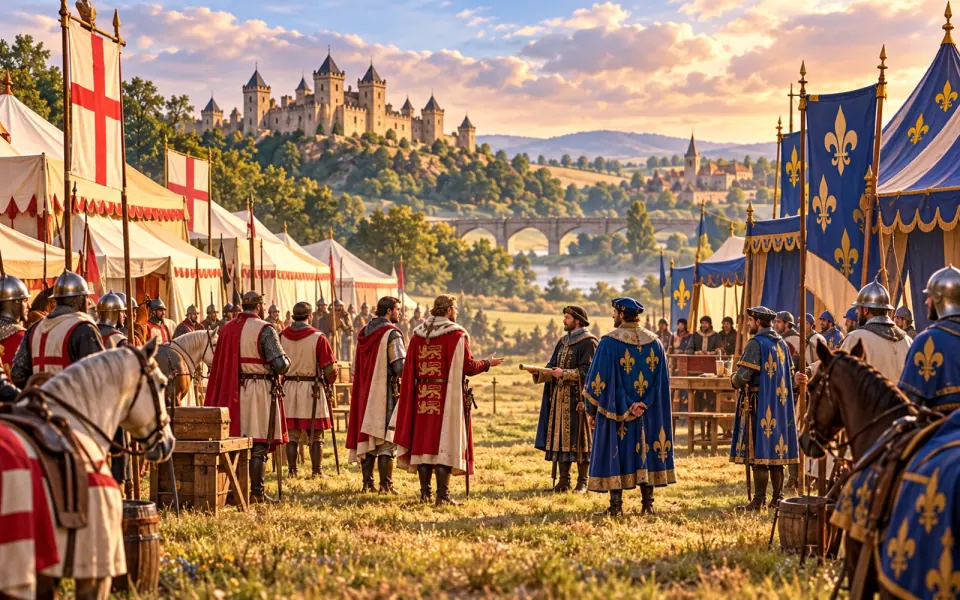
Joan was born around 1412 at Domrémy, a village in Lorraine, in north-eastern France, into a family of well-off peasants. She could neither read nor write. She helped her parents in the fields, spun wool and went to Mass. It was a time of war: the Hundred Years' War between France and England had lasted for almost a century, and her village was attacked several times by bands of soldiers.
The situation of France was desperate. King Charles VI, who was mentally ill, had died in 1422, and the Treaty of Troyes had given the crown to the King of England. His son, the Dauphin Charles, had been disinherited and had not even been crowned. The English and their Burgundian allies controlled Paris and the north. In 1428 the English began to besiege Orléans, an important town on the Loire: if it fell, the whole south would be at risk.
The voices
Joan said later that, at thirteen, she had begun to hear voices, accompanied by a light, and that they were the archangel Michael and Saint Catherine and Saint Margaret. They told her to go to the help of the Dauphin and to see that he was crowned king. At first she told nobody. Then, in 1428, at sixteen, she asked to be taken to the captain of Vaucouleurs, Robert de Baudricourt, who sent her away with scorn. She came back, insisted, and in the end he gave her an escort of men.
Dressed as a man to travel safely, she crossed for eleven days a country full of enemies and reached Chinon, in February 1429, where the Dauphin was. Charles tested her, hiding among the courtiers: according to tradition Joan recognised him at once. Theologians and learned men questioned her at Poitiers to check that she was not a witch or mad, and judged her sincere.
Joan had her hair cut at ear level, like the young men of the time, and was called “the Maid” (in French “la Pucelle”), that is, the girl, because she was unmarried. She did not fight with a sword, but carried the banner and urged on the soldiers; she said she had never killed anyone.
Orléans and Reims
Joan asked for armour and a white banner with the names of Jesus and Mary. With the army she reached Orléans at the end of April 1429. Within a few days the French, heartened by her presence, attacked the English forts around the town. Joan was wounded by an arrow in the shoulder, but went back to the fight. On 8 May the English lifted the siege.
In the following months other victories followed, such as Patay, in June, and on 17 July 1429 Charles VII was crowned king in Reims Cathedral, with Joan beside him. Then she tried to take Paris, but was wounded and the attack failed. At this point the king, who preferred to negotiate with Burgundy, stopped supporting her.
The trial and the stake
In May 1430, at Compiègne, Joan was captured by the Burgundians, who sold her to the English for ten thousand pounds. She was taken to Rouen, where a church court, led by Bishop Pierre Cauchon, a man loyal to the English, tried her for heresy. For months they questioned her, with cunning questions about her voices and her wearing men's clothes. Joan answered promptly, without letting herself be trapped.
On 30 May 1431, aged about nineteen, she was condemned and burned alive in the Old Market Square of Rouen. Some years later, in 1450, King Charles VII had the inquiry reopened: in 1456 a new trial declared the sentence void and cleared her name. In 1909 the Church declared her blessed, and on 16 May 1920 a saint.
Why it happened
France was divided, exhausted and almost defeated; the Dauphin did not dare to act. At that moment, a girl sure of herself and convinced of a divine mission gave new confidence to soldiers and citizens.
For the people of that time it was normal to believe that God intervened in history; many thought that Joan was a sign of heaven's favour for the French cause.
What changed
The relief of Orléans and the coronation at Reims changed the course of the war: from then on the French, with more courage and a new organisation, regained ground until the final victory, in 1453.
Joan has become a French national heroine and one of the most famous women in history. She is one of the patron saints of France and her memory has been used by very different people and movements. Many books, paintings, films and plays, from Shakespeare to Schiller, from Verdi to Bernard Shaw, are about her.
The Rouen trial and that of the rehabilitation, whose records survive, are among the most complete documents on the life of a person of the Middle Ages, and let us hear her words directly.
Key people and places
People
- Joan of Arc
- Peasant from Lorraine (about 1412-1431): she led the French army at Orléans.
- Charles VII
- King of France from 1422 to 1461 (1403-1461): crowned at Reims thanks to her.
- Pierre Cauchon
- Bishop of Beauvais (about 1371-1442): he presided over the Rouen trial.
- Robert de Baudricourt
- Captain of Vaucouleurs (about 1400-1454): he gave her an escort.
Places
- Domrémy
- The Lorraine village where she was born, now with her birthplace house.
- Orléans
- Town on the Loire relieved in May 1429.
- Reims
- Town of the cathedral where the kings of France were crowned.
- Rouen
- Norman town where she was tried and burned on 30 May 1431.
Good to know
- Joan could neither read nor write.
- She was about seventeen when she led the army at Orléans.
- Her banner was white, with the names of Jesus and Mary.
- The trial that condemned her was annulled in 1456.
- The Church declared her a saint in 1920.
Find out more
- Wikipedia, “Joan of Arc” en.wikipedia.org
- Wikipedia, “Siege of Orléans” en.wikipedia.org
- Wikipedia, “Trial of Joan of Arc” en.wikipedia.org
- Wikipedia, “Charles VII of France” en.wikipedia.org
Related events
- The Hundred Years' War1337–1453 · Late Middle AgesJoan lived and fought during the Hundred Years' War.
- The Black Death1347–1352 · Late Middle AgesThe Black Death had struck France eighty years earlier.
- Public mechanical clocksabout 1350 · Late Middle AgesThe clocks of the towns were by now marking out the day.
- Dante begins the Divine Comedyabout 1307 · Late Middle AgesDante had written in the vernacular a century earlier.
Before and after, in the era “Late Middle Ages”
Event 25 of 25
 BeforeThe growth of medieval townsabout 1050
 BeforeThe East–West Schism1054
 BeforeThe Bayeux Tapestryabout 1070
 BeforeThe University of Bolognaabout 1088
 BeforeThe First Crusade1096–1099
 BeforeThe Italian communesabout 1100
 BeforeRomanesque cathedralsabout 1100
 BeforeWatermills and windmillsabout 1100
 BeforeGothic style at Saint-Denis1144
 BeforeHildegard of Bingenabout 1150
 BeforePaper arrives in Europeabout 1150
 BeforeFrederick Barbarossa1155
 BeforeFrancis of Assisiabout 1182
 BeforeFibonacci and the Liber abaci1202
 BeforeMagna Carta1215
 BeforeThe gold florin1252
 BeforeMarco Polo sets off for Asia1271
 BeforeSpectaclesabout 1286
 BeforeThe Hanseatic League and northern tradeabout 1300
 BeforeGiotto paints in Paduaabout 1305
 BeforeDante begins the Divine Comedyabout 1307
 BeforeThe Hundred Years' War1337–1453
 BeforeThe Black Death1347–1352
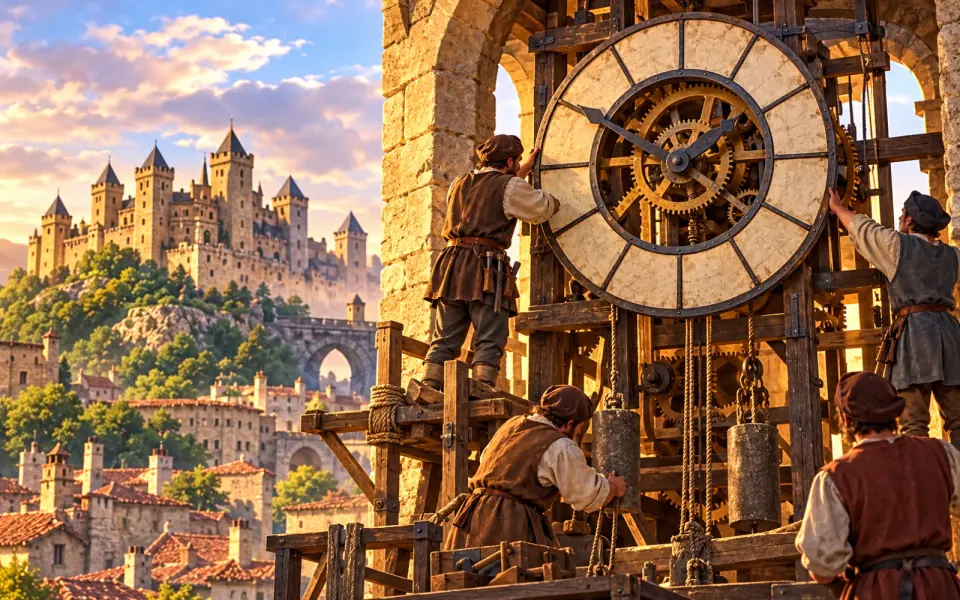 BeforePublic mechanical clocksabout 1350
- You are hereJoan of Arc1429
Listen / Read next
- Music to read by: Cinematic JourneyEpic film-style music, no lyrics, by Ciro Simone IrmiciSpotifyYouTube Music
Meanwhile, elsewhere in the world
Other events of the era “Late Middle Ages”
- The growth of medieval towns
- The East–West Schism
- The Bayeux Tapestry
- The University of Bologna
- The First Crusade
- The Italian communes
- Romanesque cathedrals
- Watermills and windmills
- Gothic style at Saint-Denis
- Hildegard of Bingen
- Paper arrives in Europe
- Frederick Barbarossa
- Francis of Assisi
- Fibonacci and the Liber abaci
- Magna Carta
- The gold florin
- Marco Polo sets off for Asia
- Spectacles
- The Hanseatic League and northern trade
- Giotto paints in Padua
- Dante begins the Divine Comedy
- The Hundred Years' War
- The Black Death
- Public mechanical clocks
