The gold florin
1252 Florence, Tuscany
In short
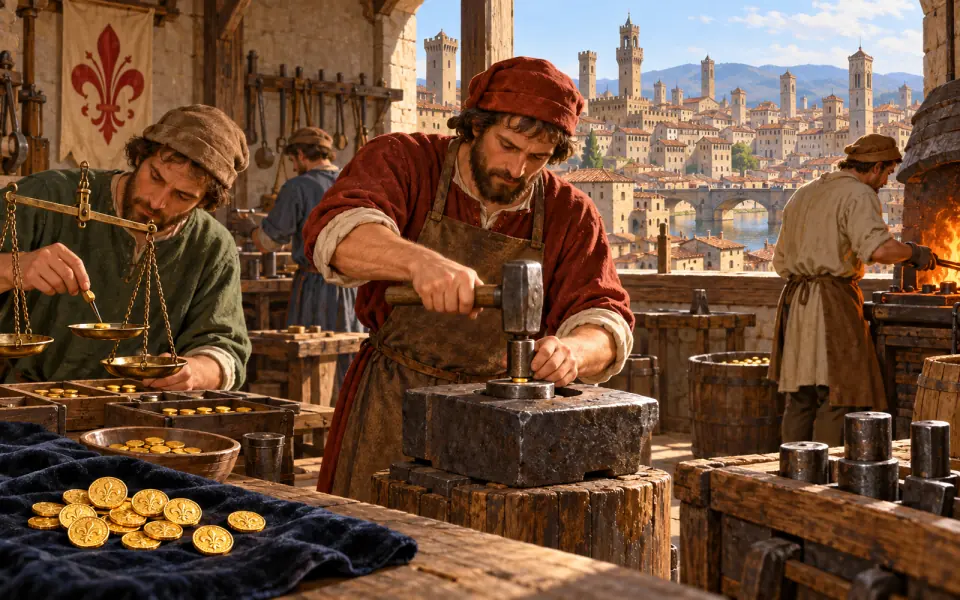
Florence began to mint the florin, a coin of almost pure gold weighing about three and a half grams. On one side was the lily, the symbol of the city, on the other St John the Baptist, its patron saint. Because the weight and quality of the gold always stayed the same, merchants and bankers all over Europe trusted it. Florins were used to pay for goods, loans and even armies.
Why it matters It was a kind of medieval ‘euro’ and made Florence one of the capitals of finance.
Source: Treccani, entry “Fiorino”
Study card about 4 minutes of reading
The story
Coins of silver and copper
In the Middle Ages, for centuries, western Europe used almost only silver coins, the pennies (denarii), of small value, and coins of copper or alloy. Gold coins were hardly minted any more: the gold in circulation came from the East, above all from the Byzantine Empire and the Arab world, and there was little of it: for important business a gold coin would have been extremely convenient. A merchant who had to pay a large sum found himself with a sack of silver coins that were heavy and hard to count.
Coins, moreover, were a practical disaster. Every lord, bishop or town minted its own, of different weights and qualities, and sometimes rulers secretly reduced the amount of silver to get more coins from the same quantity of metal. To know what a coin was worth you had to weigh and check it, and there were money-changers everywhere.
The florin of Florence
In 1252 the commune of Florence decided to mint a coin of pure gold, that is, 24 carat: the gold florin. It weighed about 3.5 grams. On one side it had the lily, the symbol of the city (the “flower” from which it took its name), and on the back Saint John the Baptist, the patron saint of the Florentines. The design stayed the same for centuries, so that everyone would recognise it at a glance.
Genoa too had minted its own gold genovino in the same year. But it was the florin that became the reference coin of Europe. Its secret was stability: for more than two hundred years Florence kept the weight and purity of the florin unchanged. Whoever received one knew it was worth what it had always been worth, and this gave confidence. Traders of every country accepted it; many states and towns imitated it. In 1284 Venice minted its ducat, also of almost pure gold.
Around the coin ran an inscription in Latin: on one side the name of the city, “Florentia”, on the other that of the saint. Every florin was checked by the mint officials, who had to guarantee the quality of the gold. Anyone who forged coins risked very severe punishments.
A bankers' economy
Florence had grown rich above all through wool and finance. Its wool cloth was finished in the city and sold all over Europe. The banking families, such as the Bardi and the Peruzzi in the 1300s, and the Medici in the 1400s, opened branches in London, Bruges, Paris, Avignon and many other cities. They lent money to kings, popes and merchants, accepted deposits, and made payments at a distance with bills of exchange, that is, documents that allowed payment to be made in one place without having to carry the coins.
To keep these affairs in order a new way of keeping accounts was also developed, double-entry bookkeeping, in which every transaction is recorded twice, once as an entry and once as an outgoing, to catch mistakes. Not all the bankers were lucky: the Bardi and the Peruzzi failed between 1343 and 1346, above all because King Edward III of England did not repay the loans they had made him.
A “cursed” flower
Not everyone looked on money with favour. Dante, in the Paradiso, writes that the “cursed flower”, that is, the florin, had led sheep and lambs astray, meaning that it had corrupted both the faithful and the shepherds of the Church. For the Christian morality of the time, making a profit from money, and above all interest, was viewed with suspicion, and the Church condemned usury. The bankers found ways round the ban, for example through exchange dealings, but many, at the end of their lives, left money to charity, to feel more at ease.
Why it happened
The Italian towns traded with the whole Mediterranean and with northern Europe, and needed a coin of high value, recognisable and reliable. Gold was the most suitable metal for this.
Florence was a city with flourishing banking and manufacturing. It was in its own interest to offer a stable coin that would favour its business and its good reputation across Europe.
What changed
The florin remained for two and a half centuries the most important coin of western Europe. Its name spread: in the Netherlands it was called “florin” or “guilder” until the adoption of the euro, in Hungary “forint”, still the national currency today.
The Florentine bankers opened the way to modern finance: deposits, loans, cheques, double-entry bookkeeping. The wealth they gained helped to pay for Renaissance artists and architects: without the florin and the banks, there would probably have been no Medici as patrons.
In time, however, the florin lost importance: Florence debased it in the 1400s and 1500s and other coins, such as the Venetian ducat and later the scudo, took its place.
Key people and places
People
- The Florentine bankers
- Merchant-bankers such as the Bardi, the Peruzzi and the Medici, who lent money all over Europe.
- Giovanni Villani
- Florentine chronicler (about 1276-1348): in his Cronica he described the minting of the florin.
- Dante Alighieri
- Florentine poet (1265-1321): he called the florin the “cursed flower”.
- Edward III
- King of England from 1327 to 1377: he did not repay the loans to the Bardi and the Peruzzi.
Places
- Florence
- Tuscan city where the florin was minted from 1252.
- Genoa and Venice
- The other cities that minted gold coins: the genovino (1252) and the ducat (1284).
Good to know
- The florin weighed about 3.5 grams and was pure gold.
- The Hungarian national currency, the forint, takes its name from the florin.
- For more than two hundred years Florence did not change the weight and purity of the florin.
- The bankers Bardi and Peruzzi failed above all because the King of England did not repay the loans.
- On the coin there were a lily and Saint John the Baptist.
Find out more
- Wikipedia, “Florin” en.wikipedia.org
- Wikipedia, “Genovino” en.wikipedia.org
- Wikipedia, “Hungarian forint” en.wikipedia.org
- Wikipedia, “Giovanni Villani” en.wikipedia.org
Related events
- The growth of medieval townsabout 1050 · Late Middle AgesThe growth of towns created markets and bankers.
- Fibonacci and the Liber abaci1202 · Late Middle AgesFibonacci taught the calculations merchants needed.
- Dante begins the Divine Comedyabout 1307 · Late Middle AgesDante condemned the florin in the Paradiso.
- The Black Death1347–1352 · Late Middle AgesThe Black Death of 1348 hit the Florentine banks hard.
Before and after, in the era “Late Middle Ages”
Event 16 of 25
 BeforeThe growth of medieval townsabout 1050
 BeforeThe East–West Schism1054
 BeforeThe Bayeux Tapestryabout 1070
 BeforeThe University of Bolognaabout 1088
 BeforeThe First Crusade1096–1099
 BeforeThe Italian communesabout 1100
 BeforeRomanesque cathedralsabout 1100
 BeforeWatermills and windmillsabout 1100
 BeforeGothic style at Saint-Denis1144
 BeforeHildegard of Bingenabout 1150
 BeforePaper arrives in Europeabout 1150
 BeforeFrederick Barbarossa1155
 BeforeFrancis of Assisiabout 1182
 BeforeFibonacci and the Liber abaci1202
 BeforeMagna Carta1215
- You are hereThe gold florin1252
 AfterMarco Polo sets off for Asia1271
 AfterSpectaclesabout 1286
 AfterThe Hanseatic League and northern tradeabout 1300
 AfterGiotto paints in Paduaabout 1305
 AfterDante begins the Divine Comedyabout 1307
 AfterThe Hundred Years' War1337–1453
 AfterThe Black Death1347–1352
 AfterPublic mechanical clocksabout 1350
 AfterJoan of Arc1429
Listen / Read next
- Music to read by: Cinematic JourneyEpic film-style music, no lyrics, by Ciro Simone IrmiciSpotifyYouTube Music
Meanwhile, elsewhere in the world
Other events of the era “Late Middle Ages”
- The growth of medieval towns
- The East–West Schism
- The Bayeux Tapestry
- The University of Bologna
- The First Crusade
- The Italian communes
- Romanesque cathedrals
- Watermills and windmills
- Gothic style at Saint-Denis
- Hildegard of Bingen
- Paper arrives in Europe
- Frederick Barbarossa
- Francis of Assisi
- Fibonacci and the Liber abaci
- Magna Carta
- Marco Polo sets off for Asia
- Spectacles
- The Hanseatic League and northern trade
- Giotto paints in Padua
- Dante begins the Divine Comedy
- The Hundred Years' War
- The Black Death
- Public mechanical clocks
- Joan of Arc
