Gothic style at Saint-Denis
1144 Saint-Denis, near Paris (France)
In short
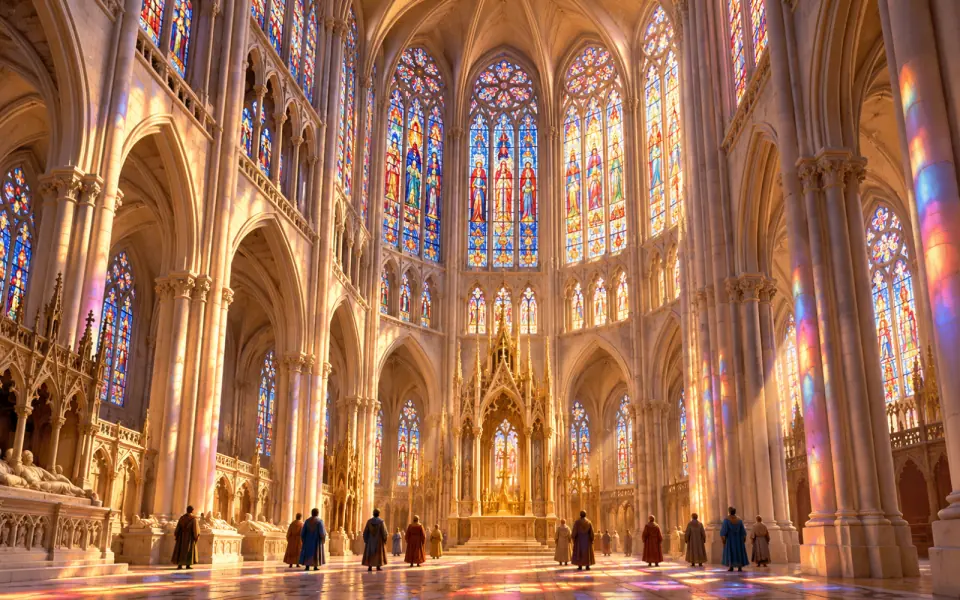
Suger, Abbot of Saint-Denis near Paris, wanted a church full of light, because for him light made people think of God. He had the choir, the part behind the altar, rebuilt with pointed arches, rib vaults and large stained-glass windows. On 11 June 1144 the new choir was consecrated in front of the King of France and many bishops. That way of building, with thinner walls and bigger windows, would later be called Gothic.
Why it matters That choir launched the style of the great Gothic cathedrals, such as Notre-Dame and Chartres.
Source: Encyclopaedia Britannica, “Suger”
Study card about 4 minutes of reading
The story
An abbot who wanted more light
At the gates of Paris stood, and still stands, the abbey of Saint-Denis, the monastery where Saint Denis, the first bishop of Paris, and many kings of France were buried. From 1122 its abbot was a monk named Suger, the son of a modest family, who had become a friend and adviser of King Louis VI and then of Louis VII. Suger governed the kingdom when the king was away, and he was also very devout.
The abbey church was old, dark, and too small for the crowds of pilgrims who came to see the relics. Suger decided to rebuild it. He did not just want a bigger church: he wanted a church full of light. He was influenced by the ideas of a writer of ancient times, who in the Middle Ages was confused with Saint Denis, according to whom light is the highest way in which man can come close to God. A bright church, he thought, would make people feel the divine presence.
The technical novelties
To bring light into the church, Suger's architects used together several solutions that already existed, but were scattered about. The first was the pointed arch, instead of a round one: it rises higher and pushes less to the sides. The second was the rib vault, that is, a vault with stone ribs that support the covering, like the frame of an umbrella. The third was the possibility of lightening the walls: instead of thick solid walls, they made slimmer supports, and between them they opened wide windows.
Later, when Gothic churches became taller, flying buttresses were added outside, light supports that hold up the walls and pass the weight on to external buttresses. Inside, the windows were filled with coloured glass, held together by strips of lead: the stained-glass windows told sacred stories, and the light passing through them filled the church with blue, red and gold.
1144
The choir of Saint-Denis, that is, the part of the church behind the altar, was consecrated on 11 June 1144, in the presence of King Louis VII, his wife Eleanor of Aquitaine and many bishops. It was considered a marvel: Suger wrote an account of it, in which he described with enthusiasm the glass, the precious stones and the gold of the altar. That is why we know so much about his ideas today. The façade had already been finished in 1140.
The new style spread quickly. In 1163 the building of Notre-Dame in Paris began; after the fire of 1194 Chartres Cathedral, famous for its stained glass, was rebuilt; then came Reims, Amiens, Bourges, Strasbourg and Cologne. The name “Gothic” was not given at the time: it was invented in the Renaissance by Italians such as Vasari, who used it with contempt, because they considered it a barbarous style, of the Goths, a Germanic people.
At Saint-Denis Suger had windows put in that told the life of Jesus and stories from the Bible. One of the most famous is the Tree of Jesse, which shows the ancestors of Christ as the branches of a tree. To make coloured glass, powdered minerals were added to the molten sand: cobalt gave blue, copper gave red. Then the pieces were cut and joined with lead.
Building sites lasting centuries
A Gothic cathedral took tens or hundreds of years. Whoever began a building site did not know whether he would see the end. Masons, stonecutters, sculptors, carpenters, glaziers and blacksmiths worked there. Treadwheel cranes were used, driven by the strength of men walking inside them. Sometimes the builders went too far: in 1284 the vaults of the choir of Beauvais Cathedral, among the highest in Europe, collapsed.
Why it happened
The towns were rich and wanted large churches to show their power. The builders' knowledge had grown: ribbed vaults and pointed arches made it possible to build taller, brighter buildings.
And there were the ideas of men like Suger, for whom light was a religious symbol. The link with the French monarchy, which used churches to show its greatness, helped the style to spread.
What changed
Gothic dominated European architecture for about four centuries, from Saint-Denis to the 1400s and, in some countries, even beyond. It changed the look of towns: cathedrals were the tallest buildings, visible from far away.
It gave work to generations of craftsmen and carried forward new techniques, from glassmaking to sculpture, from geometry to cranes.
In the 19th century it was rediscovered: Victor Hugo wrote “The Hunchback of Notre-Dame” (1831) and many architects rebuilt churches in the Gothic Revival style. Today many Gothic cathedrals are among the most visited monuments in the world.
Key people and places
People
- Suger of Saint-Denis
- Abbot (about 1081-1151): he rebuilt Saint-Denis and left writings about the work.
- Louis VII
- King of France from 1137 to 1180 (about 1120-1180): he attended the consecration of the choir in 1144.
- Eleanor of Aquitaine
- Duchess and queen (about 1122-1204): wife of Louis VII, present at the ceremony.
- Giorgio Vasari
- Painter and writer (1511-1574): one of the first to use the term “Gothic”, with contempt.
Places
- Saint-Denis (Paris)
- The abbey where, in 1144, the first Gothic choir was consecrated.
- Chartres
- French town with a Gothic cathedral famous for its stained glass.
- Notre-Dame, Paris
- Cathedral begun in 1163.
Good to know
- The name “Gothic” was invented by Italians of the Renaissance, as an insult.
- A Gothic cathedral could take more than a hundred years of work.
- In 1284 the vaults of the choir of Beauvais collapsed.
- Chartres Cathedral still keeps stained glass from the 1200s.
- The choir of Saint-Denis was consecrated on 11 June 1144.
Find out more
- Wikipedia, “Gothic architecture” en.wikipedia.org
- Wikipedia, “Basilica of St Denis” en.wikipedia.org
- Wikipedia, “Abbot Suger” en.wikipedia.org
- Wikipedia, “Chartres Cathedral” en.wikipedia.org
Related events
- Romanesque cathedralsabout 1100 · Late Middle AgesBefore Gothic, there was Romanesque.
- The growth of medieval townsabout 1050 · Late Middle AgesGrowing towns paid for the great cathedrals.
- Giotto paints in Paduaabout 1305 · Late Middle AgesGiotto painted shortly afterwards in Italy, where Gothic was received with its own variations.
- Dante begins the Divine Comedyabout 1307 · Late Middle AgesDante lived in the age of the great cathedrals.
Before and after, in the era “Late Middle Ages”
Event 9 of 25
 BeforeThe growth of medieval townsabout 1050
 BeforeThe East–West Schism1054
 BeforeThe Bayeux Tapestryabout 1070
 BeforeThe University of Bolognaabout 1088
 BeforeThe First Crusade1096–1099
 BeforeThe Italian communesabout 1100
 BeforeRomanesque cathedralsabout 1100
 BeforeWatermills and windmillsabout 1100
- You are hereGothic style at Saint-Denis1144
 AfterHildegard of Bingenabout 1150
 AfterPaper arrives in Europeabout 1150
 AfterFrederick Barbarossa1155
 AfterFrancis of Assisiabout 1182
 AfterFibonacci and the Liber abaci1202
 AfterMagna Carta1215
 AfterThe gold florin1252
 AfterMarco Polo sets off for Asia1271
 AfterSpectaclesabout 1286
 AfterThe Hanseatic League and northern tradeabout 1300
 AfterGiotto paints in Paduaabout 1305
 AfterDante begins the Divine Comedyabout 1307
 AfterThe Hundred Years' War1337–1453
 AfterThe Black Death1347–1352
 AfterPublic mechanical clocksabout 1350
 AfterJoan of Arc1429
Listen / Read next
- Music to read by: Cinematic JourneyEpic film-style music, no lyrics, by Ciro Simone IrmiciSpotifyYouTube Music
Meanwhile, elsewhere in the world
Other events of the era “Late Middle Ages”
- The growth of medieval towns
- The East–West Schism
- The Bayeux Tapestry
- The University of Bologna
- The First Crusade
- The Italian communes
- Romanesque cathedrals
- Watermills and windmills
- Hildegard of Bingen
- Paper arrives in Europe
- Frederick Barbarossa
- Francis of Assisi
- Fibonacci and the Liber abaci
- Magna Carta
- The gold florin
- Marco Polo sets off for Asia
- Spectacles
- The Hanseatic League and northern trade
- Giotto paints in Padua
- Dante begins the Divine Comedy
- The Hundred Years' War
- The Black Death
- Public mechanical clocks
- Joan of Arc
