The Standard of Ur
about 2600 BC Ur, Mesopotamia (now Iraq)
In short
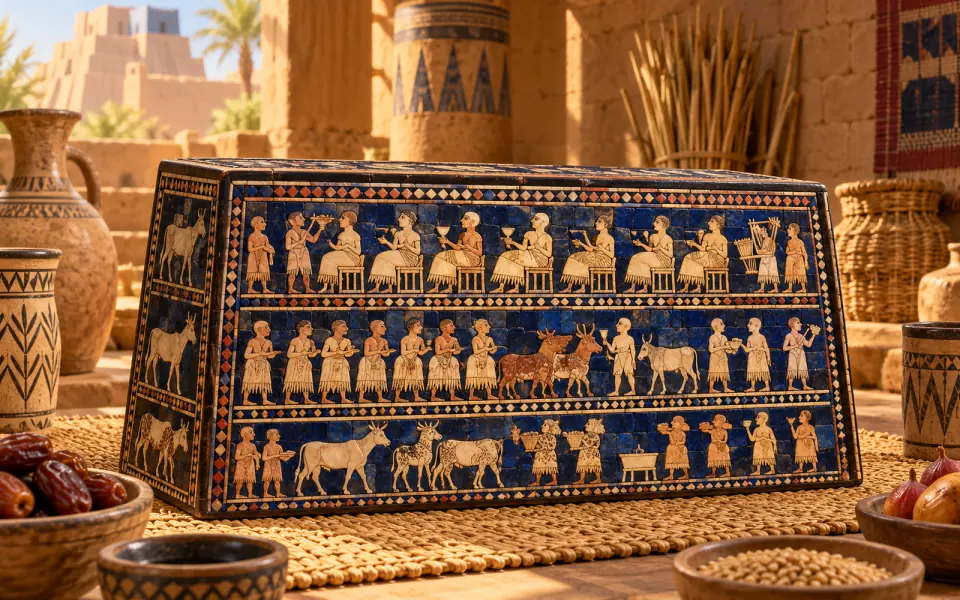
The Standard of Ur is a wooden box decorated with shell, red stone and blue lapis lazuli, found in a royal tomb at Ur. One side shows an army with chariots pulled by donkey-like animals; the other, a banquet with musicians and animals brought as gifts. The archaeologist Leonard Woolley discovered it in the 1920s and called it a ‘standard’, but nobody really knows what it was for. Today it is in the British Museum in London.
Why it matters Like a 4500-year-old comic strip, it shows war and peace in the lives of the Sumerians.
Study card about 6 minutes of reading
The story
A box found beside a skeleton
Between 1922 and 1934, in the south of Iraq, the English archaeologist Leonard Woolley dug the ruins of Ur, one of the oldest cities in the world, for twelve seasons. His work, funded jointly by the British Museum in London and the museum of the University of Pennsylvania, had an exceptional result: under the ground, in a cemetery a few steps from the ziggurat, he found more than 1,800 tombs, and sixteen of these were so rich that they were called “royal tombs”. They date from a period between about 2600 and 2400 BC.
In the tomb called PG 779, in the winter of 1927–1928, the diggers discovered a wooden box, almost completely rotted and crushed by the weight of the earth, near the shoulder of a buried man. The wood had vanished, but the decoration had survived, held together by bitumen, a kind of natural tar. With patience the restorers put the pieces back in place. The result is one of the most famous objects in all of Mesopotamia: the Standard of Ur, about 50 centimetres long and a little over 20 high.
A mosaic of stones and shells
The box has the shape of a trapezium, with two decorated long sides and two short triangular ends. The decoration is made with the technique of mosaic, or rather inlay: many small pieces of mother-of-pearl (shell), red stone and lapis lazuli are glued with bitumen to make up the figures. Lapis lazuli is a deep blue stone that was mined in only one place, in the mountains of Badakhshan, in Afghanistan, over two thousand kilometres from Ur. Already in the 3rd millennium BC, then, materials that had come from an immense distance ended up in a tomb in a Sumerian city.
The two long sides are divided into three bands, and are read from bottom to top, like the strips of a comic. Woolley called one side “war” and the other “peace”.
The war side
In the lowest band run four-wheeled chariots with solid wheels, pulled by four animals like donkeys (scholars think they were onagers, wild asses). They trample the fallen enemies. In the middle band, soldiers in long cloaks and helmets march and capture prisoners, who are brought before the king. In the top band, the naked, bound prisoners are led to the ruler, who can be recognised because he is taller than everyone and his head touches the edge of the decoration. The king has his chariot and his officers beside him. The message is simple and clear: the king and his army have won.
The peace side
On the other side we see a banquet. At the top, the king and people of rank sit on stools and drink; a musician plays the lyre and perhaps beside him there is a singer. In the two bands below, men in a line carry animals, fish, sacks and objects: goats, oxen, an onager. They look like gifts or tribute for the banquet, perhaps the produce of fields, flocks and distant lands. This scene shows a rich, orderly society, with a king who guarantees food and music.
What was it for?
Woolley thought it was a standard, that is, an emblem carried on top of a long pole during processions. That is why he named it so, but there is no proof. Other scholars have proposed that it was the sound box of a musical instrument, a little box for keeping something precious, or perhaps an object to put in the tomb for the dead person's banquet. None of these ideas is certain: the name “standard” has stuck out of habit. Nor do we know who the king shown was, or which battle is pictured. The box may not even tell of a specific event but of an ideal way of ruling.
What it teaches us
The Standard is one of the first images in the history of the Sumerians in which we can see how an army worked. There were foot soldiers and soldiers on heavy, slow chariots with solid wheels, pulled by donkeys or crosses between donkeys: horses came only much later. It shows how people dressed, how they celebrated a banquet, how kings showed their power. In a way it is a history book that needs no words.
Today the box is in the British Museum in London, and is one of the most celebrated pieces in the room dedicated to Mesopotamia.
Why it happened
The Standard of Ur was born in a world of rival city-states. Ur, Lagash, Umma and other cities fought wars over borders, over canal water and over control of trade. Kings needed armies, and images of war served to remember and justify their power.
Then there was wealth. Ur controlled trade towards the Persian Gulf and the routes of lapis lazuli, and its kings could afford highly skilled craftsmen and costly materials. In the royal tombs objects of gold, silver and rare stones were buried with them, because it was believed that the dead person would go on using them in the afterlife.
Finally, the burial of kings was a great public ritual. In the large funeral pits, together with the dead person, servants, soldiers and musicians were laid. The banquet pictured on the Standard perhaps reflects what really took place in royal ceremonies.
What changed
The discovery of the tombs of Ur changed what we thought about the Sumerians. Before Woolley, what was mainly known were the written tablets; the tombs showed instead that in 2500 BC in the south of Iraq there were very rich kings and highly refined craftsmen, with jewellery, harps, gold helmets and inlaid objects. It was material proof of the greatness of the Sumerian cities.
The Standard is now one of the main sources for studying the society of the time: war, transport, music, food, hierarchy. Art historians regard it as a masterpiece of storytelling through images, with the reading in bands that we will find for centuries in Mesopotamian and Egyptian reliefs.
For visitors to the British Museum it is one of the first objects that make them realise how sophisticated Mesopotamia was. And for scholars it is a warning: even a name like “standard”, given by an archaeologist a century ago, can last through time without ever having been proved.
Key people and places
People
- Leonard Woolley
- British archaeologist (1880–1960) who directed the excavations at Ur from 1922 to 1934, discovered the royal tombs and the Standard, and was one of the first to use scientific methods in Mesopotamia.
- Puabi
- A woman of very high rank (perhaps a queen or a priestess) whose tomb at Ur contained a gold headdress and necklaces of precious stones. Her name is carved on a seal.
- The musicians of Ur
- Harps and decorated lyres have been found in the tombs, like the famous “Bull Lyre”, showing how important music was in ceremonies.
Places
- Ur (southern Iraq)
- An ancient Sumerian city on the Euphrates. Here are the royal tombs, the ziggurat and the remains of ancient neighbourhoods.
- Badakhshan (Afghanistan)
- A mountain region from which came the blue lapis lazuli used for the decorations, over two thousand kilometres from Ur.
- British Museum (London)
- The museum that keeps the Standard of Ur together with other treasures from the royal tombs.
Good to know
- The Standard is about 50 centimetres long and about 20 high: an object you could carry under your arm.
- The blue lapis lazuli that decorates the Standard came from Afghanistan, more than 2,000 kilometres from Ur.
- Nobody knows what it was for: the name “standard” is only Woolley's guess, and other scholars think of a sound box for a musical instrument.
- On the war side the king is drawn taller than the others, so that his head touches the edge: it was a way of showing who is important.
- The royal tombs of Ur are roughly contemporary with the Great Pyramid of Egypt.
Find out more
- Wikipedia, “Standard of Ur” en.wikipedia.org
- Wikipedia, “Ur” en.wikipedia.org
- Wikipedia, “Leonard Woolley” en.wikipedia.org
- World History Encyclopedia, “Ur” worldhistory.org
- Penn Museum, Iraq: Ur penn.museum
Related events
- The first Sumerian citiesabout 4000 BC · River civilisationsUr was one of the first Sumerian cities.
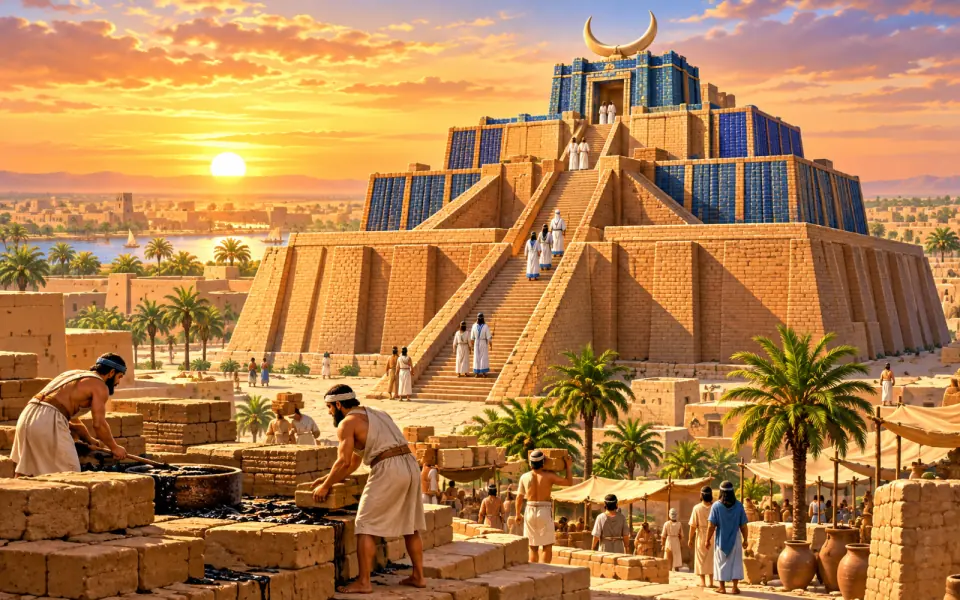
- The Ziggurat of Urabout 2100 BC · River civilisationsAt Ur stands the ziggurat of Ur-Nammu, not far from the royal cemetery.
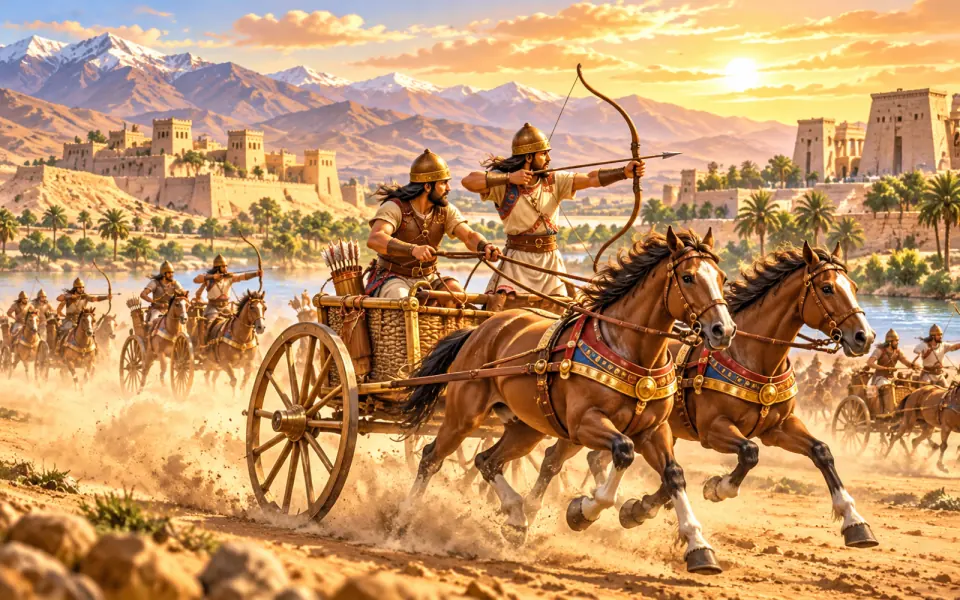
- War chariotsabout 1700 BC · River civilisationsThe chariots on the Standard come centuries before the light, spoked war chariots.
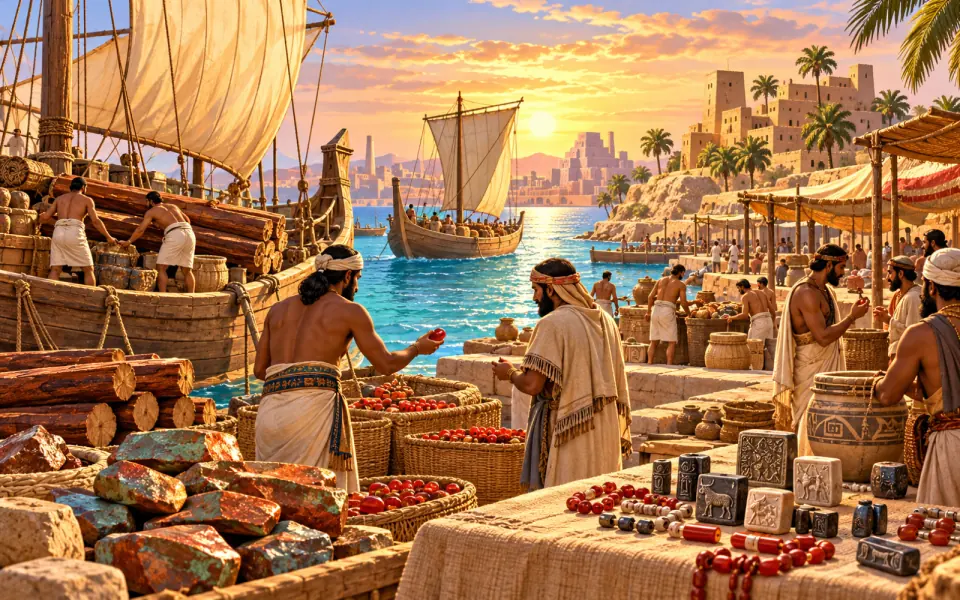
- Trade between the Indus and Mesopotamiaabout 2300 BC · River civilisationsThe lapis lazuli from Afghanistan is a sign of long-distance trade.
- Sargon and the Akkadian Empireabout 2334 BC · River civilisationsA few centuries later Ur was conquered by Sargon of Akkad.
Before and after, in the era “River civilisations”
Event 8 of 25
 BeforeThe first Sumerian citiesabout 4000 BC
 BeforeCuneiform writingabout 3200 BC
 BeforeEgyptian hieroglyphsabout 3200 BC
 BeforeThe unification of Egyptabout 3100 BC
 BeforeUruk, the great cityabout 3000 BC
 BeforeThe Egyptian calendarabout 2800 BC
 BeforeThe Step Pyramid of Djoserabout 2650 BC
- You are hereThe Standard of Urabout 2600 BC
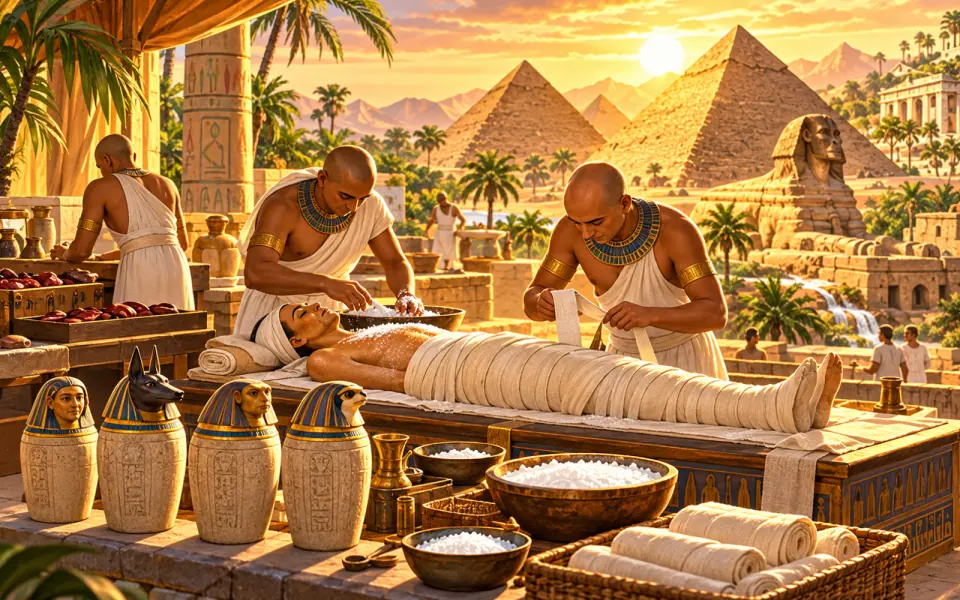 AfterEgyptian mummificationabout 2600 BC
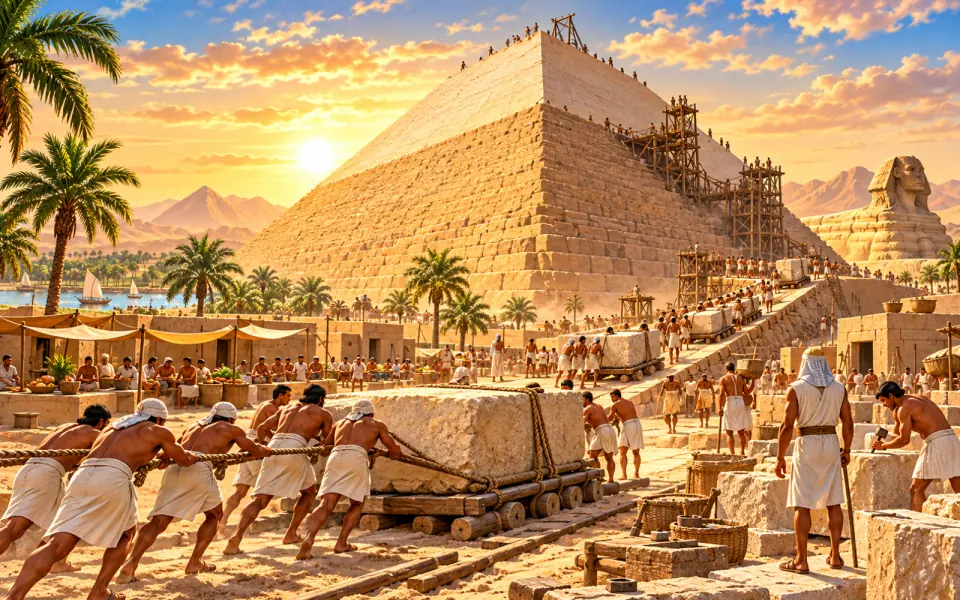 AfterThe Great Pyramid of Gizaabout 2560 BC
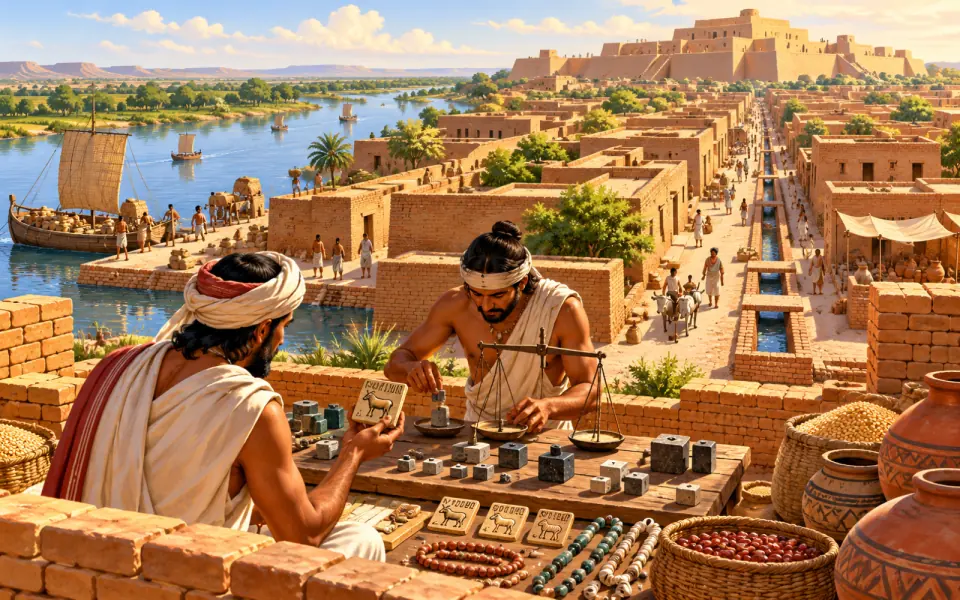 AfterThe cities of the Indus Valleyabout 2500 BC
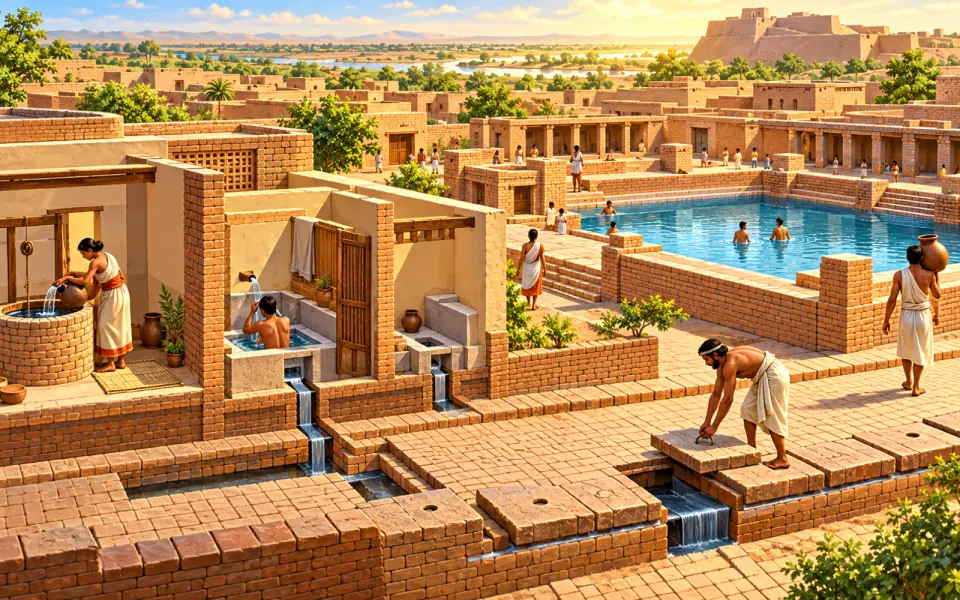 AfterThe drains and baths of Mohenjo-daroabout 2450 BC
 AfterSargon and the Akkadian Empireabout 2334 BC
 AfterTrade between the Indus and Mesopotamiaabout 2300 BC
 AfterThe Epic of Gilgameshabout 2100 BC
 AfterThe Ziggurat of Urabout 2100 BC
 AfterBabylonian mathematicsabout 1800 BC
 AfterThe Code of Hammurabiabout 1754 BC
 AfterWar chariotsabout 1700 BC
 AfterThe Shang dynastyabout 1600–1046 BC
 AfterHatshepsut, the woman pharaohabout 1479–1458 BC
 AfterThe reign of Akhenatenabout 1353–1336 BC
 AfterThe reign of Ramesses IIabout 1279–1213 BC
 AfterWriting on oracle bonesabout 1250 BC
 AfterThe Bronze Age collapseabout 1200 BC
Listen / Read next
- Music to read by: Cinematic JourneyEpic film-style music, no lyrics, by Ciro Simone IrmiciSpotifyYouTube Music
Meanwhile, elsewhere in the world
Other events of the era “River civilisations”
- The first Sumerian cities
- Cuneiform writing
- Egyptian hieroglyphs
- The unification of Egypt
- Uruk, the great city
- The Egyptian calendar
- The Step Pyramid of Djoser
- Egyptian mummification
- The Great Pyramid of Giza
- The cities of the Indus Valley
- The drains and baths of Mohenjo-daro
- Sargon and the Akkadian Empire
- Trade between the Indus and Mesopotamia
- The Epic of Gilgamesh
- The Ziggurat of Ur
- Babylonian mathematics
- The Code of Hammurabi
- War chariots
- The Shang dynasty
- Hatshepsut, the woman pharaoh
- The reign of Akhenaten
- The reign of Ramesses II
- Writing on oracle bones
- The Bronze Age collapse
