The Ziggurat of Ur
about 2100 BC Ur, Mesopotamia (now Iraq)
In short
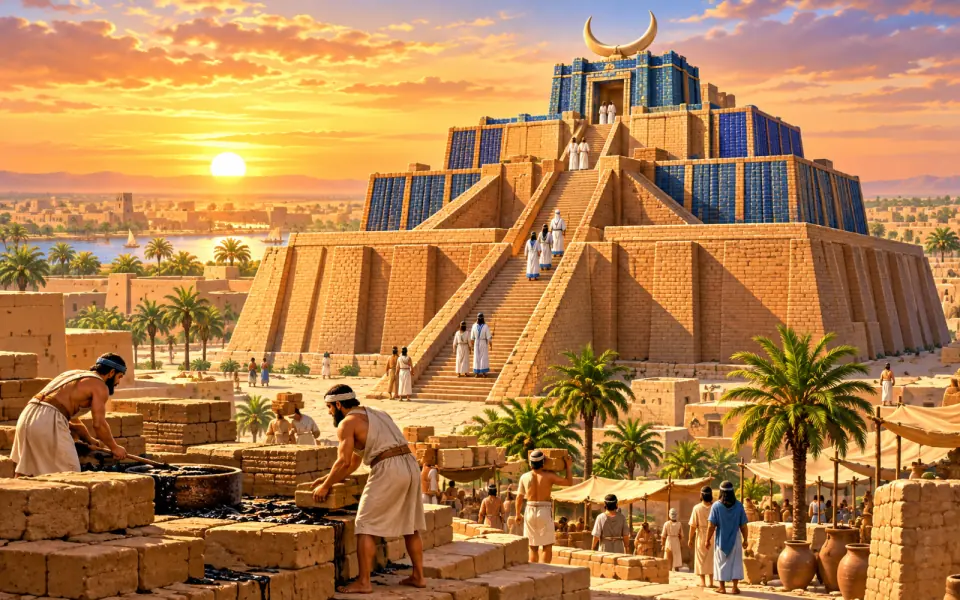
King Ur-Nammu had a ziggurat built at Ur, a man-made mountain with terraces dedicated to the moon god, Nanna. Its core was made of mud bricks, covered with a layer of baked bricks stuck together with bitumen to stand up to the rain. Great staircases led up to the small temple at the top, which only priests could enter. The base, restored in the 20th century, can still be seen in southern Iraq.
Why it matters Ziggurats were the most visible sign of the bond between a city and its gods.
Source: Encyclopaedia Britannica, “Ziggurat”
Study card about 6 minutes of reading
The story
A mountain of bricks on the plain
Anyone arriving at Ur, four thousand years ago, saw from afar something unlike anything else on the flat plain of Mesopotamia: a terraced tower, dark at the base and pale at the top, with three staircases that met halfway up and then climbed together to a small temple at the summit. This was the ziggurat of Ur, which King Ur-Nammu had begun (his son Shulgi completed it) and dedicated to the Moon god Nanna, lord of the city. Its Sumerian name, Etemennigur, is usually translated as “house whose foundation makes the earth tremble”.
The word “ziggurat” comes from the Akkadian ziqqurratu and means “peak, summit”: it was an artificial mountain. The Mesopotamian plain has no mountains, and it is thought that these buildings recalled the mountains where, according to tradition, the gods lived. The higher the temple, the closer the sky.
What it was like
Ur-Nammu reigned from about 2112 to 2095 BC and was the founder of the Third Dynasty of Ur, when the cities of the south were united again after the fall of the Akkadian Empire. He had temples built or rebuilt all over the country, and the ziggurat of Ur is the most important of his works. Its core was a block of mud brick, perhaps thirty metres high, with a rectangular base of about 64 by 45 metres. On the outside, to protect it from rain and sun, it was covered with a thick layer of fired bricks joined with bitumen. It is calculated that there were hundreds of thousands of fired bricks, and many carry the stamp with the king's name.
Holes were left in the wall to let out water that seeped in from the wall. Three staircases, each of a hundred steps, started from the base and met at a gateway halfway up, then climbed together to a high terrace. On top, a little shrine housed the god. Scholars think three levels followed one another, but they cannot say for certain what the top was like, because it has been lost.
A house for the god, not a church
Understanding what a ziggurat was for is not easy, because today we think of temples as places where the faithful gather. It was not so. The ziggurat was the god's house, not a place for everyone. Ordinary people were forbidden to climb it. Only priests could reach the top, to bring offerings, look after the statue and perform ceremonies. The faithful stopped at the base, in the courtyard, where there were storehouses, kitchens and workshops. The temple owned fields and flocks, gave work to hundreds of people and handed out rations. It was, at the same time, a religious place and a business.
The surprises of archaeology
The ziggurat of Ur was identified as early as 1853–1854 by an English consul, John Taylor, who found clay cylinders there with cuneiform writing. But it was Leonard Woolley, between 1922 and 1934, who dug it and worked out how it was built. In the courtyard next to it he found the remains of a building that seems to be a small museum: a collection of older objects with labels in three languages, from the time of the princess Ennigaldi-Nanna, daughter of the last Babylonian king, Nabonidus (6th century BC). If Woolley's interpretation is right, it is the oldest known museum. However, some scholars regard it as uncertain.
In the 1980s the Iraqi government rebuilt the lower part and the central staircase, so that today you can see in part what it was like. In 2021 Pope Francis held a meeting there with representatives of the religions, because according to the biblical tradition Ur is the city of Abraham (Ur of the Chaldees). This identification is traditional, not proven.
Ziggurats and the Tower of Babel
Ur was not the only one. More than twenty are known in Mesopotamia and Iran, among them the Etemenanki of Babylon, the tower that some scholars link to the biblical story of the Tower of Babel. The one at Ur, however, is the best preserved and the best known. After Ur-Nammu it was restored several times, until Nabonidus, in the 6th century BC; then the Euphrates changed course, the city lost its water and trade, and was abandoned.
Why it happened
The most immediate cause was religion. The people of Mesopotamia believed that each city belonged to a god and that humans had been created to serve him. For this reason the temple had to be tall, clearly visible and as beautiful as possible. The ziggurat was his house.
Then there was politics. After the fall of the Akkadian Empire, the country was divided, and Ur-Nammu wanted to show that he was the king chosen by the gods to reunite it. Building great temples in all the cities was a way of showing strength and winning the support of the priests. Ur-Nammu is also remembered for the oldest law code that has come down to us, written in Sumerian.
Finally there was the material. Mesopotamia lacked stone, but mud and bitumen (which surfaces in some areas) were plentiful. Mud bricks were cheap and easy to make, and fired ones bound with bitumen served to protect the core from rain. The environment pointed to the technical solution.
What changed
The ziggurat was the symbol of Mesopotamian cities for about two thousand years. The Assyrians and Babylonians went on building them, ever larger. The idea of a tall sacred building, with a staircase and a temple on top, has influenced collective memory and probably also the story of the Tower of Babel.
It has left traces in language and architecture: from the stepped towers of ancient Iran to the pyramids of Central America, often compared with ziggurats, although the two traditions have no direct link. In the twentieth century skyscraper architecture too borrowed the stepped form.
For archaeologists the ziggurat of Ur is an important source: the bricks with the king's name, the foundations and the tablets found in the surroundings have made it possible to date precisely a crucial period, that of the Third Dynasty of Ur, and to learn about the organisation of temples.
Key people and places
People
- Ur-Nammu
- King of Ur (about 2112–2095 BC), founder of the Third Dynasty. He built the ziggurat and promoted the oldest known law code.
- Nanna (Sin)
- Moon god of the Sumerians, protector of Ur. His temple on top of the ziggurat was his home on earth.
- Leonard Woolley
- British archaeologist who dug Ur from 1922 to 1934 and reconstructed the appearance of the ziggurat.
- Ennigaldi-Nanna
- Daughter of King Nabonidus and priestess at Ur in the 6th century BC; according to some scholars she looked after the oldest known museum.
Places
- Ur (southern Iraq)
- An ancient Sumerian city, now in the desert near Nasiriyah, with the ziggurat partly rebuilt.
- Babylon (Iraq)
- The city where the Etemenanki stood, the tallest ziggurat, associated with the Tower of Babel.
- Nippur (Iraq)
- A holy city with another great ziggurat dedicated to the god Enlil.
Good to know
- On many fired bricks of the ziggurat there is the stamp of King Ur-Nammu: like a “trademark” from 4,100 years ago.
- Ordinary people were forbidden to climb the ziggurat: the top was reserved for priests.
- The Sumerian name of the ziggurat, Etemennigur, is translated “house whose foundation makes the earth tremble”.
- According to Woolley, beside the ziggurat there was a small museum of ancient objects with labels in three languages; the idea is still debated.
- In 2021 Pope Francis visited the ruins of Ur, remembered by tradition as the city of Abraham.
Find out more
- Wikipedia, “Ziggurat of Ur” en.wikipedia.org
- Wikipedia, “Ur-Nammu” en.wikipedia.org
- Wikipedia, “Ziggurat” en.wikipedia.org
- World History Encyclopedia, “Ur” worldhistory.org
- Wikipedia, “Mesopotamia” en.wikipedia.org
Related events
- The Standard of Urabout 2600 BC · River civilisationsThe Standard of Ur comes from the tombs not far from the ziggurat.
- Uruk, the great cityabout 3000 BC · River civilisationsThe White Temple of Uruk is an ancestor of ziggurats.
- Sargon and the Akkadian Empireabout 2334 BC · River civilisationsThe collapse of Akkad opened the way to Ur-Nammu's Sumerian rebuilding.
- The Code of Hammurabiabout 1754 BC · River civilisationsThe code of Ur-Nammu comes three centuries before that of Hammurabi.
- The Step Pyramid of Djoserabout 2650 BC · River civilisationsThe step pyramid of Saqqara, in Egypt, is another artificial mountain made for a king.
Before and after, in the era “River civilisations”
Event 16 of 25
 BeforeThe first Sumerian citiesabout 4000 BC
 BeforeCuneiform writingabout 3200 BC
 BeforeEgyptian hieroglyphsabout 3200 BC
 BeforeThe unification of Egyptabout 3100 BC
 BeforeUruk, the great cityabout 3000 BC
 BeforeThe Egyptian calendarabout 2800 BC
 BeforeThe Step Pyramid of Djoserabout 2650 BC
 BeforeThe Standard of Urabout 2600 BC
 BeforeEgyptian mummificationabout 2600 BC
 BeforeThe Great Pyramid of Gizaabout 2560 BC
 BeforeThe cities of the Indus Valleyabout 2500 BC
 BeforeThe drains and baths of Mohenjo-daroabout 2450 BC
 BeforeSargon and the Akkadian Empireabout 2334 BC
 BeforeTrade between the Indus and Mesopotamiaabout 2300 BC
 BeforeThe Epic of Gilgameshabout 2100 BC
- You are hereThe Ziggurat of Urabout 2100 BC
 AfterBabylonian mathematicsabout 1800 BC
 AfterThe Code of Hammurabiabout 1754 BC
 AfterWar chariotsabout 1700 BC
 AfterThe Shang dynastyabout 1600–1046 BC
 AfterHatshepsut, the woman pharaohabout 1479–1458 BC
 AfterThe reign of Akhenatenabout 1353–1336 BC
 AfterThe reign of Ramesses IIabout 1279–1213 BC
 AfterWriting on oracle bonesabout 1250 BC
 AfterThe Bronze Age collapseabout 1200 BC
Listen / Read next
- Music to read by: Cinematic JourneyEpic film-style music, no lyrics, by Ciro Simone IrmiciSpotifyYouTube Music
Other events of the era “River civilisations”
- The first Sumerian cities
- Cuneiform writing
- Egyptian hieroglyphs
- The unification of Egypt
- Uruk, the great city
- The Egyptian calendar
- The Step Pyramid of Djoser
- The Standard of Ur
- Egyptian mummification
- The Great Pyramid of Giza
- The cities of the Indus Valley
- The drains and baths of Mohenjo-daro
- Sargon and the Akkadian Empire
- Trade between the Indus and Mesopotamia
- The Epic of Gilgamesh
- Babylonian mathematics
- The Code of Hammurabi
- War chariots
- The Shang dynasty
- Hatshepsut, the woman pharaoh
- The reign of Akhenaten
- The reign of Ramesses II
- Writing on oracle bones
- The Bronze Age collapse
