The cities of the Indus Valley
about 2500 BC Harappa and Mohenjo-daro (now Pakistan)
In short
Along the River Indus, across today's Pakistan and north-western India, a great civilisation flourished with cities such as Harappa and Mohenjo-daro. The streets were straight and crossed at right angles, and the houses were built with bricks all of the same size. The people used accurate stone weights for trade and small seals carved with animals and signs. Their writing has still not been deciphered.
Why it matters It was one of the largest civilisations of the ancient world, yet it is still full of mysteries.
Source: Encyclopaedia Britannica, “Indus civilization”
Study card about 6 minutes of reading
The story
Ancient bricks used for railway tracks
Around 1856, the English engineers who were building the railway between Lahore and Multan, in the Punjab, had a problem: they needed ballast for the tracks and the area had none. They then noticed that near the village of Harappa there were hills full of fired bricks, very ancient and well made. They took them and used them. It is calculated that kilometres of track bed were prepared with those bricks. They did not know they were destroying part of a city 4,500 years old, the capital of a civilisation the world had forgotten.
The real rediscovery began only in the 1920s. In 1921 Harappa was excavated, and in 1922 the archaeologist Rakhaldas Banerji began to dig another great ruin in Sindh, Mohenjo-daro, whose name in the local language means “the mound of the dead”. In 1924 John Marshall, director of the Archaeological Survey of India, announced to the world the discovery of “a forgotten civilisation”. Today we call it the Indus Valley Civilisation, or Harappan civilisation.
Bigger than Egypt and Mesopotamia
By the standards of the time it was immense. At its peak, between about 2600 and 1900 BC (the phase called “mature”), it covered an area of more than a million square kilometres: the Indus valley, in Pakistan, but also Gujarat and Rajasthan in India and parts of Afghanistan. More than a thousand sites have been identified, almost all small villages. The main cities were few: Mohenjo-daro, Harappa, Dholavira, Rakhigarhi and Ganweriwala. Scholars estimate that the civilisation numbered between one and five million inhabitants, but the figures are very uncertain.
Its origins are older: at Mehrgarh, in the hills of Balochistan, farming villages already existed from 7000 BC, growing barley and wheat and raising cattle. In the following millennia the villages grew along the rivers, and around 2600 BC the cities were born.
Cities planned on paper
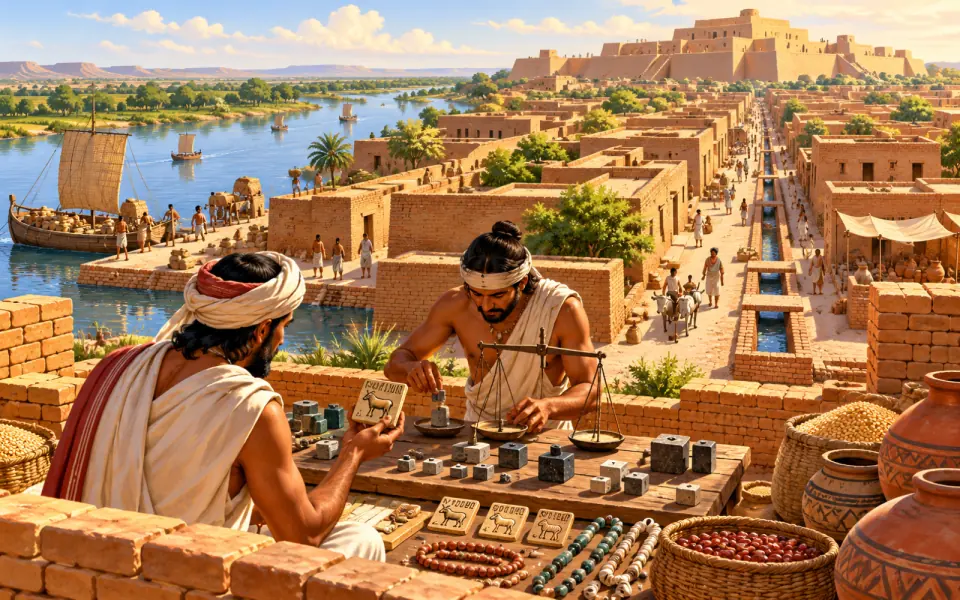
The most surprising feature is order. The main streets ran straight from north to south and from east to west and crossed at right angles, like a chessboard. Houses were built with fired bricks (at Mohenjo-daro) or mud bricks (elsewhere) of always the same proportions: the length was double the width and four times the height. This 4:2:1 ratio is found in all the cities, even hundreds of kilometres apart. It seemed that someone had decided the measure for everyone.
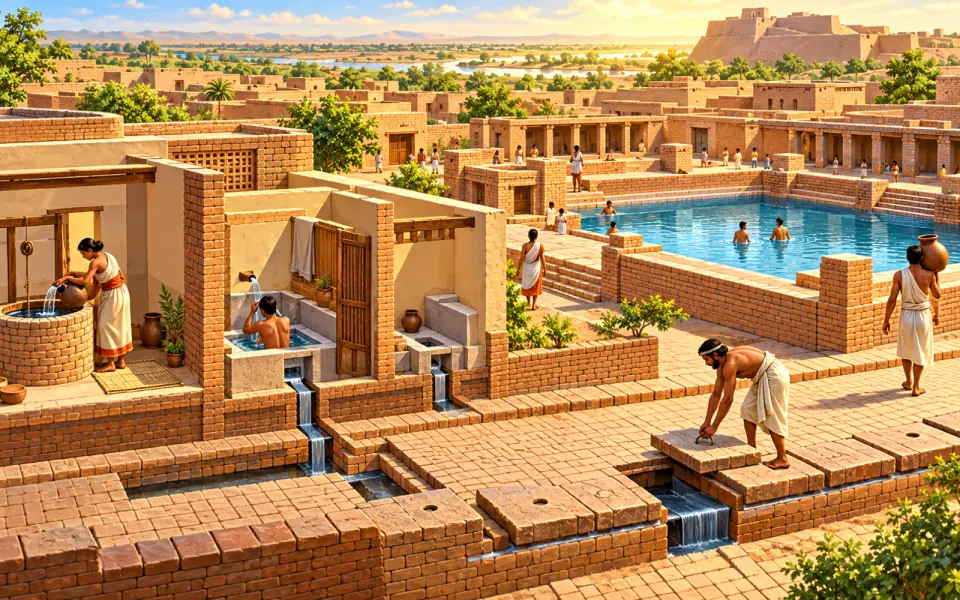
Weights were standard too: small stone cubes, each double the one before (1, 2, 4, 8, 16, 32, 64...), used for trade. The cities had a high district, the citadel, built on a platform, with public buildings and cisterns, and a lower district with the dwellings. Almost all houses had wells and bathrooms, connected to drains (we will talk about them in another card).
Trade, crafts and seals
The people of the Indus made beautiful cotton, carnelian beads worked with great skill, painted pottery, terracotta figurines and jewellery. They traded with their neighbours and with Mesopotamia (see the card on trade). They used small square stone seals with carved animals, such as bulls, tigers, elephants, rhinoceroses and a one-horned creature, often called the “unicorn”, with a line of small signs above. The most famous object from Mohenjo-daro is a bronze statuette 10 centimetres tall, the “Dancing Girl”: a young woman with her arm covered in bangles, in a pose full of life.
A script nobody can read
The signs on the seals, about four hundred different ones, form short inscriptions, usually of five or six signs; the longest has twenty-six, spread over several faces of one object. Nobody has managed to read them. There is no bilingual inscription, like the Rosetta Stone, and the texts are too short. Some scholars even doubt that it is true writing. That is why, of the people of the Indus, we know neither their language, nor the names of their kings, nor their stories. It is like listening to music without words.
Without kings and without wars?
Another riddle: unlike Egypt and Mesopotamia, here no great royal palaces have been found, nor kings' tombs, nor clearly recognisable temples, nor many weapons. Some think of less unequal societies; others remind us that perhaps we have not yet understood how to read the remains. We do not know.
The end
Around 1900 BC the cities were slowly abandoned. An old theory spoke of an invasion of warriors on horseback, but today hardly anyone believes it: the remains found at Mohenjo-daro are not the victims of a massacre. Scholars think rather of a change in climate, with weaker monsoons, and of rivers changing course or drying up. With less water and fewer harvests, people moved east and south, into smaller villages.
Why it happened
The cities of the Indus were born thanks to the rivers. The Indus and its tributaries, fed by Himalayan snow and by the monsoons, bring water and fertile silt to the plains. Those who farmed there could get plentiful harvests of barley, wheat and, perhaps first in the world, cotton.
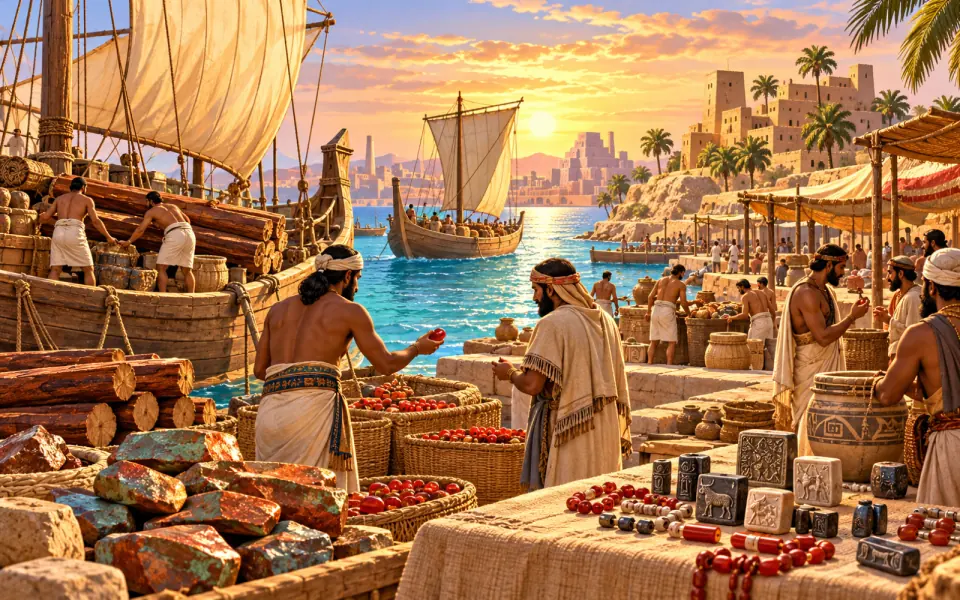
Trade was important. The valley lies between the mountains of Afghanistan and Iran, rich in metals and precious stones, and the Arabian Sea, with its ports. Those who controlled the passes could grow rich by selling cotton, beads and pottery in exchange for copper, silver and lapis lazuli.
Finally the tradition of the older villages counted. At Mehrgarh and other places, for thousands of years, communities had learned to farm, to build with bricks and to make pottery. The cities of 2600 BC are the fruit of that long preparation.
What changed
The Indus civilisation left a heritage of practical ideas: town planning, standard measures, attention to water and hygiene. Many habits, such as the use of certain motifs on pots or the care for ritual bathing, may have been passed on to the later cultures of India, although historians debate how far.
Its discovery, in the 1920s, pushed the ancient history of India back by more than two thousand years and showed that the subcontinent had its cities even before the great later kingdoms. It has also given a new sense to the cultural identity of Pakistan and India, which today preserve and study the sites.
The mystery of the script continues to stimulate scholars, who try to decipher it with computers and artificial intelligence. Meanwhile the sites are in danger: salt, floods and heat damage the bricks, and in 1980 Mohenjo-daro was declared a World Heritage Site precisely to protect it.
Key people and places
People
- Rakhaldas Banerji
- Indian archaeologist (1885–1930) who in 1922 began the excavations of Mohenjo-daro and recognised the antiquity of the site.
- John Marshall
- British archaeologist (1876–1958), director of the Archaeological Survey of India, who in 1924 announced to the world the discovery of the Indus civilisation.
- Mortimer Wheeler
- British archaeologist (1890–1976) who between 1946 and 1950 excavated Harappa and Mohenjo-daro with very precise methods; he supported the hypothesis, now abandoned, of an invasion.
Places
- Harappa (Punjab, Pakistan)
- The city that gives the civilisation its name. Its ruins were used for decades as a brick quarry for the railway.
- Mohenjo-daro (Sindh, Pakistan)
- The largest city of the Indus, with straight streets, drains and the Great Bath.
- Dholavira (Gujarat, India)
- A city with large water reservoirs and a gate with an inscription of ten large signs, among the longest texts of the Indus script.
Good to know
- The railway engineers used the bricks of Harappa for the tracks: in effect a city 4,500 years old was turned into gravel.
- The bricks of the Indus cities always had the same proportions, 4:2:1, even hundreds of kilometres apart.
- On the seals there often appears an animal with a single horn, called the “unicorn”, that nobody can identify with certainty.
- The name Mohenjo-daro means “mound of the dead” in Sindhi: it is the modern name, and we do not know what the city was called.
- The Indus script, with about 400 signs, is still undeciphered after a century of attempts.
Find out more
- Wikipedia, “Indus Valley Civilisation” en.wikipedia.org
- World History Encyclopedia, “Indus Valley Civilization” worldhistory.org
- Wikipedia, “Mohenjo-daro” en.wikipedia.org
- Wikipedia, “Dholavira” en.wikipedia.org
Related events
- The drains and baths of Mohenjo-daroabout 2450 BC · River civilisationsThe drains and baths of Mohenjo-daro are one of the boasts of these cities.
- Trade between the Indus and Mesopotamiaabout 2300 BC · River civilisationsTrade between the Indus and Mesopotamia linked the two civilisations.
- The Neolithic Revolutionabout 12,000 years ago · PrehistoryThe farming born in the Neolithic is the foundation of the Indus civilisation.
- The first Sumerian citiesabout 4000 BC · River civilisationsThe first Sumerian cities were born more than a thousand years earlier.
- The Shang dynastyabout 1600–1046 BC · River civilisationsIn the same period, in China, the Shang dynasty was taking shape.
Before and after, in the era “River civilisations”
Event 11 of 25
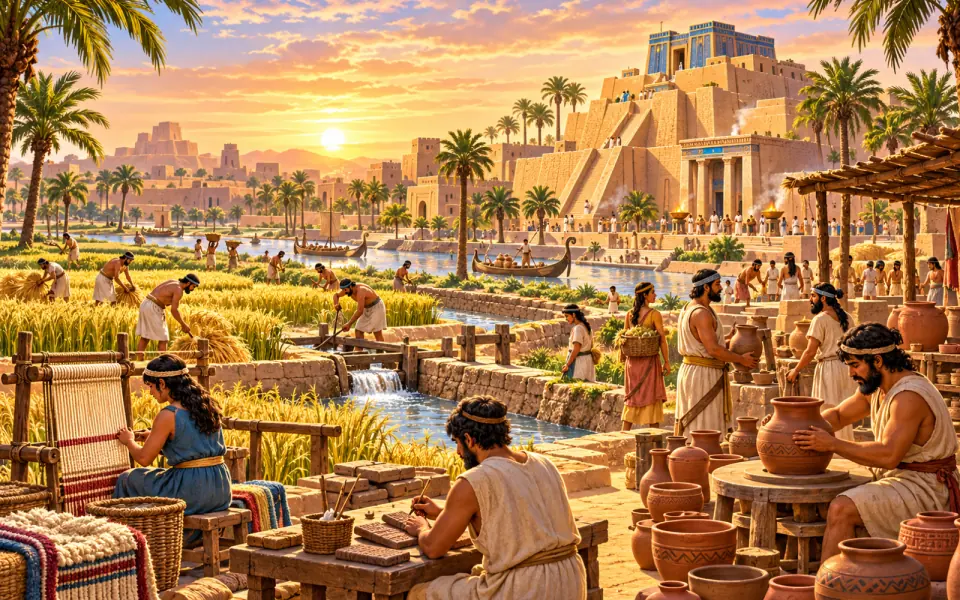 BeforeThe first Sumerian citiesabout 4000 BC
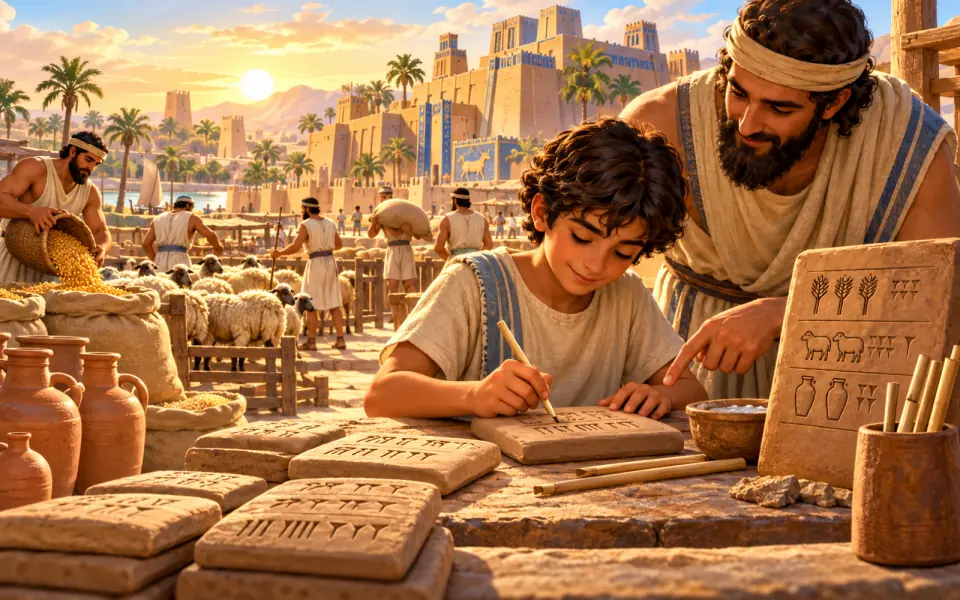 BeforeCuneiform writingabout 3200 BC
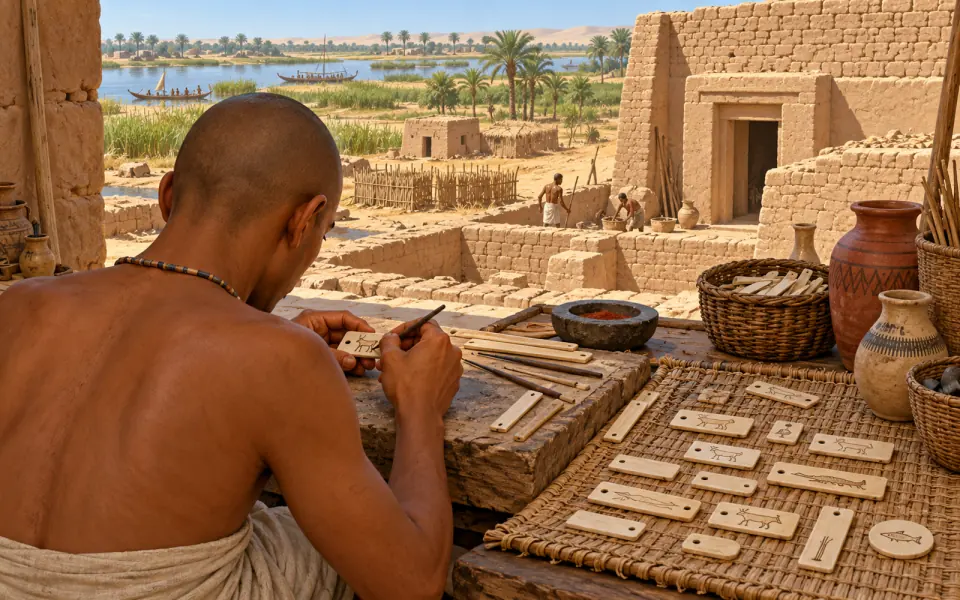 BeforeEgyptian hieroglyphsabout 3200 BC
 BeforeThe unification of Egyptabout 3100 BC
 BeforeUruk, the great cityabout 3000 BC
 BeforeThe Egyptian calendarabout 2800 BC
 BeforeThe Step Pyramid of Djoserabout 2650 BC
 BeforeThe Standard of Urabout 2600 BC
 BeforeEgyptian mummificationabout 2600 BC
 BeforeThe Great Pyramid of Gizaabout 2560 BC
- You are hereThe cities of the Indus Valleyabout 2500 BC
 AfterThe drains and baths of Mohenjo-daroabout 2450 BC
 AfterSargon and the Akkadian Empireabout 2334 BC
 AfterTrade between the Indus and Mesopotamiaabout 2300 BC
 AfterThe Epic of Gilgameshabout 2100 BC
 AfterThe Ziggurat of Urabout 2100 BC
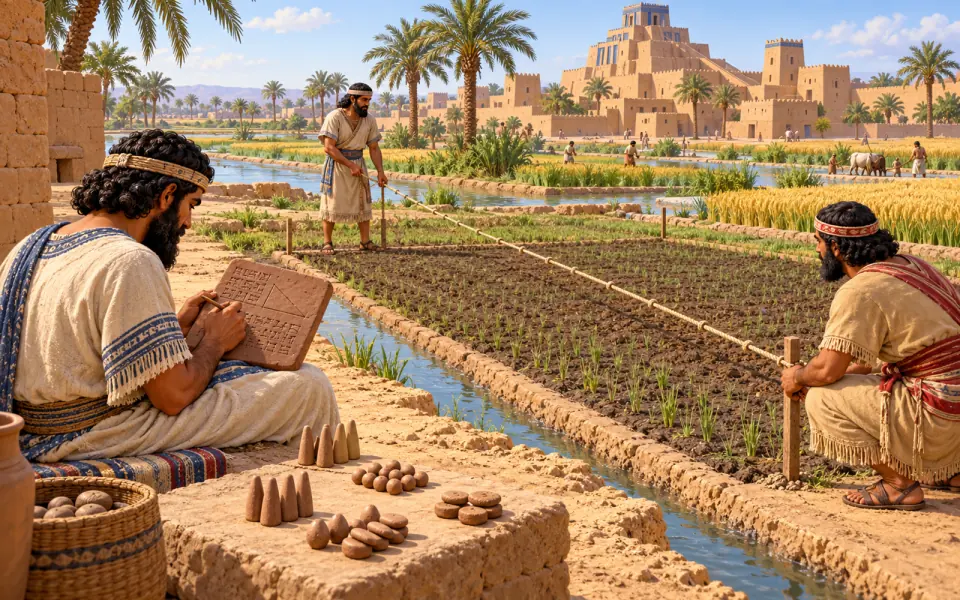 AfterBabylonian mathematicsabout 1800 BC
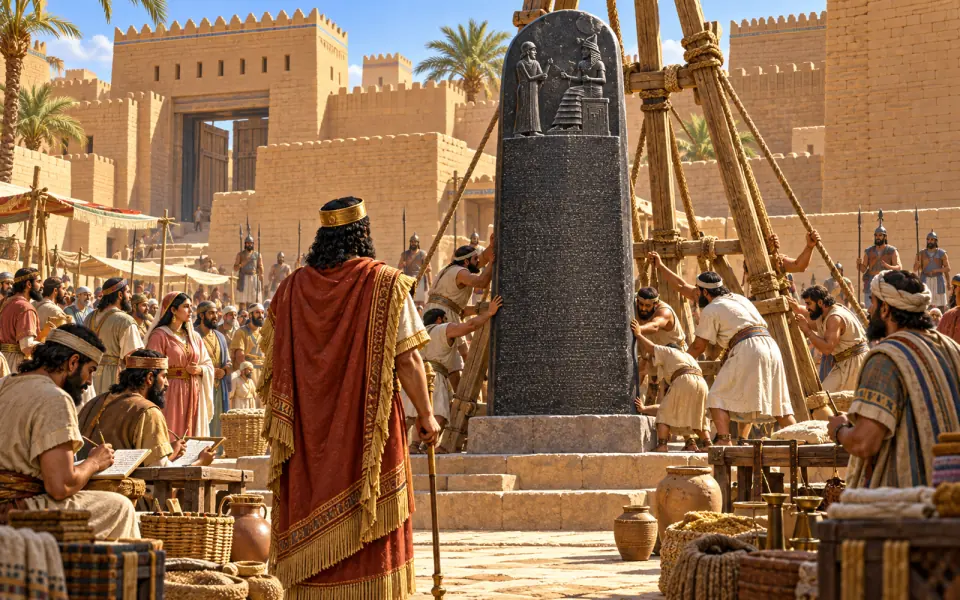 AfterThe Code of Hammurabiabout 1754 BC
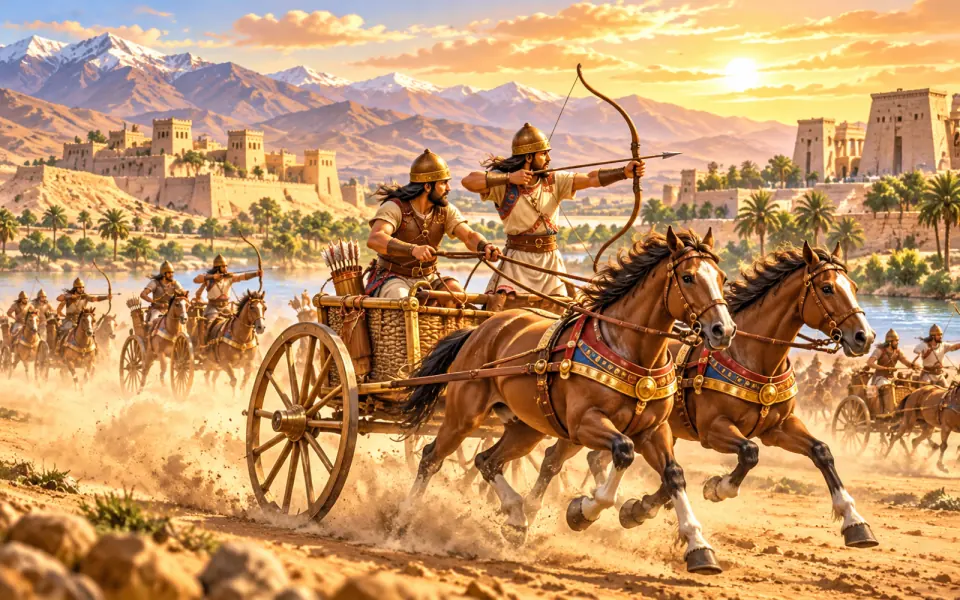 AfterWar chariotsabout 1700 BC
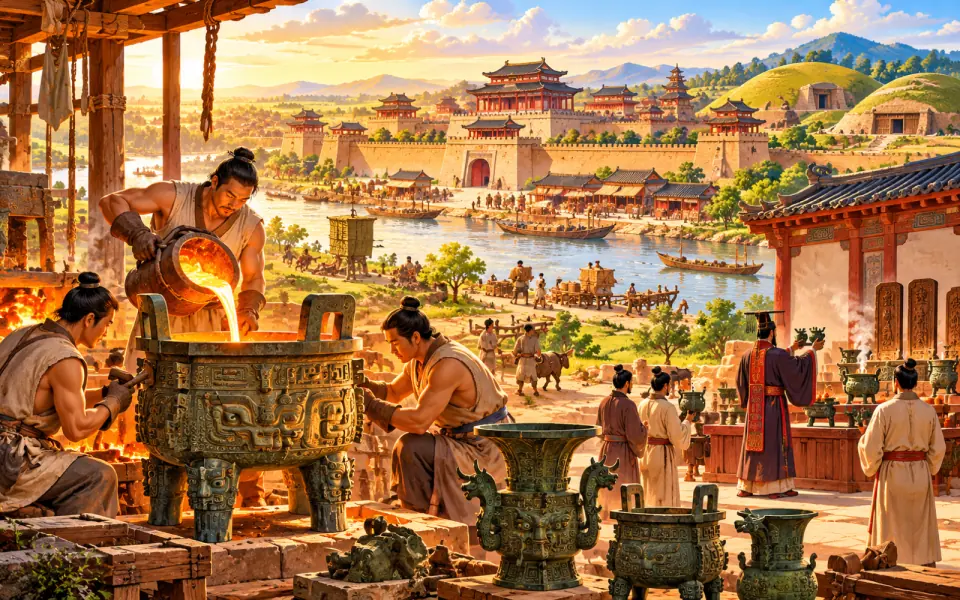 AfterThe Shang dynastyabout 1600–1046 BC
 AfterHatshepsut, the woman pharaohabout 1479–1458 BC
 AfterThe reign of Akhenatenabout 1353–1336 BC
 AfterThe reign of Ramesses IIabout 1279–1213 BC
 AfterWriting on oracle bonesabout 1250 BC
 AfterThe Bronze Age collapseabout 1200 BC
Listen / Read next
- Music to read by: Cinematic JourneyEpic film-style music, no lyrics, by Ciro Simone IrmiciSpotifyYouTube Music
Meanwhile, elsewhere in the world
Other events of the era “River civilisations”
- The first Sumerian cities
- Cuneiform writing
- Egyptian hieroglyphs
- The unification of Egypt
- Uruk, the great city
- The Egyptian calendar
- The Step Pyramid of Djoser
- The Standard of Ur
- Egyptian mummification
- The Great Pyramid of Giza
- The drains and baths of Mohenjo-daro
- Sargon and the Akkadian Empire
- Trade between the Indus and Mesopotamia
- The Epic of Gilgamesh
- The Ziggurat of Ur
- Babylonian mathematics
- The Code of Hammurabi
- War chariots
- The Shang dynasty
- Hatshepsut, the woman pharaoh
- The reign of Akhenaten
- The reign of Ramesses II
- Writing on oracle bones
- The Bronze Age collapse
