Babylonian mathematics
about 1800 BC Larsa, Mesopotamia (now Iraq)
In short
The Babylonians counted in base 60, and from them we have inherited the 60 minutes in an hour and the 360 degrees in a circle. They could solve difficult problems, such as working out the area of a field or the square root of a number. A famous tablet, called Plimpton 322, contains a table of numbers linked to right-angled triangles. It was written more than a thousand years before Pythagoras was born.
Why it matters Every time we look at a clock we are using a Babylonian idea without knowing it.
Source: INAF Media, “Il teorema di Pitagora al tempo dei Babilonesi” (in Italian)
Study card about 6 minutes of reading
The story
A tablet bought by a collector
At the start of the twentieth century an American publisher from New York, George Arthur Plimpton, collected ancient manuscripts. Around 1922 he bought from an antiquities dealer a clay tablet, broken at one corner, as big as the palm of a hand, written in cuneiform. He later gave it to Columbia University, where it is kept today under the label “Plimpton 322”. For years nobody paid it any attention. In 1945 two historians of mathematics, Otto Neugebauer and Abraham Sachs, studied it and realised that it contained a table of very particular numbers. Since then scholars have not stopped discussing it.
The tablet, written probably around 1800 BC and perhaps coming from Larsa, in the south of Iraq, has fifteen rows of numbers. According to Neugebauer and Sachs, these numbers are linked to right-angled triangles, that is, to triples of numbers like 3, 4, 5 or 5, 12, 13 for which the square of the longest side equals the sum of the squares of the other two. If so, the Babylonians knew that property more than a thousand years before Pythagoras. Other scholars, such as Eleanor Robson, maintain that the tablet is above all a list of numbers prepared by a teacher to build problems for pupils. The question remains open, but everyone agrees on one thing: behind those numbers lies a sophisticated mathematics.
Counting in base 60
The Babylonians did not count as we do. Our system is base ten: after nine, we move to ten. Theirs was base sixty, called sexagesimal. We do not know for certain why they chose it: perhaps because 60 divides exactly by many numbers (2, 3, 4, 5, 6, 10, 12, 15, 20, 30), and is very handy for dividing into equal parts. A curious hypothesis is that it comes from a way of counting on the fingers: with the thumb of one hand you touch the twelve finger-joints of the other four fingers, and with the other hand you keep count of the rounds.
Above all, the Babylonian system was “positional”: the value of a digit depends on the place it stands in, as in our 305, where the 3 is worth three hundred. This makes calculations with enormous or tiny numbers easy, and it was a fundamental invention. For a long time, however, there was no zero: where today we write 305, the scribes left an empty space, and only much later, around the 3rd century BC, did they invent a sign to mark the empty place.
What they could do
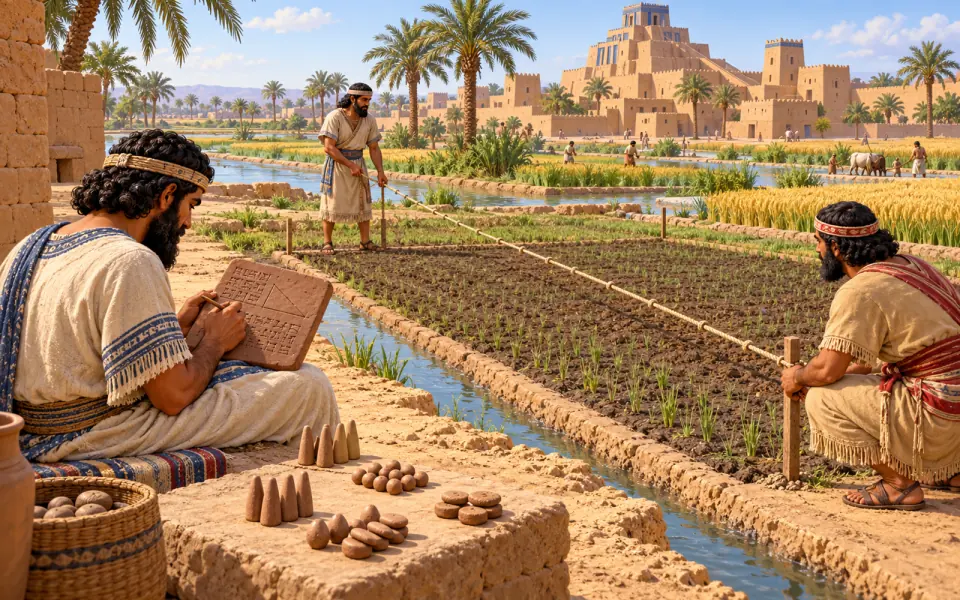
Babylonian scribes, trained in the schools of Nippur, Ur and Larsa, used ready-made tables: of multiplications, of reciprocals (the numbers to divide by), of squares and roots. With these tools they solved practical problems, such as calculating the area of a field, the volume of a heap of earth or a canal, the number of bricks for a wall, or how long it takes for a sum of money to double at a certain interest.
They could also solve quadratic equations, with methods that resemble those studied today. Another famous tablet, YBC 7289, kept at Yale University, shows a square with its diagonals and a number written in base 60 that gives the square root of 2 to an accuracy of six decimal places: 1.41421296. Whoever calculated this number, more than 3,600 years ago, had no calculator.
The sky, time and the clock
The Babylonians were also great observers of the sky. For centuries they noted down the movements of the Moon and planets, eclipses and the risings of the stars, and learned to predict them by calculation. Their numbers were taken up by Greek astronomers, in particular by Hipparchus in the 2nd century BC and Ptolemy in the 2nd century AD, who adopted the sexagesimal system for fractions. From here comes a legacy we use every day: the hour divided into 60 “minute parts”, that is, minutes, and the minute into another 60 “second” parts (in Latin partes minutae secundae). The 24-hour day, on the other hand, is of Egyptian origin, as we have seen.
The division of the circle into 360 degrees also comes from that tradition. Why 360? Perhaps because the year lasts about 360 days, perhaps because 360 is a multiple of 60 and has a great many divisors. Scholars are not sure of the reason. But the Greeks took it from the Babylonians, and from them it has reached us.
Doubts and caution
We must be careful not to exaggerate. The Babylonians did not write proofs like those of the Greeks: they said “do this and you get that”, with numerical examples, and did not explain why the method worked. Historians debate whether they really had a theory or only very good recipes. And the texts we have are few and damaged: our picture of Babylonian mathematics could change with new discoveries.
Why it happened
Babylonian mathematics was born from practical needs. Mesopotamian cities had harvests to record, fields to measure, canals to dig, temples to build, goods to sell and debts to calculate. Those who managed these affairs, the scribes, had to know how to do precise sums.
A second cause was school. Scribes trained for years in the “tablet houses”, where they learned the tables by heart and solved problems of increasing difficulty. In the schools the habit arose of inventing problems that were not practical too, for the pleasure of solving them, and from this a more abstract mathematics developed.
A third cause was astronomy. Priests watched the sky to foresee omens and to fix the calendar of festivals. For this they needed angular measures and long calculations, and the base-60 system was perfect for fractions.
What changed
The most visible legacy is that of time and angles: the 60 minutes of the hour, the 60 seconds of the minute, the 360 degrees of the circle. Every time we look at a clock or a compass we use, without knowing it, an idea from four thousand years ago.
The positional system, together with the calculation tables, was a model for later mathematicians: the Greeks knew it through the astronomers, the Indians developed our decimal system (see the card on Indo-Arabic numerals), and the Arabs passed it on to Europe. Without the first idea of giving a digit a value by its position, modern calculation would be much harder.
Finally, the discovery of Plimpton 322 and the other tablets has changed the history of mathematics: it was not born only in Greece, but has older roots, in Mesopotamia. Today's scholars try to read these tablets in a new way, with modern techniques such as three-dimensional digital images.
Key people and places
People
- George Arthur Plimpton
- American publisher and collector (1855–1936) who bought the tablet and then gave it to Columbia University.
- Otto Neugebauer
- Austrian-American mathematician and historian (1899–1990), the greatest scholar of Babylonian mathematics and astronomy. In 1945 he explained Plimpton 322 with Abraham Sachs.
- Eleanor Robson
- British historian of mathematics, who in 2001 proposed that Plimpton 322 was a school text for building problems.
- Hipparchus
- Greek astronomer of the 2nd century BC who helped to spread in Greece the division of the circle into 360 degrees, taken from the Babylonians.
Places
- Larsa (southern Iraq)
- A city in the south of Mesopotamia that was the capital of a kingdom rival to Babylon, the probable place of origin of Plimpton 322.
- Nippur (Iraq)
- A sacred city with one of the most important scribal schools, where thousands of exercises have been found.
- Columbia University (New York)
- The American university where the Plimpton 322 tablet is kept.
Good to know
- Plimpton 322 was bought around 1922 by a New York publisher, who gave it to a university: for decades nobody understood its value.
- The Babylonians calculated the square root of 2 to six decimal places, between about 1800 and 1600 BC.
- For a long time they had no zero: they left an empty space, and only around the 3rd century BC did they invent a sign for it.
- Some tablets contain problems about interest: for example, how long it takes for a sum of money to double.
- The division of the circle into 360 degrees and of the hour into 60 minutes is a legacy, passed through the Greeks, of Babylonian mathematics.
Find out more
- MacTutor History of Mathematics, “Pythagoras’s theorem in Babylonian mathematics” mathshistory.st-andrews.ac.uk
- Wikipedia, “Plimpton 322” en.wikipedia.org
- Wikipedia, “Babylonian mathematics” en.wikipedia.org
- Wikipedia, “Sexagesimal” en.wikipedia.org
Related events
- Cuneiform writingabout 3200 BC · River civilisationsBabylonian mathematics was born on cuneiform tablets.
- Pythagoras at Crotonabout 530 BC · Ancient GreecePythagoras, more than a thousand years later, proved the theorem that the Babylonians already used.
- Euclid writes the Elementsabout 300 BC · Ancient GreeceEuclid gave geometry the form of proofs, which the Babylonians did not have.
- Hindu-Arabic numerals head westabout AD 825 · Early Middle AgesIndo-Arabic numerals perfected the Babylonian idea of place value.
- Public mechanical clocksabout 1350 · Late Middle AgesMechanical clocks divide the hour into 60 minutes, as in the Babylonian system.
Before and after, in the era “River civilisations”
Event 17 of 25
 BeforeThe first Sumerian citiesabout 4000 BC
 BeforeCuneiform writingabout 3200 BC
 BeforeEgyptian hieroglyphsabout 3200 BC
 BeforeThe unification of Egyptabout 3100 BC
 BeforeUruk, the great cityabout 3000 BC
 BeforeThe Egyptian calendarabout 2800 BC
 BeforeThe Step Pyramid of Djoserabout 2650 BC
 BeforeThe Standard of Urabout 2600 BC
 BeforeEgyptian mummificationabout 2600 BC
 BeforeThe Great Pyramid of Gizaabout 2560 BC
 BeforeThe cities of the Indus Valleyabout 2500 BC
 BeforeThe drains and baths of Mohenjo-daroabout 2450 BC
 BeforeSargon and the Akkadian Empireabout 2334 BC
 BeforeTrade between the Indus and Mesopotamiaabout 2300 BC
 BeforeThe Epic of Gilgameshabout 2100 BC
 BeforeThe Ziggurat of Urabout 2100 BC
- You are hereBabylonian mathematicsabout 1800 BC
 AfterThe Code of Hammurabiabout 1754 BC
 AfterWar chariotsabout 1700 BC
 AfterThe Shang dynastyabout 1600–1046 BC
 AfterHatshepsut, the woman pharaohabout 1479–1458 BC
 AfterThe reign of Akhenatenabout 1353–1336 BC
 AfterThe reign of Ramesses IIabout 1279–1213 BC
 AfterWriting on oracle bonesabout 1250 BC
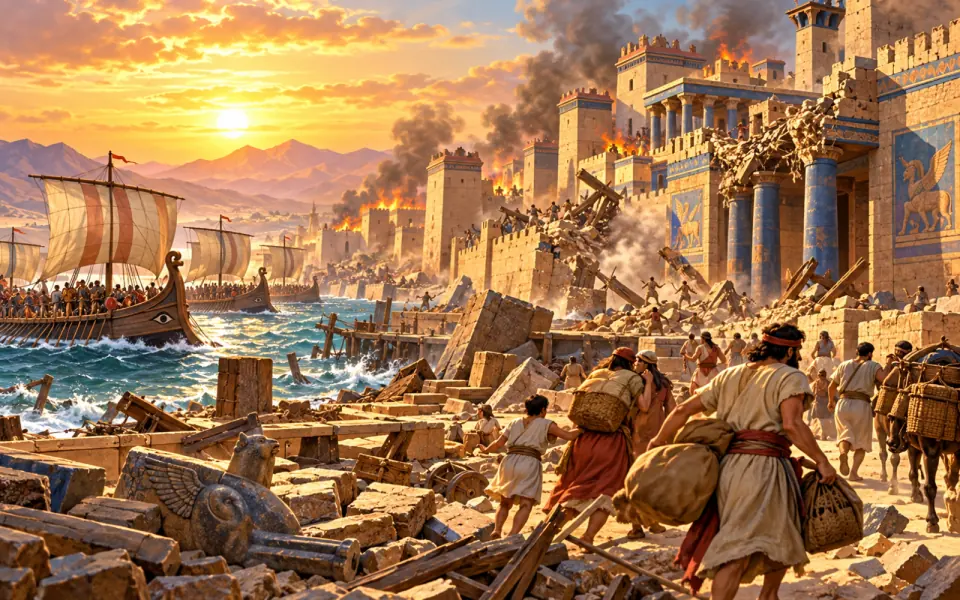 AfterThe Bronze Age collapseabout 1200 BC
Listen / Read next
- Music to read by: Cinematic JourneyEpic film-style music, no lyrics, by Ciro Simone IrmiciSpotifyYouTube Music
Meanwhile, elsewhere in the world
Other events of the era “River civilisations”
- The first Sumerian cities
- Cuneiform writing
- Egyptian hieroglyphs
- The unification of Egypt
- Uruk, the great city
- The Egyptian calendar
- The Step Pyramid of Djoser
- The Standard of Ur
- Egyptian mummification
- The Great Pyramid of Giza
- The cities of the Indus Valley
- The drains and baths of Mohenjo-daro
- Sargon and the Akkadian Empire
- Trade between the Indus and Mesopotamia
- The Epic of Gilgamesh
- The Ziggurat of Ur
- The Code of Hammurabi
- War chariots
- The Shang dynasty
- Hatshepsut, the woman pharaoh
- The reign of Akhenaten
- The reign of Ramesses II
- Writing on oracle bones
- The Bronze Age collapse
