The first fish with jaws
about 440 million years ago Silurian seas
In short
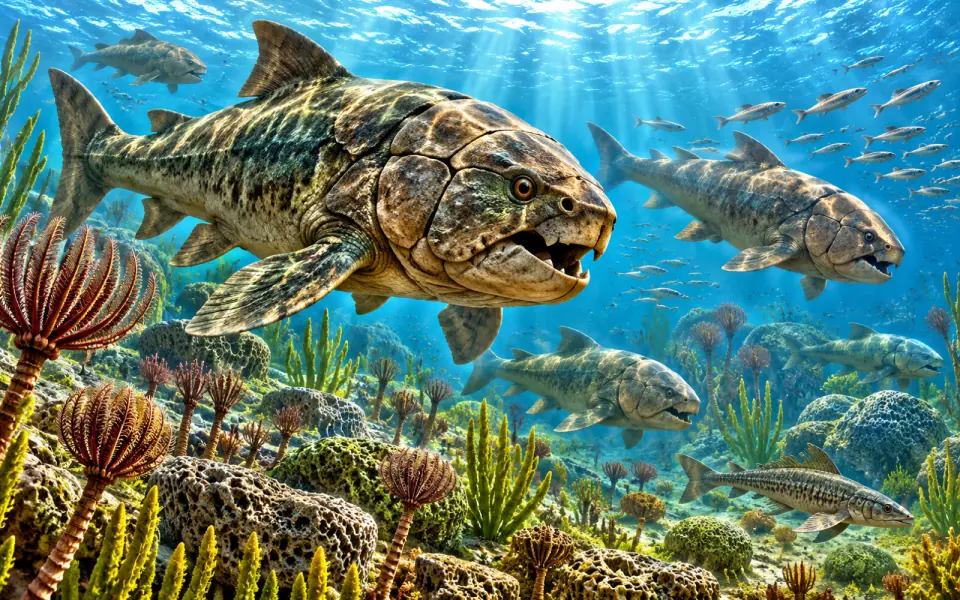
In the Silurian seas, fish spread with jaws that could open and close. Jaws probably developed from the arches that supported the gills. Biting and grabbing food opened up new possibilities compared with simply filtering water. In China, complete jawed fish about 436 million years old have been found.
Why it matters This new invention changed food chains in the sea and is found in almost all of today's vertebrates.
Source: Nature, 2022, “The oldest complete jawed vertebrates from the early Silurian of China”
Study card about 5 minutes of reading
The story
Fish without jaws
If you could go back to the seas of 450 million years ago, you would find fish very different from today's. Almost all the vertebrates of the time, that is, animals with a backbone, were fish without jaws. They had a round mouth, an opening that was always wide open, used to suck in water and filter food, or to suck at prey. They were often covered with bony plates, like small suits of armour. Their living descendants are few: lampreys and hagfish, narrow, long animals that have no jaws.
Then, in the Silurian, that is, between about 443 and 419 million years ago, something new appeared that would change the history of vertebrates: the jaw. A jaw is a movable bone of the mouth, hinged, which opens and shuts with force. With one, an animal can grab, bite, cut and crush. From then on fish were no longer simple filter-feeders, but could become great hunters.
The Chinese fossils
In recent years discoveries in China have pushed the date of the first fish with jaws further back. In 2022 a team of palaeontologists led by Min Zhu, of the Chinese Academy of Sciences, described fossils of fish with jaws found near the city of Chongqing, in rocks about 436 million years old. They are armoured fish, with bony plates on the body and head, called placoderms, and some were found complete, with the shape of the body preserved.
In the same year, another team, led by Plamen Andreev of Queen Mary University of London, described Qianodus duplicis, a fish of which only tiny teeth have been found, about 439 million years old, in China. The teeth are arranged in rows, as in sharks, and for this reason they are considered the oldest proof that fish with jaws existed. As always in palaeontology, new discoveries may move the date again: that is why the timeline speaks of about 440 million years ago.
How the jaw came about
Where does such an important bone come from? In this case, the answer lay hidden for a long time in the anatomy of living animals. Fish without jaws have bars of cartilage that support the gills, called gill arches. Scientists think that in fish with jaws the first arches grew bigger and moved forward, becoming the jaws. In other words, jaws are transformed gill arches, as if a piece of a tool had been reused for a new job. A process like this, in which a structure changes its function, is common in evolution.
One piece of evidence comes from the development of embryos: jaws and gill arches form in a similar way, from the same type of cells. Another comes from intermediate fossils, such as Entelognathus, a fish of about 419 million years ago discovered in China in 2013, which combines features of armoured fish and bony fish.
Hunting fish
After the Silurian, fish with jaws diversified quickly. The Devonian, the period that follows, is called the “age of fishes”. Sharks and their relatives appeared, with a skeleton of cartilage, along with bony fish and the great placoderms. The most famous is Dunkleosteus, which grew to about 3 to 4 metres long, and was one of the biggest predators of the seas of its time. It had no teeth, but sharp blades of bone on its jaws, with a very powerful bite.
Fish without jaws declined. They did not disappear completely, but most of them died out, crushed by competition and by the new predators.
Why it happened
Why did jaws appear? We do not know for certain, but there are hypotheses. One says that the enlarged gill arches also served to breathe better: to pump more water over the gills. Only later would those arches have turned out to be useful for grabbing food. Another explains the change by the need to feed on bigger, more active prey, in a world now full of animals with shells and armour.
Genes played an important part: those that tell cells where to form the face and the gills changed and made it possible to build a new structure. This is studied by comparing the DNA of lampreys and jawed fish.
Research goes on: the discovery of the teeth of Qianodus and of the fish of Chongqing has shown that the origin is older and more complex than people believed.
What changed
With jaws, vertebrates could eat anything: other animals, plants, prey with hard shells. This enormously widened the number of ways of living and opened the way to sharks, bony fish, amphibians, reptiles, birds and mammals. Almost all vertebrates today, more than 99 per cent of species, have jaws.
Jaws have a history that reaches all the way to us. The jaw bones of our distant reptile ancestors became smaller and moved: the three little bones of the mammal middle ear, the hammer, the anvil and the stirrup, come from bones of the jaw and the gill arches of animals of the past. When you hear a sound, you are using bones that for a distant ancestor were used for chewing.
Some of the things we do every day also come, in part, from jaws and gill arches: biting, chewing, speaking, singing. They are a good example of how evolution reuses parts that already exist.
Key people and places
People
- Min Zhu
- Chinese palaeontologist at the Chinese Academy of Sciences. He leads the study of the oldest jawed fish found in China.
- Plamen Andreev
- Palaeontologist at Queen Mary University of London. In 2022 he described Qianodus, the oldest teeth of a jawed fish.
- Carl Gegenbaur
- German anatomist (1826–1903). In the 19th century he proposed that jaws come from gill arches.
Places
- Chongqing, China
- A region of southern China where the jawed fish of about 436 million years ago have been found.
- Guizhou, China
- The Chinese province where the teeth of Qianodus, about 439 million years old, have been found.
- Silurian seas
- Warm, shallow seas, rich in corals and animals with shells, where the first fish with jaws began to hunt.
Good to know
- Lampreys, fish without jaws that are still alive, have a sucker mouth full of teeth and are among the oldest kinds of vertebrate alive today.
- Sharks have no bones: their skeleton is made of cartilage, the same substance you have in your nose and ears.
- The bite of Dunkleosteus has been estimated at between 4,000 and 7,000 newtons, an enormous force for a fish that lived about 380 million years ago.
- The hammer, anvil and stirrup, the three little bones of the ear, are the smallest bones in the human body and come from jaw bones of ancient animals.
- Today there are about 65,000 species of vertebrates: all of them, apart from about a hundred lampreys and hagfish, have jaws.
Find out more
- Natural History Museum, London, “Dunkleosteus” nhm.ac.uk
- Wikipedia, “Gnathostomata” en.wikipedia.org
- Wikipedia, “Placoderm” en.wikipedia.org
- University of California Museum of Paleontology (Berkeley), the Silurian (in English) ucmp.berkeley.edu
Related events
- The Cambrian explosionabout 539 million years ago · The Earth before usThe first vertebrates, fish-like, appeared in the seas of the Cambrian.
- The first amphibiansabout 375 million years ago · The Earth before usFrom fish with strong fins came four-legged animals.
- The first mammalsabout 225 million years ago · The Earth before usThe ear bones of mammals come from jaw bones.
- The great Permian extinctionabout 252 million years ago · The Earth before usThe great Permian extinction hit the fish of the seas hard.
Before and after, in the era “The Earth before us”
Event 17 of 25
 BeforeThe Big Bangabout 13.8 billion years ago
 BeforeThe first starsabout 13.5 billion years ago
 BeforeBirth of the Milky Wayabout 13 billion years ago
 BeforeFormation of the Solar Systemabout 4.6 billion years ago
 BeforeBirth of the Earthabout 4.5 billion years ago
 BeforeFormation of the Moonabout 4.5 billion years ago
 BeforeThe oldest pieces of Earthabout 4.4 billion years ago
 BeforeThe first oceansabout 4.3 billion years ago
 BeforeThe first life on Earthabout 3.5 billion years ago
 BeforeCyanobacteria and photosynthesisabout 2.7 billion years ago
 BeforeThe Great Oxidation Eventabout 2.4 billion years ago
 BeforeThe first complex cellsabout 1.8 billion years ago
 BeforeThe first many-celled living thingsabout 1 billion years ago
 BeforeThe Ediacaran creaturesabout 555 million years ago
 BeforeThe Cambrian explosionabout 539 million years ago
 BeforeThe first plants on landabout 475 million years ago
- You are hereThe first fish with jawsabout 440 million years ago
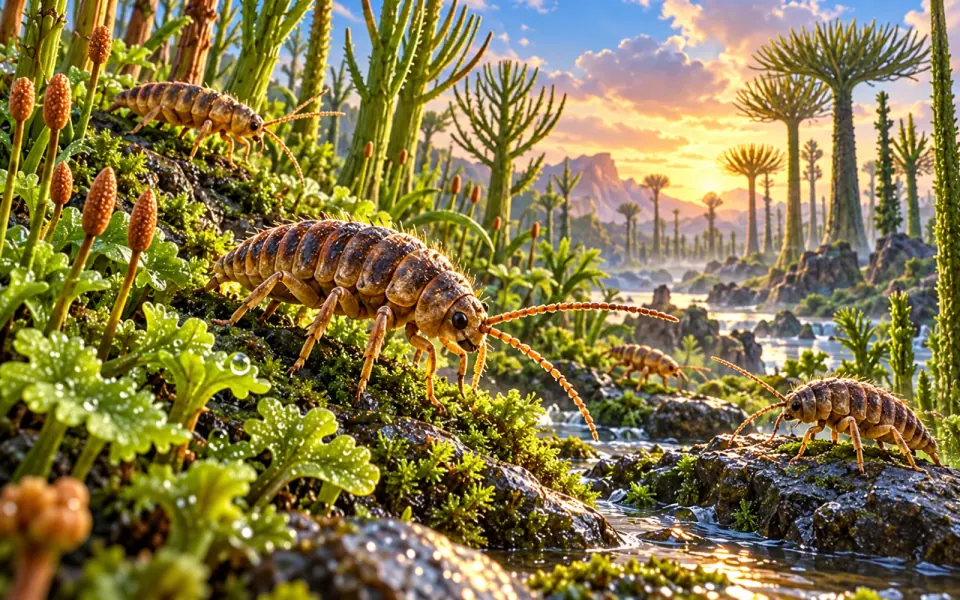 AfterThe first insectsabout 400 million years ago
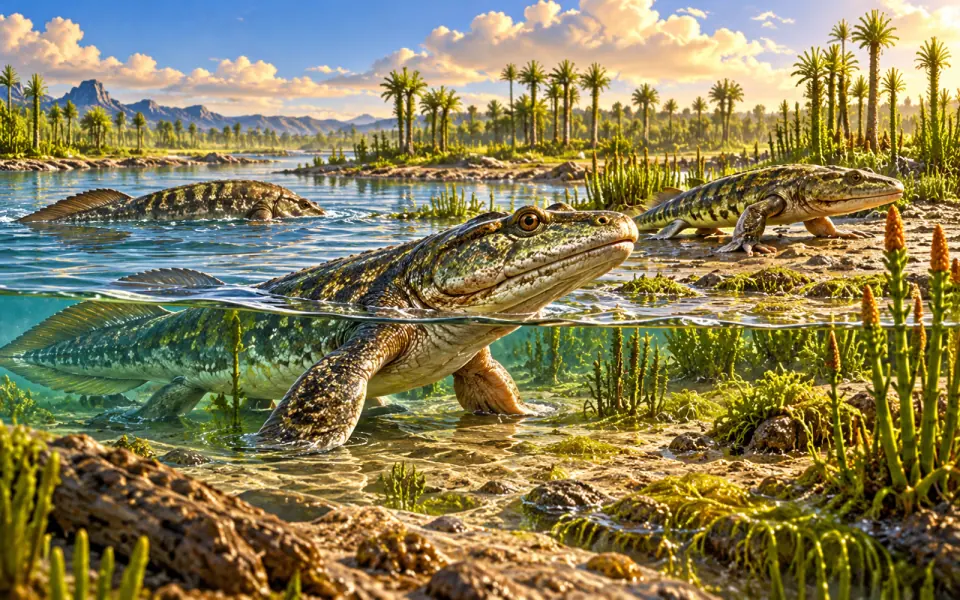 AfterThe first amphibiansabout 375 million years ago
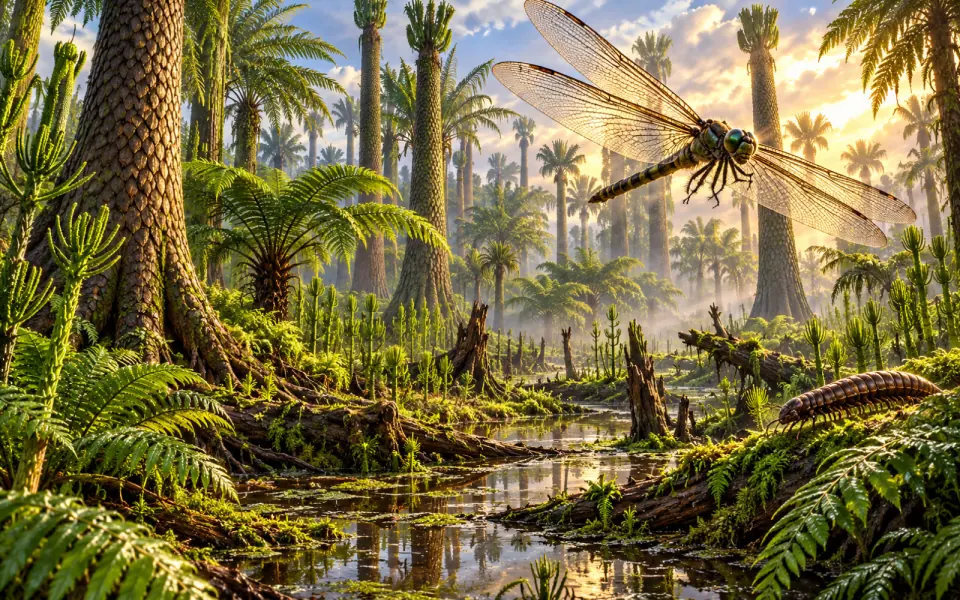 AfterCarboniferous forestsabout 320 million years ago
 AfterThe great Permian extinctionabout 252 million years ago
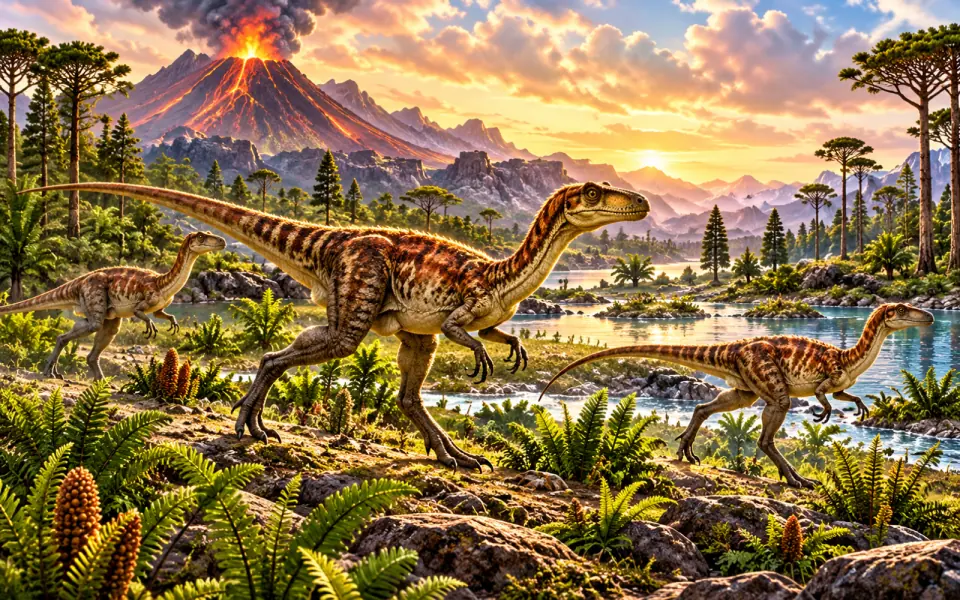 AfterThe first dinosaursabout 230 million years ago
 AfterThe first mammalsabout 225 million years ago
 AfterThe first birdsabout 150 million years ago
 AfterExtinction of the non-avian dinosaursabout 66 million years ago
Listen / Read next
- Music to read by: Cinematic JourneyEpic film-style music, no lyrics, by Ciro Simone IrmiciSpotifyYouTube Music
Meanwhile, elsewhere in the world
Other events of the era “The Earth before us”
- The Big Bang
- The first stars
- Birth of the Milky Way
- Formation of the Solar System
- Birth of the Earth
- Formation of the Moon
- The oldest pieces of Earth
- The first oceans
- The first life on Earth
- Cyanobacteria and photosynthesis
- The Great Oxidation Event
- The first complex cells
- The first many-celled living things
- The Ediacaran creatures
- The Cambrian explosion
- The first plants on land
- The first insects
- The first amphibians
- Carboniferous forests
- The great Permian extinction
- The first dinosaurs
- The first mammals
- The first birds
- Extinction of the non-avian dinosaurs
