The first plants on land
about 475 million years ago Coasts and wetlands
In short
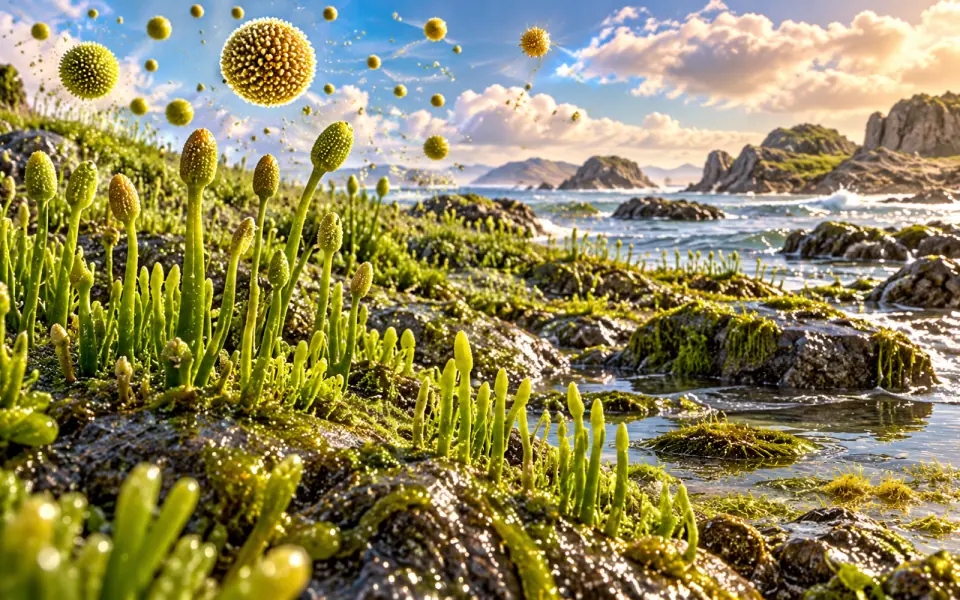
The first land plants were small and lived in damp places, without real roots. They came from green algae and had to learn to cope with drought and strong light. The oldest evidence is tiny spores about 475 million years old; in Oman, bits of these plants have also been found with the spores still inside. Over time they developed tissues to carry water and stand upright.
Why it matters Conquering dry land prepared soils and habitats for animals and for the forests to come.
Source: Nature, 2003, “Fragments of the earliest land plants”
Study card about 5 minutes of reading
The story
A land without green
Try to imagine a landscape with mountains, plains, rivers and deserts, but without a single blade of grass, a bush or a tree. Bare rock, mud, sand. That is what the continents were like for almost the whole history of the Earth. Life lived in the seas, in lakes and perhaps in thin films of microbes on the shores. Then, about 475 million years ago, something began to change: the first plants came out of the water.
The traces: microscopic spores
The oldest evidence for these plants is not leaves or trunks, but microscopic grains, spores. Spores are very tiny cells that plants without seeds use to reproduce, as mosses and ferns do today. They have a very tough outer wall, which survives in rocks for hundreds of millions of years. The oldest spores generally accepted as belonging to land plants are about 470 to 475 million years old and come from Ordovician rocks, in particular from the Middle East and Argentina. They have a regular shape and are found in groups of two or four.
In 2003, in Ordovician rocks in Oman, a group of palaeobotanists found not only scattered spores but also tiny fragments of plants with the spores still inside. For the researchers they are proof that those spores were really produced by land plants, perhaps like liverworts, small green plants without roots that grow today on damp stones. Exactly which plants they were and how they were built remains largely a mystery: no whole fossil of them has been found.
Where they came from
Scientists are almost certain that land plants descend from freshwater green algae, relatives of those that still grow in ponds today. By studying DNA, they have found that the closest living relatives of plants are certain groups of green algae, such as the Zygnematophyceae. To come out of the water, these algae had to face new problems: not drying out in the air, putting up with the Sun's strong light without the filter of water, staying upright without the support of water, and finding mineral salts in the soil.
The first land plants solved these problems one step at a time. They developed a waterproof film, the cuticle, so as not to lose water. They invented pores, the stomata, to exchange gases with the air. And they made a partnership with fungi: their primitive roots, or simple filaments, joined with soil fungi, which brought them water and mineral salts in exchange for sugars. This cooperation still exists today and involves most plants.
The first whole plants
Fossils of whole plants, with stems and capsules that held the spores, appear later. Cooksonia, found in Ireland, Wales and other places, lived in the Silurian, about 430 million years ago. It was only a few centimetres tall, made of thin stems that forked in two, each with a small capsule on top. It had neither leaves nor true roots.
An exceptional deposit is the one at Rhynie, in Scotland, discovered in 1912 by the geologist William Mackie. It is a siliceous rock, called chert, about 407 million years old, formed by hot springs that buried small ecosystems: the stems of plants, fungi, algae and insects are preserved in detail, down to the cells. For the first time it showed what a land ecosystem was like at its beginnings.
Then, in a few tens of millions of years, plants made great progress. In the Devonian there appeared tissues strengthened with lignin, a substance that makes wood rigid, vessels that carry water, the first true leaves and deep roots. Around 385 million years ago, in places such as Gilboa, in New York State, the first forests formed, with trees many metres tall, such as Wattieza, like a tree fern; a little later, in nearby places such as Cairo, came Archaeopteris, which had leaves like those of a fern but a trunk of real wood.
Why it happened
Why did plants leave the water? Probably the shores offered advantages: more light without the shade of water, carbon dioxide more available in the air, soils rich in minerals, and no competition or predators. Those who managed to cope with life in the air found an empty place.
The ancestors of plants were already in some way prepared: some freshwater algae lived in pools that sometimes dried up. They had genes useful for putting up with drought and for communicating with soil microbes. Scientists have found just these genes in green algae that are still alive today.
The move was not a single event. More probably it happened in waves, with many attempts, some successful and others not. The date of 475 million years is therefore that of the first accepted traces, and does not rule out that there are older ones.
What changed
When plants colonised dry land they changed the planet. Their roots broke up rocks and turned them into soil, which still supports fields and woods today. Plants held the soil in place, slowing erosion, and changed the course of rivers, which went from wide and unstable to narrower channels, held steady by roots.
They changed the air too. By taking carbon dioxide out of the atmosphere through photosynthesis, plants helped to cool the climate and, later, to raise the amount of oxygen. The forests that formed in the Devonian and the Carboniferous are the origin of the coal deposits we still burn today.
Above all, plants prepared the way for animals. They provided food and shelter for the first insects and the first four-legged animals, and they created ecosystems. Without plants dry land would never have hosted dinosaurs, mammals or human beings. We too live thanks to them: all our farming comes from plants that are, in a distant sense, descendants of those little liverworts.
Key people and places
People
- William Mackie
- Scottish doctor and geologist (1856–1932). In 1912 he discovered at Rhynie the rocks with the oldest land plants and animals preserved in detail.
- Charles Wellman
- English palaeobotanist at the University of Sheffield. He studies the oldest spores; in 2003 he described the Ordovician plant fragments found in Oman.
- Dianne Edwards
- Welsh palaeobotanist at Cardiff University. She has devoted her life to the study of Cooksonia and the first land plants.
Places
- Rhynie, Aberdeenshire (Scotland)
- A deposit 407 million years old, with a whole small land ecosystem preserved in chert.
- Gilboa, New York (United States)
- The place where the remains of one of the oldest forests, about 385 million years old, have been found.
- Oman
- The country where fragments of land plants with Ordovician spores have been discovered.
- Coasts and wetlands of the Ordovician
- The first environments near water where plants tried to live on dry land.
Good to know
- The word “cuticle” comes from the Latin cuticula, “little skin”: it is the waxy coating you can see, shiny, on the leaves of many plants today.
- Archaeopteris, one of the first true trees, had trunks up to 25 to 30 metres tall, and leaves like those of a fern.
- More than 80 per cent of today's land plants live in partnership with fungi in their roots: it is an invention more than 400 million years old.
- Liverworts and mosses, relatives of the first land plants, have no true roots and still grow today on damp stones, in woods and even in city gardens.
- The chert of Rhynie preserves cells so well that scientists have been able to count the pores on the surface of the plants and see the fungi inside the roots.
Find out more
- Natural History Museum, London, “What is a fossil?” nhm.ac.uk
- Wikipedia, “Evolutionary history of plants” en.wikipedia.org
- Wikipedia, “Carboniferous” en.wikipedia.org
- University of California Museum of Paleontology (Berkeley), the Silurian period (in English) ucmp.berkeley.edu
Related events
- The Cambrian explosionabout 539 million years ago · The Earth before usBefore plants, the animals of the Cambrian filled the seas.
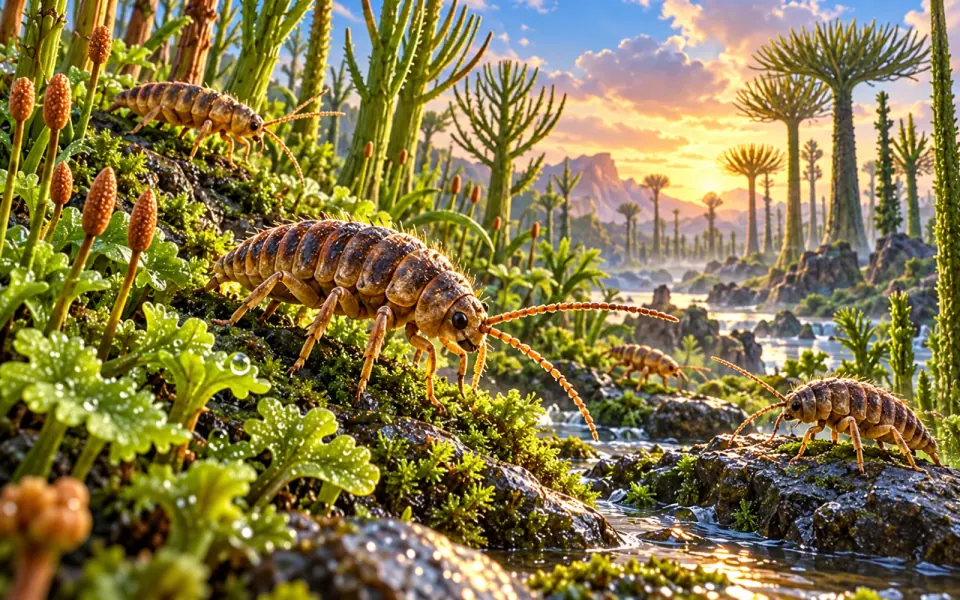
- The first insectsabout 400 million years ago · The Earth before usOn the green lands the first insects arrived.
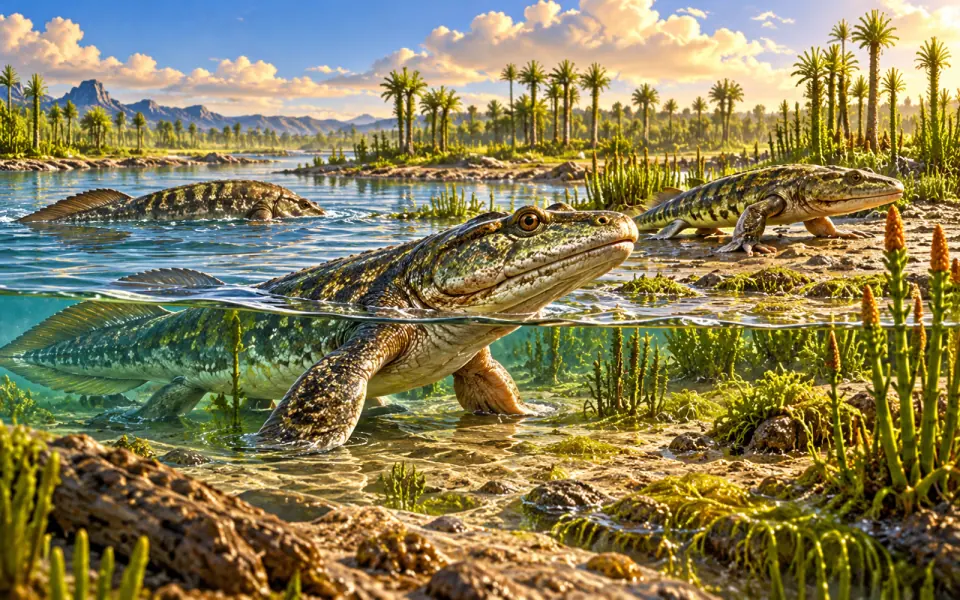
- The first amphibiansabout 375 million years ago · The Earth before usFrom water to land: after plants, four-legged animals came out too.
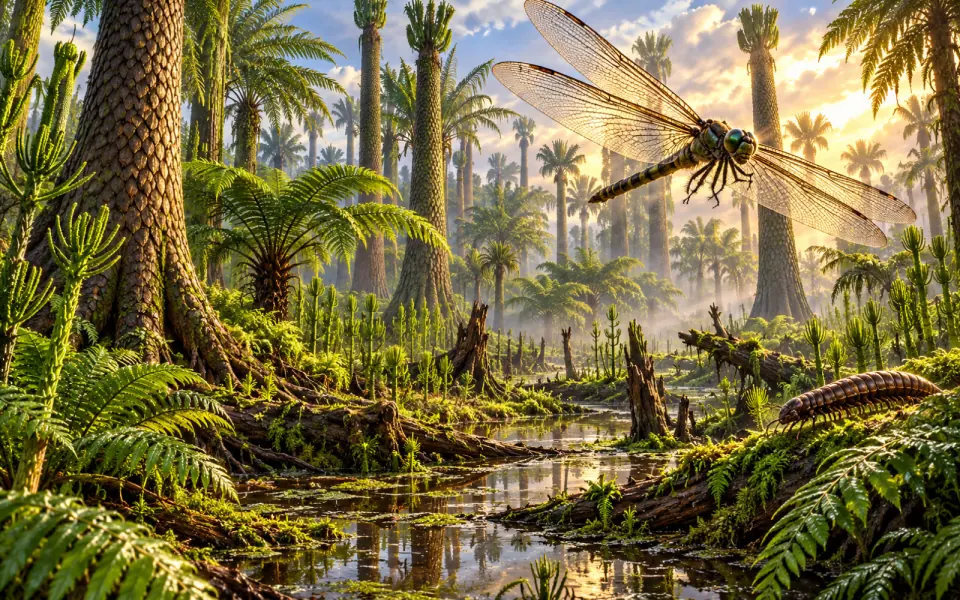
- Carboniferous forestsabout 320 million years ago · The Earth before usThe forests of the Carboniferous turned into coal.
- The Neolithic Revolutionabout 12,000 years ago · PrehistoryThousands of years later, human beings learned to farm plants.
Before and after, in the era “The Earth before us”
Event 16 of 25
 BeforeThe Big Bangabout 13.8 billion years ago
 BeforeThe first starsabout 13.5 billion years ago
 BeforeBirth of the Milky Wayabout 13 billion years ago
 BeforeFormation of the Solar Systemabout 4.6 billion years ago
 BeforeBirth of the Earthabout 4.5 billion years ago
 BeforeFormation of the Moonabout 4.5 billion years ago
 BeforeThe oldest pieces of Earthabout 4.4 billion years ago
 BeforeThe first oceansabout 4.3 billion years ago
 BeforeThe first life on Earthabout 3.5 billion years ago
 BeforeCyanobacteria and photosynthesisabout 2.7 billion years ago
 BeforeThe Great Oxidation Eventabout 2.4 billion years ago
 BeforeThe first complex cellsabout 1.8 billion years ago
 BeforeThe first many-celled living thingsabout 1 billion years ago
 BeforeThe Ediacaran creaturesabout 555 million years ago
 BeforeThe Cambrian explosionabout 539 million years ago
- You are hereThe first plants on landabout 475 million years ago
 AfterThe first fish with jawsabout 440 million years ago
 AfterThe first insectsabout 400 million years ago
 AfterThe first amphibiansabout 375 million years ago
 AfterCarboniferous forestsabout 320 million years ago
 AfterThe great Permian extinctionabout 252 million years ago
 AfterThe first dinosaursabout 230 million years ago
 AfterThe first mammalsabout 225 million years ago
 AfterThe first birdsabout 150 million years ago
 AfterExtinction of the non-avian dinosaursabout 66 million years ago
Listen / Read next
- Music to read by: Cinematic JourneyEpic film-style music, no lyrics, by Ciro Simone IrmiciSpotifyYouTube Music
Meanwhile, elsewhere in the world
Other events of the era “The Earth before us”
- The Big Bang
- The first stars
- Birth of the Milky Way
- Formation of the Solar System
- Birth of the Earth
- Formation of the Moon
- The oldest pieces of Earth
- The first oceans
- The first life on Earth
- Cyanobacteria and photosynthesis
- The Great Oxidation Event
- The first complex cells
- The first many-celled living things
- The Ediacaran creatures
- The Cambrian explosion
- The first fish with jaws
- The first insects
- The first amphibians
- Carboniferous forests
- The great Permian extinction
- The first dinosaurs
- The first mammals
- The first birds
- Extinction of the non-avian dinosaurs
