The first complex cells
about 1.8 billion years ago The Earth's seas
In short
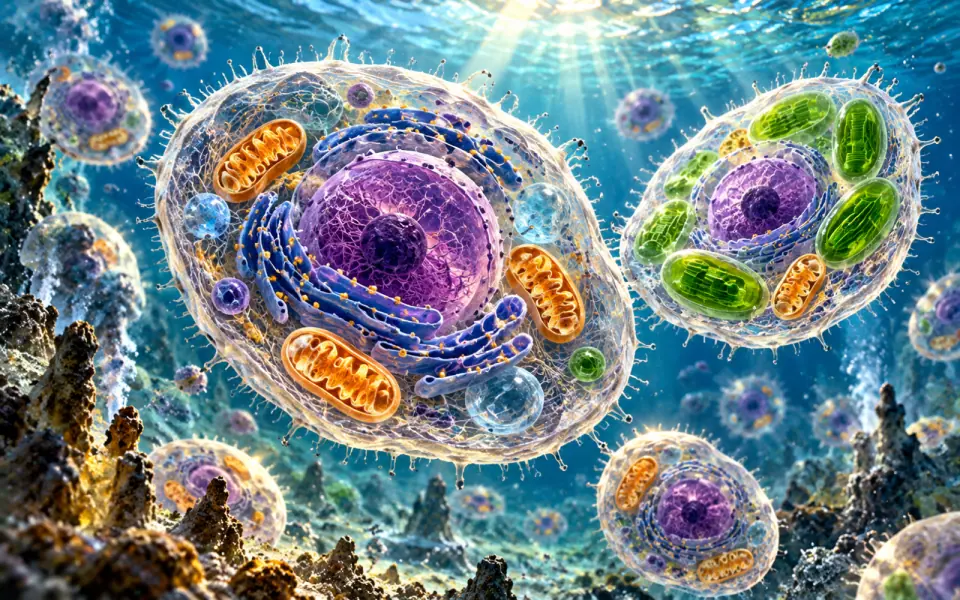
Complex cells, called eukaryotic cells, have a nucleus that holds the DNA and lots of small inside parts with different jobs. Scientists think some of these parts were once free-living bacteria that got inside another cell and stayed there. Mitochondria, the ‘power stations’ of the cell, still keep a small DNA of their own. The oldest fossils of these cells are about 1.8 billion years old.
Why it matters Complex cells are the basis of animals, plants, fungi and many single-celled organisms.
Source: University of California Museum of Paleontology, “Fossil Record of the Eukaryota”
Study card about 5 minutes of reading
The story
Two kinds of cells
All living things are made of cells, but not all cells are the same. There are two big kinds. The simplest cells, those of bacteria and archaea, are small and their DNA floats loose inside. The complex cells, called eukaryotic, are much bigger, often ten times longer or more, and their DNA is kept in a separate compartment, the nucleus. Inside they also have many small structures with different jobs, called organelles. Plants, animals, fungi and all the larger single-celled organisms, such as amoebas, are made of eukaryotic cells. So are you.
Eukaryotic cells appeared after at least a billion and a half years of life made only of bacteria and archaea. The exact moment is not clear. The oldest certain fossils, small spheres with decorated surfaces called acritarchs, are about 1.8 billion years old, although they are rare and debated. Studies of the DNA of living things today suggest that eukaryotic cells arose between 2 and 1.6 billion years ago, in a time that scientists estimate with a wide margin of error.
A great partnership
How did such a complicated cell come about? The most widely accepted idea is called the endosymbiotic theory, that is, the theory of “partnership inside the cell”. It says that some parts of complex cells were originally independent bacteria. One day a larger cell swallowed a smaller bacterium; instead of digesting it, the two began to cooperate. The bacterium inside received protection and food, and the host cell received energy. Over many generations, the two became inseparable.
The bacterium that turned into the mitochondrion, the “power station” of the cell, was able to use oxygen to get energy from food. Later, in some cells, a second guest was added: a cyanobacterium that became the chloroplast, the organ of photosynthesis. The evidence is plentiful. Mitochondria and chloroplasts have a little DNA of their own, circular like that of bacteria; they divide by themselves inside the cell, as bacteria would; they have a double membrane, as if they had been swallowed. The mitochondrial DNA of a person, for example, is made of only 37 genes and is almost always inherited from the mother.
The idea was put forward in the early 20th century by some Russian scientists and was taken up strongly in 1967 by the American biologist Lynn Margulis. At first it was met with a lot of scepticism; today it is in school books all over the world.
Who was the host?
It remains to be understood who the host cell was. In recent years geneticists have found the most likely answer in a group of archaea, discovered from 2015 on the seabed near Greenland, close to an area of hot springs called Loki's Castle, which is why they are called “Asgard archaea”. In their DNA they have many genes that were once thought to belong only to eukaryotic cells. It is therefore likely (although not all scholars agree) that our cells were born from the union of an archaeon of this kind and a bacterium able to use oxygen. The order of the steps is still open: for example, whether the nucleus appeared before or after the mitochondrion.
Why it was such a big step
A bacterium has little room for keeping energy: it produces it along its surface. A eukaryotic cell, with many mitochondria inside, can produce far more energy and so can afford bigger DNA, many more proteins and complex structures. It is like going from a bicycle to a factory with lots of small power stations. This extra energy also made other innovations possible, such as the cell's internal skeleton, which allows it to change shape and to engulf food, and later sexual reproduction, in which the DNA of two parents is mixed and individuals are born that are always a little different.
Almost everything we call “visible life” starts here. For a long time, however, eukaryotic cells stayed microscopic and lived on their own: the next step, joining together in one body, is told in the next card.
Why it happened
Complex cells probably arose because, in a world that now had a little oxygen, after the Great Oxidation Event, living together with a bacterium able to breathe oxygen was a great advantage. The host could survive and grow in places where oxygen would have been a problem.
The swallowing may have happened many times, but only once did it succeed in a lasting way. This rarity is one of the reasons why the appearance of complex cells is thought to have been an exceptional event, and why for billions of years life stayed simple.
There are several hypotheses about exactly how things went and the debate is lively. What seems certain is that cooperation, and not only competition, was an important force in evolution.
What changed
Without eukaryotic cells there would be no animals, no plants and no fungi. Many consequences of this event are themselves events on this timeline: many-celled organisms, land plants, fish, insects, dinosaurs and human beings all come from complex cells.
Eukaryotic cells can specialise. A nerve cell, a muscle cell and a skin cell have the same DNA, but use different parts of it and become very different from one another. This is possible thanks to their internal complexity and the large amount of energy available.
Understanding how mitochondria and cells work is useful in medicine too: many rare diseases depend on mitochondria that do not work well, and studying their DNA makes it possible to follow the history of human populations. Analysis of mitochondrial DNA, passed on by mothers, has helped, for example, to reconstruct the migrations of humankind and to identify the remains of ancient people.
Key people and places
People
- Lynn Margulis
- American biologist (1938–2011). In 1967 she gave strength to the endosymbiotic theory, according to which mitochondria and chloroplasts were swallowed bacteria.
- Konstantin Mereschkowski
- Russian biologist (1855–1921). He was among the first to propose, in 1905, that chloroplasts came from cyanobacteria.
- Thijs Ettema
- Dutch biologist. In 2015 his team discovered the Lokiarchaeota, the first of a family later named Asgard (2017), close relatives of complex cells.
Places
- Loki's Castle, Arctic Ocean
- A group of hot springs on the seabed between Greenland and Norway, where the first Asgard archaea were found.
- Seas of the Proterozoic
- The oceans of 2 to 1.5 billion years ago, where the first cells with a nucleus lived.
- Changcheng, China
- Rocks about 1.6 billion years old with possible fossils of complex cells.
Good to know
- The human body has tens of trillions of cells; almost all types have mitochondria, while mature red blood cells have none.
- A single muscle cell can contain thousands of mitochondria, because it uses a lot of energy.
- Mitochondrial DNA is almost always inherited only from the mother, and for this reason it is used to study the female lines of families and populations.
- Mitochondria are named from the Greek mitos, “thread”, and chondros, “grain”, because of their shape seen under the microscope.
- “Loki's Castle” is named after the god of Norse mythology; the archaea found there have been given the names of Norse gods: Lokiarchaeota, Thorarchaeota, Odinarchaeota.
Find out more
- Wikipedia, “Eukaryote” en.wikipedia.org
- Wikipedia, “Symbiogenesis” en.wikipedia.org
- Wikipedia, “Cell (biology)” en.wikipedia.org
- University of California Museum of Paleontology (Berkeley), the eukaryotes (in English) ucmp.berkeley.edu
Related events
- Cyanobacteria and photosynthesisabout 2.7 billion years ago · The Earth before usThe chloroplast was a cyanobacterium swallowed by a complex cell.
- The Great Oxidation Eventabout 2.4 billion years ago · The Earth before usThe oxygen in the air made the bacteria that use it for breathing an advantage.
- The first many-celled living thingsabout 1 billion years ago · The Earth before usComplex cells joined together to form the first many-celled bodies.
- The double helix of DNA1953 · TodayThe structure of DNA, found in the nucleus of cells, was discovered in 1953.
- Darwin publishes On the Origin of Species1859 · Age of revolutionsDarwin suggested that living things are linked by common descent.
Before and after, in the era “The Earth before us”
Event 12 of 25
 BeforeThe Big Bangabout 13.8 billion years ago
 BeforeThe first starsabout 13.5 billion years ago
 BeforeBirth of the Milky Wayabout 13 billion years ago
 BeforeFormation of the Solar Systemabout 4.6 billion years ago
 BeforeBirth of the Earthabout 4.5 billion years ago
 BeforeFormation of the Moonabout 4.5 billion years ago
 BeforeThe oldest pieces of Earthabout 4.4 billion years ago
 BeforeThe first oceansabout 4.3 billion years ago
 BeforeThe first life on Earthabout 3.5 billion years ago
 BeforeCyanobacteria and photosynthesisabout 2.7 billion years ago
 BeforeThe Great Oxidation Eventabout 2.4 billion years ago
- You are hereThe first complex cellsabout 1.8 billion years ago
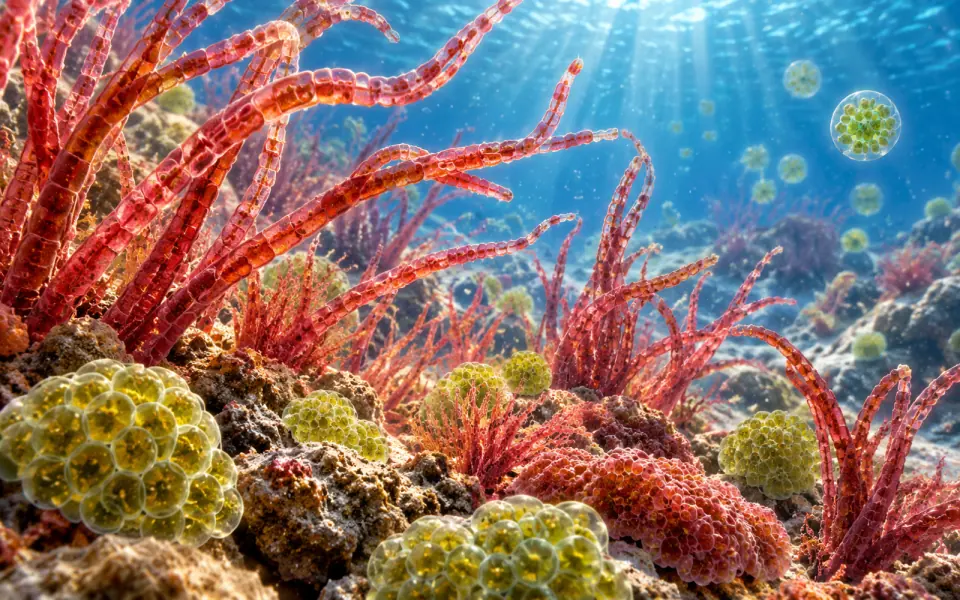 AfterThe first many-celled living thingsabout 1 billion years ago
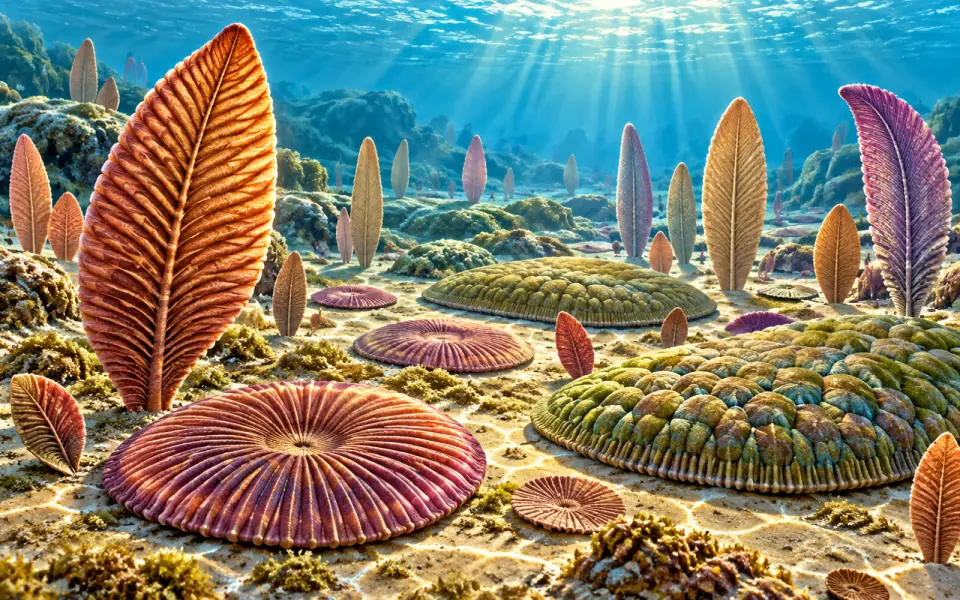 AfterThe Ediacaran creaturesabout 555 million years ago
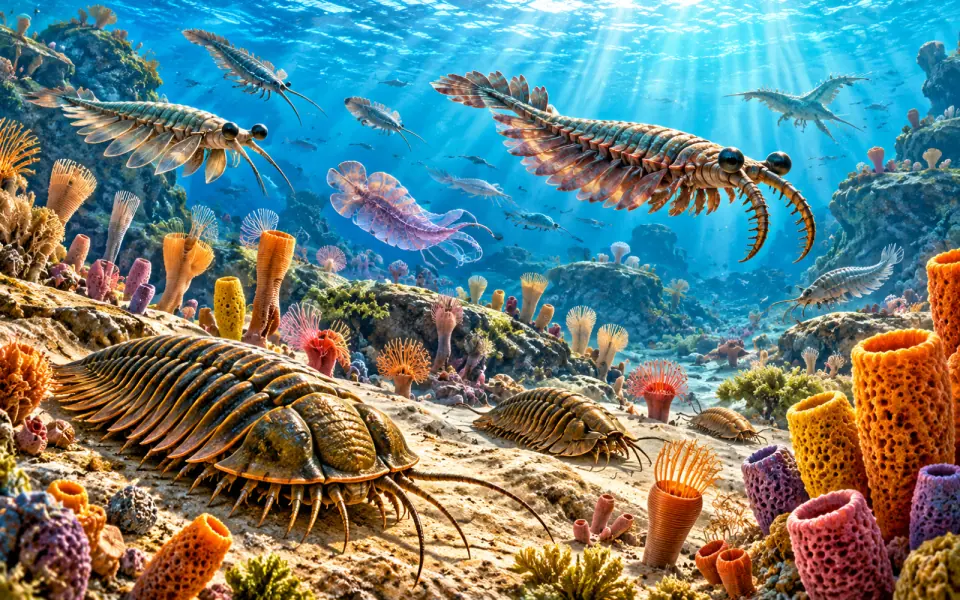 AfterThe Cambrian explosionabout 539 million years ago
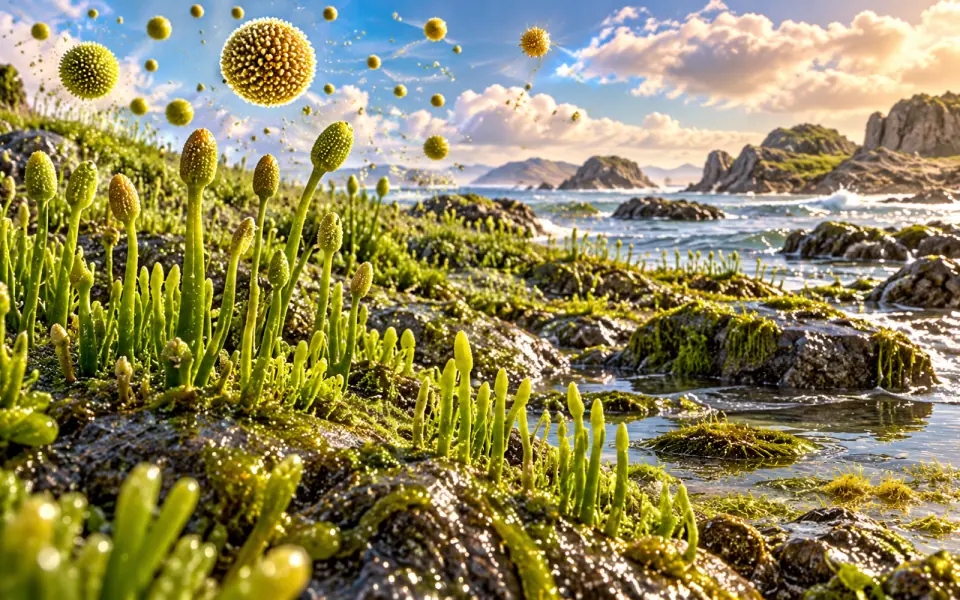 AfterThe first plants on landabout 475 million years ago
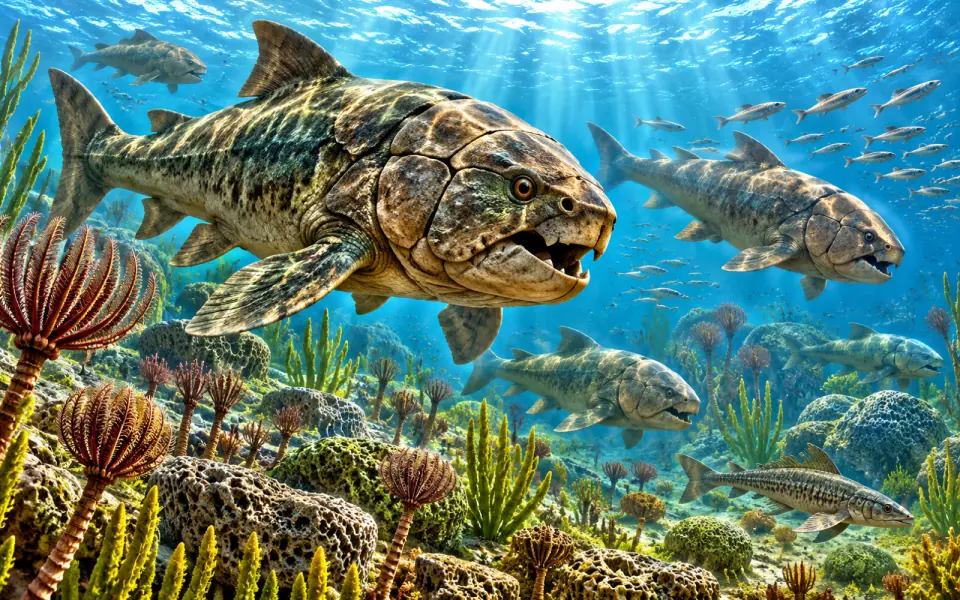 AfterThe first fish with jawsabout 440 million years ago
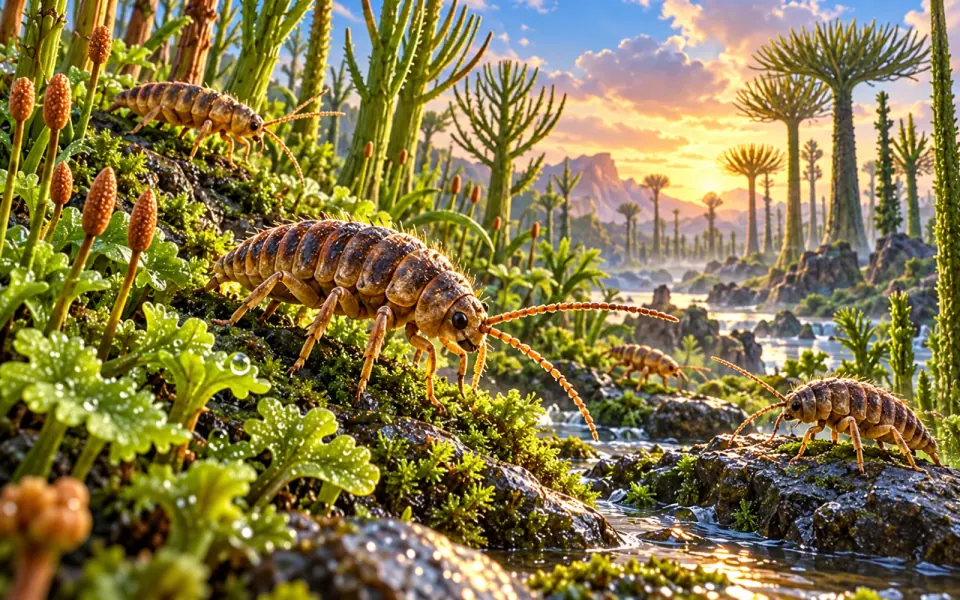 AfterThe first insectsabout 400 million years ago
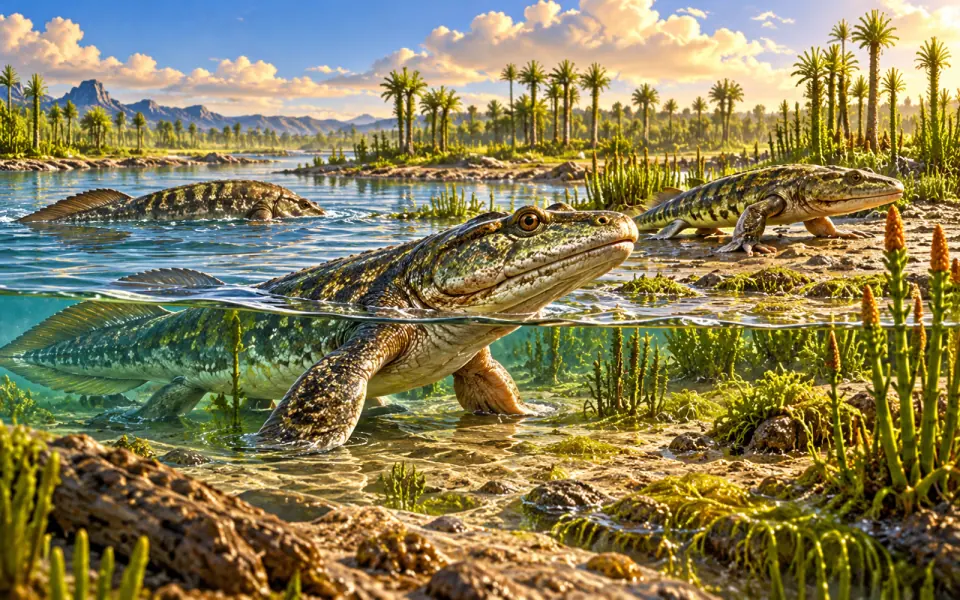 AfterThe first amphibiansabout 375 million years ago
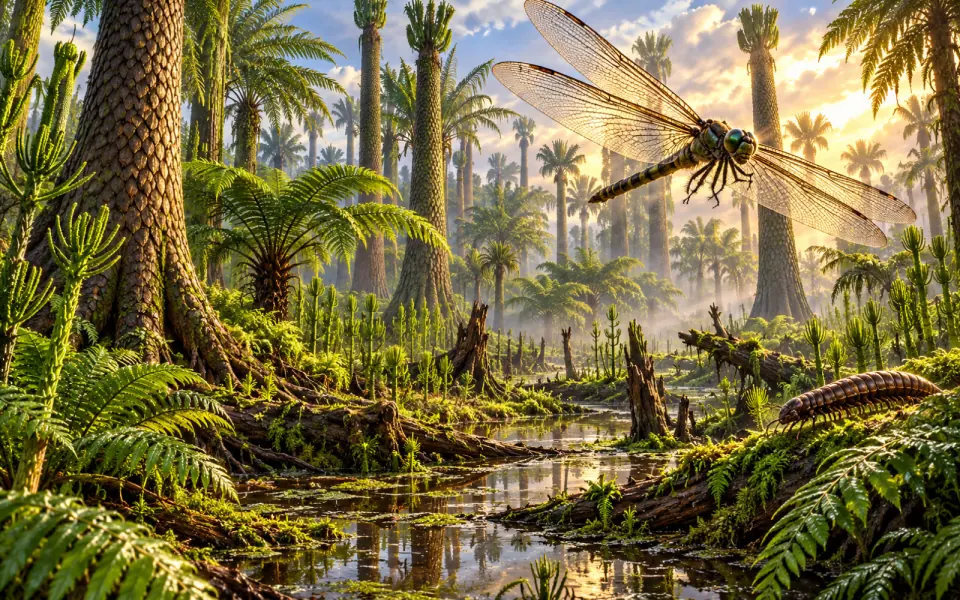 AfterCarboniferous forestsabout 320 million years ago
 AfterThe great Permian extinctionabout 252 million years ago
 AfterThe first dinosaursabout 230 million years ago
 AfterThe first mammalsabout 225 million years ago
 AfterThe first birdsabout 150 million years ago
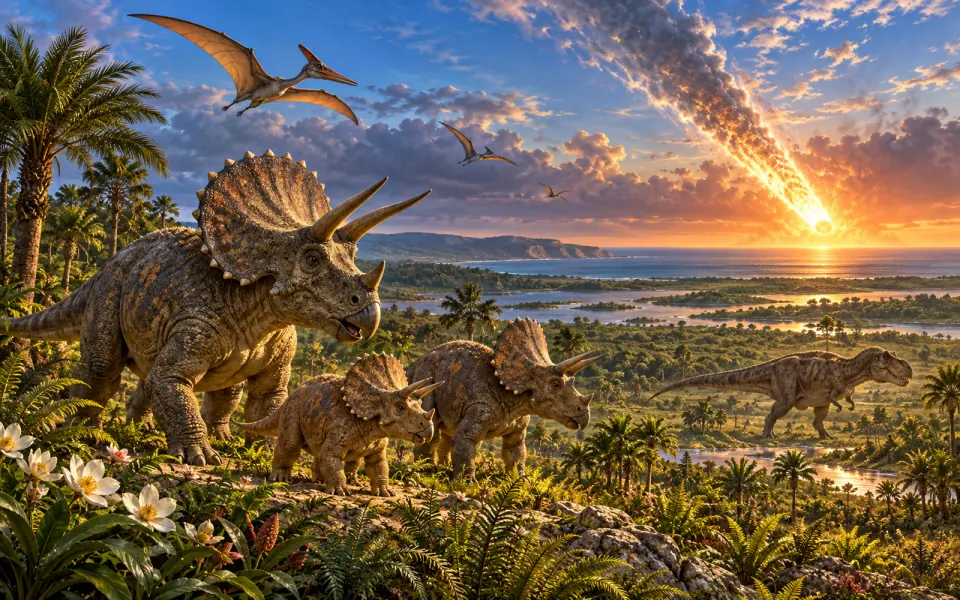 AfterExtinction of the non-avian dinosaursabout 66 million years ago
Listen / Read next
- Music to read by: Cinematic JourneyEpic film-style music, no lyrics, by Ciro Simone IrmiciSpotifyYouTube Music
Other events of the era “The Earth before us”
- The Big Bang
- The first stars
- Birth of the Milky Way
- Formation of the Solar System
- Birth of the Earth
- Formation of the Moon
- The oldest pieces of Earth
- The first oceans
- The first life on Earth
- Cyanobacteria and photosynthesis
- The Great Oxidation Event
- The first many-celled living things
- The Ediacaran creatures
- The Cambrian explosion
- The first plants on land
- The first fish with jaws
- The first insects
- The first amphibians
- Carboniferous forests
- The great Permian extinction
- The first dinosaurs
- The first mammals
- The first birds
- Extinction of the non-avian dinosaurs
