Extinction of the non-avian dinosaurs
about 66 million years ago Yucatán Peninsula, Mexico
In short
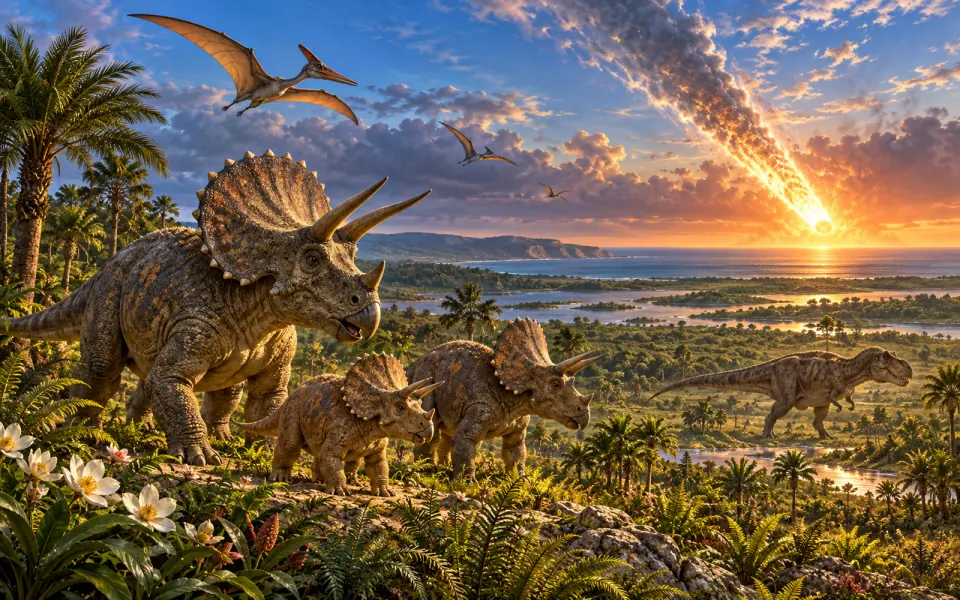
About 66 million years ago an asteroid 10-15 kilometres wide struck the area of today's Yucatán Peninsula, in Mexico. Soot spread all over the world, dimming the sunlight and throwing climate and food chains into chaos. The non-avian dinosaurs, that is all of them except the birds, disappeared, while mammals and other groups survived the crisis.
Why it matters The extinction closed the Mesozoic and freed up many habitats where mammals branched out into new forms.
Source: Natural History Museum (London), “How an asteroid ended the age of the dinosaurs”
Study card about 6 minutes of reading
The story
A mystery 150 years old
What happened to the dinosaurs? Ever since the 19th century, when people understood that they had existed and then vanished, scientists have suggested explanations of every kind: a climate too hot or too cold, diseases, mammals eating their eggs, even boredom, some said as a joke. None was really convincing. The breakthrough came from an unexpected place: a mountain gorge near Gubbio, in Umbria.
The clay of Gubbio
At the end of the 1970s the American geologist Walter Alvarez was working in Italy, in the Bottaccione Gorge, near Gubbio. The rocks there are pinkish limestones formed on the floor of an ancient sea, layer after layer, over millions of years. In the older limestones there were plenty of fossils of tiny sea organisms, the foraminifera; in the more recent ones very few were left. Between the two groups there was a thin layer of clay, about a centimetre thick. Alvarez wanted to know how long it had taken to be laid down.
His father, the physicist Luis Alvarez, a Nobel Prize winner, suggested measuring in that clay a metal that is very rare on the Earth's surface, iridium, which reaches the Earth mainly with cosmic dust at a steady rate. The more iridium there is, the more time has passed. Together with the chemists Frank Asaro and Helen Michel, the researchers found a surprise: the clay held much more iridium than normal, tens of times more than the rock around it. In 1980 they published their idea in the journal Science: that iridium could not have come from dust building up slowly, but from a big asteroid that had struck the Earth about 66 million years ago, bringing with it, and scattering in the air, an enormous quantity of that metal.
The idea was met with scepticism. Then, over the years, the same layer of iridium was found in dozens of other places around the world, always of the same age. There was other evidence: small grains of quartz with marks of violent impact, and tiny spheres of molten rock that had solidified in flight.
The crater
If the asteroid had fallen, it must have left a crater. It was found in Mexico, on the Yucatán Peninsula, near the village of Chicxulub. Already between the late 1970s and the early 1980s two geologists from the Mexican oil company, Antonio Camargo and Glen Penfield, had seen in geophysical data a gigantic buried circular structure, but at the time it was not linked to the dinosaurs. In the early 1990s the geologist Alan Hildebrand and his colleagues identified it as the crater being sought. It measures about 180 kilometres across, and is largely under the sea and under sediments. In 2016 an international drilling expedition collected rock samples from inside it, confirming that it was formed by an impact.
The asteroid that made it was about 10 to 15 kilometres wide, like a mountain, and arrived at a speed of tens of thousands of kilometres an hour. The energy released was greater than that of many billions of atomic bombs.
What happened next
The effects were of two kinds. In the first minutes and days there were earthquakes, very high tsunami waves and a rain of molten rock falling over much of the planet, and probably fires near the place of impact. But the real catastrophe was what followed. Dust, soot and droplets of sulphur rose into the upper atmosphere and cut down the sunlight for months or years. Without light, plants could not carry out photosynthesis; the seas cooled and became more acidic; food chains collapsed, starting with plankton and plants.
About three quarters of living species disappeared. Gone were the great marine reptiles, the pterosaurs, the ammonites and all the non-avian dinosaurs, that is, all except the birds. Survivors were small animals, able to hide, to burrow or to feed on seeds, insects and scraps: small mammals, birds, crocodiles, turtles, frogs. Some scientists recall another factor: at the same time in India the volcanoes of the Deccan Traps were erupting, and their gases may have made the crisis worse. The weight of the different causes is still debated, but most researchers consider the impact the main cause.
Why it happened
The cause is the impact of a large asteroid. Asteroids are rocky leftovers from the formation of the Solar System, and most of them circle quietly between Mars and Jupiter. Every so often a collision or the pull of a planet changes the orbit of one of them, and it may end up on a path towards the Earth. A 2024 study of the chemical make-up of the material from the impact suggests that the asteroid was of a carbon-rich, carbonaceous type, but the details are still being studied.
The effects were multiplied because the rock that was struck, in the Yucatán, was rich in limestone and gypsum, which contain sulphur and carbon. When they were vaporised they ended up in the upper atmosphere, where the effect on the climate was strongest.
Some scientists think the dinosaurs were already in difficulty before the impact, but the debate is open: fossils from the last period are few. Others argue that they were thriving right to the end.
What changed
The end of the non-avian dinosaurs, 66 million years ago, closes the Mesozoic, the era of reptiles, and begins the Cenozoic, the era of mammals. The places left empty were taken by animals that had until then stayed in the background. In a few million years the mammals diversified and the first large plant-eaters and meat-eaters appeared, and bats. Birds also diversified a great deal. From the surviving mammals, much later, descended the primates and so ourselves.
Alvarez's discovery changed the way we think about the history of the Earth. People used to believe that changes were always slow and gradual. Now we know that sudden, violent events, coming from space, can change the course of life. This idea opened a new field, the science of asteroid hazards.
Today astronomers look for and follow with telescopes the asteroids that pass near the Earth, and the probability of an impact like that one is very low. In 2022 NASA's DART probe was crashed into a small asteroid, Dimorphos: the experiment worked, and the time Dimorphos takes to go round the larger asteroid, Didymos, was shortened by about half an hour. It is the first time humanity has changed the motion of a celestial body. The dinosaurs did not have that possibility.
Key people and places
People
- Walter Alvarez
- American geologist. He studied the clay of Gubbio and in 1980, with his father, proposed the asteroid hypothesis.
- Luis Alvarez
- American physicist (1911–1988), Nobel Prize in 1968. He suggested measuring the iridium in the clay.
- Alan Hildebrand
- Canadian geologist. In 1991 he and his colleagues identified the Chicxulub crater.
- Alessandro Montanari
- Italian geologist who worked with Alvarez at Gubbio and helped to study the layer of clay.
Places
- Bottaccione Gorge, Gubbio (Umbria)
- Where in 1977–1980 Walter Alvarez found the iridium-rich clay that marks the end of the Cretaceous.
- Chicxulub, Yucatán (Mexico)
- The village near which the impact crater, about 180 kilometres wide, lies buried.
- Deccan Traps, India
- Immense lava flows erupted at about the same time as the impact.
- Hell Creek, Montana (United States)
- An area where the layers with the fossils of the last dinosaurs can be seen below the impact layer.
Good to know
- The layer of clay at Gubbio can still be seen today: you can touch it with a finger, and geologists from all over the world go to see it.
- The Chicxulub crater was spotted in the search for oil, before anyone knew about the asteroid.
- All birds today descend from a small group of birds that survived the impact.
- On the day of the impact, the molten rock thrown into the air fell back as a rain of tiny glass spheres: they are still found in rocks all over the world.
- Just above the impact layer, in many rocks in North America, there are huge numbers of fern spores: ferns were among the first plants to resettle the devastated land.
Find out more
- Wikipedia, “Cretaceous–Paleogene extinction event” en.wikipedia.org
- Wikipedia, “Chicxulub crater” en.wikipedia.org
- Wikipedia, “Walter Alvarez” en.wikipedia.org
- NASA, the DART mission (Double Asteroid Redirection Test) science.nasa.gov
- Natural History Museum, London, Tyrannosaurus rex (in English) nhm.ac.uk
Related events
- The first dinosaursabout 230 million years ago · The Earth before usThe dinosaurs had appeared 164 million years earlier.
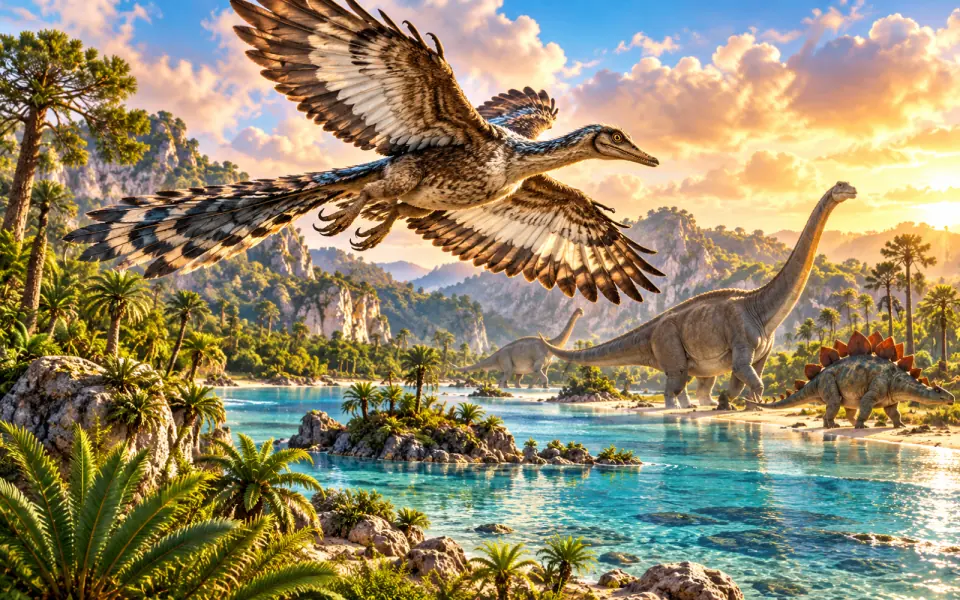
- The first birdsabout 150 million years ago · The Earth before usBirds were the only dinosaurs to survive.
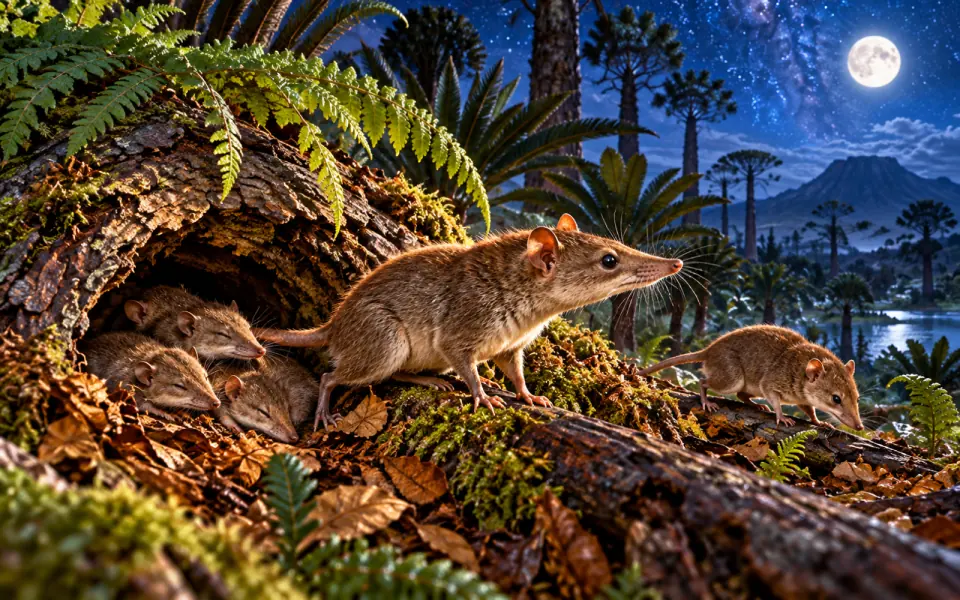
- The first mammalsabout 225 million years ago · The Earth before usAfter the impact the small mammals were able to diversify.
- The great Permian extinctionabout 252 million years ago · The Earth before usAnother mass extinction, 186 million years earlier, had struck the life of the Permian.
- The first homininsabout 7 million years ago · PrehistoryFrom the surviving mammals, millions of years later, the first hominins were born.
Before and after, in the era “The Earth before us”
Event 25 of 25
 BeforeThe Big Bangabout 13.8 billion years ago
 BeforeThe first starsabout 13.5 billion years ago
 BeforeBirth of the Milky Wayabout 13 billion years ago
 BeforeFormation of the Solar Systemabout 4.6 billion years ago
 BeforeBirth of the Earthabout 4.5 billion years ago
 BeforeFormation of the Moonabout 4.5 billion years ago
 BeforeThe oldest pieces of Earthabout 4.4 billion years ago
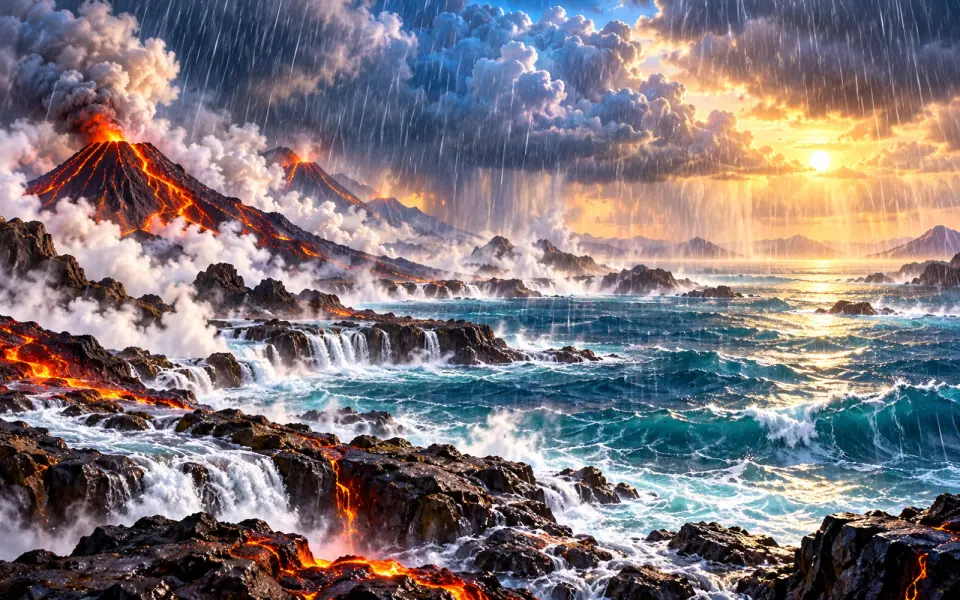 BeforeThe first oceansabout 4.3 billion years ago
 BeforeThe first life on Earthabout 3.5 billion years ago
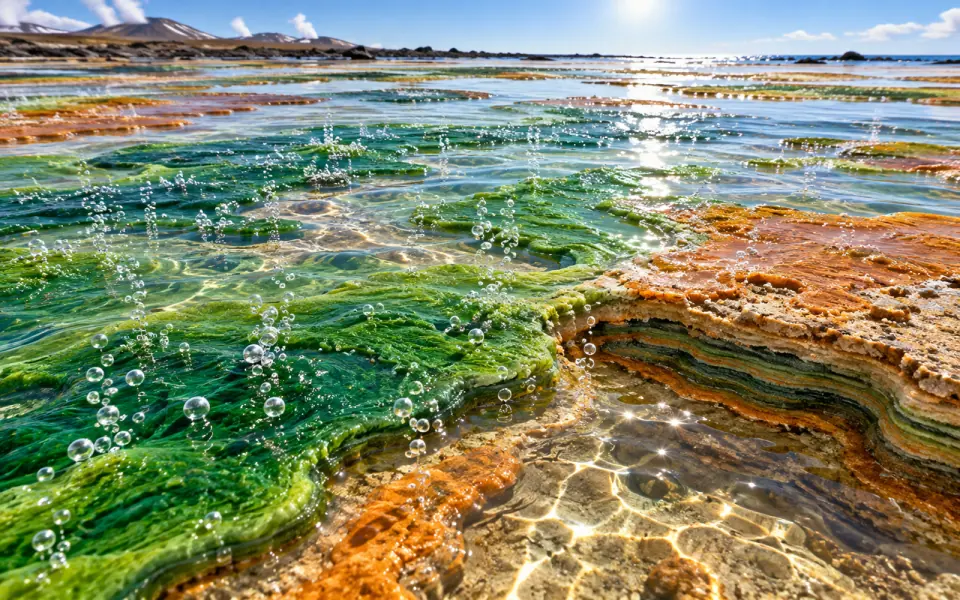 BeforeCyanobacteria and photosynthesisabout 2.7 billion years ago
 BeforeThe Great Oxidation Eventabout 2.4 billion years ago
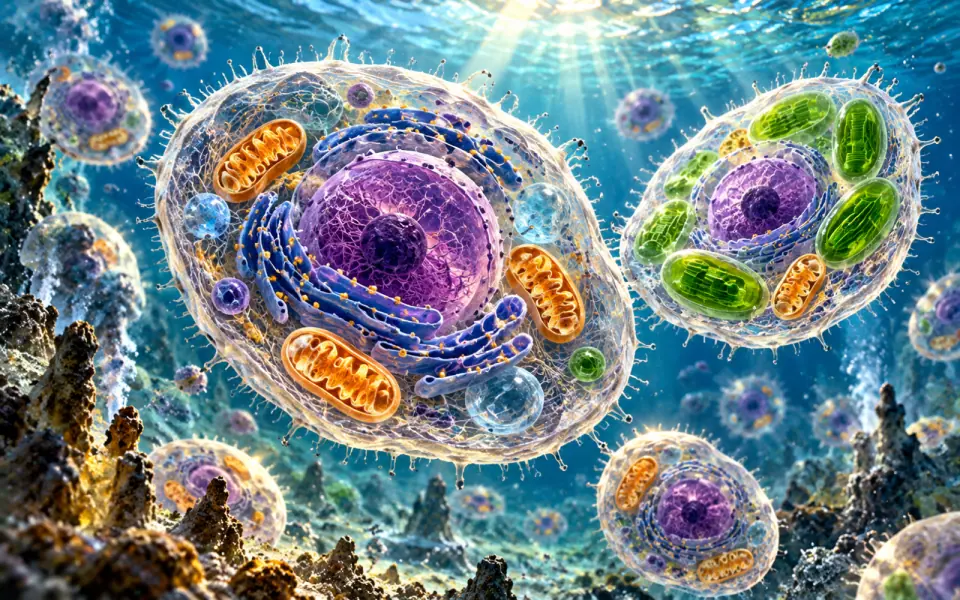 BeforeThe first complex cellsabout 1.8 billion years ago
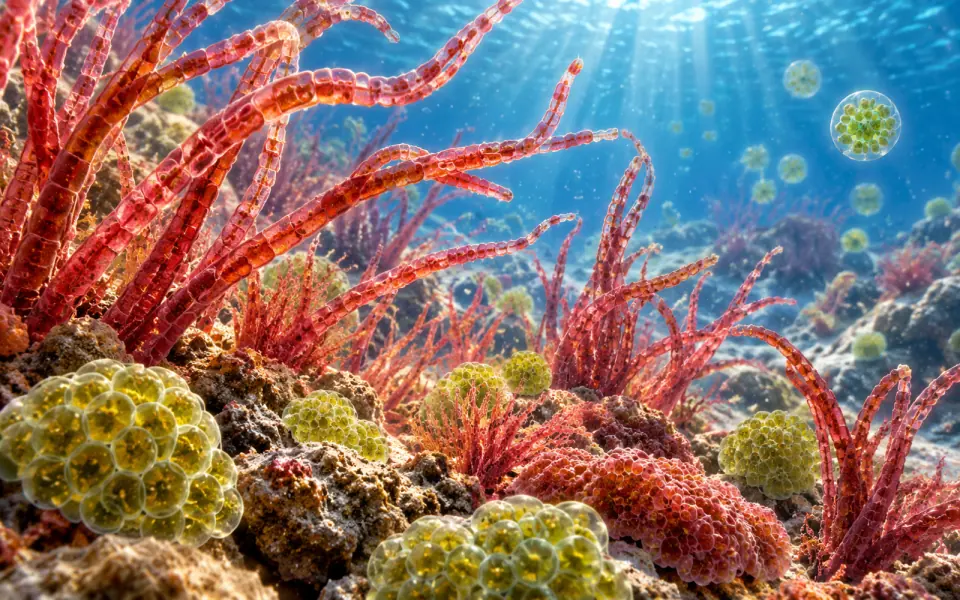 BeforeThe first many-celled living thingsabout 1 billion years ago
 BeforeThe Ediacaran creaturesabout 555 million years ago
 BeforeThe Cambrian explosionabout 539 million years ago
 BeforeThe first plants on landabout 475 million years ago
 BeforeThe first fish with jawsabout 440 million years ago
 BeforeThe first insectsabout 400 million years ago
 BeforeThe first amphibiansabout 375 million years ago
 BeforeCarboniferous forestsabout 320 million years ago
 BeforeThe great Permian extinctionabout 252 million years ago
 BeforeThe first dinosaursabout 230 million years ago
 BeforeThe first mammalsabout 225 million years ago
 BeforeThe first birdsabout 150 million years ago
- You are hereExtinction of the non-avian dinosaursabout 66 million years ago
Listen / Read next
- Music to read by: Cinematic JourneyEpic film-style music, no lyrics, by Ciro Simone IrmiciSpotifyYouTube Music
Other events of the era “The Earth before us”
- The Big Bang
- The first stars
- Birth of the Milky Way
- Formation of the Solar System
- Birth of the Earth
- Formation of the Moon
- The oldest pieces of Earth
- The first oceans
- The first life on Earth
- Cyanobacteria and photosynthesis
- The Great Oxidation Event
- The first complex cells
- The first many-celled living things
- The Ediacaran creatures
- The Cambrian explosion
- The first plants on land
- The first fish with jaws
- The first insects
- The first amphibians
- Carboniferous forests
- The great Permian extinction
- The first dinosaurs
- The first mammals
- The first birds
