The great Permian extinction
about 252 million years ago The whole Earth (eruptions in Siberia)
In short
At the end of the Permian, most species in the sea and many on land disappeared. Huge volcanic eruptions in Siberia warmed the climate and made the seas more acidic and short of oxygen. The crisis did not have one single, instant cause: it was a chain of disasters.
Why it matters It was the worst mass extinction we know of, and it completely changed the world's ecosystems.
Study card about 6 minutes of reading
The story
The “Great Dying”
In the history of life on Earth there have been five great mass extinctions, moments when, in a time that is very short for geology, a large share of the planet's species disappears. The worst of them all happened at the end of the Permian period, about 252 million years ago. Scientists call it the “Great Dying”. It was so devastating that life took millions of years to recover.
According to estimates, between 80 and 90 per cent of the species in the seas vanished. If an aquarium held a hundred species of animals, only ten or twenty would have been left. On land too the losses were very severe: about two thirds or more of the known species of land animals disappeared. It is the most severe mass extinction for insects, with whole orders wiped out. Gone for ever were the trilobites, which had lived in the seas for almost 270 million years, many ancient corals and a great many other forms.
The world before the disaster
The Permian was a different world. The continents were gathered into a single supercontinent, Pangaea, surrounded by a great ocean. The climate was dry and there were large deserts in the interior. The seas held reefs with corals, sponges, molluscs and fish. On land lived large mammal-like reptiles, the synapsids, such as Dimetrodon, with its sail on its back, and the gorgonopsids, predators with sabre-like teeth. There were no dinosaurs yet.
What happened?
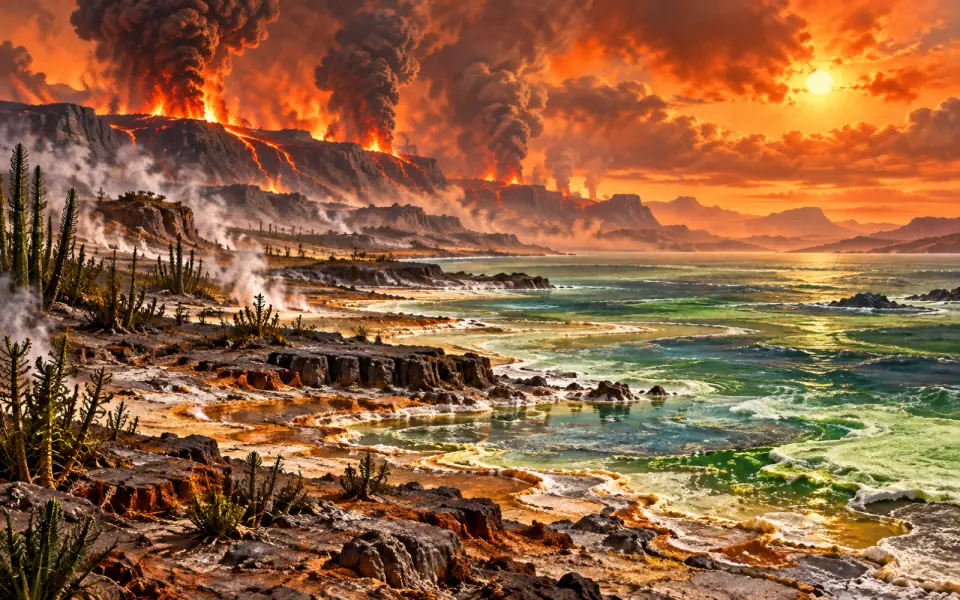
The main cause, according to most researchers, was volcanic eruptions of unbelievable size in a region that is now Siberia. For hundreds of thousands of years lava poured out of the ground in enormous flows, covering millions of square kilometres. The rocks it formed are called the “Siberian Traps” (from a Swedish word meaning “steps”). But lava was not the only problem: enormous quantities of gas came out of the volcanoes, above all carbon dioxide, but other substances too. As the magma rose, it also burned or heated deposits of coal and other materials, releasing more gas.
The effect was a chain of disasters. The carbon dioxide warmed the climate very quickly: the temperatures of tropical seas rose so much that they became unbearable for many species, perhaps above 35 degrees. Warmer water holds less oxygen, and in many places the oceans became poor in oxygen or had none. Some of the gas dissolved in water, making the seas more acidic, which makes it hard to build shells and skeletons of limestone. On land, the heat and the acid rain killed many plants, and without plants the food chains collapsed.
How we know
Scientists have rebuilt this story from the rocks. In a quarry near Meishan, in China, there is a layer of rock that marks exactly the boundary between the Permian and the Triassic, and it is used as a reference all over the world. With precise measurements of the age of zircon crystals in volcanic ash, studied in 2011 and 2014, researchers have established that the extinction in the seas was concentrated into a short time, perhaps a few tens of thousands of years. Other evidence comes from changes in the amounts of types of carbon and oxygen in the rocks, which point to warming and to an upheaval in the carbon cycle.
Some scientists propose additional hypotheses, such as the action of methane-producing microbes, and the debate goes on. Almost all of them, however, agree on the role of Siberian volcanism.
Who survived
Not everything died. Among the survivors was Lystrosaurus, an animal the size of a pig, with a beak and two tusks, which after the catastrophe became the most common land vertebrate on the planet. Also surviving were reptiles and small ancestors of mammals, some fish, molluscs such as the nautiloids, the first archosaurs, the group from which crocodiles, pterosaurs and dinosaurs would come. It took 5 to 10 million years in the seas, and up to about 30 million for land animals, for ecosystems to become rich again, and many environments stayed poor and unstable.
Why it happened
The most accepted cause is the eruptions of the Siberian Traps. They were not eruptions like those of Vesuvius, short and violent, but activity that lasted a long time, with lava coming out of cracks in the crust and spreading over millions of square kilometres. The magma passed through layers of rock that contained coal, limestone and salt, and released far more gases than the lava alone.
Greenhouse gases warmed the atmosphere, the oxygen in the seas fell and the oceans turned acidic. More than one factor acted together, which is why scientists speak of a “chain of disasters” and not of a single cause. For this extinction there is no convincing evidence of an asteroid impact, unlike the one that killed the dinosaurs.
The link with the Traps is confirmed by the timing of the two events: the dates of the Siberian rocks and those of the extinction coincide, within the precision of the measurements.
What changed
After the catastrophe the world started again in a different way. The old rulers, such as the large mammal-like animals and the ancient corals, were gone or much reduced, and in the seas new forms, such as bivalve molluscs and modern corals, took their place. On land, room opened up for a group of reptiles, the archosaurs, which in the Triassic gave rise to the crocodiles, the pterosaurs and the first dinosaurs.
Without the Great Dying the history that followed would probably have been very different, and perhaps we would not have had the dinosaurs as we know them. The next step in this story is told in the card on the first dinosaurs. For millions of years the mammals, born shortly after, lived in the shadow of those great reptiles.
Today the Great Dying is used as a point of comparison for understanding our own time. Some scientists point out that today it is we who are releasing large amounts of carbon dioxide, and that the seas are warming and becoming more acidic. The differences are big: the Permian was far more extreme and the length of the changes is different. But studying that crisis helps us understand what can happen when the climate changes too fast.
Key people and places
People
- Shuzhong Shen
- Chinese geologist at Nanjing University. In 2011 he led the team that precisely dated the end of the Permian in the rocks of Meishan.
- Seth Burgess
- American geologist. In 2014 he showed that the Siberian eruptions and the extinction coincide in time.
- Michael Benton
- British palaeontologist at the University of Bristol. He wrote the book When Life Nearly Died, about the Great Dying.
Places
- Siberian Traps, Siberia (Russia)
- An immense region of lavas that covered millions of square kilometres: the probable cause of the Great Dying.
- Meishan, China
- A quarry in Zhejiang province with the layer of rock that marks the boundary between the Permian and the Triassic.
- Pangaea
- The single supercontinent that existed then; its interior was dry and very hot.
Good to know
- The Permian is named after the Russian region of Perm, where rocks of that age were studied in 1841 by the Scottish geologist Roderick Murchison.
- Geologists use the Great Dying to mark the boundary between two great eras: the Palaeozoic, which ends, and the Mesozoic, which begins.
- Coral reefs disappeared for about 10 million years: the first new, modern reefs appear only in the Middle Triassic.
- Dimetrodon, with its big sail on its back, was not a dinosaur: it lived before them and was closer to mammals.
- The gorgonopsids too, predators with sabre-like teeth that were mammal-like, died out completely in this crisis.
Find out more
- University of California Museum of Paleontology (Berkeley), the Permian (in English) ucmp.berkeley.edu
- Wikipedia, “Permian–Triassic extinction event” en.wikipedia.org
- Wikipedia, “Siberian Traps” en.wikipedia.org
- Wikipedia, “Extinction event” en.wikipedia.org
Related events
- Carboniferous forestsabout 320 million years ago · The Earth before usThe forests of the Carboniferous had left behind the coal that the Siberian volcanoes burned.
- The first dinosaursabout 230 million years ago · The Earth before usAfter the Great Dying the age of the dinosaurs began.
- The first mammalsabout 225 million years ago · The Earth before usWith the dinosaurs the first mammals were born too.
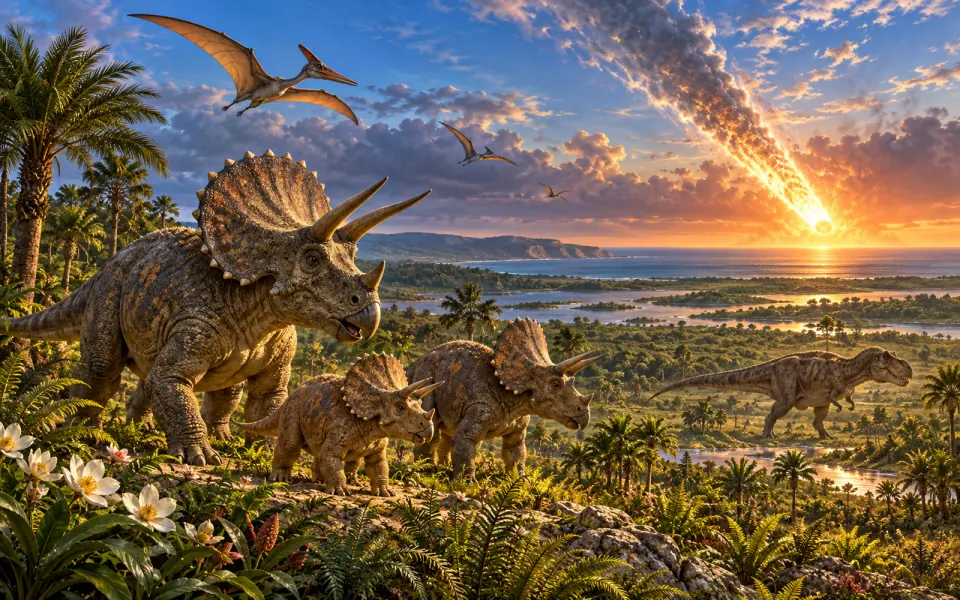
- Extinction of the non-avian dinosaursabout 66 million years ago · The Earth before usAnother great extinction, 186 million years later, put an end to the non-avian dinosaurs.
- The Paris Agreement on climate2015 · TodayToday the Paris Agreement tries to stop warming that is too rapid.
Before and after, in the era “The Earth before us”
Event 21 of 25
 BeforeThe Big Bangabout 13.8 billion years ago
 BeforeThe first starsabout 13.5 billion years ago
 BeforeBirth of the Milky Wayabout 13 billion years ago
 BeforeFormation of the Solar Systemabout 4.6 billion years ago
 BeforeBirth of the Earthabout 4.5 billion years ago
 BeforeFormation of the Moonabout 4.5 billion years ago
 BeforeThe oldest pieces of Earthabout 4.4 billion years ago
 BeforeThe first oceansabout 4.3 billion years ago
 BeforeThe first life on Earthabout 3.5 billion years ago
 BeforeCyanobacteria and photosynthesisabout 2.7 billion years ago
 BeforeThe Great Oxidation Eventabout 2.4 billion years ago
 BeforeThe first complex cellsabout 1.8 billion years ago
 BeforeThe first many-celled living thingsabout 1 billion years ago
 BeforeThe Ediacaran creaturesabout 555 million years ago
 BeforeThe Cambrian explosionabout 539 million years ago
 BeforeThe first plants on landabout 475 million years ago
 BeforeThe first fish with jawsabout 440 million years ago
 BeforeThe first insectsabout 400 million years ago
 BeforeThe first amphibiansabout 375 million years ago
 BeforeCarboniferous forestsabout 320 million years ago
- You are hereThe great Permian extinctionabout 252 million years ago
 AfterThe first dinosaursabout 230 million years ago
 AfterThe first mammalsabout 225 million years ago
 AfterThe first birdsabout 150 million years ago
 AfterExtinction of the non-avian dinosaursabout 66 million years ago
Listen / Read next
- Music to read by: Cinematic JourneyEpic film-style music, no lyrics, by Ciro Simone IrmiciSpotifyYouTube Music
Meanwhile, elsewhere in the world
Other events of the era “The Earth before us”
- The Big Bang
- The first stars
- Birth of the Milky Way
- Formation of the Solar System
- Birth of the Earth
- Formation of the Moon
- The oldest pieces of Earth
- The first oceans
- The first life on Earth
- Cyanobacteria and photosynthesis
- The Great Oxidation Event
- The first complex cells
- The first many-celled living things
- The Ediacaran creatures
- The Cambrian explosion
- The first plants on land
- The first fish with jaws
- The first insects
- The first amphibians
- Carboniferous forests
- The first dinosaurs
- The first mammals
- The first birds
- Extinction of the non-avian dinosaurs
