The electric telegraph
1844 Washington and Baltimore, United States
In short
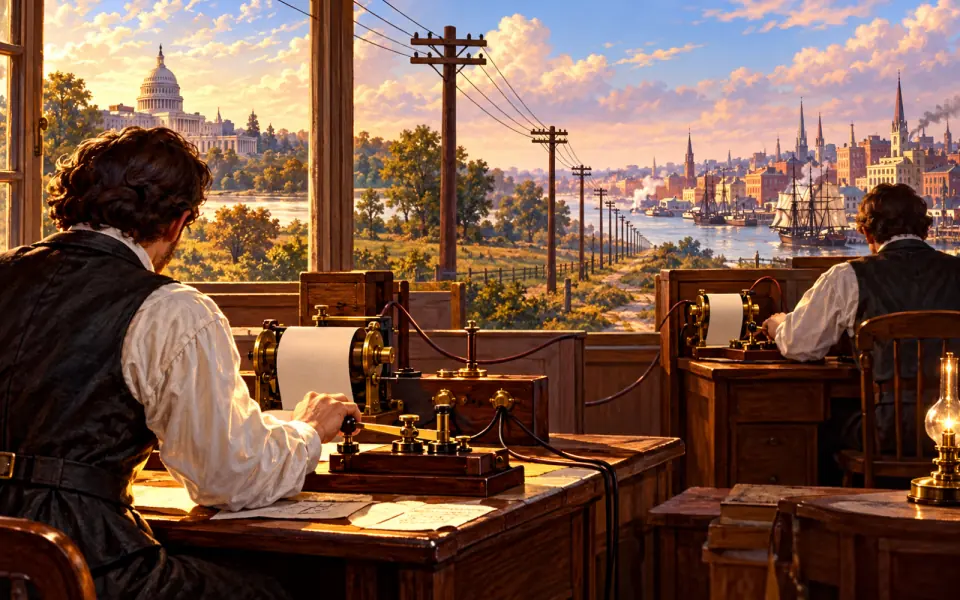
The American painter and inventor Samuel Morse worked for years on a telegraph that sent electrical signals along a wire. With his assistants he invented a code made of dots and dashes, short and long pulses, to stand for letters and numbers. On 24 May 1844 he sent the first official message from Washington to Baltimore, about 60 kilometres away. Soon telegraph wires crossed continents and even the ocean.
Why it matters News could travel in minutes instead of days: instant long-distance communication was born.
Source: Encyclopaedia Britannica, “Samuel Morse”
Study card about 5 minutes of reading
The story
Slow news
Until two hundred years ago, a message travelled at the speed of a horse, a ship or a runner. A letter from London to Rome could take a week or more; one from London to New York, by sea, took a couple of months. Important news, such as a victory in battle or the death of a king, arrived days or weeks later. There were some faster systems, such as beacon fires on hills, flag signals or carrier pigeons, but they were not suited to long, precise messages.
At the end of the 18th century a Frenchman, Claude Chappe, had built an “optical telegraph”: a chain of towers on hills, each topped by big movable wooden arms which, set in certain positions, stood for letters. Each tower repeated the signal to the next, and a message could cross France in a few hours. It worked only in fine weather, by day, and it was very expensive, but it was a great step forward.
The discovery of electricity
With Volta's battery and then the discoveries about electromagnetism by Ørsted, Ampère, Faraday and Henry, scientists realised that a metal wire could carry an electric signal over a distance, almost instantly. Several experiments were made, and in 1837 in England William Cooke and Charles Wheatstone set up an electric telegraph along a railway. But their device was complicated and used several wires and needles that pointed to the letters.
In the United States, a painter and professor of drawing, Samuel Morse, had the same idea. Morse, born in 1791, was a famous portrait painter who suffered a painful experience: in 1825, while he was painting a portrait in Washington, he received a letter telling him that his wife was ill; by the time he got home, in Connecticut, after days of travelling, she had already been buried. A few years later, on a voyage by ship, listening to a talk about electromagnetism, he realised that a message could be sent using electricity, and he began to work on it.
Dots and dashes
Morse was not an expert in electricity, and he got help from others: Professor Joseph Henry, who gave him technical advice about electromagnets, and a young mechanic, Alfred Vail, who helped him build the machines and perfect a code. The system was simple: a key, called a sender, opened and closed an electric circuit; at the other end of the wire, an electromagnet moved a pen that marked dashes and dots on a strip of paper. With combinations of dots, dashes and pauses, every letter could be written: this is “Morse code”. The most common letters had the shortest signs: E, for example, is a single dot.
24 May 1844
In 1843 the United States Congress granted thirty thousand dollars to build an experimental line between Washington and Baltimore, about sixty kilometres long, running alongside the railway. On 24 May 1844, in a room in the Capitol in Washington, in front of a few politicians, Morse sent the first official message to Vail, who was in Baltimore: “What hath God wrought”. The phrase, taken from the Bible, had been chosen by a girl, Annie Ellsworth, the daughter of an official. In Baltimore, Vail replied by repeating the same message. It worked.
A network around the world
Within a few years telegraph wires stretched along the railways, and then across every country. In 1851 a submarine cable was laid under the English Channel, between Dover and Calais. In 1858 a cable across the Atlantic was opened, and Queen Victoria sent a message to the American president: it took sixteen hours to transmit, and the cable stopped working after a few weeks. But in 1866 a new cable, laid by the great ship Great Eastern, worked: from then on, a message from London to New York took a few minutes instead of weeks.
In 1861 the telegraph crossed the whole of the United States, from the Atlantic to the Pacific, and the Pony Express, the service of mounted couriers which carried the mail in ten days, closed two days later, after only nineteen months of life.
Why it happened
The telegraph was born from the meeting of a scientific discovery, electromagnetism, and a practical need: railways, businesses, governments and newspapers wanted to communicate quickly. Trains in particular needed to coordinate with each other.
What made it simple was Morse and Vail's idea of a code that turned letters into signals that were easy to send and to recognise. Many inventors, in different countries, had arrived at similar ideas: the difference was made by simplicity and government support.
What changed
The telegraph changed the world of communications: for the first time news travelled faster than people. Newspapers changed, as they could publish news from far away within hours, and news agencies were founded, such as Reuters (1851) and, in Italy, Stefani (1853). Trade, finance and war changed too, with generals able to control their armies from a distance.
Morse code was used for more than a hundred years, including for radio communications, and the distress signal SOS, adopted in 1906, is made of three dots, three dashes and three dots. The telegram stayed in use until a few years ago: the last American company, Western Union, stopped sending telegrams in 2006.
It has been said that the telegraph was a sort of “Internet of the 19th century”: it made the world smaller and created new habits, but it also brought new problems, such as too much information. From there, with the telephone and the radio, we arrived at today's age of communications.
Key people and places
People
- Samuel Morse
- American painter and inventor (1791–1872): he invented the electric telegraph and Morse code.
- Alfred Vail
- American mechanic and inventor (1807–1859): he worked with Morse and perfected the code.
- Joseph Henry
- American physicist (1797–1878): he studied the electromagnets used in the telegraph.
- Charles Wheatstone
- English physicist (1802–1875): with Cooke he built a needle telegraph in 1837.
- Cyrus Field
- American businessman (1819–1892): he promoted the laying of the transatlantic cable.
Places
- The Capitol, Washington
- The seat of Congress, from which Morse sent the first message on 24 May 1844.
- Baltimore, Maryland (United States)
- The city where Alfred Vail was, and where he received the message.
Good to know
- The first message sent on Morse's telegraph, in 1844, was “What hath God wrought”.
- In Morse code the letter E, the most frequent, is a single dot.
- The first transatlantic cable, in 1858, stopped working after a few weeks.
- The SOS signal is made of three dots, three dashes and three dots.
- The last commercial telegram from Western Union was sent in 2006.
Find out more
- Wikipedia, “Samuel Morse” en.wikipedia.org
- Wikipedia, “Telegraph” en.wikipedia.org
- Wikipedia, “Morse code” en.wikipedia.org
Related events
- Volta's battery1800 · Age of revolutionsThe telegraph used the current produced by Volta's batteries.
- The first public steam railway1825 · Age of revolutionsThe first telegraph lines ran along the railways.
- The internet's first ARPANET links1969 · TodayToday the Internet is the telegraph of our times.
- Radio for everyoneabout 1920 · Early 20th centuryAfter the telegraph, radio sent signals without wires.
Before and after, in the era “Age of revolutions”
Event 16 of 25
 BeforeNewcomen's steam engine1712
 BeforeThe European Enlightenmentabout 1720
 BeforeDiderot's Encyclopédie1751
 BeforeWatt's steam engine1769
 BeforeThe American Revolution1776–1783
 BeforeThe first hot-air balloon flight1783
 BeforeThe French Revolution1789–1799
 BeforeThe metric system1795
 BeforeJenner's vaccine1796
 BeforeVolta's battery1800
 BeforeNapoleon becomes emperor1804
 BeforeThe Congress of Vienna1815
 BeforeThe first public steam railway1825
 BeforeNiépce's photographabout 1826
 BeforeManzoni's The Betrothed1827
- You are hereThe electric telegraph1844
 AfterThe revolutions of 18481848
 AfterDarwin publishes On the Origin of Species1859
 AfterThe Expedition of the Thousand1860
 AfterThe unification of Italy1861
 AfterThe labour movementabout 1864
 AfterCompulsory primary school (Coppino law)1877
 AfterA practical electric light bulb1879
 AfterThe first modern motor car1886
 AfterThe Lumière brothers' cinema1895
Listen / Read next
- Music to read by: Cinematic JourneyEpic film-style music, no lyrics, by Ciro Simone IrmiciSpotifyYouTube Music
Meanwhile, elsewhere in the world
Other events of the era “Age of revolutions”
- Newcomen's steam engine
- The European Enlightenment
- Diderot's Encyclopédie
- Watt's steam engine
- The American Revolution
- The first hot-air balloon flight
- The French Revolution
- The metric system
- Jenner's vaccine
- Volta's battery
- Napoleon becomes emperor
- The Congress of Vienna
- The first public steam railway
- Niépce's photograph
- Manzoni's The Betrothed
- The revolutions of 1848
- Darwin publishes On the Origin of Species
- The Expedition of the Thousand
- The unification of Italy
- The labour movement
- Compulsory primary school (Coppino law)
- A practical electric light bulb
- The first modern motor car
- The Lumière brothers' cinema
