The Expedition of the Thousand
1860 From Quarto (Genoa) to Marsala, Sicily
In short
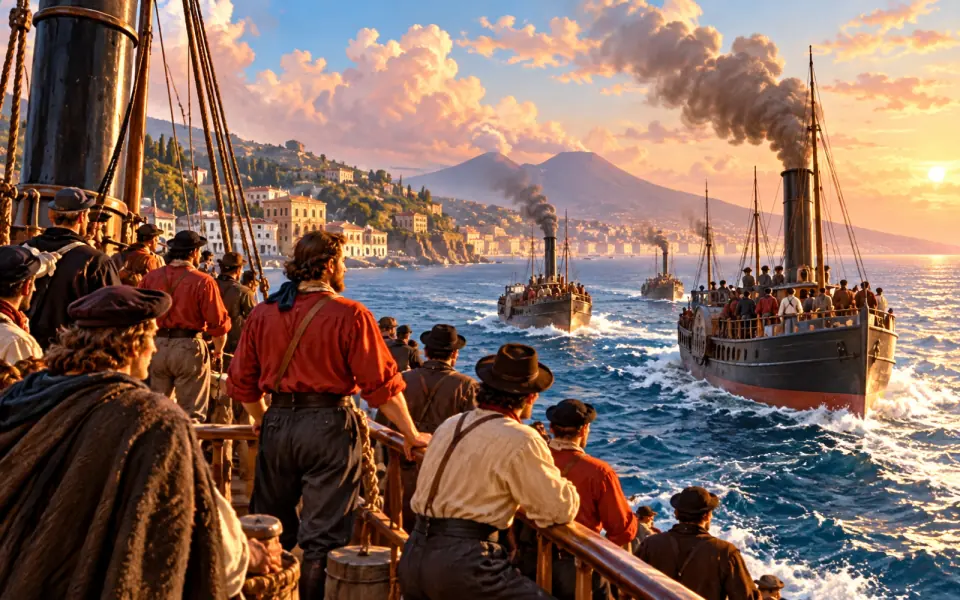
On the night of 5 to 6 May 1860 Giuseppe Garibaldi set out from Quarto, near Genoa, with just over a thousand volunteers on two steamships. Many wore red shirts and came mainly from northern Italy. After landing at Marsala, in Sicily, they defeated the army of the Kingdom of the Two Sicilies and marched north as far as Naples. In October, at Teano, Garibaldi met King Victor Emmanuel II and handed over the lands he had conquered.
Why it matters With this exploit the South joined the new Italian state, and Garibaldi became the most famous hero of the Risorgimento.
Source: Treccani, entry “Spedizione dei Mille”
Study card about 5 minutes of reading
The story
Italy half made
In 1860 Italy did not yet exist as a state. After the Congress of Vienna it had been divided into many states. But something had changed: in 1859, with the help of Napoleon III's France, the Kingdom of Sardinia, led by King Victor Emmanuel II and the prime minister Camillo Benso, Count of Cavour, had defeated Austria in a Second War of Independence, with the battles of Magenta and Solferino, and had gained Lombardy. The following year, through plebiscites, that is votes by the people, Tuscany, Emilia and Romagna had joined the kingdom. In exchange, France had received Nice and Savoy: Nice was the birthplace of Giuseppe Garibaldi, who suffered over it.
Still outside were Veneto, still Austrian, Lazio and Rome, ruled by the Pope, and the whole south, the Kingdom of the Two Sicilies, ruled by the Bourbons, an ancient and powerful monarchy with a large army, but weak, and with a government often accused of being backward and of not granting freedoms.
The hero of two worlds
Garibaldi, born in 1807, was already a legend. A sailor, he had fought for freedom in South America, in Brazil and Uruguay, where he had met Anita, the brave woman who became his wife and who fought at his side. That is why he was called “the hero of two worlds”. In 1849 he had led the defence of the Roman Republic, and had become the symbol of the Italian patriot. He wore a red shirt and a poncho, and his men were ready to follow him anywhere.
In April 1860 a revolt broke out in Palermo, quickly put down, but other uprisings continued in Sicily. Some patriots, among them the Sicilian Francesco Crispi, asked Garibaldi to step in. Garibaldi hesitated: he knew it was dangerous, and he knew that Cavour did not want to put the kingdom at risk with an adventure that could anger France and Britain. But in the end he accepted.
The night of 5 to 6 May
On the night of 5 to 6 May 1860, at Quarto, near Genoa, about a thousand volunteers secretly boarded two steamships, the “Piemonte” and the “Lombardo”. There were in fact about 1,100 men, and one woman, Rosalia Montmasson, Crispi's wife, the only one recognised among the Thousand. They were students, lawyers, doctors, craftsmen, workers, ex-soldiers, many of them very young, from all over Italy, above all from Lombardy, in particular from Bergamo. They were not professional soldiers, they had old rifles, and they wore the red shirt. It looked like a hopeless enterprise.
The two steamships landed at Marsala, in Sicily, on 11 May, under the eyes of British warships that happened to be there, and that, perhaps deliberately, stopped the Bourbon ships from attacking at once. On 15 May, at Calatafimi, the outnumbered Garibaldians faced the Bourbon army in a hard battle. On the point of giving way, Garibaldi, it is said, told his lieutenant Nino Bixio: “Here we make Italy or we die”. They won, and the news led many Sicilians, the “picciotti”, to join him.
Palermo, Naples, Teano
At the end of May Garibaldi entered Palermo, after days of fighting in the streets. In July he won at Milazzo. On 19 August he crossed the Strait of Messina and landed in Calabria: by then the Bourbon army was falling apart, and cities were surrendering. On 7 September Garibaldi entered Naples, almost alone, by train, welcomed by cheering crowds. King Francis II had withdrawn to Gaeta.
Garibaldi was a republican, but he wanted the south to be joined to the Kingdom of Sardinia. Meanwhile a Piedmontese army entered the Papal States, passing through the Marche and Umbria, and moved south. After the battle of the Volturno, on 1 and 2 October, in which the Garibaldians defeated the Bourbons, on 26 October 1860, at Teano, near Naples, Garibaldi met Victor Emmanuel II and greeted him as “King of Italy”, handing the south over to him. A few days earlier, on 21 October, a plebiscite had approved the union of the Kingdom of the Two Sicilies with Piedmont. Garibaldi refused rewards and returned to his island of Caprera, with a small amount of seed and a sack of stockfish, so the story goes.
Why it happened
The expedition came out of a crisis in the Kingdom of the Two Sicilies, the revolts in Sicily and the desire of many Italians to unite the country. Garibaldi had great charisma, and many young people were ready to follow him.
Political game-playing counted too: Cavour, though he seemed to be against it, let the expedition leave and helped it indirectly, because it could serve the cause of unity. Britain, which looked kindly on the failure of the Bourbons, played a part, and so did Garibaldi's military skill.
What changed
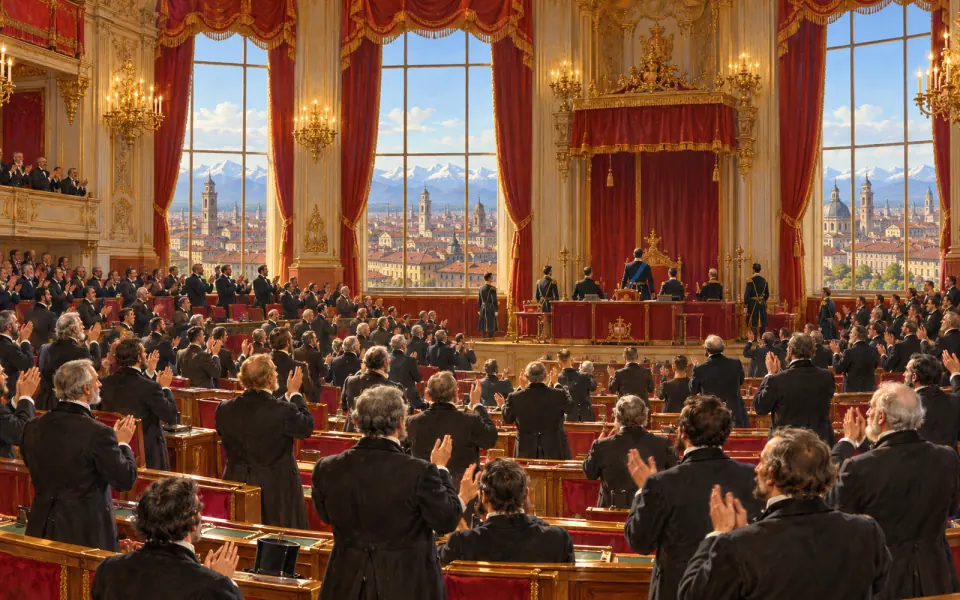
The enterprise of the Thousand led to the unification of Italy, proclaimed on 17 March 1861 with King Victor Emmanuel II. Veneto was still missing, and would be united in 1866, and Rome, in 1870.
It was a great event in Italian history, and it has left songs, monuments, and names of streets and squares all over Italy. But it has also left many questions. Historians still argue about how the South was united: there was enthusiasm, but also disappointment and revolts, and in the early years of unity there was a long war against “brigandage”. The “Southern Question”, that is the gap between North and South, was born in those very years.
After 1860 Garibaldi carried on fighting: he twice tried to conquer Rome, in 1862 and in 1867, and took part in the later wars. He died at Caprera in 1882, and his memory is still alive. On 17 March, National Unity Day, Italians remember the road that led to the birth of their country.
Key people and places
People
- Giuseppe Garibaldi
- Italian general and patriot (1807–1882): he led the expedition of the Thousand.
- Nino Bixio
- Genoese general and patriot (1821–1873): he was Garibaldi's right-hand man.
- Francesco Crispi
- Sicilian patriot and politician (1818–1901): one of the organisers of the expedition, later prime minister.
- Rosalia Montmasson
- Patriot of French origin (1823–1904): the only woman recognised among the Thousand.
- Camillo Benso di Cavour
- Piedmontese politician (1810–1861): prime minister of the Kingdom of Sardinia, the great weaver of unity.
Places
- Quarto, Genoa
- The place from which the Thousand set out on the night of 5 to 6 May 1860.
- Teano, Campania
- The place where Garibaldi met Victor Emmanuel II, on 26 October 1860.
Good to know
- The Thousand were in fact about 1,100 men and one recognised woman.
- Garibaldi wore a red shirt, and his volunteers were called “Redshirts”.
- At Calatafimi, on 15 May 1860, it is said that Garibaldi told Nino Bixio: “Here we make Italy or we die”.
- Garibaldi entered Naples by train, on 7 September 1860.
- After the enterprise Garibaldi returned to his island of Caprera, refusing honours and rewards.
Find out more
- Wikipedia, “Expedition of the Thousand” en.wikipedia.org
- Wikipedia, “Giuseppe Garibaldi” en.wikipedia.org
- Wikipedia, “Rose Montmasson” en.wikipedia.org
- Wikipedia, “Italian unification” en.wikipedia.org
Related events
- The revolutions of 18481848 · Age of revolutionsIn 1848–49 Garibaldi had defended the Roman Republic.
- The unification of Italy1861 · Age of revolutionsA few months after the enterprise, the Kingdom of Italy was born.
- The Congress of Vienna1815 · Age of revolutionsThe Congress of Vienna had divided Italy.
- Manzoni's The Betrothed1827 · Age of revolutions“The Betrothed” had helped to create a common language for Italy.
Before and after, in the era “Age of revolutions”
Event 19 of 25
 BeforeNewcomen's steam engine1712
 BeforeThe European Enlightenmentabout 1720
 BeforeDiderot's Encyclopédie1751
 BeforeWatt's steam engine1769
 BeforeThe American Revolution1776–1783
 BeforeThe first hot-air balloon flight1783
 BeforeThe French Revolution1789–1799
 BeforeThe metric system1795
 BeforeJenner's vaccine1796
 BeforeVolta's battery1800
 BeforeNapoleon becomes emperor1804
 BeforeThe Congress of Vienna1815
 BeforeThe first public steam railway1825
 BeforeNiépce's photographabout 1826
 BeforeManzoni's The Betrothed1827
 BeforeThe electric telegraph1844
 BeforeThe revolutions of 18481848
 BeforeDarwin publishes On the Origin of Species1859
- You are hereThe Expedition of the Thousand1860
 AfterThe unification of Italy1861
 AfterThe labour movementabout 1864
 AfterCompulsory primary school (Coppino law)1877
 AfterA practical electric light bulb1879
 AfterThe first modern motor car1886
 AfterThe Lumière brothers' cinema1895
Listen / Read next
- Music to read by: Cinematic JourneyEpic film-style music, no lyrics, by Ciro Simone IrmiciSpotifyYouTube Music
Meanwhile, elsewhere in the world
Other events of the era “Age of revolutions”
- Newcomen's steam engine
- The European Enlightenment
- Diderot's Encyclopédie
- Watt's steam engine
- The American Revolution
- The first hot-air balloon flight
- The French Revolution
- The metric system
- Jenner's vaccine
- Volta's battery
- Napoleon becomes emperor
- The Congress of Vienna
- The first public steam railway
- Niépce's photograph
- Manzoni's The Betrothed
- The electric telegraph
- The revolutions of 1848
- Darwin publishes On the Origin of Species
- The unification of Italy
- The labour movement
- Compulsory primary school (Coppino law)
- A practical electric light bulb
- The first modern motor car
- The Lumière brothers' cinema
